
A small Go CLI over the freehire job API — built so an
agent (or a human) can search, open, and apply to jobs from the terminal,
without a browser. Sign in once — freehire auth login opens your browser — and
the token is stored in ~/.freehire/creds.json.
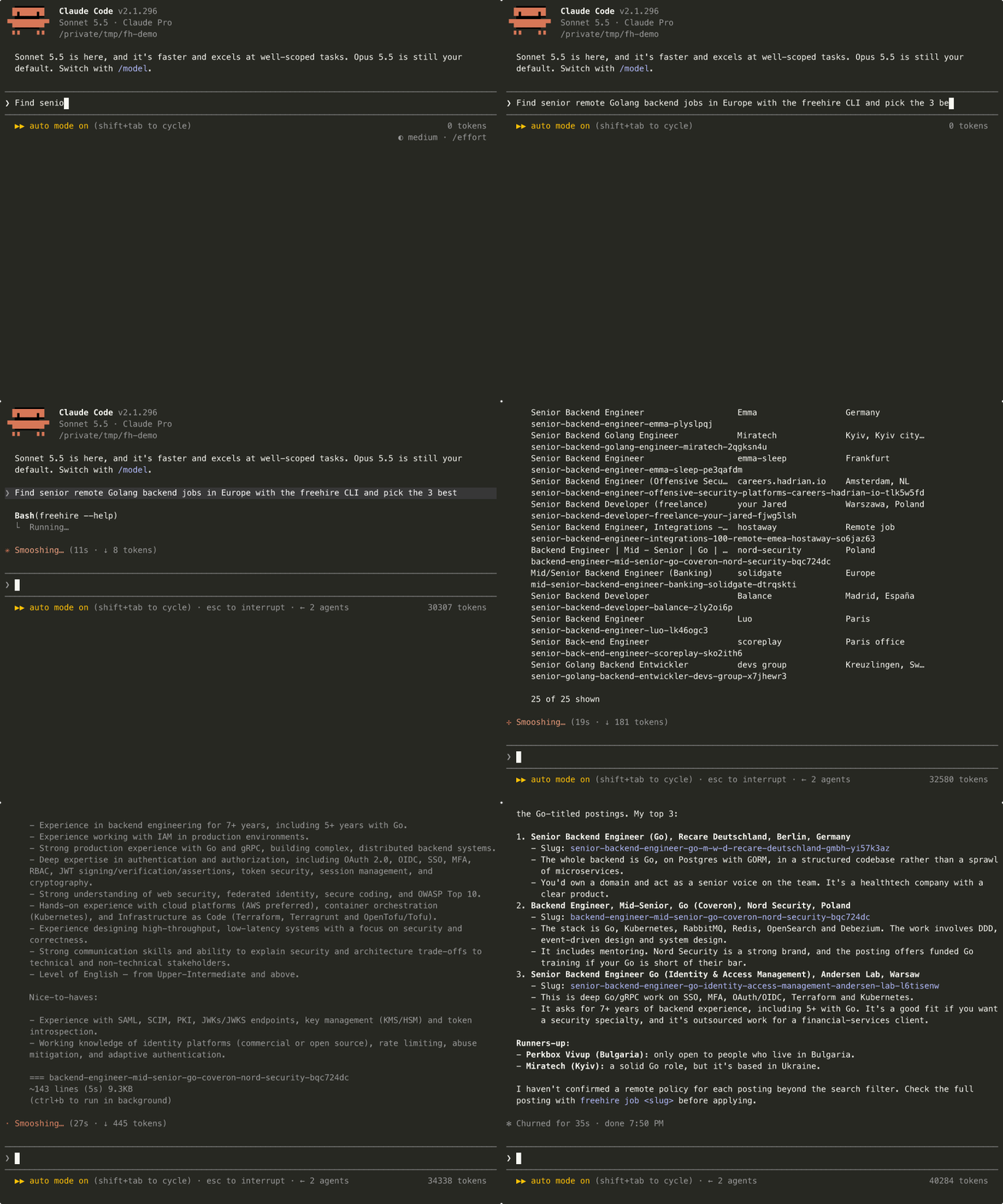
A real Claude Code session driving the CLI against the live catalogue, sped up 1.5×.
Install
curl (prebuilt binary, no Go needed):
curl -fsSL https://freehire.me/install.sh | sh
Go:
go install github.com/strelov1/freehire-cli/cmd/freehire@latest # installs the `freehire` binary
Authenticate
freehire auth login                        # opens a browser to sign in — no key to paste or manage
freehire auth login --token fhk_xxxxxxxx   # or: an API key from the web app (account menu → API keys)
freehire auth status                       # Authenticated as you@example.com @ https://freehire.me
freehire auth logout                       # removes ~/.freehire/creds.json
Run in a terminal, auth login registers this CLI with freehire's OAuth 2.1 authorization server
(freehire#3114), opens your browser to approve the connection, and stores the
resulting token exactly like a pasted key — nothing else in this CLI, or in
freehire-mcp reading the same
~/.freehire/creds.json, needs to know which method produced it. Revoke a
browser-granted connection any time from the web app's Connected devices
list, without touching an API key.
auth login validates the credential against the API before saving, so a bad
key or a failed sign-in is never stored. A script without a browser passes
--token, or pipes the key on stdin (echo "$KEY" | freehire auth login).
Use
freehire profile                                               # your saved roles, skills, geography and CV (no contacts)
freehire experience list                                       # your whole experience bank (employments + achievements)
freehire experience employments add --company Acme --role SWE  # record a new job or project
freehire experience atoms add --claim "Cut latency 20s to 1s" --metric "20s->1s" --skill go  # record a new achievement
freehire experience atoms update <id> --claim "Cut p99 20s to 900ms"  # fix one field; the rest is kept
freehire experience employments update <id> --end "Dec 2025"   # same, for a place
freehire experience atoms rm <id>                              # remove an achievement (asks first)
freehire experience employments rm <id>                        # remove a place — it must be empty
freehire cv tailor <slug>                                      # start (or reopen) tailoring for a vacancy — prints the CV id
freehire cv list                                               # the tailored CVs you already have, with their vacancies
freehire cv context <cv-id>                                    # the fit analysis to reframe toward (missing_have vs missing_gap)
freehire cv edit <cv-id> --set 'summary=…'                     # edit by path; a claim needs --evidence <atom-id>
freehire cv render <cv-id> --out cv.pdf                        # download the ATS PDF
freehire auto-apply status <job-slug>                          # where an attempt already queued on the site stands
freehire auto-apply tailor <queue-id>                          # (re)start writing the CV for a queued attempt
freehire auto-apply review <queue-id> --approve                # queue it for unattended submission
freehire auto-apply review <queue-id> --decline                # park it for good
freehire facets                                                # list every filter's live values + counts (what to filter by)
freehire search "golang"                                       # list matching jobs (title · company · location · slug)
freehire search "backend" --remote --region eu --company acme  # facet filters (repeatable: --region, --company)
freehire search "data" --country BR --employment-type full_time --facet source=greenhouse  # any facet via --facet key=value
freehire search "help kids learn to read" --semantic            # also match postings that say it in other words
freehire market-fit --skills go,docker,react --category backend  # how much of the market your skills cover (+ gaps)
freehire market-fit --skills go --country BR                    # one skill probes that skill's demand under the filter
freehire job <slug>                                            # show a job's full content (incl. posting URL + company slug; says CLOSED if it closed)
freehire similar <slug>                                        # postings most like this one, nearest first
freehire company <slug>                                        # show a company and its open jobs
freehire apply <slug>                                          # mark a job applied for your account
freehire apply <slug> --on 2026-07-27                          # ...on the day you actually sent it
freehire save <slug>                                           # bookmark a job for later
freehire unsave <slug>                                         # remove a bookmark
freehire stage <slug> <stage>                                  # set application stage (applied→…→offer, or rejected/withdrawn)
freehire note <slug> a quick reminder                          # attach a free-text note (trailing args; no quotes needed)
freehire my --filter applied                                   # tracked jobs, showing stage + note (all|viewed|saved|applied)
freehire alerts add --skills go --remote --region eu           # a job alert over search's own filters (see below)
freehire alerts list                                           # your alerts: id, filters, channels, paused
freehire alerts update <id> --salary-min 5000                  # change only what you pass
freehire alerts pause <id> / resume <id>                       # hold an alert without losing it
freehire alerts remove <id>                                    # stop it (the saved search stays as a bookmark)
freehire alerts updates                                        # postings your alerts matched this week
freehire contribute <url>                                      # hand freehire a job link (see below)
freehire contributions                                         # boards you've contributed
freehire ghost report <slug> --applied-on 2026-06-01           # you applied that day and were never answered
freehire ghost retract <slug>                                  # withdraw that report
freehire inbox push < mail.json                                # upload mail your own client fetched
freehire inbox list --unclassified --body                      # mail still awaiting a verdict, with its text
freehire inbox triage <id> rejection --slug <slug>             # record what a message is + link it
freehire inbox list --link suggested                          # matcher proposals awaiting your word
freehire inbox confirm <id>                                   # accept one of them
freehire inbox application <id> <slug>                        # mail about an untracked application
Job alerts. An alert is a saved search delivered on the channels your account
has connected — email, Telegram, the mobile app or a webhook — never to the
terminal. alerts add takes search's filter flags (plus --salary-max, --name
and repeatable --channel) and refuses a search that does not narrow the catalogue;
run the same flags through freehire search first to see what it would catch. A
filter value outside the vocabulary is dropped and named on stderr. On alerts update, any filter flag replaces the alert's whole filter set (--clear-filters
empties it), so a rename never touches the filters. The commands call the signed-in
MCP server's alert tools, so they need a browser sign-in or a full-scope key.
Experience bank. experience list shows every achievement grouped under the
employment it belongs to (achievements with no place come back under unplaced) —
copy an id from there to attach a new achievement to it with atoms add --employment <id>. Anything added this way is recorded with manual provenance,
which is what lets it later be cited as cv edit --evidence <id>.
atoms update <id> and employments update <id> correct an entry. Only the flags
you pass change — the API replaces the whole row, so the command reads what is
banked and sends it back with your changes applied, which is what keeps a typo fix
from deleting the metrics. --metric and --skill replace the whole list when
given.
A correction made with a key does not restamp provenance: an achievement the
agent inferred stays agent_inferred, and so stays uncitable on a CV. Only your
own edit on the site turns it into something you assert.
atoms rm <id> and employments rm <id> remove an entry. This is final — the
bank has no undo — so both ask you to type delete unless you pass --yes. A
place must be empty before it can go: removing one would delete every
achievement under it, and the API refuses that from a key. To retire a duplicate
place, move its achievements to the one you are keeping
(atoms update <id> --employment <keep-id>), then remove the shell. Folding two
achievements into one — keeping the numbers from both — is on the site.
Tailoring a CV. cv tailor <job-slug> copies your base CV into a
vacancy-bound one and prints the CV id every other cv command takes; it is
idempotent per vacancy, so running it again reopens the same copy. cv list
shows the copies you already have. It spends AI credits the first time it
creates one, and needs a résumé on the site to seed a base CV from. Editing with
a key edits as the tailoring agent: the contact block is refused, and anything
stating what you DID needs --evidence <atom-id> from the experience bank. The
readiness score, the revision history and undo stay on the site — deliberately,
so the agent cannot read or revert the measure of its own work.
Auto-apply. Queuing a new attempt is cookie-only on freehire.me itself — a
real application can go out, and the browser is the only place you can watch it
happen and undo it, so there is no auto-apply run here and there will not be
one. Once an attempt is queued from the site, auto-apply status <job-slug>
shows where it stands (tailoring → pending_review → approved, or
blocked/declined/failed) and gives you the queue id the other two take.
tailor <queue-id> (re)starts writing the CV for it; when it reaches
pending_review, status shows exactly what would be submitted, and review <queue-id> --approve/--decline records your decision — once only, the server
refuses a second call.
Discovering values. freehire facets [filters] lists every filter's live
values with a vacancy count each (and the skills vocabulary), so you pass real
values to search/market-fit instead of guessing. Narrow it with any filter flag
to see the values for that slice (e.g. freehire facets --category backend).
Filters. search and market-fit share the same market-filter flags:
--remote, --region, --country, --city, --company, --category, --role,
--seniority, --employment-type, --english-level, --salary-min, --visa
(each named facet is repeatable). Any other facet in the API's vocabulary is
reachable with --facet key=value (repeatable), e.g. --facet source=greenhouse
or --facet company_size=startup.
market-fit measures how much of the live open-vacancy market your skills reach
for a filtered role: the headline coverage (N% of vacancies list ≥1 of your
skills), the must-have skills you hold, and the missing skills that unlock the most
new vacancies. Pass your skills with --skills (comma-separated or repeated) — one
skill probes that single skill's demand; a list scores your whole stack. Note that
here --skills is the measured set, not a filter (in search, --skills filters
to jobs listing the skill).
Moderators can author postings (requires the moderator role; a regular key gets 403):
freehire jobs add --url https://acme.example/jobs/1 --title "Senior Go Developer" --company Acme --remote
freehire jobs add --url <url> --source workatastartup --title <t> --company <c> --description "<p>…HTML…</p>"
freehire jobs edit <slug> --title "Staff Go Developer"         # partial: only the flags you pass change
--source records the posting's real origin (defaults to manual); it does not change that
the job is flagged as manually added (that comes from the moderator authorship). --description
is stored and rendered as HTML, so pass HTML markup. The URL is the dedup key — re-running add
with the same URL updates the posting.
Contributing a link
freehire contribute <url> hands over any vacancy or ATS board link. One sequence answers,
whichever surface you use:
| Outcome | Meaning |
|---|---|
| already in the catalogue | we carry that posting; you get its URL |
| added, company already crawled | we read the page and imported it; the rest of that company's roles follow on the next crawl |
| added, company new to us | imported, and its board is queued for crawling — +1 AI credit |
| queued | nothing could read the page, so a maintainer will look; not credited |
The board, not the vacancy, is what earns the credit, and only the first person to name a board earns it — later links to the same company are still recorded (they tell us the board matters) but pay nothing.
freehire contribute https://acme.recruitee.com/o/senior-go
freehire --json contribute https://acme.recruitee.com/o/senior-go | jq '.status, .public_slug'
freehire contributions
A posting that may not be real
freehire job <slug> shows a signal above the description when a posting looks like it is
not being worked — how it behaves, whether the employer's own careers board carries it, and
what happened to people who applied:
Possibly inactive — 2 of 4 checks fired
  · Posting behaves as evergreen
  · Not on the company's own careers board (checked 2026-07-30)
  Not observed: applications here, reports from people.
The wording is hedged on purpose, and the unfired checks are printed too: they are what says how sure the signal is. These are observations about a posting, never a claim about anyone's intent.
If you applied and were never answered, say so — human evidence is the only thing that can raise the signal past what a posting's shape can show:
freehire ghost report senior-go-acme --applied-on 2026-06-01
freehire ghost retract senior-go-acme
The date is the day you applied, and it is required. Reporting needs a verified email address, works once per posting, and reaches no moderator — nothing here closes a job.
Application mail — bring your own client
freehire does not fetch your mail. Your own client does — himalaya, mbsync,
notmuch, anything that can emit JSON — and inbox push hands the result over.
Your agent then reads it and records what each message is, so the tracker stays
current without freehire running a mail connector or a classifier for you.
himalaya envelope list --output json | jq '[.[] | {
    external_id: .message_id, from_addr: .from.addr, from_name: .from.name,
    subject: .subject, received_at: .date }]' | freehire inbox push

freehire --json inbox list --unclassified --body --limit 50   # what still needs judging, with its text
freehire inbox triage 812 rejection --slug go-dev-acme-t35nijto
external_id is the deduplication key — use the message's Message-ID. Re-pushing
the same id updates that message instead of storing a copy, and never un-reads it,
resurrects a deleted one, or overwrites a verdict. Batches hold up to 100 messages.
inbox list --body returns each message's readable text (HTML-only ATS mail arrives
stripped) and marks nothing read — unlike inbox read, which is for opening a single
message a person asked to see. Triage signals: acknowledgement, screening,
interview_invitation, assessment, offer, rejection, info_request,
incomplete_application, other. A forward signal on a linked message advances that
application's stage; a settled application is never dragged back into the pipeline.
Only a deterministic match links mail automatically; anything the classifier merely
believes lands as a suggestion awaiting your word. inbox list --link suggested is
that queue, drained with inbox confirm <id> or inbox reject <id>. An unconfirmed
suggestion is a link that never happens, so a mailbox nobody confirms looks far less
matched than it is.
inbox list --link unlinked is the other queue: mail with no application to attach
to, usually because the application was never recorded. inbox link cannot help
there — it needs something to point at. inbox application <id> <slug> creates the
application and links the message in one call, dating it by the message rather than
by now(), since the employer replied to something that already existed.
Corrections: inbox link/unlink, inbox delete/restore, inbox read-all.
For agents
Pass --json for the raw API payload (faithful to the API; ideal for piping):
freehire --json search "site reliability" --limit 5 | jq '.[].public_slug'
freehire --json search "golang" --limit 3 | jq -r '.[].description'   # full postings, no extra call
freehire --json job <slug> | jq '{title, url}'
search reads the API's agent endpoint, so every hit already carries the job's
full description as markdown — an agent can judge a result set without a
job <slug> call per hit. The human table view stays compact (title · company ·
location · slug); the descriptions are in the --json payload.
Conventions: results go to stdout, errors to stderr, and a non-zero exit
code signals failure (e.g. an unauthenticated call exits non-zero with
run \freehire auth login``).
Agent skills and slash commands
Six agent skills ship in skills/, one per task rather than one per
tool, so an agent loads what the question needs and not the whole surface:
| Skill | Covers |
|---|---|
using-freehire |
install, auth, and the map of the rest |
freehire-job-search |
profile → facets → search → job/company, contributing a link, reading the inactive-posting signal |
freehire-track-applications |
apply, save, stage, note, my, and reporting a posting that never answered |
freehire-market-fit |
scoring a stack against live vacancy demand |
freehire-tailor-cv |
reframing a CV toward one vacancy, and the evidence rule |
freehire-mail-triage |
pushing, judging and linking application mail |
Drop them into a Claude Code (or compatible) skills directory, or install this repo as a Claude Code plugin to get the skills and the slash commands wired up automatically:
/plugin marketplace add strelov1/freehire-cli
/plugin install freehire@freehire-cli
The plugin adds commands/: /job-search, `/market-fit