
Clone my robot. One script gives any repo the setup I use to make AI coding agents trustworthy — in about 30 seconds.
git clone https://github.com/noidsoup/my-robot
my-robot/bootstrap.sh --dry-run /path/to/your/repo   # see what it would do
my-robot/bootstrap.sh /path/to/your/repo             # do it
Prefer the clone path. A one-liner fetch exists for convenience — review the script before piping to a shell, and start with --dry-run:
curl -fsSL https://raw.githubusercontent.com/noidsoup/my-robot/main/bootstrap.sh | bash -s -- --dry-run
It wires the repo for Claude Code: rules in .claude/rules/, and .claude/CLAUDE.md importing AGENTS.md. Repos that only have .cursor/ get Cursor .mdc rules instead.
Working in someone else's repo? --local-only keeps the whole setup off their radar: every new file goes in .git/info/exclude, and tracked files (.gitignore, package.json) are not edited.
The problem
Left alone, an AI coding agent will invent paths it never checked, forget everything between sessions, and say "done" without running a single test. Every serious AI-assisted project ends up hand-building the same fixes: a verify script, some agent rules, a memory file, a way to search the docs.
This is that work, done once, installable anywhere.
What you get
| What | Why it matters | |
|---|---|---|
| Verify gate | .verify.sh runs your existing tests / lint / typecheck |
“Done” means something. No suite? It fails loudly instead of faking a pass. |
| Semantic search | LanceDB over your docs and code (offline) | Agents look things up before inventing them. Non-Python repos get a short sidecar note, not broken scripts. |
| Agent rules | Search-before-acting + verify-before-done | Installed to .claude/rules/ (Cursor-only repos: .cursor/rules/). |
| loops | 9 workflows + 9 review personas | Symlinked in as .loops (plan-and-implement, tdd, adversarial-gate, …). |
| Obsidian wiki | <repo> wiki/ |
Decisions, runbooks, index, and log — agent-readable, human-browsable, searchable. |
| Memory | Session + long-term memory files | Context survives across chats. |
| AGENTS.md | Stub with working rules, tested commands, error baseline, local login, push safety | The things that cost an agent hours when nobody wrote them down. |
Safe by default: nothing you already have is overwritten. Re-runs report existed and skip. Prefer --dry-run first. Health-check an install with bootstrap.sh --doctor.
What it looks like
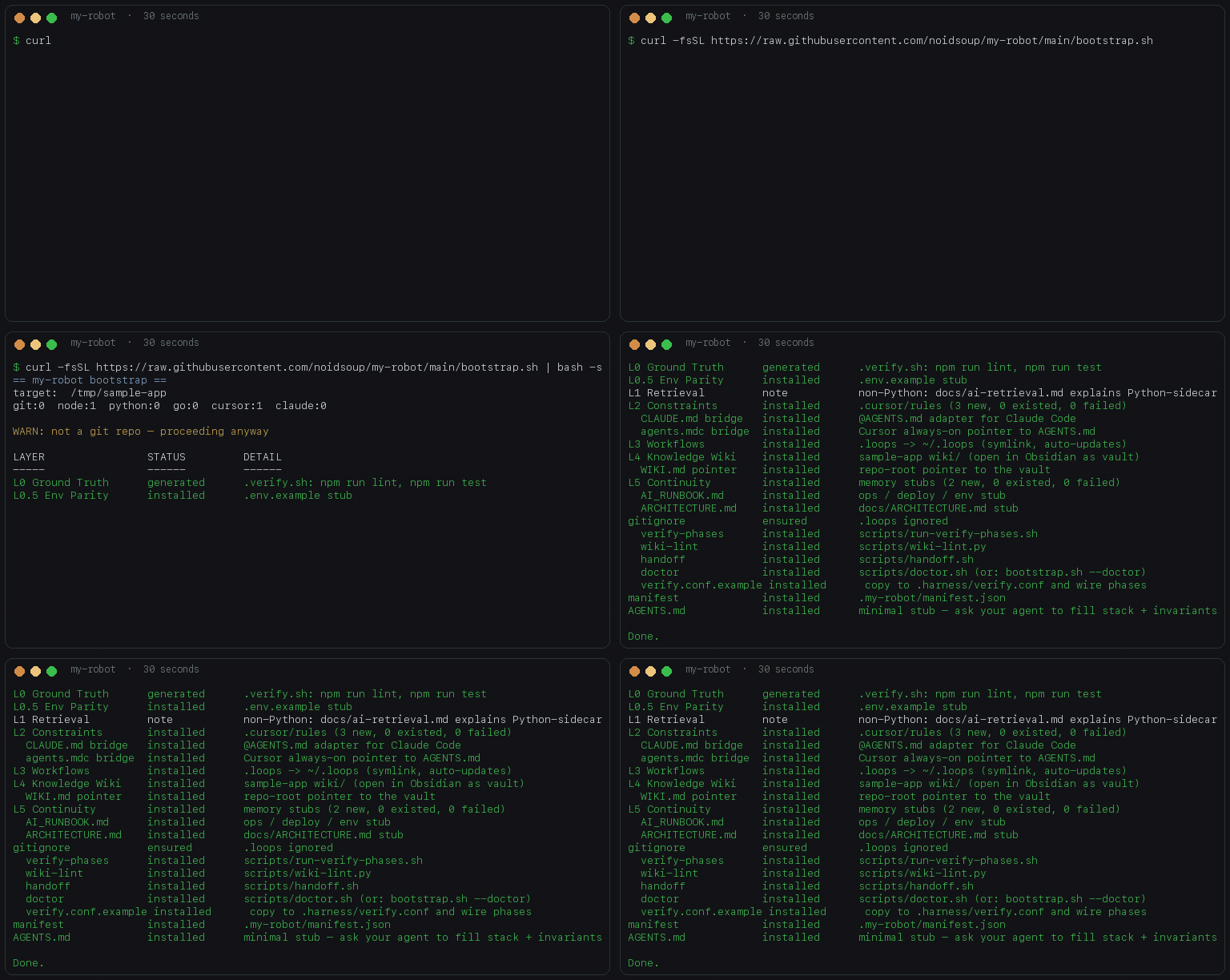
L0 Ground Truth      generated      .verify.sh: npm test, npm run lint
L1 Retrieval         note           non-Python: docs/ai-retrieval.md
L2 Constraints       installed      .claude/rules (3 new)
L3 Workflows         installed      .loops -> ~/.loops (symlink)
L4 Knowledge Wiki    installed      my-app wiki/ (open in Obsidian)
L5 Continuity        installed      memory stubs (2 new)
Done.
Full transcript of a real run, plus the curl check: docs/demo.md. Copy-paste blurbs: docs/portfolio-blurb.md.
After it runs
- Verify gate — if you got the fail-loud stub, add real tests or lint so “correct” means something.
- AGENTS.md — ask your coding agent to fill the
<PLACEHOLDERS>from the repo (stack, deploy host, hard rules). Spot-check; don’t invent secrets. - Optional harness — copy
.harness/verify.conf.example→.harness/verify.conf, thenbash scripts/run-verify-phases.sh. Lint the wiki withpython3 scripts/wiki-lint.py.
Python repos, one more step to light up search:
pip install -r requirements-lancedb.txt
python3 -u scripts/index_project_knowledge_lancedb.py --apply
Then open your repo in Cursor or Claude Code and say "use the loops."
Who made this
I'm noidsoup. I run AI-first development across a fleet of production repos, and this is the system I install everywhere — honest verify, search-before-acting, memory that survives the next chat. Want it running on yours? Let's talk.
License
MIT — take it, fork it, ship it.