
Peek at an image, get booleans back (and choices, and scores).
A small vision-language model that answers typed questions about an image, fast enough
for a laptop. You send one image, a state (context) and any number of named
questions. Each question is one of three types:
- choice: pick one of the options you supply, each with its own description
- score: place the image on an ordinal rubric you supply (any number of levels)
- noul: yes/no, returned as a probability
The model never generates text. It scores the options the caller wrote, so it only returns answers you asked for, the probabilities are calibrated, and a rubric the model never saw in training works as well as a familiar one.
- Backbone: LFM2.5-VL-450M, LoRA on the language model, vision tower frozen (v0.2.0 and earlier: SmolVLM-500M-Instruct)
- Head: the backbone's own
logit(Yes) − logit(No)for "is this proposed answer correct?" - Training: distilled from two local teachers plus public VQA data. Qwen3.6-35B-A3B wrote and labelled requests, and Qwen3-VL-30B-A3B labelled them again.
- Can't tell: every answer carries
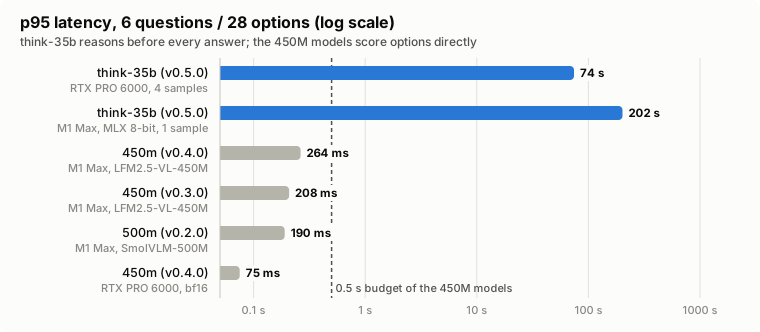
unknown_probabilityandabstained, from a trained candidate "It cannot be determined from the image and the given information." (new in v0.4.0) - Latency: 248 ms p50 (264 ms p95) for a six-question request (28 options) on an M1 Max (MPS, fp16, torch 2.14, 512 px); 75 ms p95 on an RTX PRO 6000. Not re-measured on an M1 Pro: there v0.1.0 took about 400 ms p95 in fp32 on torch 2.11, against 327 ms on the M1 Max
- Weights: GitHub release v0.4.0 and bykof/peekaboolean-450m (CC BY-NC 4.0, see Licence); earlier checkpoints stay at v0.3.0 (no can't-tell, 20% faster), v0.2.0 and v0.1.0
- Jev: the request format is TypeSafe's Jev with an image; the local
server also answers
POST /v1/systemone
How it was built and what did and did not work: docs/REPORT.md.
v0.5.0 adds a second, large model: peekaboolean-think-35b. Same request and response, but it reasons before it answers: Qwen3.6-35B-A3B with a LoRA, reading the option probabilities from the answer letter after the reasoning. It is far more accurate than the 450M model and than imajev-4b (results), and far slower: about a minute per six-question request on a GPU. It runs on a 64 GB Mac in 8-bit MLX. Weights: release v0.5.0, bykof/peekaboolean-think-35b (adapter) and bykof/peekaboolean-think-35b-mlx-8bit (Mac). Report: docs/think-35b.md.
Quickstart
git clone https://github.com/bykof/peekaboolean && cd peekaboolean
uv sync --python 3.13
curl -L https://github.com/bykof/peekaboolean/releases/download/v0.4.0/peekaboolean-450m.tar.gz | tar xz
uv run python -m peekaboolean.serve --adapter peekaboolean-450m \
  --image photo.jpg --request requests/general.json --max-edge 512
--adapter takes a local checkpoint directory or a Hugging Face repo id
(--adapter bykof/peekaboolean-450m skips the download above). The base model downloads on
first use. --device picks cuda, mps or cpu (default: auto). On MPS the model runs in
fp16: on the 42 demo images, answers moved by at most 0.006 against CPU fp32 and none changed.
--check runs in fp32.
A request (requests/general.json):
{
  "state": "Answer using only what is visible in the image.",
  "questions": {
    "kind": {
      "type": "choice",
      "instructions": "What kind of image is this?",
      "criteria": {
        "photo": "A photograph of a real scene",
        "screenshot": "An application or website screenshot",
        "document": "A scanned or photographed document page",
        "chart": "A chart, graph, or diagram"
      }
    },
    "sharpness": {
      "type": "score",
      "instructions": "How sharp is the image?",
      "criteria": [
        "very blurry",
        "somewhat blurry",
        "acceptable",
        "sharp"
      ]
    },
    "person_visible": {
      "type": "noul",
      "instructions": "Is a person visible in the image?"
    }
  }
}
The answer for a chart image:
{
  "answers": {
    "kind": {"type": "choice", "choice": "chart", "confidence": 0.755,
             "probabilities": {"photo": 0.0002, "screenshot": 0.180, "document": 0.004, "chart": 0.817}},
    "sharpness": {"type": "score", "score": 1.96, "confidence": 0.151,
                  "probabilities": {"0": 0.114, "1": 0.176, "2": 0.346, "3": 0.363},
                  "legend": {"0": "very blurry", "1": "somewhat blurry", "2": "acceptable", "3": "sharp"}},
    "person_visible": {"type": "noul", "noul": 0.047}
  }
}
score is the expected level index (0 = first level). noul is P(yes).
Since v0.4.0 every answer also carries unknown_probability, the mass on the trained can't-tell
candidate, and abstained, true when that mass beats every option. probabilities are then the
distribution given that the image answers the question, and noul is P(yes) +
unknown_probability / 2, Jev's convention. Adapters without "unknown": true in
scorer_config.json (v0.3.0 and earlier) leave both fields out, and /v1/systemone reports them
as 0 and false.
From Python, load once and reuse:
from peekaboolean.serve import load, evaluate
model, processor, calibration = load("peekaboolean-450m", device="mps", merge=True)
result = evaluate(model, processor, state, questions, "photo.jpg", calibration, max_edge=512)
state, instructions and every option may be a string, an object or a list. Noul
questions may carry their own wording: "criteria": {"true": "...", "false": "..."}.
Each question is scored independently, so answers do not depend on option order or on
the other questions in the request.
Local UI
uv run python -m peekaboolean.ui --adapter peekaboolean-450m
Opens a page on http://127.0.0.1:8765. Drop a folder or images on it (or choose them,
or paste), write the questions, press Sort (⌘↵). Each image lands in the bin of its
answer; the manifest lists every answer with its probabilities, and Export JSON saves
{request, results, errors}. Choice options are one per line as key: description,
score levels one per line lowest first, yes/no wording optional as yes: … / no: ….
The JSON view edits the same request in the format above. Images stay on the machine.
The same server answers POST /v1/systemone: TypeSafe's Jev request with the images
extension that imajev and its ImajevBench harness use
(data URLs or base64, one image here), in Jev's {model, answers, usage} envelope:
curl -s http://127.0.0.1:8765/v1/systemone -H 'Content-Type: application/json' \
  -d "{\"state\": \"\", \"questions\": {\"person\": {\"type\": \"noul\", \"instructions\": \"Is a person visible?\"}},
       \"images\": [\"data:image/jpeg;base64,$(base64 < photo.jpg | tr -d '\n')\"]}"
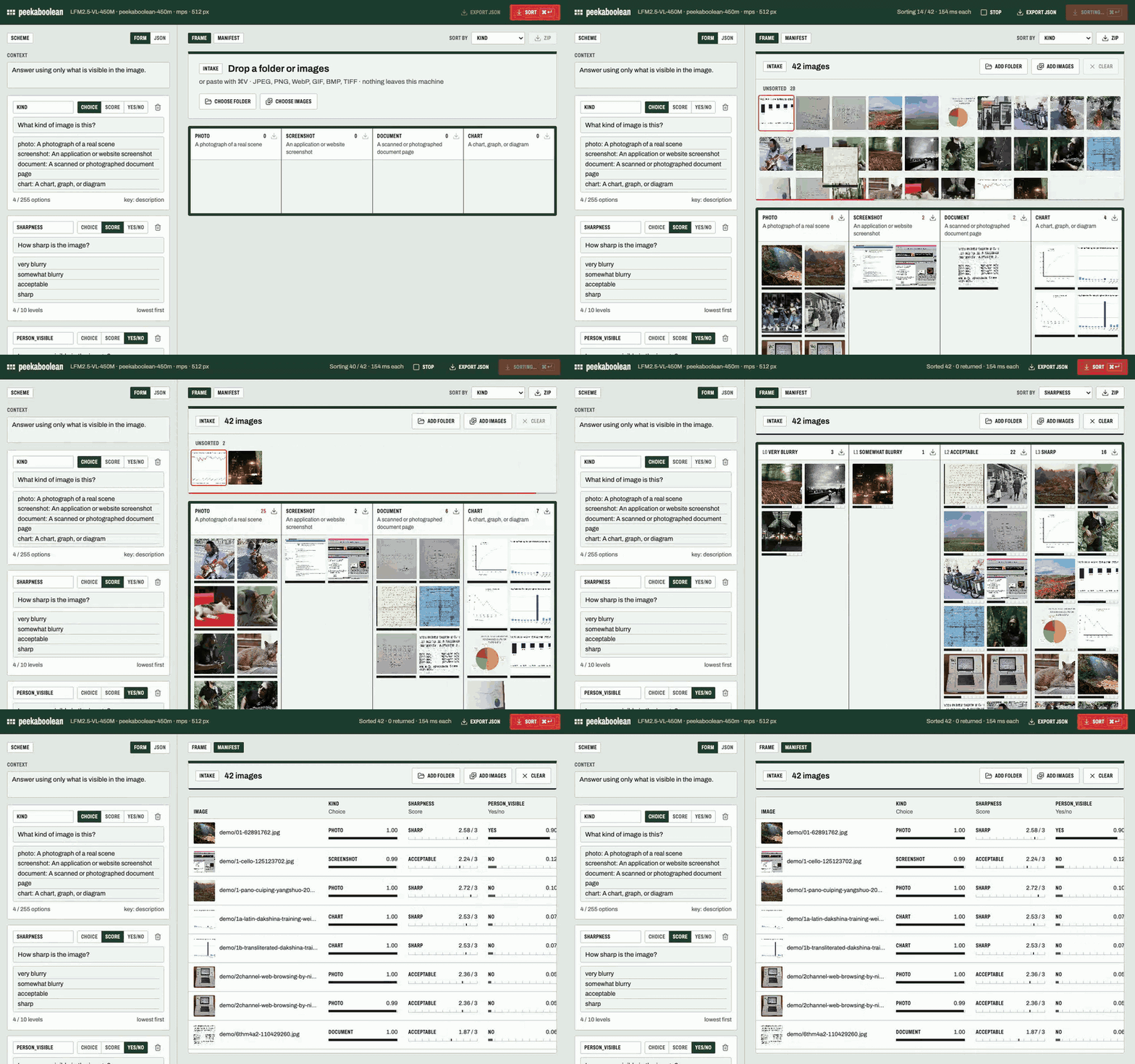
Real time with v0.4.0 on an M1 Max (MPS, fp16, 512 px): 42 images from Wikimedia Commons with
the three questions of requests/general.json (the page's default) sort in 6.7 s, 154 ms of
model time each. The same images, authors and licences are listed in
docs/demo-images.tsv; fetch them and drop data/demo on the page:
mkdir -p data/demo && tail -n +2 docs/demo-images.tsv | while IFS=$'\t' read -r file url _; do
  curl -sSfL -A "peekaboolean-demo (https://github.com/bykof/peekaboolean)" -o "data/demo/$file" "$url"; done
Serving modes
--mode (default auto); all return the same answers in fp32:
tree: the whole request as one packed sequence under a tree mask: image and state once, each question's text once, then each option's own tokens. Plain-attention backbones only (SmolVLM, InternVL)shared: encode image and state once, then score every option as a suffix against the KV cachesingle: everything in one forward pass; faster for small requests on MPSauto:treewhere the backbone allows it; otherwisesinglefor the smallest requests andsharedabovenaive: one forward pass per question; the reference path
On an M1 Max (MPS, fp16, torch 2.14, 512 px), request6 on v0.2.0's SmolVLM takes 182 ms
p50 through tree against 240 ms through shared. LFM2.5-VL (v0.3.0 and later) has short-convolution
layers, so auto scores request6 through shared there: 201 ms p50 for v0.3.0, 248 ms for v0.4.0,
which scores one more candidate per question.
serve --check asserts that the three agree. python -m peekaboolean.benchmark measures warm
latency per image size and request shape (--breakdown for per-stage times).
Calibration temperatures were fitted separately for 256, 384 and 512 px. Serve at 512 px unless latency forces a smaller size.
Results
v0.5.0: peekaboolean-think-35b
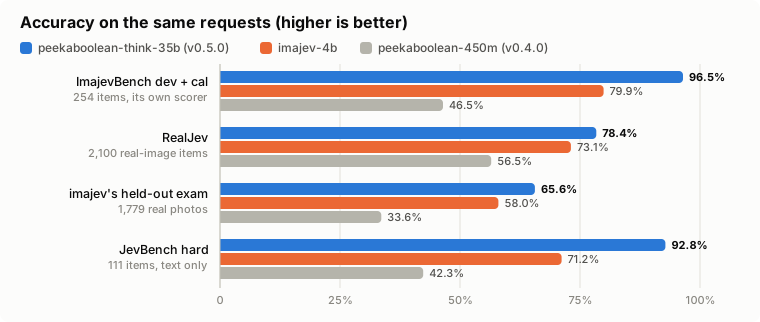
peekaboolean-think-35b, imajev-4b (run by us as shipped: its server, 4 option rotations, its calibration file) and v0.4.0 got the same requests on the same server.
| Benchmark | think-35b (v0.5.0) | imajev-4b | 450m (v0.4.0) |
|---|---|---|---|
| ImajevBench v2.0-lite, dev + calibration (254 items, its own scorer) | 245 (96.5%) | 203 (79.9%) | 118 (46.5%) |
| RealJev: 2,100 human-labelled real-image items from 8 public sets | 78.4% | 73.1% | 56.5% |
| imajev's held-out real-photo exam (its own converters, 1,779 items) | 65.6% | 58.0% | 33.6% |
| JevBench public hard / original / easy (text only, its own harness) | 103 / 72 / 48 | 79 / 71 / 48 | 47 / 36 / 35 |
ECE on RealJev / held-out exam, with calibration.json |
0.038 / 0.055 | 0.080 / 0.072 | 0.075 / 0.115 |
- Against imajev-4b: +5.3 points on RealJev [+3.5, +7.1] and +7.6 on the held-out exam [+5.1, +10.3] (paired, group bootstrap). It loses on image-quality scoring (LIVE, 32.5% against 57.2%) and POPE adversarial (−4.0).
- v0.4.0 takes one image, so the 80 two-image RealJev items and the 179 two-image exam items count as wrong.
- What it costs: request6 takes about a minute on one GPU (four reasoning samples per question), against 75 ms for the 450M model. On an M1 Max the 8-bit MLX model scores the ImajevBench calibration split 76/81, as on the GPU.
- Details: docs/think-35b.md: method, every table, calibration, the Qwen3.8-27B attempt and the limitations.
v0.4.0
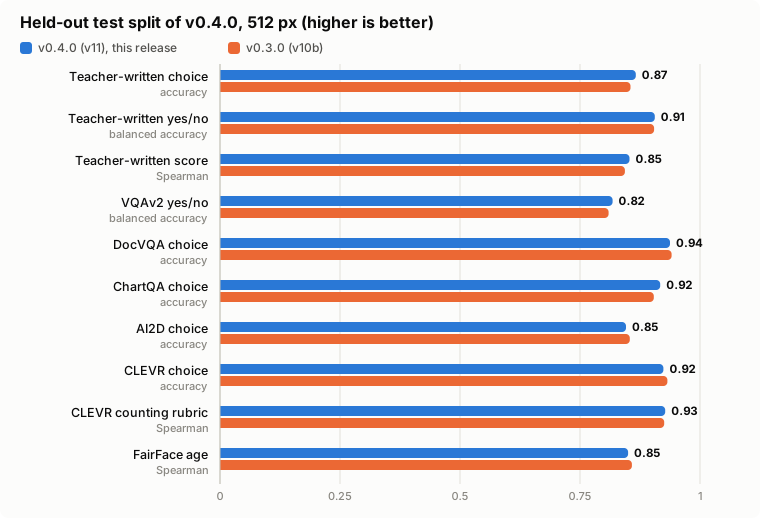
v0.4.0 (v11) against v0.3.0 (v10b). Both models are scored on the same rows: the held-out test split of v0.4.0's mixture, 512 px, 31,000 questions (v0.2.0's test split plus the new teacher rows). Image splits are by content hash, so no test image was seen in training.
| Group | v0.3.0 (v10b) | v0.4.0 (v11) |
|---|---|---|
| teacher choice / noul / score (acc. / bal. acc. / Spearman) | 0.86 / 0.90 / 0.84 | 0.87 / 0.91 / 0.85 |
| VQAv2 choice / noul | 0.92 / 0.81 | 0.92 / 0.82 |
| DocVQA / ChartQA / TextVQA choice | 0.94 / 0.90 / 0.97 | 0.94 / 0.92 / 0.97 |
| AI2D / CLEVR / Screen2Words choice | 0.85 / 0.93 / 0.92 | 0.85 / 0.92 / 0.93 |
| counting rubrics VQAv2 / CLEVR, Spearman | 0.80 / 0.93 | 0.79 / 0.93 |
| FairFace age Spearman / child / gender | 0.86 / 0.98 / 0.97 | 0.85 / 0.98 / 0.97 |
| selection NLL (lower is better) | 0.460 | 0.462 |
| can't tell: abstains on the teachers' can't-tell questions, choice / noul / score | – | 79% / 30% / 84% |
| can't tell: abstains on the other teacher questions | – | 1.5% / 0.2% / 1.4% |
| ImajevBench v2.0-lite, dev + calibration (254 items) | 110 (43.3%) | 118 (46.5%) |
- What changed: v11 is v0.3.0 fine-tuned with
--unknownon v0.2.0's data plus 72,735 new teacher questions whose labels include a can't-tell option, with record and rule states. - Public groups move by less than about one standard error.
- Can't tell works on questions like the ones the teachers could not answer: 367 choice, 67 noul and 229 score questions in the test split. On ImajevBench it still gets none of the 24 Unknown items, and its 11 abstentions there were all text-only items (see Limitations).
- Latency: 248 ms p50 per request6 on the M1 Max, against 201 ms for v0.3.0.
- Details: docs/REPORT.md §4.10 and the JSON reports attached to the release.
v0.3.0
v0.3.0 (v10b) against v0.2.0 (v9b). Both models are scored on the same rows: the held-out test split of v0.2.0, 512 px, 21,996 questions.
| Group | v0.2.0 (v9b) | v0.3.0 (v10b) |
|---|---|---|
| teacher choice / noul / score (acc. / bal. acc. / Spearman) | 0.83 / 0.89 / 0.78 | 0.89 / 0.92 / 0.87 |
| VQAv2 choice / noul | 0.91 / 0.80 | 0.92 / 0.81 |
| DocVQA / ChartQA / TextVQA choice | 0.86 / 0.87 / 0.96 | 0.94 / 0.90 / 0.97 |
| AI2D / CLEVR / Screen2Words choice | 0.89 / 0.77 / 0.95 | 0.86 / 0.93 / 0.92 |
| counting rubrics VQAv2 / CLEVR, Spearman | 0.78 / 0.75 | 0.79 / 0.93 |
| FairFace age Spearman / child / gender | 0.81 / 0.97 / 0.96 | 0.86 / 0.98 / 0.97 |
| selection NLL (lower is better) | 0.507 | 0.424 |
- Same data, new backbone. v10b is v9b's data and recipe on LFM2.5-VL-450M.
- Teacher groups are requests written by Qwen3.6 and measure agreement with the teachers, not with ground truth.
- Public groups gain most on CLEVR (+16 points) and DocVQA (+8). AI2D (−2.4, n = 253) is about one standard error lower, and Screen2Words (−2.6, n = 386) about two.
- Details: training curves and the comparison with v9a are in docs/newer-models-and-jev.md §3c. The JSON reports are attached to the release.
v0.2.0
v0.2.0 (v9b) against v0.1.0 (v8b), on the same rows as above.
| Group | v0.1.0 (v8b) | v0.2.0 (v9b) |
|---|---|---|
| teacher choice / noul / score (acc. / bal. acc. / Spearman) | 0.79 / 0.84 / 0.75 | 0.83 / 0.89 / 0.78 |
| the same, labelled by Qwen3-VL-30B-A3B alone | 0.78 / 0.82 / 0.72 | 0.82 / 0.88 / 0.74 |
| VQAv2 choice / noul | 0.91 / 0.79 | 0.91 / 0.80 |
| DocVQA / ChartQA / TextVQA choice | 0.87 / 0.88 / 0.97 | 0.86 / 0.87 / 0.96 |
| AI2D / CLEVR choice | 0.91 / 0.80 | 0.89 / 0.77 |
| counting rubrics VQAv2 / CLEVR, Spearman | 0.79 / 0.78 | 0.78 / 0.75 |
| FairFace age Spearman / child / gender | 0.81 / 0.97 / 0.96 | 0.81 / 0.97 / 0.96 |
- Teacher groups are requests written by Qwen3.6 and measure agreement with the teachers, not with ground truth. The second row grades both models against the labeller v8b was trained on, so v9b's gain does not come from grading against its own labels. The question style, though, is the one v9b trained on.
- Public groups are equal within noise. The largest drops, CLEVR (n = 603) and AI2D (n = 253), are about one standard error.
- Details: how the data was made and the per-group numbers are in docs/alternative-backbones.md §9. The JSON reports are attached to the release.
v0.1.0
Held-out test split, 512 px. Image splits are by content hash, so no test image was seen in training. "Teacher" groups are requests written by the teacher model and measure agreement with the teacher, not with ground truth.
| Group | untrained 500M (yes/no head) | v6 (256M, scalar head) | v8b (v0.1.0) |
|---|---|---|---|
| teacher choice, accuracy | 0.51 | 0.77 | 0.78 |
| teacher noul, balanced accuracy | 0.65 | 0.87 | 0.94 |
| teacher score, Spearman | 0.37 | 0.71 | 0.73 |
| VQAv2 choice / noul | 0.73 / 0.83 | 0.91 / 0.79 | 0.91 / 0.79 |
| DocVQA / ChartQA / TextVQA choice | 0.69 / 0.60 / 0.85 | 0.85 / 0.86 / 0.96 | 0.87 / 0.87 / 0.96 |
| AI2D / CLEVR choice | 0.76 / 0.48 | 0.79 / 0.74 | 0.90 / 0.80 |
| counting rubrics VQAv2 / CLEVR, Spearman | 0.44 / 0.47 | 0.79 / 0.70 | 0.79 / 0.79 |
| FairFace age (10 bins), Spearman | – | – | 0.81 |
| FairFace "is this a child" / gender, balanced accuracy | – | – | 0.97 / 0.96 |
The untrained column comes from a 4,000-row validation sample. v6 is measured on its own (v6) test split, v8b on the full v7/v8 test split (21k questions); both use the same image splits. Per-group JSON reports are attached to the v0.1.0 release.
Mac latency (M1 Pro, MPS, fp32, --mode auto, 512 px): a six-question request with 28
options measured about 380–400 ms p95 for the 500M backbone. The 256M v6 model: 116 ms
for one noul, 230 ms for the six-question request. The same code and checkpoint take 327 ms
p95 on an M1 Max.
Limitations
- Accuracy against the teacher is not accuracy against people. There is no public human-labelled acceptance set for request-shaped questions yet.
- Photo aesthetics were dropped from training in v7; the model's aesthetic scores are no better than a text-only prior.
- The model estimates age, gender and "child or adult" from faces (FairFace training). These estimates carry the biases of the data and are wrong for individual people often enough that they must not be used to decide anything about a person. It also answers such questions for drawings and cartoon characters.
- Options are scored independently, so the model cannot compare options that differ only by contrast ("the larger one").
- "Can't tell" (v0.4.0) fires for facts the image hides: text too small or cut off, a hidden side, something outside the frame. It does not fire when a rule in the state cannot be decided from the photo and the record, which is most of ImajevBench's Unknown items.
- A request without an image i