relayline
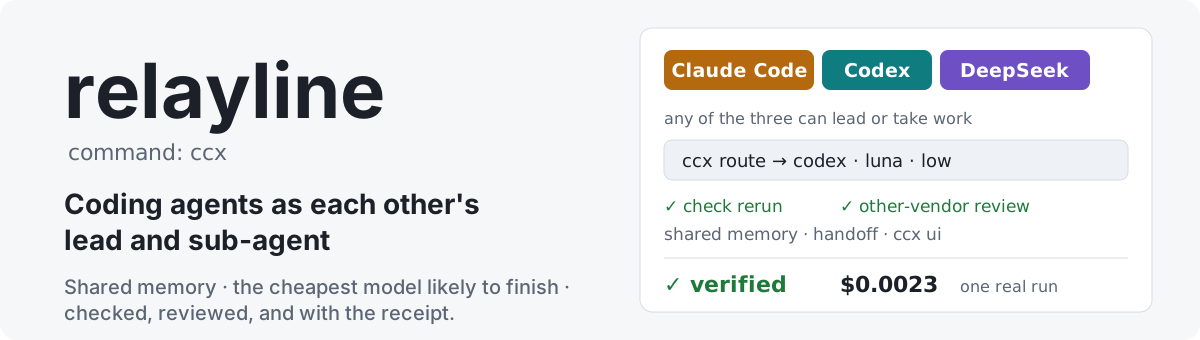
One promise: spend less on AI coding. Claude Code, Codex and DeepSeek become one team that hands work to each
other: each piece goes to the cheapest agent likely to get it right, every piece is checked, and all of them share
memory and working context. The command is ccx; Python standard library only.
Four pillars
| What ccx does | Measured | |
|---|---|---|
| Save money | Routes each piece to the cheapest agent, model and effort likely to finish it (or says "do it yourself"); slim sub-agent start-up; ccx lead shows what every turn of your lead re-reads. |
Delegated tasks that carried the lead's recent work cost 63 % less in all, with 0 reworks instead of 29 (A/B) |
| More accurate | ccx reruns the acceptance check itself, another vendor can review the diff, every run gets a verdict that calibrates routing. | First try right 36/36 with the shared work context vs 7/36 without (A/B) |
| Split the work | A five-question difficulty score picks agent, model and effort; the lead keeps only the summary; any of the three can lead. | The lead made one request fewer on every task, 21/21, after delegating (seven-cores A/B) |
| Share | Project and personal memory, handoffs between leads, a shared work context (ccx run --context, ccx peek), a board open sessions write to. |
A project note reached the sub-agent and was followed: 9/9 right with it, 0/9 without (seven-cores A/B) |
Read the numbers with their limits. They come from small, controlled tasks on one machine. The shared-context A/B is that feature's best case by design. Delegating small tasks alone left the total spend about even (ratio 1.02, 3.3× the tokens, about 23 s slower); the saving with a real, long lead conversation is extrapolated, not yet measured. Every number, the unfavourable ones too: docs/measured.md.
Quick start
claude plugin install relayline --marketplace SUPERD6/relayline   # the skills and hooks in Claude Code (2.1.275+)
pipx install git+https://github.com/SUPERD6/relayline             # ccx itself, for your terminal and Codex
ccx setup                    # guided: explains each step and asks before changing anything
ccx run --to codex --mode read "Summarise README.md in three lines"
You need Python 3.11+ and the claude and codex CLIs, logged in; DeepSeek (dsh, or a key in
DEEPSEEK_API_KEY) is optional. ccx -h lists the everyday commands first.
Who works with whom
| Lead | Takes work | |
|---|---|---|
| Claude Code | yes | yes |
| Codex | yes | yes |
DeepSeek (dsh, or through Claude Code; as a sub-agent also through Codex) |
yes | yes |
| Gemini CLI; Kimi, GLM, Qwen, OpenRouter through Claude Code | no | adapted, not run for real |
All "yes" cells ran for real on one Windows machine; macOS and Linux run in CI only. This is v0.5, work in progress: what is verified and how is in docs/STATUS.md.
More
| Page | What is there |
|---|---|
| What it does, and how | the seven things in detail, ccx ui, one example end to end, where shared things live, tiers, safety |
| Install and commands | install from a clone, plugging in your own setup, every command |
| Measured | all measurements with their limits, how savings are counted, external facts checked |
| Shared work context · The board | what open sessions share with each other, and how |
| Questions and similar projects | cost, subscriptions, safety, which tools work; how ccx differs from similar projects |
| Design · Decisions · Changes | the inside |
Not the similarly named projects: relayline was called claude-codex-bridge, but it is not
CCB and not OpenAI's
codex-plugin-cc (how they differ).
Security, contributing, license
What ccx runs and may change, and how to report a problem: SECURITY.md. Contributing (tests, rules, adding an adapter for another agent CLI): CONTRIBUTING.md and the code of conduct. MIT, see LICENSE.