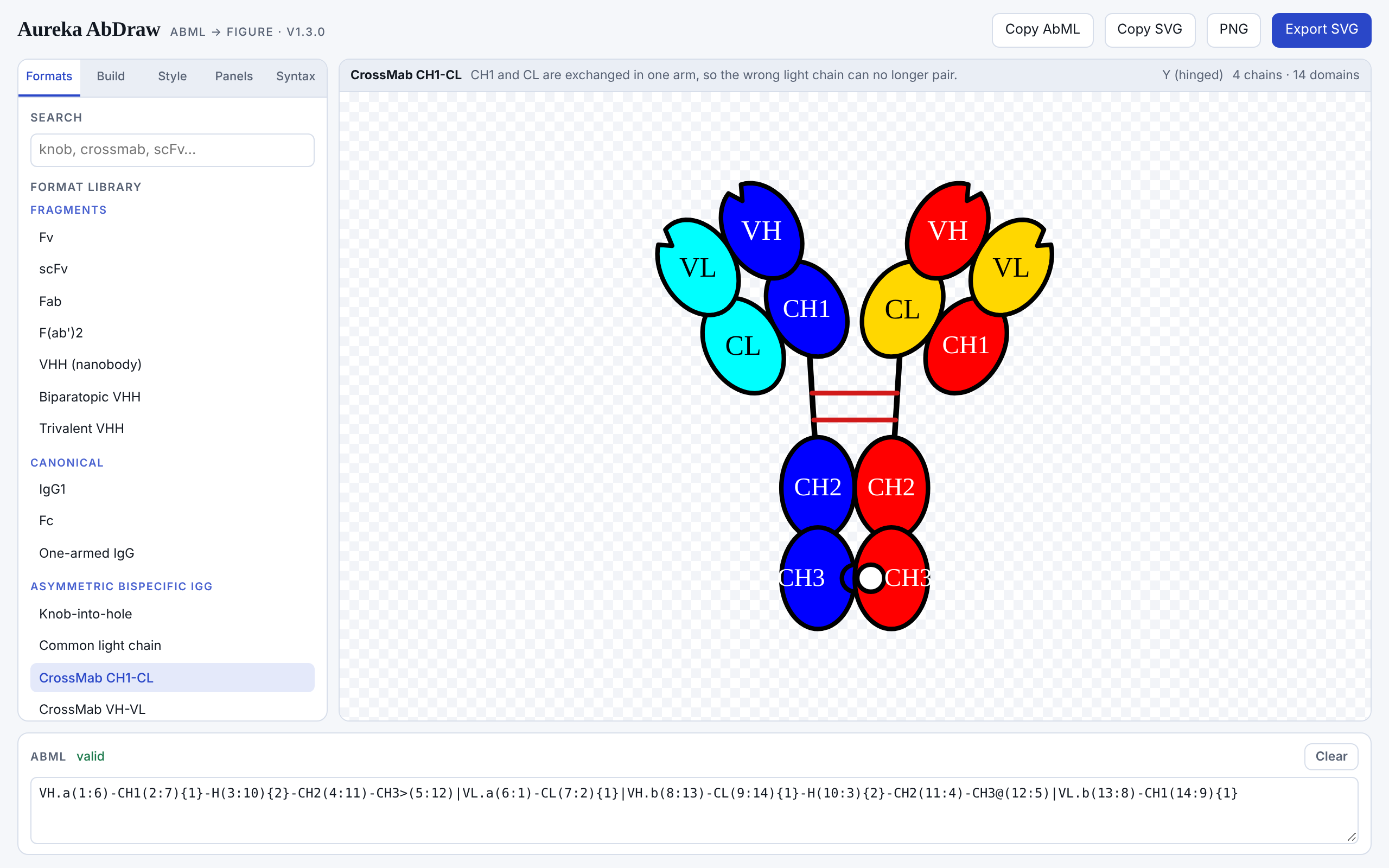
Draw multispecific antibody format schematics from one line of text.
AbDraw reads AbML — a compact notation for antibody architecture — and renders the molecule as a domain schematic that exports to clean, editable SVG. 43 formats ship in the library, from a bare Fv to trispecific knob-into-hole constructs.
Open the tool · Browse the gallery · AbML reference · Changelog
Why
Drawing an IgG is easy. Drawing a CrossMab so a reader can see which domains crossed is not — and that is exactly the figure a bispecific paper needs.
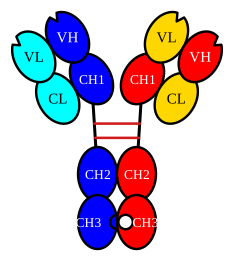
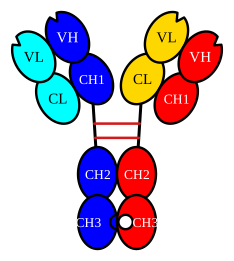
AbDraw colours each domain by where it came from, not which chain it currently sits on. When VH/VL or CH1/CL are exchanged, the colour travels with the domain, so the three CrossMab variants are visually distinct without a caption:
| CrossMab CH1-CL | CrossMab VH-VL | CrossMab Fab |
|---|---|---|
 |
 |
 |
Quick start
Pick a format from the library, or type AbML directly:
VH.a-CH1-H-CH2-CH3 | VL.a-CL
That draws a Fab arm on an Fc stem. Add identifiers to declare which domains pair, braces for the disulfides between them, and modification symbols for engineered interfaces:
VH.a(1:6)-CH1(2:7){1}-H(3:10){2}-CH2(4:11)-CH3>(5:12)
| VL.a(6:1)-CL(7:2){1}
| VH.b(8:13)-CH1(9:14){1}-H(10:3){2}-CH2(11:4)-CH3@(12:5)
| VL.b(13:8)-CL(14:9){1}
> and @ are the knob and the hole. Full grammar in docs/abml.md, and the same
reference is built into the tool under its Syntax tab.
Features
- Live parse and render — the figure follows the text as you type, with parse errors listed rather than swallowed.
- 43-format library in eight families, each one a starting point you can modify.
- Structured builder — assemble chains from dropdowns and let the tool write the AbML;
Renumber & auto-pairfixes up identifiers and interactions from the architecture. - Panel figures — stack several formats into a lettered A/B/C grid and export the comparison as one SVG.
- SVG and PNG export, plus copy-to-clipboard for both the AbML and the SVG markup.
- Deep links — every format has a URL, e.g.
app/#crossmab-ch1-cl. - Aureka figure conventions — Times New Roman labels, transparent ground, and a palette built on the Blues/Reds/Greys ramps, all overridable.
Running it
| How | What to do |
|---|---|
| Hosted | drjackxiaoyuchen.github.io/aureka-abdraw |
| Offline | Download app/index.html and open it. One file, no build step, no dependencies, no network. |
| As data | formats.json carries every format as name, category, description and AbML string. |
Format library
Fragments
| Format | Description |
|---|---|
| Fv | The minimal antigen-binding unit: a VH–VL heterodimer with no constant domains. |
| scFv | VH and VL carried on one polypeptide and held together by a flexible linker. |
| Fab | Heavy-chain Fd (VH–CH1) disulfide-bonded to a complete light chain. |
| F(ab')2 | Two Fab arms held together by the hinge disulfides, with no Fc. |
| VHH (nanobody) | A single camelid heavy-chain variable domain that binds without a light chain. |
| Biparatopic VHH | Two VHH domains in tandem, each raised against a different epitope on one target. |
| Trivalent VHH | Three linked VHH domains giving three binding specificities on one short chain. |
Canonical
| Format | Description |
|---|---|
| IgG1 | The parental monospecific, bivalent antibody that every format below modifies. |
| Fc | The hinge–CH2–CH3 homodimer on its own, the effector and half-life module. |
| One-armed IgG | Monovalent IgG: one Fab arm, a bare knob-into-hole Fc on the other side. |
Asymmetric bispecific IgG
| Format | Description |
|---|---|
| Knob-into-hole | Reciprocal CH3 steric mutations drive heterodimerisation of two different heavy chains. |
| Common light chain | Both arms share one light chain, so only heavy-chain pairing has to be engineered. |
| CrossMab CH1-CL | CH1 and CL are exchanged in one arm, so the wrong light chain can no longer pair. |
| CrossMab VH-VL | VH and VL are exchanged in one arm, keeping the constant-domain interface untouched. |
| CrossMab Fab | The whole Fab is swapped in one arm — both the variable and the constant pair cross over. |
| Orthogonal Fab | Complementary charge and steric mutations across both Fab interfaces enforce correct pairing. |
| Charge-pair bispecific | Electrostatic steering: opposing charges at the CH3 and CH1/CL interfaces instead of knobs. |
| DuetMab | Knob-into-hole plus an engineered CH1–CL disulfide replacing the native one in one arm. |
| kappa-lambda body | One common heavy chain pairs with a kappa and a lambda light chain, giving two specificities. |
Appended IgG
| Format | Description |
|---|---|
| DVD-Ig | A second variable domain stacked N-terminal to each native one: tetravalent and bispecific. |
| IgG-scFv (heavy C-term) | An scFv fused to each heavy-chain C-terminus — tetravalent, bispecific, symmetric. |
| IgG-scFv (light C-term) | The same idea with the scFv hung off each light-chain C-terminus instead. |
| scFv-IgG (heavy N-term) | An scFv placed ahead of each VH, so the second specificity sits at the tip of the arm. |
| IgG-VHH | A single VHH domain on each heavy-chain C-terminus — the smallest symmetric append. |
| Two-in-one Fab (DAF) | One paratope engineered to bind two antigens, so the molecule stays a plain IgG. |
| ADC (site-specific) | An IgG carrying defined conjugation sites for a cytotoxic payload. |
Fragment bispecifics
| Format | Description |
|---|---|
| BiTE (tandem scFv) | Two scFvs in tandem on one chain — the T-cell engager archetype, no Fc at all. |
| Diabody | Linkers too short to fold back, so two chains cross-pair into a compact bivalent dimer. |
| scDiabody | The diabody folded onto a single chain by adding a third, longer middle linker. |
| DART | A diabody locked by an added C-terminal interchain disulfide for stability. |
| TandAb | Two identical four-domain chains dimerise head-to-tail into a tetravalent bispecific. |
| Triplebody | Three scFvs in a row on one chain, giving three specificities without an Fc. |
Fc fusions
| Format | Description |
|---|---|
| scFv-Fc | An scFv on each side of an Fc: bivalent, monospecific, roughly half the mass of an IgG. |
| VHH-Fc (HCAb) | Camelid-style heavy-chain-only antibody: one VHH per chain, straight onto the hinge. |
| Bispecific VHH-Fc | Two different VHH domains on a knob-into-hole Fc — the compact asymmetric bispecific. |
| Tandem scFv-Fc | Two tandem scFvs per chain on an Fc: tetravalent and bispecific, fully symmetric. |
| Diabody-Fc | A diabody grafted onto an Fc, which restores long serum half-life. |
| Receptor-Fc trap | A soluble receptor ectodomain on an Fc, used to soak up a ligand. |
| Zipper-assembled bispecific | A leucine zipper on each C-terminus forces the two different half-antibodies together. |
Trispecific
| Format | Description |
|---|---|
| Trispecific IgG-scFv | A knob-into-hole bispecific with a third specificity appended as an scFv on one chain. |
| Trispecific VHH-Fc | Three VHH domains distributed across a knob-into-hole Fc. |
Receptors
| Format | Description |
|---|---|
| TCR alpha-beta | The alpha/beta T-cell receptor ectodomain pair. |
| TCR gamma-delta | The gamma/delta T-cell receptor ectodomain pair. |
Repository layout
index.html              landing page (generated)
app/index.html          the tool — single self-contained file
gallery/index.html      rendered gallery (generated)
formats.json            the format library as data
assets/svg/             one pre-rendered SVG per format (generated)
docs/abml.md            AbML reference
tools/build_formats.py  generates formats.json from scaffold builders
tools/build_site.py     generates index.html and gallery/
tools/render_gallery.js generates assets/svg/
Regenerate everything after editing tools/build_formats.py:
python3 tools/build_formats.py formats.json
node    tools/render_gallery.js     # needs playwright
python3 tools/build_site.py
Limits
- AbML in, figure out. There is no free-form drag canvas and no inference of AbML from a drawing — use the Build tab instead.
- Asymmetric constructs with more than four chains lay out legibly but may not match a hand-drawn cartoon.
- AbML describes architecture, not sequence. Residue-level annotation is out of scope.
Credits
The AbML notation is from:
Sweet-Jones J, Ahmad M, Martin ACR. Antibody markup language (AbML) — a notation language for antibody-based drug formats and software for creating and rendering AbML (abYdraw). mAbs 14:1 (2022). doi:10.1080/19420862.2022.2101183 · open access at PMC9291709
Please cite that paper if you use AbDraw in published work.
This project is an independent implementation and shares no code with the reference tool, abYdraw (GPL-3.0). See NOTICE.md for detail on how the format library was produced.
Versioning
Semantic Versioning; see CHANGELOG.md. Every exported SVG records the version that produced it and the AbML string behind it, so a figure in a paper can always be traced back to its source expression.
License
MIT — see LICENSE.