

an open-source autonomous software factory.

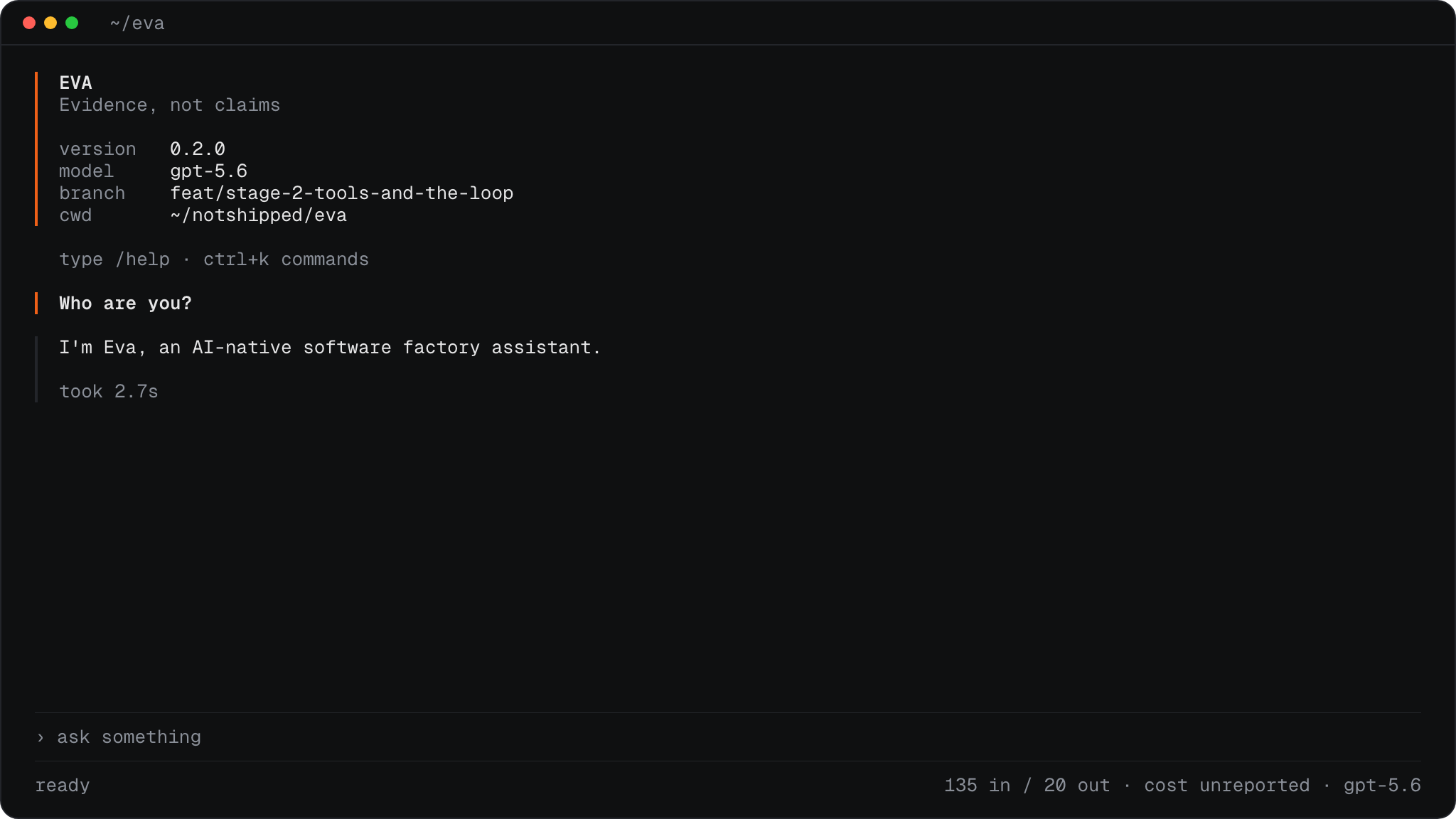
Eva is an open-source, autonomous software factory. It runs coding work end to end — from a spec a machine can check, through a harness that does the work, to evidence that it was done. Eva ships its own harness and drives the ones you already pay for behind one contract, with one trace, one verifier, and one bill. It runs on your laptop as a CLI and as a service you reach from anywhere; those are the same program.
Note
Eva is early. Today it answers a prompt at a terminal and runs a declared Workflow, on a plugin kernel: a small core loads plugins, and every capability — the model, the surface, the trace, the themes, the Workflow itself — is one. Every one of them is in this repository. The Build is a closed import table, no package here is published, and loading a plugin from outside the tree arrives at the extension-distribution stage. No agent yet, and nothing verifies work beyond the shape of it. Where this goes next is the roadmap.
Install
# Homebrew, on macOS
brew install --cask missingstudio/tap/eva

# The install script, on macOS and Linux
curl -fsSL https://raw.githubusercontent.com/missingstudio/eva/main/scripts/install.sh | sh

# npm — a prebuilt binary for your platform, no runtime needed
npm i -g @missingstudio/eva

# From source, with Bun 1.4 or newer
git clone git@github.com:missingstudio/eva.git && cd eva && bun install && bun run eva
The script checks the download against the release's signed checksums before it
installs anything, and says so either way. Read
scripts/install.sh first if you prefer, or pass
--require-signature to make an unverifiable download a refusal. Every archive
also carries a provenance attestation:
gh attestation verify <archive> --repo missingstudio/eva.
Connect a model
Eva talks to Anthropic and to OpenAI, so a key is the whole setup:
export ANTHROPIC_API_KEY=sk-ant-...   # or OPENAI_API_KEY=sk-...
eva
Your key never reaches a settings file, a log, or the session record. Any
OpenAI-compatible endpoint — Ollama, llama.cpp, vLLM, LM Studio, a hosted
gateway — is named in config instead, and its models join /model:
provider-compatible has the keys.
Use it
| Command | What it does |
|---|---|
eva |
Open the interactive surface |
eva --web |
The same terminal, with the page served beside it |
eva -p "<prompt>" |
Answer once, print to stdout, exit |
eva run <name> [file] |
Run a Workflow: one input in, the last Run's text out |
eva serve --web |
Headless: serve the page and the API, at a loopback bind |
eva attach <url> |
Drive a runtime another process serves, from this terminal |
eva trust |
Read this directory's .eva, and record the grant |
eva untrust |
Drop the grant for this directory |
eva config show |
Print the resolved config, and where each key came from |
eva policy check |
Validate a tool-policy rule set, for CI |
eva --version |
What you have |
A Workflow is a declared list of Steps — one Instruction and one model
request each — where the file owns the control flow and the model fills the
slots. A Step may name a JSON Schema, and a Candidate that does not conform is
asked again with every Fault named — once by default. Nothing it does depends
on what a model decided, which is why it comes before agents. You declare one under the
workflows key or as .eva/workflows/<name>.yaml; none ship:
git diff --staged | eva run commit-msg     # piped standard input
eva run review src/auth/login.ts           # a positional file
eva run release-notes --input CHANGELOG.md # or --input
One route at a time — two at once is refused with both named. eva-workflow is the whole surface.
In the chat, type / for the local commands: /help, /model, /cost,
/clear, /sessions, /mode, /undo, and /theme. They never reach a
model, so they cost nothing. eva -p and
eva run exit non-zero when the answer fails, which makes them safe in a
pipeline.
The global flags are valid on every command: --model provider/model sets the
model for this run, --config <path> overlays a config file, and --plugin /
--without-plugin add or skip a plugin. The full surface, including how it is
parsed, is reference/command-line.md.
Settings
A repository can carry a .eva directory to share a team's setup. Eva reads it
only after you run eva trust there — the grant is yours to give, so it is a
verb you run rather than a file a repository can ship. eva config show names
every resolved key and where it came from.
Documentation
| docs/README.md | The map — start here |
| docs/context.md | The glossary. One concept, one name |
| docs/architecture.md | The shape of the whole system |
| docs/ux-dx.md | How the base layer becomes good to use |
| reference/architecture.md | The plugin model, the kernel, every interface |
| reference/writing-plugins.md | Author a plugin |
| reference/command-line.md | Every command and flag |
| reference/toolchain.md | How to build and test, and CI's jobs |
| docs/development.md | How a change is made, and where each stage is |
| reference/ci-cd.md | How a change is checked and a release ships |
| docs/product.md | What Eva is for, and who for |
| docs/roadmap.md | What we build, in what order |
Contributing
bun install && bun run verify
That is exactly what CI checks on every change.
CONTRIBUTING.md is the rest of the short path: a green
verify, a plugin of your own, and the two lines that load it.
MIT licensed. See LICENSE.