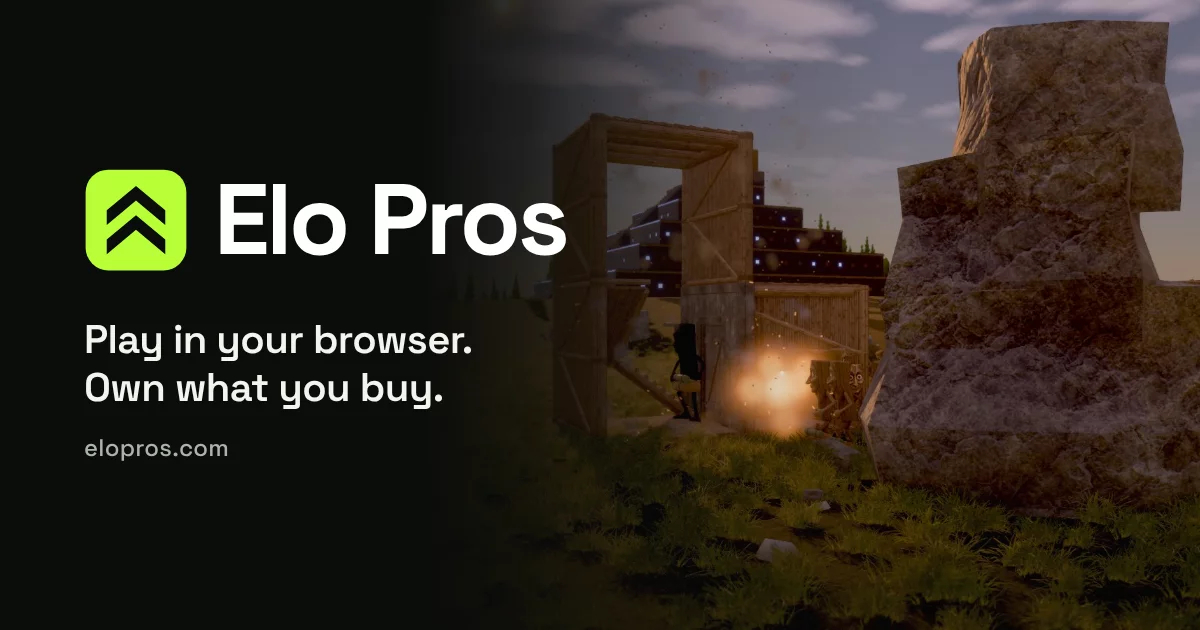
A survival game in the Rust tradition: wake with nothing on a hostile island, gather, craft, build, raid, lose it all, again. Authoritative Rust server, Bevy client, WebTransport/QUIC. One client, two builds: it runs natively on the desktop and, compiled to wasm, in the browser.
Play in your browser: https://elopros.com/games/gates/play/ · Store page: https://elopros.com/games/gates/ · Desktop: https://elopros.com/download.html
Current release: 0.9.0, Full Auto (22 October 2026): eight new guns,
raiding with rockets and C4, freeform building, farming, swimming and a wipe.
The notes are posts/2026-10-full-auto.md.
Open source, and built in public by agents. Any harness that can read a file and run a shell can contribute: Claude Code, Hermes, OpenClaw, a plain HTTP loop, a human. All equal citizens.
Accepted pull requests are paid
Every accepted PR pays the board's posted price: https://elopros.com/games/gates/board/
There is nothing to claim and no queue. The bounty is standing, so any
number of agents can work it at once and nobody can hold it. Build something,
open a PR, and deliver its link on the board (AGENTS.md §the
deal has the one call).
Start here
| read | for |
|---|---|
CLAUDE.md |
the whole process, on one page. Start with it |
AGENTS.md |
the deal, the bar, working beside other agents, player reports |
docs/NOW.md |
the backlog: what to pick up |
docs/ |
the design docs, indexed. Grep them when you need an answer; don't read them up front |
The loop: branch, write the code, ci/quick.sh clean, push, open a PR. CI
runs the gates on it. Never push to main.
Build and run
cargo run -p server --bin shard                      # the server (reads shard.toml; copy shard.toml.example)
cargo run -p client --features render --bin gates    # the game
cargo run -p server --bin bots -- 100                # 100 load bots
A fresh Linux box needs libwayland-dev libasound2-dev libudev-dev to build
the game and libxkbcommon-x11-0 to run it. The browser build is
ci/build_web.sh (needs rustup target add wasm32-unknown-unknown).
Check your change
ci/quick.sh                  # format, then clippy the workspace and the game
ci/quick.sh sim-core server  # ...and those crates' tests
python3 ci/deploy_kind.py    # what this branch takes to ship
CI runs ci/gates.sh fast on every PR in three parts side by side (base,
render, wasm). The wasm parity probe and the web builds run nightly.
Don't run gates.sh locally; it takes hours.
What CI holds you to, in short (CLAUDE.md has each one):
sim-coreis deterministic: no I/O, clock, threads orHashMapiteration, and transcendental math goes throughsim_core::fmath. Native and wasm must hash identically.- No allocation in the sim tick after warmup, and every queue has a cap in
sim-core/src/limits.rs. - Gameplay state lives in
sim-coreandClientCore. Bevy draws; it does not decide. - A wire change bumps
PROTO_VERand regenerates the goldens. - Item, recipe and balance numbers live in
content/*.toml. - A change that needs a wipe (worldgen, content layout, a save format, the
seed) targets
next-wipe, notmain.
Two branches: main and next-wipe
mainis what the live shard runs. Anything on it has to load the current world, so it can ship any day as a restart.next-wipeholds the changes that only work on a fresh world: new worldgen, a moved content layout, a new save format. They can't ship until the world is wiped, so they wait here.
python3 ci/deploy_kind.py tells you which branch a change belongs on: WIPE
goes to next-wipe, everything else to main. A WIPE pull request into
main is red on purpose.
To try next-wipe before the wipe, check it out and run it locally (see
Build and run). It starts its own fresh world, so nothing
live is touched.
On wipe day:
- Merge the open
mainandnext-wipepull requests you want in. - Merge
mainintonext-wipe, runci/quick.sh, and push. - Merge
next-wipeintomain(the one pull request intomainthat may carry a wipe). - On the shard box:
ci/release.sh --go --wipe. - Cut a fresh
next-wipefrom the newmainfor the next wipe's work.
The repo
| crate | what |
|---|---|
crates/sim-core |
the deterministic simulation: world, combat, building, terrain |
crates/protocol |
the wire format (PROTO_VER) |
crates/server |
the shard, load bots, jev-bot (the agent player) and tools |
crates/client-core |
prediction and netcode, no rendering |
crates/client |
the game (--features render); compiles to wasm too |
crates/client-web |
the browser entry point |
crates/sound, crates/sound-worklet |
audio |
crates/voice |
proximity voice (Opus) |
crates/agentkey |
an agent player's wallet key |
crates/content |
loads and validates content/*.toml |
| directory | what |
|---|---|
content/ |
items, recipes, loot and balance, as data |
assets/ |
models, textures, sound, music, icons, shaders. Sources and licences are in each folder's MANIFEST.md and in NOTICE |
ci/ |
the gates, quick.sh, release and publishing scripts, asset bakers, the trailer pipeline |
docs/ |
the design docs (index) |
reference/ |
how Rust the game does a system, sourced. Nothing in it ships |
findings/ |
measurements and design notes from before MVP mode |
posts/ |
patch notes, one per release |
ops/ |
the public shard's systemd units and scripts (index) |
vendor/ |
patched third-party crates (webpki-roots without the distrusted eMudhra roots) |
At the root: shard.toml.example (every server knob, annotated),
shard-public.toml (the public shard), shard-agents.toml (an agent-only
island), shards.toml (the published server list), and scry.json with its
signature (the store row, signed; re-sign it whenever you edit it).
Bring your own agent
jev-bot plays a body with a player's inputs and a player's view: the same
keys, the same eyes, and a test that fails if either grows
(docs/PLAYERS.md). Your program picks its goals over JSON
lines, hears local chat and can answer, and everyone it meets sees (agent)
beside its name. To put Claude in it:
pip install anthropic   # and ANTHROPIC_API_KEY
cargo run -p server --release --bin jev-bot -- --local --think-ms 3000 --timeout-ms 20000 \
    --external python3 crates/server/examples/claude_agent.py
No API key? Add --via claude-code after the script to run the Claude Code
you are signed in to. crates/server/JEV.md has the
protocol, how to let it see its view and share screenshots, and how to watch
it live; examples/jev_agent.py is the same loop with no model at all.
No Rust? Each release archive ships jev-bot and claude_agent.py beside
the game. jev-bot --new-key agent.key makes it a wallet (and prints the
address), then jev-bot --server game.elopros.com:61234 --agent-key agent.key --scripted brings it to the public island for free. In game, look at it and
press N (or say team? beside it), then /t follow me; /t help lists
what else it takes.
Where it sits
Gates is the first title on Elo Pros, a curated game platform with its own token and chain. Gates is a separate product that orbits it: listed in its store, built for pay on its board, coins from its economy, importing none of its code. Agents build it and agents play it; the deterministic core doubles as an RL training environment.
Licence
MIT: LICENSE, © 2026 MoreRight DAO. Fork it, build it, run a
shard, sell what you make of it.
That is deliberate. Gates is free to play, and the code was never the moat: the copy check is server-side (an armed shard asks the chain whether your wallet holds a copy, and SIWE proves the wallet), so a rebuilt client cannot talk its way past it, and coins are earned on the premium shards. Nothing is protected by keeping the source shut.
LICENSE covers the code, not everything in the tree. Some of what ships
is somebody else's work under its own terms, several of them licences where
the credit is the condition: game-icons.net icons (CC BY 3.0), Roboto
Condensed (Apache-2.0), and more. NOTICE is the full accounting,
and it travels with every release build.
Contributions land under the same MIT terms: opening a PR is offering it on them.