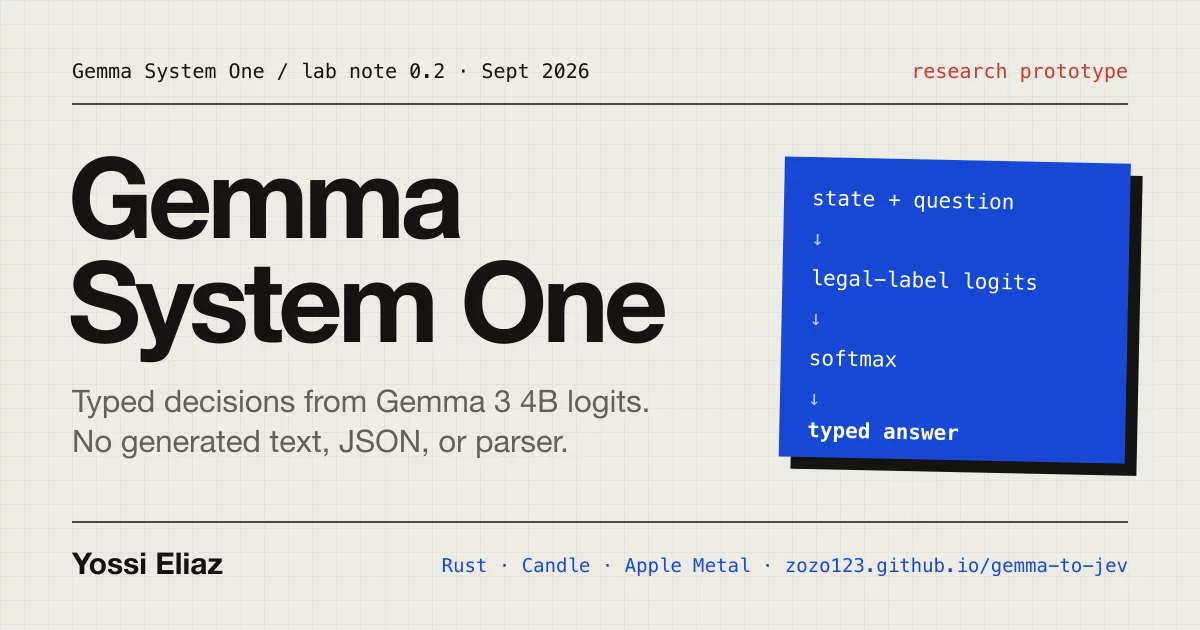

Gemma System One
A research prototype that turns a small Gemma into a language-conditioned
decision function, in native Rust, and uses it as a laboratory for
semantics-preserving shared-state inference. This demo uses
google/gemma-3-4b-it (Q4_K_M GGUF weights from
unsloth/gemma-3-4b-it-GGUF)
with Candle on Apple Metal.
Project page: https://zozo123.github.io/gemma-to-jev/
Measured: 47 ms per warm decision on the experimental packed-sheet path, 21.2 decisions/s, 7/7 option-order stability — on an Apple M1 Pro. 58.9% on JevBench's 231 public decisions.
The important caveat is now first-class: the packed-sheet optimization can change an answer. The public API therefore defaults to an isolated shared-prefix batch, while the faster sheet topology remains experimental.
Instead of:
prompt -> generate tokens -> parse text
it does:
prompt -> legal-label logits -> softmax -> typed answer
The decision path has no open-ended generation, generated JSON, or parser.
Run
cargo run --release                 # conference demo (default)
cargo run --release -- demo
cargo run --release -- bench        # warm latency, baseline, stress
cargo run --release -- isolation-bench --repeat 10
cargo run --release -- serve        # local TypeSafe-compatible API
The first run downloads about 2.3 GB of weights and the tokenizer from Hugging Face. Later runs use the local Hugging Face cache.
cargo run --release -- bench --repeat 5
cargo run --release -- bench --skip-stress
cargo run --release -- bench --skip-baseline
cargo run --release -- demo --temperature 1.5
cargo run --release -- --cpu demo
Temperature is an inference control, not calibration.
See the landscape for related systems and the semantic-isolation plan for the research direction.
Use it inside an agent harness
serve loads Gemma once and exposes POST /v1/systemone, matching the
TypeSafe request/response shape. It binds to 127.0.0.1:8080 by default.
cargo run --release -- serve

curl http://127.0.0.1:8080/v1/systemone \
  -H 'content-type: application/json' \
  -d '{
    "state": "The build failed with: ld: library not found for -lssl",
    "questions": {
      "route": {
        "type": "choice",
        "instructions": "Choose the next owner.",
        "criteria": {
          "build": "Build or linker failure",
          "security": "Security incident",
          "remote_llm": "Needs deeper investigation"
        }
      }
    }
  }'
The intended production shape is a local sidecar, not an in-process benchmark dependency:
event -> local System One -> typed route / policy / escalation decision
                             | high-trust allowlisted case: act locally
                             ` otherwise: call the remote LLM
Run it before a remote model when saving calls matters. Run both speculatively when latency matters, but cancellation may not save provider cost. Do not gate on this model's raw confidence alone: JevBench shows that it is overconfident. Gate only task families validated for the application, and send ambiguous, adversarial, long-policy, or multi-hop work to the remote model.
Single-question requests use the direct logit path. Multi-question API requests share only the state prefix and evaluate each question in an isolated batch row. The packed question-sheet/pointer path is retained for experiments because it is faster but has already shown semantic drift on the demo workload.
Result at a glance
full prompt                         ~400 ms / decision
shared-state KV cache                 173 ms / decision
state + question sheet cache          108 ms / decision  [experimental]
batched 2-token sheet pointers         47 ms / decision  [experimental]
The 47 ms path is not a cherry-picked smaller model. It is the same quantized
Gemma 3 4B. But it is also not semantically equivalent by assumption:
bench exposes disagreements against the independent/full-prompt path, and
isolation-bench compares all execution topologies explicitly.
Question primitives
Following Jev's interface shape, every question is one of three types, and each answer carries the full restricted distribution:
| Primitive | Question | Returns |
|---|---|---|
noul |
Is this true? | probability of yes |
choice |
Which of these options? | winning label, probabilities, confidence |
score |
Where on this scale? | fractional level, probabilities, confidence |
Confidence here is the largest probability in the restricted distribution. That is our own shape statistic, not Jev's calibrated confidence.
How it works
                  GEMMA 3 4B

state + question + runtime labels
                |
                v
        +---------------+
        | transformer   |
        +---------------+
                |
                v
      next-position logits
                |
                v
          [A] [B] [C] [D]
                |
                v
             softmax
                |
                v
       0.04 0.87 0.07 0.02
                |
                v
            DEPENDENCY
Each label must be exactly one token at the real answer boundary. The program verifies this at startup and refuses labels that tokenize any other way.
Semantic isolation is now the research question
The basic restricted-logit trick is easy to reproduce with many open models. The harder systems problem is to reuse one expensive state across many runtime-defined questions without changing what each question means.
Reference execution asks each question independently:
state + Q1 -> P1
state + Q2 -> P2
state + Q3 -> P3
The production multi-question path shares only the state computation:
             shared state KV
             /      |      \
           Q1       Q2      Q3
           |        |       |
          P1       P2      P3
The experimental sheet path instead puts every question in one context and then uses tiny answer pointers. That can be faster, but the conditioning function is different:
P_sheet(y_i) = P(y_i | state, Q1, Q2, ..., Qn, pointer_i)
rather than:
P_ref(y_i) = P(y_i | state, Qi)
On the existing demo, retry_risk changed materially between these paths.
That failure is useful: optimization should be evaluated as a
latency/throughput vs semantic-drift frontier, not by speed alone.
Run:
cargo run --release -- isolation-bench --repeat 10
It reports selected-label flips, maximum probability drift, mean Jensen-Shannon divergence, and end-to-end latency for independent, isolated shared-prefix, and packed-sheet execution.
Landscape
The space has already split into several distinct technical directions:
| Direction | Examples | What they optimize |
|---|---|---|
| Purpose-trained decision models | Jev, Laya, Kev, Mapika Decider | train representations/readouts for bounded decisions, calibration, and sometimes explicit question isolation |
| Inference-time adapters | OpenJev, SemIf, openjev-sglang | reuse ordinary LMs and read restricted logits instead of generating prose |
| Probability quality | AnyJev, Kev-style calibration | remove option/label bias and turn scores into empirically useful probabilities |
| Parallel answer architectures | djev / DiffusionGemma | make several bounded outputs native rather than sequential |
| Shared-state inference systems | vLLM prefix caching, Hydragen, DeFT | amortize expensive prefixes and branch efficiently |
| This repo | Gemma + Rust + Candle | measure the throughput/semantic-isolation frontier for many runtime-defined decisions over one state |
The basic pattern
ordinary LM -> legal option logits -> restricted softmax -> typed answer
is now common. The research question here is what happens after that: how much shared computation can we introduce before the optimized execution stops computing the same decision distribution?
Full map: docs/landscape.md.
Compared with Jev
This repo copies Jev's interface (noul / choice / score, restricted softmax, no
generate()). It does not copy Jev's model.
| This demo | TypeSafe Jev | |
|---|---|---|
| What it is | Prompted Gemma 3 4B Q4, logits over A/B/C… | A hosted System One model trained with RLCD |
| Output | Typed value + raw softmax over legal labels | Typed value + calibrated probabilities |
| Many questions, one state | API: shared state prefix + isolated batch rows; experimental packed-sheet path for speed studies | Evaluate questions in parallel against one state |
| Confidence | Max probability in the restricted set | Shape statistic from a model trained to be calibrated |
| Latency | 47 ms per decision warm, on an M1 Pro | TypeSafe quotes ~70–500 ms end-to-end, most around 100 ms, from US West |
| Throughput | 21 decisions/s after one prefill | The ~100 ms figure is about 10 requests/s on their hardware |
The systems opportunity is pay for the state once. Three experiments moved the 4B model from roughly 2.5 to 21 decisions/s, but they do not all preserve the same semantics:
- Cache the state. Prefill the common state once and run each question suffix against that exact prefix. 400 ms → 173 ms per decision in the measured serial path.
- Batch isolated suffixes. Widen the state cache to independent rows and
keep each question text in its own row. This is now the production API
topology;
isolation-benchchecks it against independent prompts. - Cache the questions too (experimental). Put state and the whole question list in one prompt, then answer via tiny pointers. This reached 108 ms serial and 47 ms batched, but changed at least one demo answer. It is therefore a speed experiment, not the semantic reference.
Two things that looked promising and did not work:
- Batching the long suffixes (the full question text per row) gave nothing: 178 ms per decision versus 165 ms serial. At ~31 tokens per row the pass is compute-bound, so extra rows cost extra work. Batching only pays once the suffix is short enough to be weight-bound.
- A one-token pointer (
1instead of1.) hit 27 ms per decision and destroyed the answers: labelled accuracy 1/4, every state classifiedcompilation. The model could no longer tell the questions apart. Speed that fails the checks is not speed.
Measured on an Apple M1 Pro
Warm, 4-bit 4B model, cargo run --release -- bench --repeat 2 --skip-baseline:
| Metric | Result |
|---|---|
| Model load (warm page cache) | 5.2 s |
| First inference after load | 2.5–4.4 s |
| Independent decision (full prompt) | ~400 ms · ~2.5/s |
| Shared-state suffix after prefill | p50 173 ms · 6.0/s |
| Prefilled sheet, serial | p50 108 ms · 9.2/s |
| Prefilled sheet, batched | p50 47 ms · 21.2 decisions/s |
| Sheet prefill (state + 5 questions) | 232 tokens · ~0.6 s, paid once |
| Determinism | 5/5 identical distributions |
| Option-order stability | 7/7 rotations kept the same decision |
| Labelled spot-check, full prompt | 3/4 |
| Labelled spot-check, fast sheet path | 4/4 |
System One vs generate() |
420 ms / 0 tokens vs 509 ms / 2 tokens |
The fast path is checked against the slow one on every bench run, not assumed,
and it does not fully agree. Four of the five discrete decisions match across the
full-prompt, serial-sheet, and batched-sheet paths. The fifth, the retry_risk
score, lands at 3.00 on the full prompt and 1.08 on the sheet — high risk versus
low risk on a 0–4 scale, which is a different answer, not rounding. Reading a
question from a cached sheet is therefore not equivalent to asking it on its own,
and anything depending on that question should use the full-prompt path.
The remaining drift between serial and batched sheet reads is small (1.08 versus 1.14 on the same score). Single-position steps skip the sliding-window mask, which is what upstream Candle already does when decoding, and is the likely source of that numeric difference.
On the four-case labelled spot-check the two paths also disagree in the other
direction: the sheet path gets 4/4 while the full prompt gets 3/4, missing an
infrastructure case it calls test. Four cases decide nothing; both numbers
are too small to rank the paths.
The generation baseline emits only two tokens, so the gap is modest and varies between runs (509–804 ms observed). The saving grows with longer outputs; the structural win is that there is no text to parse and the output space cannot go out of range.
JevBench: all 231 public decisions
The TypeSafe-compatible server was run through the official fstandhartinger/jevbench v1.3.0 adapter, serially, on every redistributable public task. These are fresh-state requests, so they measure a different workload from the 47 ms shared-state batch above.
| Metric | Result |
|---|---|
| Accuracy | 58.9% · 136/231 |
| Easy | 100% · 48/48 |
| Standard public | 62.5% · 45/72 |
| Hard public | 38.7% · 43/111 |
| Macro family accuracy | 55.3% |
| ECE / Brier | 0.402 / 0.808 |
| API and schema validity | 231/231 |
| Fresh-state latency | p50 593 ms · p95 16.6 s |
On the exact same 231 public task IDs, JevBench's published outcomes are Laya 58.4%, kev-4B 66.2%, and Jev 1.13.0 86.6%. This prompted Gemma barely clears Laya, but it is not competitive with a trained decision model. The p95 is dominated by long-context policy and multi-hop cases.
This is not an official leaderboard rank: no hidden set was run, and hardware
differs. The compact result artifact is in
bench/results/jevbench-v1.3-public.json.
Reproduce it while serve is running:
./bench/run_jevbench.sh
Two findings worth keeping:
- An earlier prompt contained a policy hint about retries. It pushed the model toward one answer and dropped option-order stability to 20% and the spot-check to 3/4. Removing it restored 100% and 4/4.
- The very first load on a cold page cache took 19 s, and early decisions took seconds before the weights became resident. Quote warm numbers only.
Limitations
- Raw softmax values are model-relative scores, not calibrated probabilities. The model frequently reports 100%, which reflects a peaked distribution rather than certainty about the world.
- On the demo incident, the model answers
yesto retrying an unchanged command, which is wrong for a deterministic missing library. Option-order testing confirms this is a genuine model judgment, not position bias. - It routes a missing
-lsslto the security team, which is defensible but debatable. - The fast path needs the question list up front, which is what makes the pointer work. Questions discovered mid-flight fall back to the 173 ms shared-state path.
- The 47 ms figure is the warm batched pass. The sheet prefill (~0.6 s) is paid once per state, so a single question against a fresh state is not fast.
- This batches rows itself rather than being Jev's parallel sampler, and the model is still a prompted chat model rather than one trained for decisions.
Next
The priority is no longer "make another Jev wrapper." It is to map and then push the semantic-isolation frontier:
- expand
isolation-benchacross question counts, state lengths, order permutations, distractors and public benchmark tasks; - optimize the isolated shared-prefix path without relaxing the semantic contract (cache reuse, suffix bucketing, branch-aware attention, better kernels);
- add held-out calibration/debiasing experiments; current JevBench ECE is 0.402;
- compare raw final-token logits against intermediate-layer / trained decision readouts;
- only after the text contract is stable, add shared multimodal state so one image/world observation can feed many isolated decisions.
Detailed plan: docs/semantic-isolation.md.
Landscape and related work: docs/landscape.md.
License
Not yet chosen.