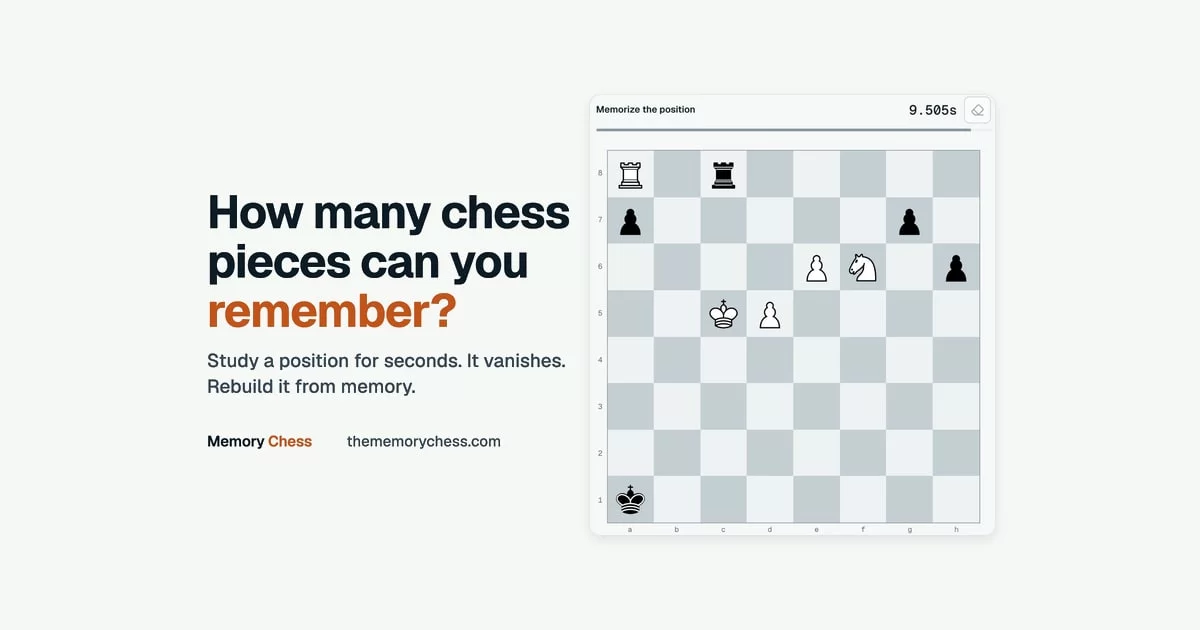
Memory Chess is a free chess memory game at thememorychess.com. You see a chess position for a few seconds, then rebuild it from memory and get a score. This repository is the source of the site.
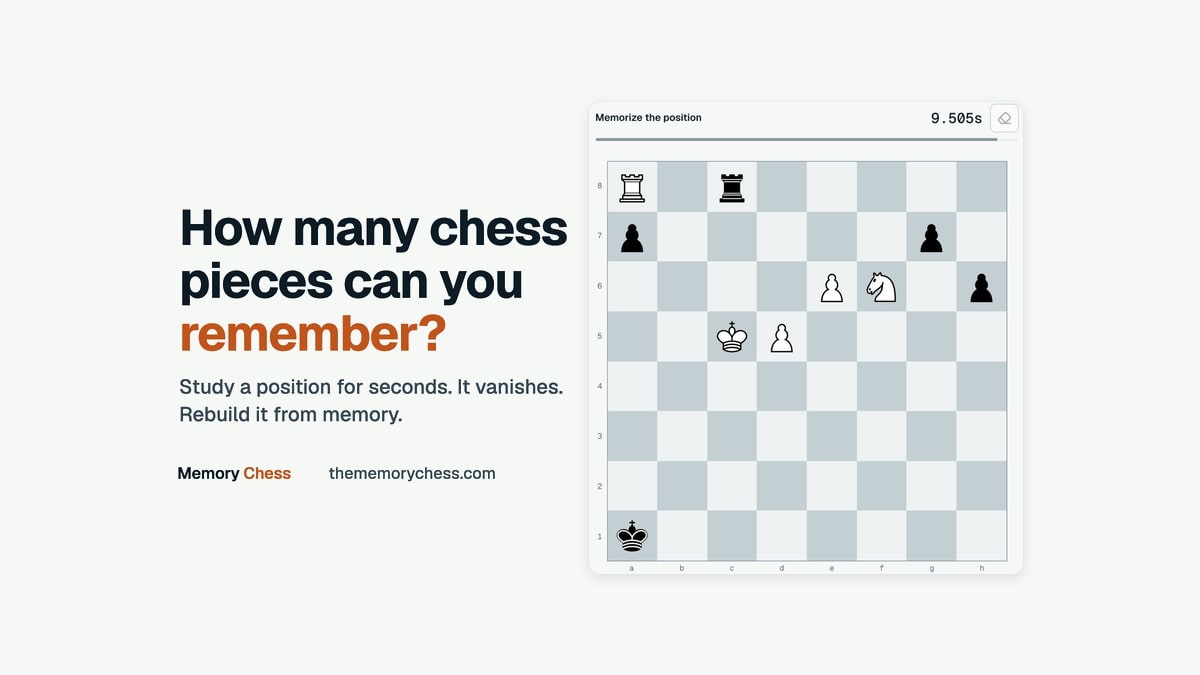
How a round works
- Pick how many pieces to show and how many seconds you get, or start a preset. The presets run from 2 pieces for 10 seconds (Easy) to 20 pieces for 5 seconds (Grandmaster).
- Study the position. The board goes blank when the time runs out or when you press Hide board.
- Rebuild it by choosing pieces from the palette and placing them on the squares where they stood.
- Submit to see your accuracy score (the share of pieces placed correctly, less 10 points for each piece placed beyond the count, never below 0), which pieces you got wrong, and how long you took.
Around the round:
- A rating that changes after each round, with a preview of what a win or a miss would do to it. Your rating history and stats are kept on your device.
- A daily board, the same position for every player that day.
- A leaderboard you can submit a score to.
- Learn guides and articles on chess memory and visualization.
- 24 languages.
- Free, with no account and no sign-up.
For developers
Memory Chess is a Next.js 15 App Router app written in TypeScript. The Node version is not pinned in the repo. The versions below are from package.json.
Stack
- Next.js 15 (App Router) with React 19
- Tailwind CSS 3, Radix UI primitives, Zustand for game state
- chess.js for position handling
- next-intl for the 24 locales, with message files in
messages/ - Supabase for the leaderboard and Google Sheets for feedback and contact forms
- Jest and Testing Library for tests
- Hosted on Vercel
Setup
git clone https://github.com/bingcheng45/memory-chess.git
cd memory-chess
npm install
npm run dev
Open http://localhost:3000. The dev server uses Turbopack.
Environment
Put these in .env.local. The names come from src/.
NEXT_PUBLIC_SUPABASE_URL,NEXT_PUBLIC_SUPABASE_ANON_KEY,SUPABASE_SERVICE_ROLE_KEY: the leaderboard. SetSUPABASE_READ_ONLY=trueto stop writes that go through the shared Supabase client insrc/lib/supabase.js. It does not cover the Google Sheets writes below. The opt-in lab backup (LAB_BACKUP=on) builds its own service-role client and honours it too: a put or delete answers 503 and a get still works.GOOGLE_SHEET_ID,GOOGLE_SERVICE_ACCOUNT_KEY: where feedback and contact messages are appended. Feedback goes to a worksheet tab namedGame Feedbackwith headersSubmitted At,Rating,Feedback,Accuracy,Correct Pieces,Piece Count,Difficulty,Memorization Time,Solution Time,App Versionin columns A to J.NEXT_PUBLIC_DATABUDDY_CLIENT_ID: analytics.
Scripts
| Command | What it does |
|---|---|
npm run dev |
Development server |
npm run build |
Validates messages and articles, builds the app, then checks the prerendered guides |
npm start |
Serves a production build |
npm run lint |
next lint |
npm run validate |
Checks the message files and the article translations |
npm run validate:messages |
Checks every locale file for missing keys and broken placeholders |
Other npm run scripts (lab:*, measure:*, migrate:rehearse, backup:verify) are measurement and maintenance tools. See package.json and scripts/.
Tests and type checks
npx jest
npx tsc --noEmit
There is no test script. Jest runs every file matching **/__tests__/**/*.test.[jt]s?(x), which covers src/, scripts/ and schema/.
Adding or changing text. Interface strings (next-intl) go into messages/en.json and the other 23 locale files. Article and trust-page translations live elsewhere: articles in src/lib/articles/translations/, and About, Privacy and Terms in src/lib/pages/translations/. Those are written and checked with node scripts/articles-i18n.mjs (add --pages for the trust pages). Run npm run validate before you open a pull request. It checks both the message files and these translations.
Ads. No ad units are active. The AdSense script is off because ADSENSE_SCRIPT_ENABLED in src/lib/adsense.ts is set to false, and the placement plan is in adsense-layout-plan.md.
Contributing
Issues and pull requests are welcome. Run npm run lint, npx tsc --noEmit and npx jest first.
License
MIT. Copyright 2025-2026 bing cheng.