
NextStarter
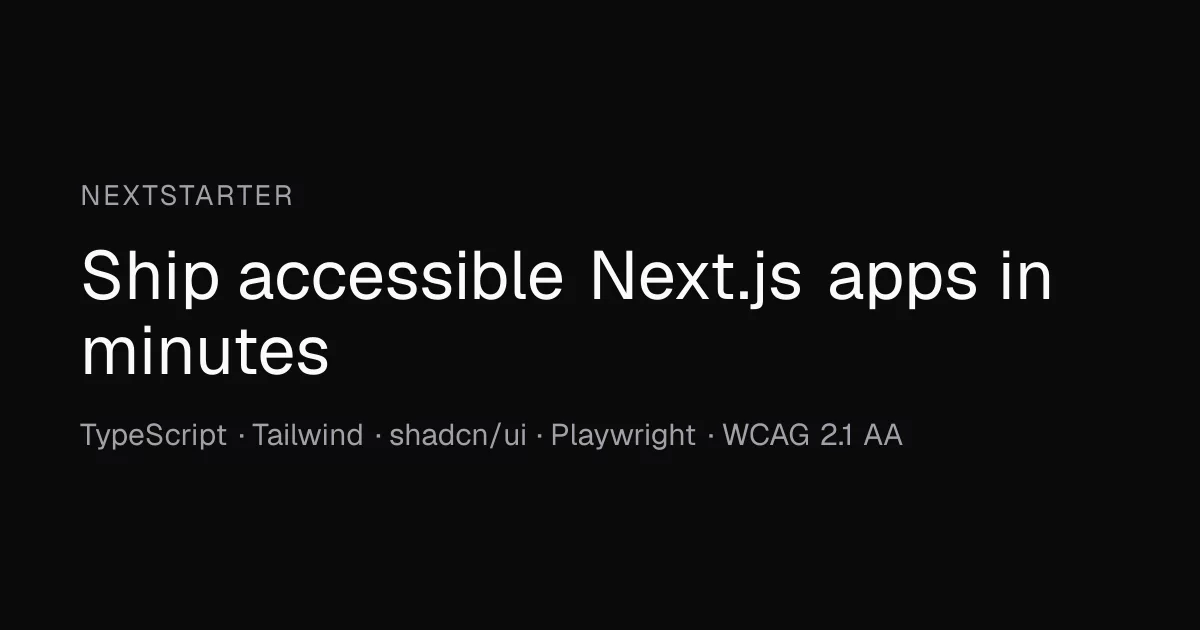
A modern Next.js boilerplate to ship production-ready projects fast — with TypeScript, Tailwind CSS v4, accessibility, testing, and developer tooling pre-configured.
This is the free version of NextStarter. NextStarter Pro adds authentication, a database, Stripe billing, email, a dashboard, admin, internationalization, and more — a complete SaaS foundation. See what's included ↓
Tech Stack
| Layer | Technology |
|---|---|
| Framework | Next.js 16 (App Router) |
| Language | TypeScript (strict mode) |
| Styling | Tailwind CSS v4 |
| Components | ShadCN/UI + Radix UI |
| Icons | Lucide React + React Icons |
| Theming | next-themes |
| Analytics | PostHog (cookieless, optional) |
| Testing | Playwright + Axe-core |
| Runtime | Node.js 22 |
Features
Developer Experience
- Turbopack — faster local development builds
- ESLint with import sorting, key sorting, arrow functions, template literals, and TypeScript rules
- Prettier with automatic Tailwind class sorting
- VS Code settings and recommended extensions pre-configured
- TypeScript strict mode with
@/*path alias - Node version file for
nvm,fnm, and other version managers
Styling & Theming
- Tailwind CSS v4 with a custom stone/orange design theme
- Light and dark modes — system preference by default, user-toggleable
- ShadCN/UI component library (Button, Card, Carousel, Tooltip), catalogued
live at
/ui-components— every variant, size, and state, with the code for each and the colour and type foundations behind them - Radix UI primitives for accessible, headless components
- Mobile-first responsive design with Tailwind breakpoints
Accessibility
- Axe-core automated accessibility scanning in Playwright tests
- Skip-to-content navigation link for keyboard users
- Semantic HTML landmarks (
<header>,<nav>,<main>,<footer>) - ARIA labels,
aria-expanded,aria-currenton interactive elements - WCAG 2.1 AA verified in both light and dark modes
SEO & Metadata
- Auto-generated
robots.txtandsitemap.xmlvia TypeScript - Configurable
<title>template (%s | NextStarter) - Open Graph and Twitter card metadata support
- Canonical URL configuration
Analytics & Privacy
- PostHog analytics, configured cookieless — no cookies, no local storage, and therefore no consent banner. Visitors are counted with a server-side privacy-preserving hash instead of an identifier that follows them around
- Core Web Vitals captured alongside pageviews
- Opt-in: with no
NEXT_PUBLIC_POSTHOG_PROJECT_TOKENset, PostHog never initializes and the app makes no third-party requests at all - Autocapture and session recording are off by default under data minimisation — turn them on deliberately, not by inheriting a default
- A
/privacypage written to the UK GDPR and PECR, linked from the footer on every page. It reads the same config the SDK does, so it describes what the site actually does rather than drifting away from it - Self-hosted fonts via
next/font— no visitor IP is ever sent to Google - The cost of going cookieless, stated plainly: PostHog strips the IP before enrichment, so there is no geography and no bot filtering — the world map reads zero for every country by design. Not having a consent banner is what you are buying with that
Testing & CI/CD
- Playwright end-to-end tests across Chromium, Firefox, and WebKit
- Axe-core accessibility scans run on every test run
- GitHub Actions workflows for ESLint and Playwright on push and pull request
- HTML test reports
Performance
- Lighthouse 100/100/100/100 on desktop in production — performance, accessibility, best practices, and SEO
- Lighthouse CI runs on every push and pull request, on both mobile and desktop, and fails the build if the scores regress
- Accessibility and SEO are asserted at a flat 100 on both form factors; performance gets a floor rather than an exact target, because it is a timing measurement on a shared CI runner
- Server components by default — minimal client-side JavaScript
next/imagefor optimized images- Static generation for sitemap and robots metadata
- Custom 404 page
Upgrade to Pro
This free starter gives you a polished, accessible marketing landing page with testing and tooling built in. NextStarter Pro turns it into a complete SaaS foundation.
Everything in the free version, plus:
- 🔐 Authentication (Clerk) — sign-in, protected routes, user profile
- 🗄️ Database (Prisma + PostgreSQL) — a user-owned CRUD example
- ✉️ Transactional email (Resend) and 💳 Stripe subscriptions
- 📊 Dashboard app shell + a protected admin panel
- 📝 MDX blog and a validated contact form
- 🌍 Internationalization — English, Spanish, and Arabic (RTL)
- 🛡️ Security headers, CSP, and API rate limiting
- 🚀 Waitlist mode and Sentry error tracking
- 📚 Comprehensive documentation
$199 one-time — lifetime access and updates via a private GitHub repo (just
git pull to update).
Getting Started
Requirements: Node.js 22+ (see .node-version)
npx @bill742/create-nextstarter my-project
cd my-project
npm run dev
The CLI asks which starting point you want:
- blank (default) — an empty home page inside the app shell: header, footer, light/dark theme, privacy notice, 404 page, tests, and CI.
- full — this site's landing page, kept as example content to adapt.
Either way the NextStarter-specific content is stripped: the Pro pages, the
changelog, and this site's metadata. The rules for that live in
.nextstarter/, and the Scaffold workflow builds
and tests both starting points on every push. Cloning the repository by hand
gets you the unmodified site; run node .nextstarter/apply.mjs blank (or
full) to do the same cleanup yourself.
| Variable | Description |
|---|---|
NEXT_PUBLIC_SITE_URL |
Full URL of your site (e.g. https://example.com/) |
NEXT_PUBLIC_SITE_NAME |
Name displayed in the header and footer |
Making this yours
Two files carry NextStarter's own content rather than yours, and both are built to be emptied:
src/lib/changelog.ts— the entries behind/whats-new. Empty both arrays and the route disappears along with its navigation entries and its sitemap listing; add your first entry and it comes back.CHANGELOG.mdis the complete record it is curated from — reset that too..env— leavingNEXT_PUBLIC_PRO_URLunset switches off the whole upsell surface: the home-page teaser, its navigation entries, and the/proand/thanksroutes. A project built on this starter never advertises NextStarter Pro unless you point it at a checkout of your own.
Scripts
| Command | Description |
|---|---|
npm run dev |
Start development server with Turbopack |
npm run build |
Build for production |
npm run start |
Serve the production build |
npm run lint |
Run ESLint |
npm run test |
Run Playwright end-to-end tests |
Lighthouse runs in CI on every push. To run it locally against a production build (it starts and stops the server itself):
npm run lighthouse           # mobile preset
npm run lighthouse:desktop   # desktop preset
License
Released under the MIT License — free to use for personal and commercial projects.