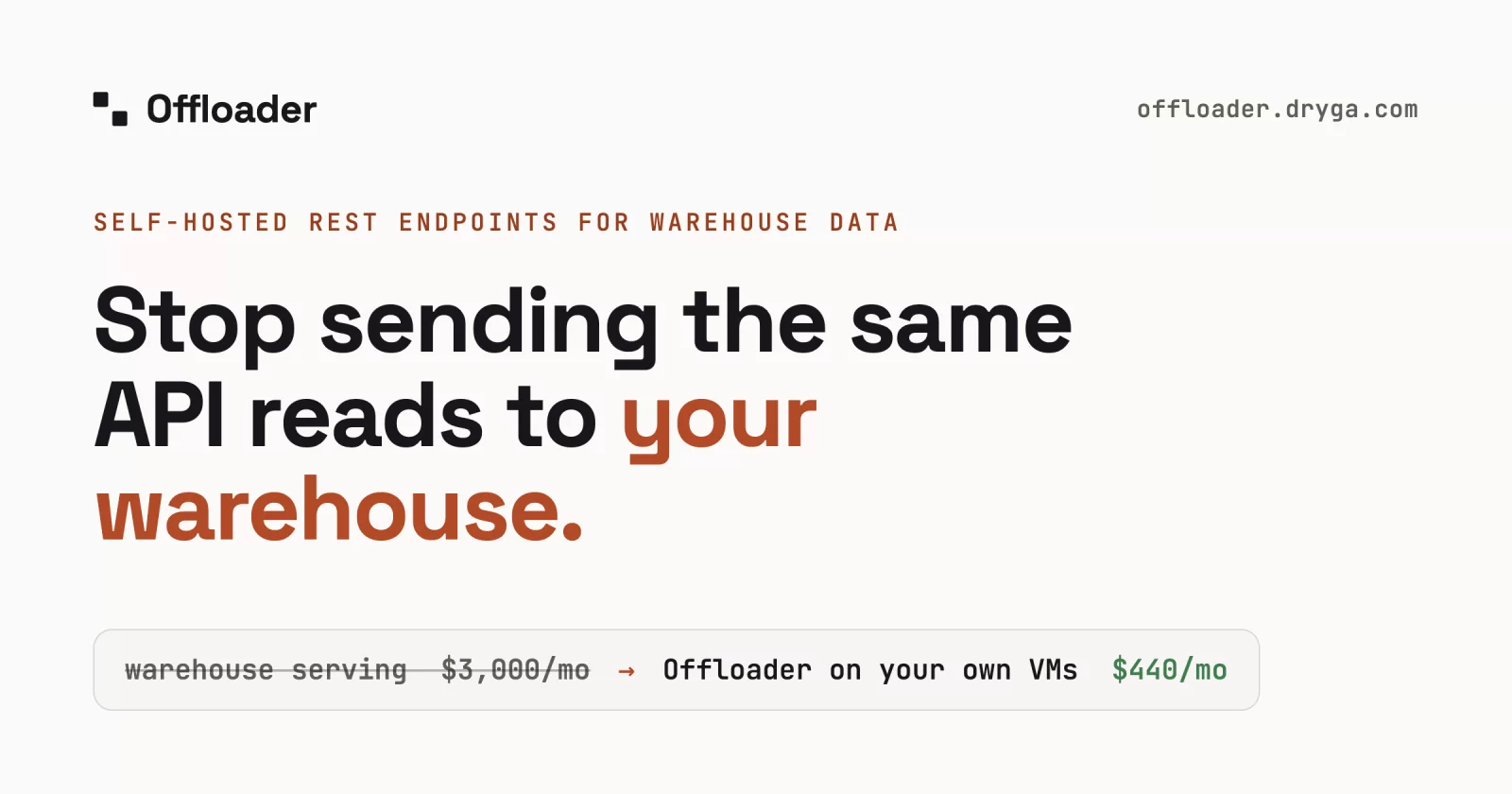

Self-hosted REST endpoints for product data your warehouse produces.
In plain terms: your warehouse computes data your product needs — usage meters, billing totals, leaderboards, recommendations, customer analytics. If your backend calls Snowflake, Databricks, BigQuery, or similar systems every time a user waits for that data, you pay warehouse cost and latency on every request.
Offloader lets your pipeline publish that data as snapshots, then serves named REST endpoints from those snapshots on your own servers. The warehouse builds the data once; your app reads it cheaply until the next snapshot is ready. New to the idea? Start with How Offloader works.
Offloader is a container you run. It reads approved Parquet/CSV snapshots from object storage, loads them into DuckDB, and exposes only the REST endpoints you configure. There is no Offloader cloud, and private data stays in your environment by default. An optional managed CDN edge can serve already-public data only; see serving public data.
Status: the server is feature-complete and validated against real production data. The commercial offer is a paid diagnostic plus offload pilot, not a broad data platform.
Documentation
New here → How Offloader works (the words and the mental model, no jargon).
Then, by what you want to do:
- Try it — Quickstart: run it against a bundled example in ~15 minutes, no cloud needed.
- Define your endpoints — Config guide: what the
offloader.yml+datasets//endpoints//keys/files look like. - Tooling — CLI reference: the optional
offloaderhelper, every command and flag. - Run it in production — Operator guide · Deployment.
- Serve it to AI agents — AI agents (MCP): the same endpoints over the Model Context Protocol, opt-in.
- Security — Security model: what's protected, and what you own.
- Cost case — ROI calculator · Benchmarks.
Deeper: Architecture · Release process.
Product boundary
Offloader is:
- A container you run for named, read-only product API endpoints over warehouse snapshots.
- A snapshot loader: it follows manifests, validates files and schema, and loads the active snapshot into DuckDB.
- A REST endpoint registry: URLs, params, API keys, tenants, and allowed columns live in config.
- Freshness, metrics, diagnostics, and before/after ROI reporting.
- A two-port service: one API port for product traffic, one admin/metrics port for customer-owned observability and access controls.
Offloader is not:
- A warehouse replacement.
- A BI tool.
- A dashboard refresh layer for internal BI.
- A general SQL workspace.
- A streaming database.
- An ELT/data modeling tool.
- A hosted cloud service.
- A control plane, RBAC system, or SSO provider.
What it replaces
Offloader is for the read path teams usually build by hand after product API traffic starts hitting warehouse-backed data:
- Product endpoints that query Snowflake, Databricks, BigQuery, or similar systems while a customer waits.
- Homegrown Redis/Postgres/DuckDB cache services without snapshot validation, rollback, generated docs, diagnostics, or safe swaps.
- A second serving database when the workload is read-only, fresh enough from snapshots, and a REST API is all your app needs.
- Tenant filters, endpoint allowlists, and column limits scattered across app handlers instead of enforced in one place.
What it does
The engineer's-eye view (the plain-language version is in concepts):
- Serve named, versioned REST endpoints over approved Parquet/CSV snapshots, materialized into DuckDB and swapped in atomically.
- Read snapshots from the local filesystem OR remote object storage —
s3://,gs://,https://via DuckDB httpfs, with S3/GCS-HMAC or GCS-OAuth-bearer credentials from env (never a request). - Boot fully stateless: point
OFFLOADER_CONFIGat ags://…prefix and the whole project (datasets, endpoints, keys) is fetched from the bucket at startup — config and data in the same place, nothing mounted. WithOFFLOADER_CONFIG_SYNC_INTERVALit also hot-reloads YAML config changes with zero downtime, blue-green even across a schema change. New data goes live when a dataset's YAML points at its new manifest, or when asource:finds a newer export. - Follow a producer that publishes on its own schedule: the Databricks
commit-protocol resolver discovers the latest
_committed_<tid>in GCS and refreshes per dataset. One slow or broken source does not block the rest; a warm restart serves the on-disk snapshot right away. - Enforce API keys, endpoint allowlists, compiler-inserted tenant filters, and column
allowlists — or run fully public (
auth: none, accepted only when no endpoint is tenant-scoped). - Serve nested
STRUCT/MAP/LISTcolumns as native JSON, and the same query ergonomics:combinations, per-param valuealiases, applieddefaults, and an allowlist-bounded?columns=subset. - Scale: a DuckDB read-connection pool + per-request serving in the caller process (~5–6k req/s cached, p99 < 60ms on 50KB nested payloads; validated at 66 datasets / 67 endpoints against a real production GCS bucket). Measure on your own data with the benchmark harness.
- Expose generated docs/OpenAPI + a client
/schema, Prometheus metrics (pool, refresh, per-endpoint latency), and redacted diagnostics on a separate admin port. - Optionally serve the same endpoints to AI agents over the Model Context Protocol
(revision
2026-07-28, and clients still on the olderinitializehandshake) atPOST /mcp— generated from the same registry, with the same key scoping and tenant filters, and no SQL surface. Off unlessOFFLOADER_MCP_ENABLED=true; see AI agents (MCP). - Preserve the previous good snapshot on refresh failure (
rollback), and ship a signed container image via CI on every version tag.
Runtime configuration
The primary product surface is the container plus environment variables. A standard deployment needs only:
docker run \
  -e OFFLOADER_CONFIG=/etc/offloader/offloader.yml \
  -e OFFLOADER_CACHE_DIR=/var/lib/offloader/cache \
  -e OFFLOADER_SECRET_KEY_BASE="$(openssl rand -base64 48)" \
  -v ./my-project:/etc/offloader:ro \
  -v offloader-cache:/var/lib/offloader/cache \
  -p 4000:4000 \
  -p 127.0.0.1:4001:4001 \
  ghcr.io/andrewdryga/offloader:<version>
The full env-var reference is in the config guide.
Repository layout
server/          Elixir/Phoenix self-hostable container: REST APIs, auth,
                  tenant enforcement, env-driven config, manifest refresh,
                  DuckDB materialization, admin/metrics port
tools/            Optional helper CLI (docs/cli.md): project scaffolding, config/
                  manifest validation, local serve for POCs, key minting,
                  diagnostics, endpoint tests, support bundles, ROI report
deploy/           Container deployment notes and examples; no managed cloud scaffold
docs/             Product, architecture, security, operations, and release docs
examples/         Local demo manifests, endpoint configs, and sample datasets
dev/              Local verification, benchmark, and deployment-check scripts
legal/            Contracting templates (diagnostic + pilot SOW) — fill per deal
Project status (for contributors)
The development gate is:
make check        # format, warnings-as-errors, tests, docs drift
make e2e          # manifest -> HTTP smoke
make deploy-check # build the prod image, boot it, verify both ports
License
Offloader is source-available under the Business Source License 1.1 (BSL 1.1).
In plain terms: you may read, modify, redistribute, and self-host it, and run it in production
free of charge if your organization and its affiliates had combined gross revenue under $1M
in the most recently completed fiscal year. At or above $1M,
production use needs a commercial license (that's the paid engagement). The license in this
revision specifies July 6, 2028 as its Change Date and Apache-2.0 as its Change License.
Check the LICENSE shipped with the version you use; change dates can vary by version.
You keep your container, your data, and the full source.