 RemainderBot
Your Claude or Codex subscription resets every week, and whatever quota you didn't use is gone. RemainderBot notices when a reset is a few hours away with quota left, and spends it on finished, easily reviewable pieces of work: pull requests in your own private repo.
Why I built it and how I use it: RemainderBot: My part-time assistant runs on tokens I was going to waste.
One run, illustrated, for a made-up founder's dog-grooming scheduler. The real run it's drawn from is in examples/groomer-time-off, with its pull request, plan, and patch. Three more runs, including a rejected one and the run that redid it from the rejection note, are in examples/.
How it works
- Trigger. An hourly cron job reads each CLI's own quota numbers. When the weekly reset is less than 4 hours away and at least 10% is left, it runs. (DESIGN.md §2)
- Select. The agent reads three things. A fresh snapshot of your sources (the task
lists, issues, docs, and notes you already keep) supplies the candidate tasks. Your
GOALS.mdsays which of those matter and in what order, since your sources mix errands with real work and don't rank anything. The verdicts on past runs keep it from repeating itself. It picks one task, checks that the task isn't already done, and commits a plan before building anything. (§3) - Build. It works against a hard deadline set from the reset time, sized to the quota left: a document, a feature with tests, or a prototype. (§4)
- Finish. If the run ends without a done marker, a short finalize pass may only cut scope and write up what works, never add to it.
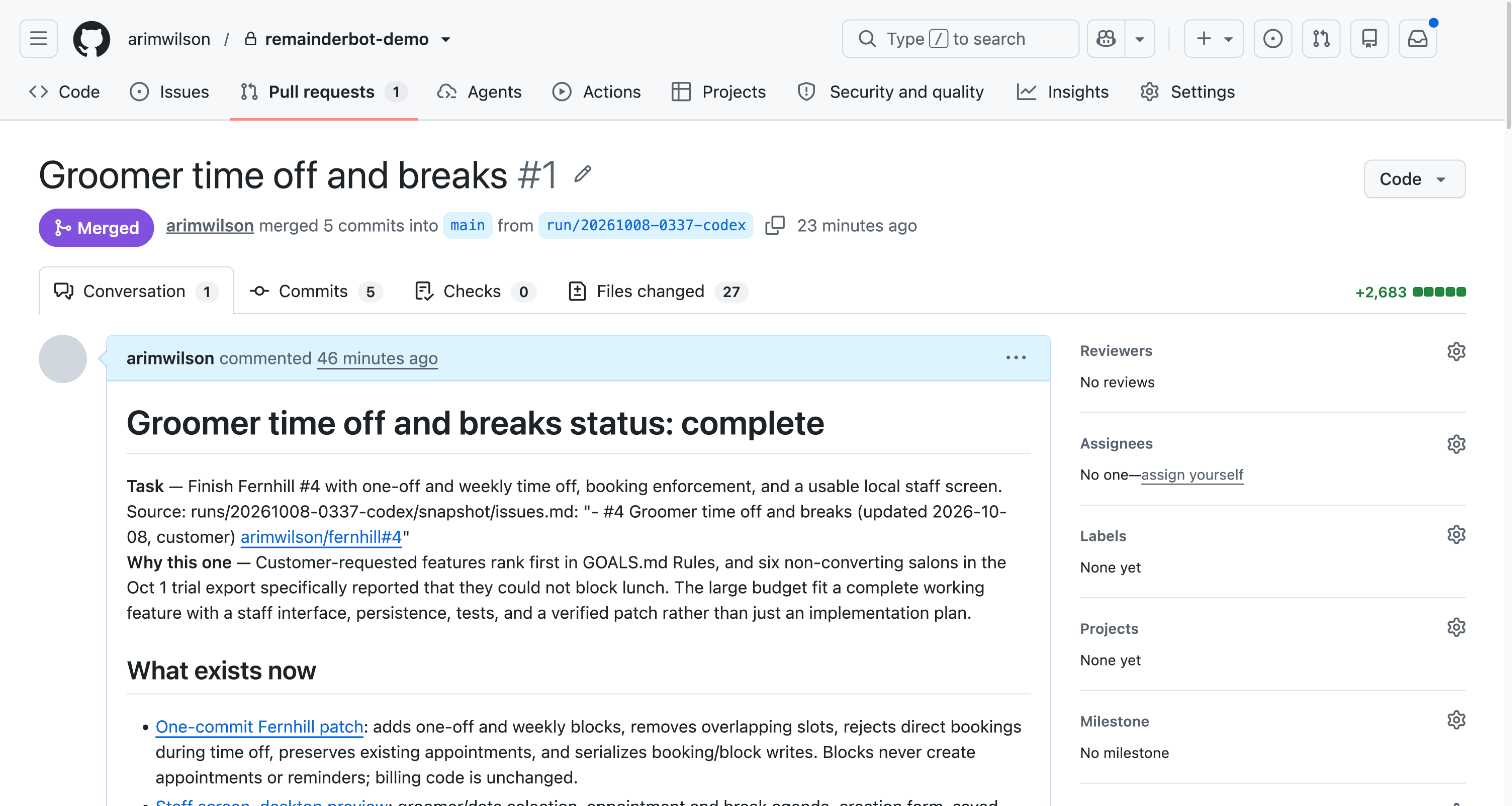
- PR and feedback. Every run opens a PR whose body says what was built, how it was verified, and the one step that ships it. Merge means approved; close with a comment means rejected, and the next run reads your comment. (§5)
What you need
- A dedicated machine, such as a small VPS. The agent runs there with every permission check off, so that machine is the sandbox (see Security).
- Python 3.11 or newer,
git, andgh. - Claude Code (
claude) and/or the Codex CLI (codex), logged in with a subscription. gws, only if you use Google Tasks or Docs as sources.
RemainderBot is a small Python package with no dependencies outside the standard library.
Set up your private instance
Every instance is a private repo. A run branch carries a copy of everything the agent read and its whole log, so the code refuses to publish to a public repo (Privacy).
On your own computer (anywhere gh can create a repo):
git clone https://github.com/arimwilson/openremainderbot.git remainderbot
cd remainderbot
git remote rename origin upstream
gh repo create remainderbot --private --source . --remote origin --push
cp -n GOALS.example.md GOALS.md
cp -n sources.example.toml sources.toml
Don't fork. A GitHub fork of a public repo can't be private. Don't use "Use this
template" either: a template copy has unrelated history, so your first update would
conflict on every file. A clone with upstream as a second remote gets updates with a
plain git merge (Updating).
Edit GOALS.md and sources.toml (the next two sections), then commit and push them:
git add GOALS.md sources.toml
git commit -m "My goals and sources"
git push
The bot creates INBOX.md and state.json itself.
Tell it what matters
Your sources say what could be done; GOALS.md says what should be. Of everything a
run reads, it's the only thing you write for the bot (sources.toml just points at
things you already keep), and every run reads it first. GOALS.example.md is a complete
example for a made-up founder. It has four sections:
-
Priorities: what the work is for, in tiers. A modest artifact in a high tier beats an impressive one in a low tier.
-
What to take off my plate (optional): the work you would hand to an assistant, and the work you'd rather keep.
-
Rules: your additions to the defaults built into the prompt. The defaults are: no errands, drafted never sent, one action to ship, no repeats, and nothing that needs your credentials to verify. For example:
## Rules - Prefer, in tier order: (a) issues labeled `customer`; (b) newsletter drafts from my outline notes; (c) anything in the repos' TODO files. - Never change billing code; I write every change there myself. -
Manual goals: one-off requests. An open one outranks everything else.
Edit it whenever you like and push. Each tick pulls main first.
Connect your sources
sources.toml says what the snapshot reads. Each [[sources]] table becomes
goals/snapshot/<name>.md, written by the adapter its type names:
version = 1

[[sources]]
name = "issues"
type = "gh-issues"
owner = "your-github-user"

[[sources]]
name = "todo"
type = "file"
paths = ["~/notes/TODO.md"]

[[sources]]
name = "notes"
type = "gh-markdown"
repo = "your-github-user/notes"
private = true            # nothing drawn from it goes into anything meant for publication

  [[sources.parts]]       # belongs to the [[sources]] table above it, however it's indented
  include = "projects/*.md"
  sections = ["Open questions", "Next"]
| Type | Reads |
|---|---|
gws-tasks |
open Google Tasks |
gws-doc |
a Google Doc, as Markdown |
gh-issues |
open GitHub issues across an owner or a list of repos |
gh-roadmaps |
each repo's README head plus its TODO/ROADMAP/PLAN files |
gh-markdown |
chosen sections, frontmatter, or whole files from a repo of Markdown |
file |
local files, by glob |
command |
the stdout of any command: an export from Linear, Notion, or your own script |
Every field, each adapter's output, and the access each one needs are in
docs/sources.md. A source whose fetch fails keeps its last content
under a stale: header; the others still refresh.
Try it
Do this on the machine that will run the bot. A run there has full access, and that is by design. Install the CLIs, then log in to each one as the user the bot will run as:
gh auth login            # see Security for a least-privilege token
gh auth setup-git        # lets git push over HTTPS with that login
claude                   # log in with your subscription, then exit; and/or: codex login
gws auth login --readonly -s tasks,docs,drive    # only for gws-* sources

gh repo clone your-github-user/remainderbot ~/remainderbot
cd ~/remainderbot
Then:
python3 -m remainderbot doctor
python3 -m remainderbot snapshot          # writes goals/snapshot/*.md; read them
python3 -m remainderbot decide --dry-run  # what the trigger rule would do now; claims nothing
python3 -m remainderbot run --provider claude --deadline-minutes 20 --size small
doctor prints one line per check and exits nonzero if any check fails. It checks:
- the CLIs, their logins, and whether it can read your quota;
- that
sources.tomlis valid andGOALS.mdis no longer the example; - that your edits are committed;
- that
originis private and accepts a push (agit push --dry-run, which creates nothing).
run launches a real agent session on a branch run/<id>. That spends real quota: a
small run typically uses a few percent of the week and much of the 5-hour window. When it
ends, run goes back to main. Nothing is pushed unless you add --publish. To read
what it made:
git show run/<id>:runs/<id>/README.md
git checkout run/<id>     # look around, then: git checkout main
Install on a server
Run crontab -e and add two lines:
PATH=/home/you/.local/bin:/usr/local/bin:/usr/bin:/bin
0 * * * * cd $HOME/remainderbot && RUN_DISABLED=1 python3 -m remainderbot tick >> $HOME/remainderbot.log 2>&1
Cron's own PATH is only /usr/bin:/bin. For the PATH= line, paste the output of
echo $PATH from your login shell, since cron does not expand variables there.
RUN_DISABLED=1 makes each tick log its decision without running anything. Each hour
the log should show something like this:
2026-10-08 02:00:01Z tick start
2026-10-08 02:00:07Z snapshot issues.md: ok
2026-10-08 02:00:08Z usage: claude 5h 3% / weekly 41% used; codex 5h 0% / weekly 12% used
2026-10-08 02:00:08Z claude: weekly reset in 51.2h (> 4.0h window), 59% left
2026-10-08 02:00:08Z codex: weekly reset in 101.7h (> 4.0h window), 88% left
2026-10-08 02:00:08Z skip: no provider eligible
2026-10-08 02:00:08Z tick end
Inside the window, the tick logs RUN_DISABLED=1: would run now instead. After a day of
clean ticks, take RUN_DISABLED=1 off the crontab line.
Review runs
- The PR is the notification. The bot opens PRs with your
ghlogin, and GitHub doesn't email you about your own actions by default. Turn on Include your own updates in GitHub's email notification settings, or give the bot its own account. - Each run's README (the PR body) says what exists now, how it was verified, and your
one next step: merge,
git ama patch, paste a draft, or run one command. The work itself is inruns/<id>/artifact/, or inartifact.patchwhen it belongs in another repo. - Merge means approved. Close means rejected. The last PR comment or review is the note the next run reads, so before you close a PR, say what should change.
INBOX.mdis the ledger onmain: one row per run, with its status and your note. Each tick updates it from the PRs, and the agent reads it so it never repeats a task. Steer the bot throughGOALS.mdand PR comments, not by editing INBOX.md.
Privacy
| Data | Where it goes | Who can read it |
|---|---|---|
| Your sources | read by gws, gh, local files, or your command |
unchanged |
goals/snapshot/ |
the server's disk; gitignored on main |
the server |
runs/<id>/snapshot/, PLAN.md, log/ |
committed on the run branch | anyone with read access to your instance repo |
The PR and INBOX.md |
your instance repo | same |
| The agent's session | Anthropic or OpenAI, as with any Claude Code or Codex use | the provider |
- The public-repo guard. Before the first push in a process,
gh repo viewmust say that every URLoriginpushes to is private (or internal). If it can't tell, the push is refused and tried again next tick.tickchecks this right after its pull, before it syncs or runs anything, so a public instance never spends quota.ALLOW_PUBLIC_REPO=1turns the guard off; use it only for a repo meant to be public, with sources that are all public. privatesources. The worker prompt names every source markedprivate. Nothing drawn from them may go into anything meant for publication (a post, a landing page), and each run's README says which sources it used.
Security
The agent runs as claude --dangerously-skip-permissions or codex --dangerously-bypass-approvals-and-sandbox. It can read any file the bot's user can
read, run any command, use any credential on the machine, and reach the network. The
prompt forbids pushing anywhere but your instance repo, sending mail, deploying, and
spending money. A prompt is not a sandbox, though: the machine is. Set it up so that
the worst thing a confused agent could do is small:
- A dedicated machine, and a dedicated non-root user on it.
- A fine-grained GitHub token for
gh auth loginwith only the instance repo selected, and Contents and Pull requests set to read and write. Fine-grained tokens can always read every public repo, so public sources need nothing more. - Know what a private source repo costs. Every
gh-*source reads with that same login, and a fine-grained token gives the same permissions to every repo it selects, all owned by one user or organization. A private source repo therefore has to be selected in that token (with Issues read added forgh-issues), which lets the agent write to it too. A private repo with a different owner than the instance repo can't be read at all. (A classic token spans owners, but itsreposcope writes to every private repo you can reach.) If that is too much, keep such repos out ofsources.toml. - Read-only Google scopes (
gws auth login --readonly), and only the services your sources use. - No other credentials on the box: no SSH keys to other machines, no cloud CLIs, no password manager.
What RemainderBot itself reads, and where it sends it:
- Claude quota. It reads Claude Code's OAuth token from
~/.claude/.credentials.json(or the macOS keychain, orCLAUDE_OAUTH_TOKEN). It sends the token only toapi.anthropic.com, to read your quota. - Codex quota comes from
codex app-server. RemainderBot never reads Codex's credentials. - Everything else goes through the CLIs:
gh,gws,claude,codex,git.
Updating
On your own computer:
git fetch upstream
git merge upstream/main      # or a release tag: git merge v0.2.0
git push
The server picks up the update at its next tick: the tick pulls main and restarts
itself on the new code. Before merging, read CHANGELOG.md: any entry
that needs an edit to GOALS.md or sources.toml has an Action required section.
doctor reports how many commits behind upstream you are.
Commands
python3 -m remainderbot doctor                # is this instance ready to run? exits 1 on a failure
python3 -m remainderbot usage                 # normalized quota JSON for each provider
python3 -m remainderbot decide --dry-run      # what the rule would do right now
python3 -m remainderbot snapshot [--source NAME]
                                              # refresh goals/snapshot/; --source refreshes only that one
python3 -m remainderbot run --provider claude --deadline-minutes 20 --size small [--publish]
                                              # one run with an explicit budget; --publish also
                                              # pushes, opens the PR, and writes the INBOX.md row
python3 -m remainderbot sync-inbox            # copy PR state and last comments into INBOX.md
python3 -m remainderbot tick [--no-snapshot]  # what cron runs: sync, snapshot, decide, run, publish
python3 -m unittest discover -s tests         # the tests; no network
run needs a clean tree (tracked files unmodified). Ticks never overlap: a tick that
finds another still running logs skip: previous tick still running.
Configuration
Environment variables, set on the crontab line or as NAME=value lines above it:
| Variable | Default | Meaning |
|---|---|---|
WINDOW_HOURS |
4 | run only when the weekly reset is this close |
MIN_REMAINING |
10 | percent of the weekly (and the 5-hour) quota that must be left |
MAX_RUN_MINUTES |
45 | cap on a run; deadline = min(reset, now + cap) − 15 min |
MIN_RERUN_MINUTES |
20 | after a run that finished, run again in the same period only if this much time is left |
PROVIDERS |
claude,codex |
which providers to read and run |
REPO_DIR |
the checkout containing the package | where GOALS.md, state.json, and runs/ live |
SOURCES_FILE |
sources.toml |
what the snapshot reads; relative to REPO_DIR |
RUN_DISABLED |
unset | log the decision and stop without claiming the period |
ALLOW_PUBLIC_REPO |
unset | push and open PRs even when origin is public |
AGENT_FULL_ACCESS |
1 | pass the bypass-permissions flags to the CLI; with 0, Codex's sandbox makes .git read-only and the run's commits fail |
CLAUDE_MODEL / CODEX_MODEL |
claude-opus-5-5 / gpt-6-astra |
models (DESIGN.md §4.4) |
CLAUDE_FALLBACK_MODEL |
claude-sonnet-5-5 |