

Session Orchestrator
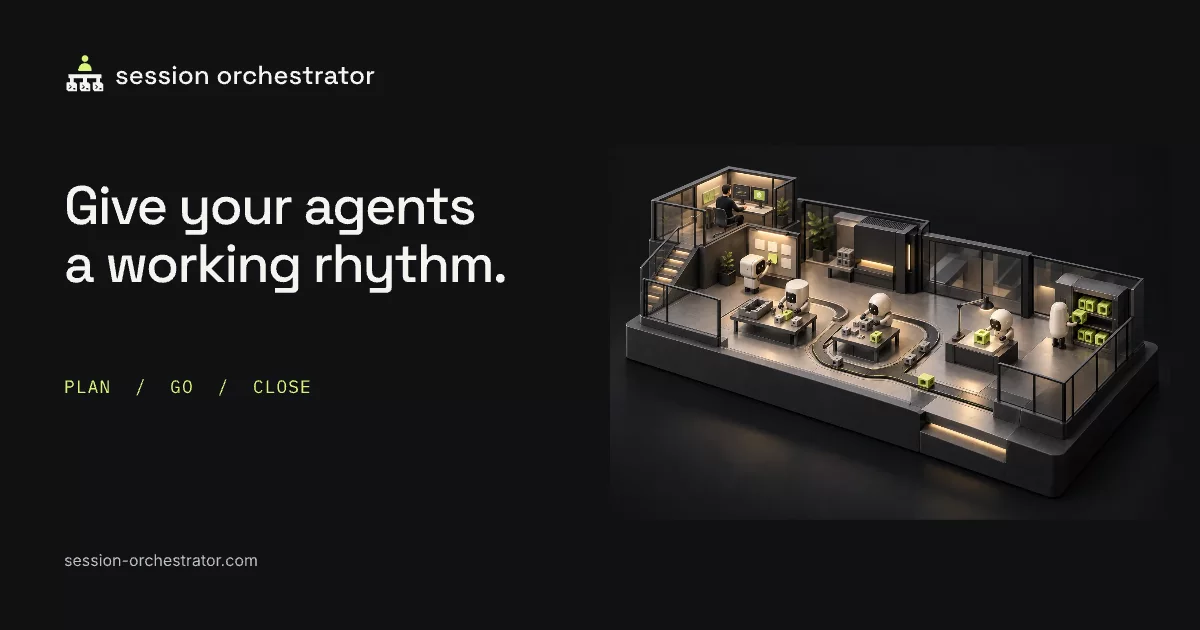
Your coding agents get an agreed plan, a check after each round of changes and a handover to the next session.
A free, MIT-licensed workflow plugin for people running Claude Code, Codex CLI, Cursor IDE or Pi on a git repository. It runs on your machine and writes plain text into your repository: no account, no server.
Website (Deutsch) · Commands · User guide · Changelog
Beta: 15 free seats in the agenticbuilders Pass for Session Orchestrator users. You learn to get real work done with Claude Code and agents. In return you tell me for 14 days what helped. Want a seat? agenticbuilders.at/so



Install
You need Node.js 24 or later and a git repository. In Claude Code:
/plugin marketplace add Kanevry/session-orchestrator
/plugin install session-orchestrator@kanevry
Codex CLI, Cursor IDE, Pi, upgrade and uninstall: docs/install.md.
How it works
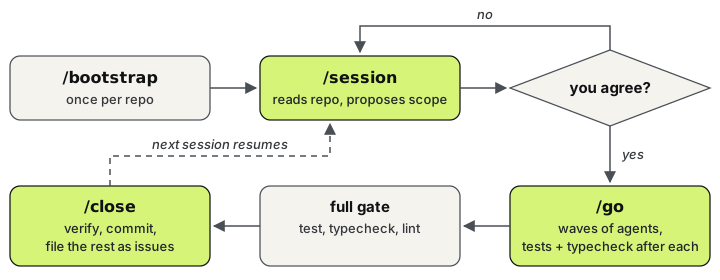
/sessionreads your repository, your open issues and the last session, proposes what to work on, and waits for your correction. Nothing changes in your code until you agree./goruns the agreed work in waves: rounds of parallel agents, each with its own list of files. Your tests and typecheck run after each wave; failures become fix tasks for the next one./closeruns the full test, typecheck and lint gate, checks every planned item against what happened, commits, and files the rest as GitLab or GitHub issues.
| Without it | With it |
|---|---|
| You paste your working rules into every session | /session reads git, issues and the last session first |
| Two agents edit the same file | Each agent gets a declared file list; overlaps are rejected |
| "Done" before the tests ran | Tests and typecheck run after each wave |
| A crash loses the plan | Progress is written down after each wave; the next /session offers to resume |
First session
- Run
/bootstrap --fast --no-interviewonce in your project. It adds a short config block to your instruction file (CLAUDE.mdorAGENTS.md). - Set the three gate commands in that block to what your project uses, for example
test-command: npm test,typecheck-command: npm run typecheck,lint-command: npm run lint. Every other key is optional (reference). - Run
/session featureand describe the task. Correct the proposed scope, then run/goand, when the work is done,/close.
On Codex and in headless Claude Code (claude -p) some command names differ: Codex · headless.
What do you want to do?
| Situation | Type | You get |
|---|---|---|
| A new project idea | /plan new |
Research, decisions, a PRD and issues (works out of the box; uses your baseline when configured) |
| A feature that is not clear yet | /plan feature |
A bounded plan with acceptance criteria |
| A feature that is clear | /session feature, then /go, then /close |
The agreed change, checked, committed, leftovers as issues |
| A big or unclear change | /session deep |
It looks first, then builds |
| Tidy up | /session housekeeping |
A short maintenance pass |
| Look back on a phase | /plan retro |
What worked, what to change |
| The same mistakes keep coming back | /evolve, then /reconcile |
Lessons you approve become rules |
All 31 commands, by situation: session-orchestrator.com/commands
It learns, with your yes
/evolve suggests lessons from your own session records; /reconcile turns the ones you approve into rule files that later sessions load. It never trains a model and never changes itself without your approval (how it works).
Add-on: lead-session-orchestrator
Running three or four sessions side by side? lead-session-orchestrator adds one lead session above them that decides which one goes next and puts their questions into one queue for you. It is a separate npm package; details and caveats: docs/install.md.
User guide · Install · Components · Telemetry (off unless you turn it on) · Contributing · Security · Issues · MIT · Privacy · npm · All docs
Provided as-is: a community project with best-effort maintenance and no SLA. Independent, and not affiliated with or endorsed by Anthropic, OpenAI or Cursor. The method is taught at agenticbuilders.at; the plugin is free and does not need the courses.