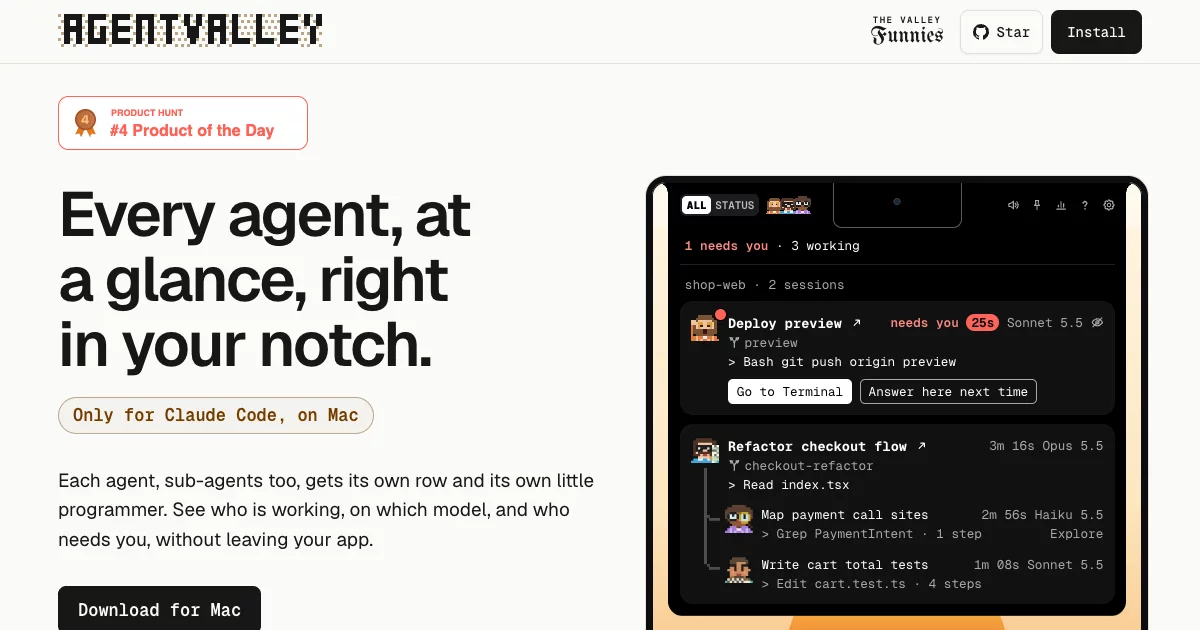



Every agent, at a glance, right in your notch.
A small valley of programmers in your Mac's notch. Each Claude Code agent, sub-agents too, gets its own row and its own little programmer.

agentvalley.app · Comics · Sponsor the crew
Only for Claude Code, on Mac · Free · Open source · macOS 15 or later · With or without a notch
Five agents running. Which one is waiting for you?
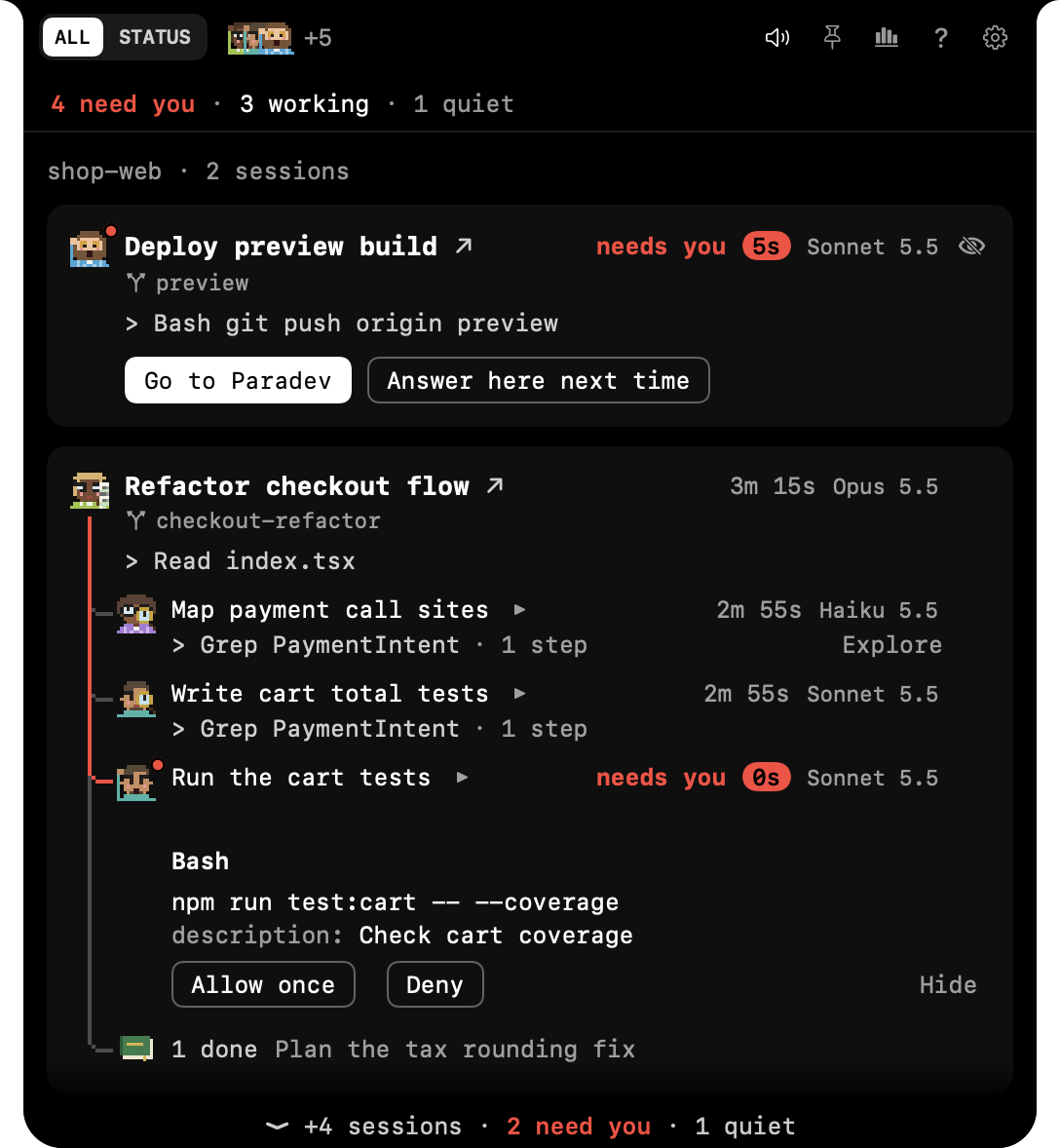
Each agent reports in its own terminal, line by line. Run a few sessions at once and you end up switching windows just to check on them. AgentValley puts all of them in one panel under the notch. See who is working, on which model, and who needs you, without leaving your app.
Try it
1. Install. Download for Mac. Open AgentValley.dmg and drag AgentValley into Applications. macOS asks once if you want to open an app from the internet: choose Open.
Or with Homebrew:
brew install --cask morsechimwai/tap/agent-valley
2. Open it from Applications. The panel opens once to show where it lives.
3. Point at the notch. The panel opens with a row for every agent. When one needs you, a red count appears beside the notch and its programmer waves. Click a row to jump to that agent's app. From any app, ⌃⌥⌘A opens the panel too: arrows to pick, Return to jump.
Signed, and Apple checked our papers. Needs macOS 15 or later and Claude Code. Made for the MacBook notch. No notch? We sit at the top of your main display.
Once an hour we check for a new version, and we ask before we install it. A green dot on the gear means one is waiting.
We moved house in 0.2. On 0.1 from Homebrew? Run brew uninstall --formula agent-valley, then install again as above. Using the plugin? Copy its command from Settings once more, so it finds the new address. Put the crew in your terminal? Run its install command from the Claude Code settings once more too.
Remove
First take out what you added yourself:
- The plugin:
claude plugin uninstall notch-answers@agent-valley && claude plugin marketplace remove agent-valley - The crew in your terminal: the command under How to take it out, in the app's Claude Code settings.
Then quit the app and move it from Applications to the Bin, or run brew uninstall --cask agent-valley. Your History stays in ~/Library/Application Support/AgentValley until you delete that folder.
What you get
Every agent gets a row
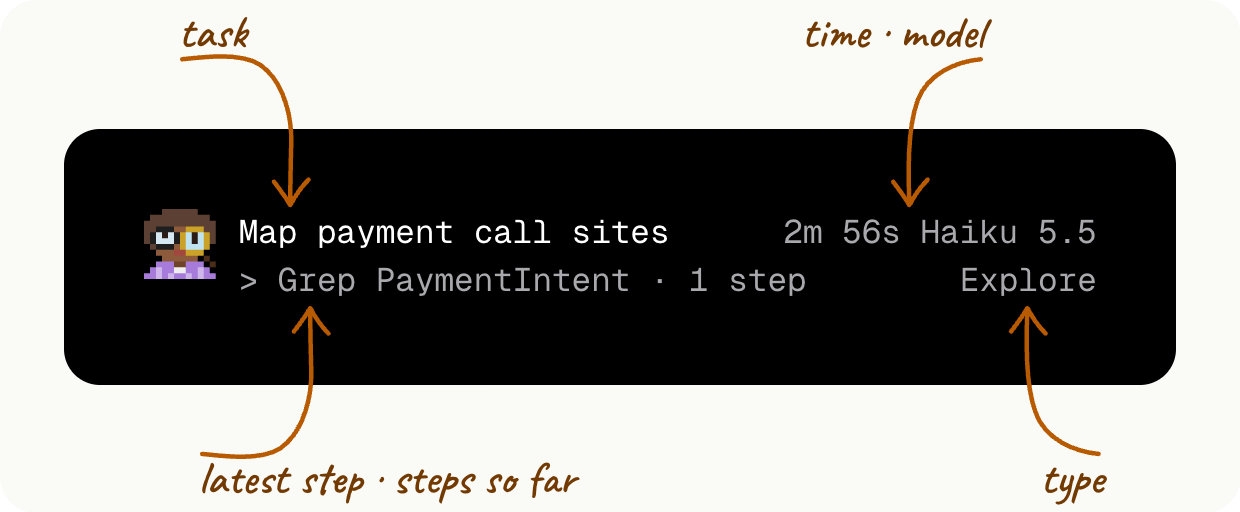
Sessions get a card, and the sub-agents they start get rows under it. Each row shows the task, the model and the latest step, and sub-agent rows count their steps too. Every session sits in one list, whichever terminal it runs in, grouped by project. Worktrees count as their project. Run more sessions than the panel fits and they fold to one line each, quiet ones first. One that needs you never folds. No guessed progress bars: if an agent goes quiet, AgentValley says so.
Pixel lines run from the lead to each sub-agent, and turn red when one waits on you. The triangle on a working sub-agent's row opens Asked: the whole prompt its lead gave it. When one finishes, it goes into a green book on its session's row, which says how many are new. Click the book to open it: each sub-agent that handed something back is a document named like a .md file after its task, with who wrote it, how long ago and its first two lines. Read all shows what it was asked and everything it handed back, Markdown as written with its marks drawn faint. Shut the book and they all fold away.
Know the moment one needs you
When an agent asks a question or waits for permission, a red count appears beside the notch. Open the panel to read the question or the command. Each one that waits gets a red badge with how long it has waited, and past a minute the longest wait shows beside the notch too. On the STATUS tab the longest wait comes first. If a question you can answer sits further down the list, the line at the bottom says so: 1 to answer here.
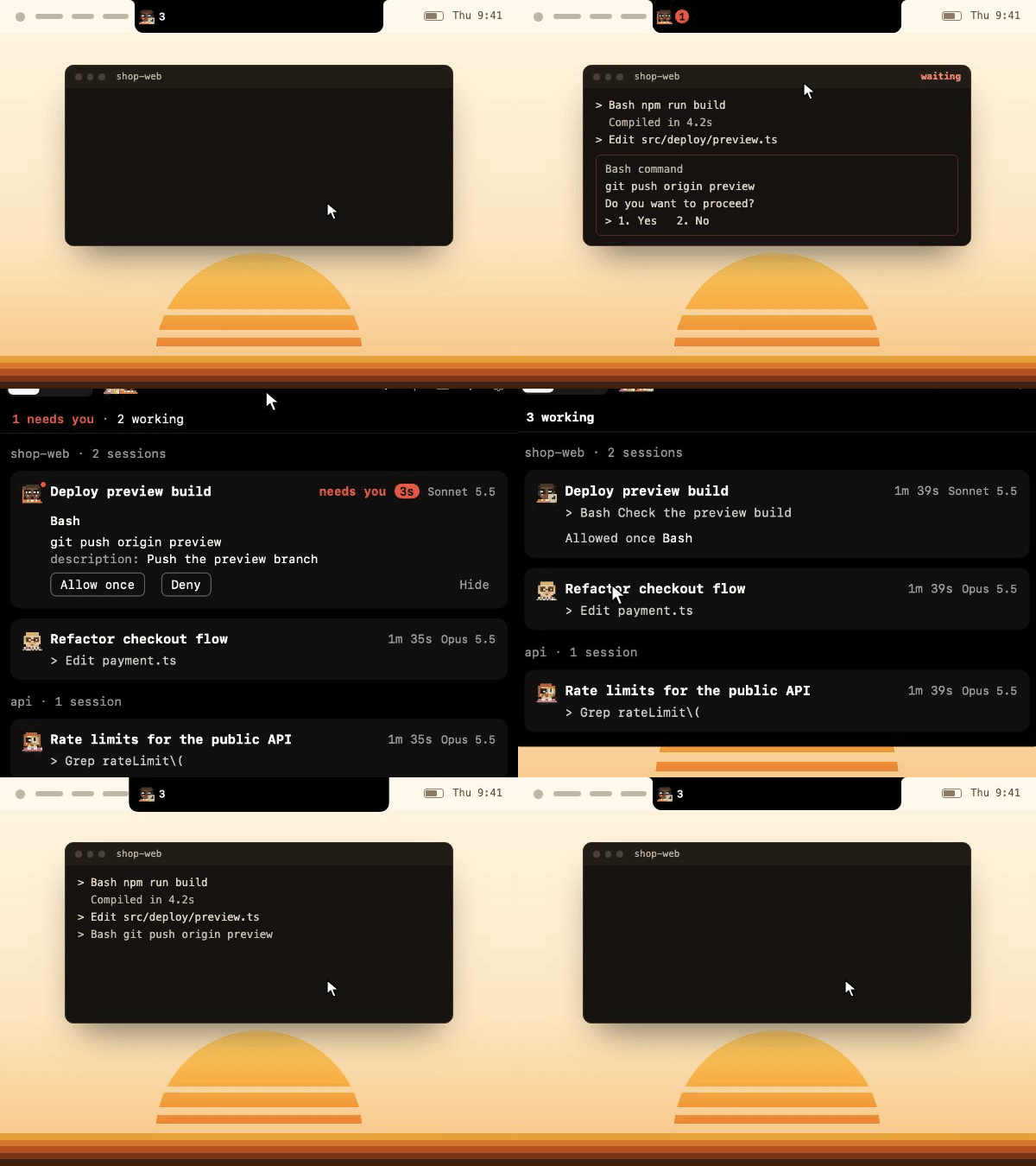
- Jump to its app in one click. Turn on Go to the session's tab in the Shortcuts settings, and Terminal and iTerm2 open the exact tab. Ghostty does too, unless two sessions run in the same folder.
- Answer from the notch. Allow once or Deny, using a plugin that comes with the app: press Install the plugin in the Claude Code settings (or run the command it shows in a terminal), then start Claude Code again. Until it's in, every session that waits on you has a button that takes you there.
- We talk. With sounds on, whoever runs the session plays a few notes on their own instrument and says what it needs: a command, an edit, a question, a plan. When the work is done you hear that too, with a different line after a long session, late at night, or for the first one of the morning. Rather have the instruments alone, or a plain chime? Settings has both. Sounds are on from the start, and the speaker button at the top of the panel turns them off, mid-word. We go quiet while your screen is locked.
See what each project cost
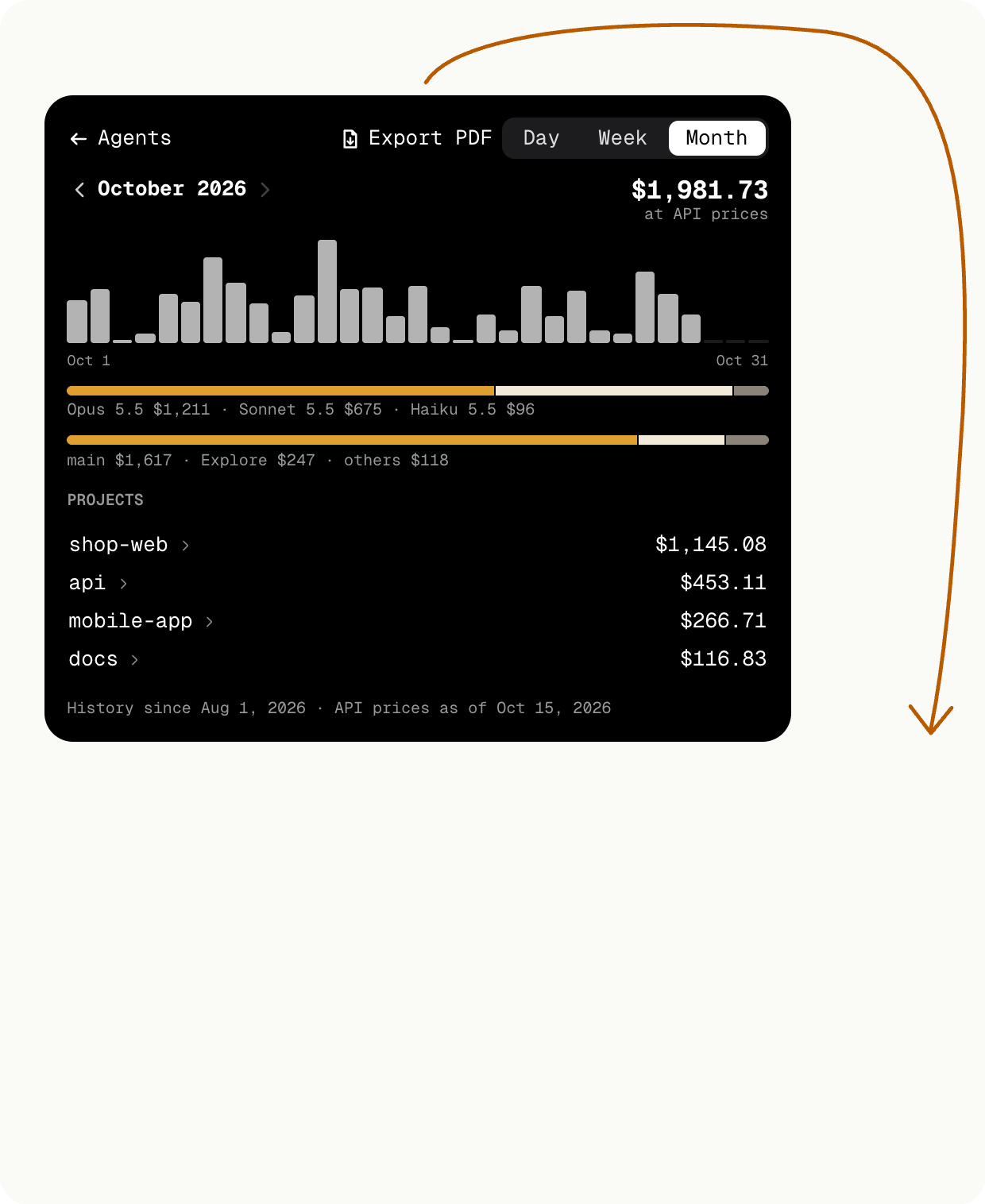
Open History from the chart button at the top of the panel. Pick a day, a week or a month, at API prices. It stays on your Mac, even after Claude Code clears its old files. Export PDF writes a statement of work: every project for you, or one project for your team or a client. A project you move or rename keeps its history, and two folders that share a name stay two projects.
The crew in your terminal too
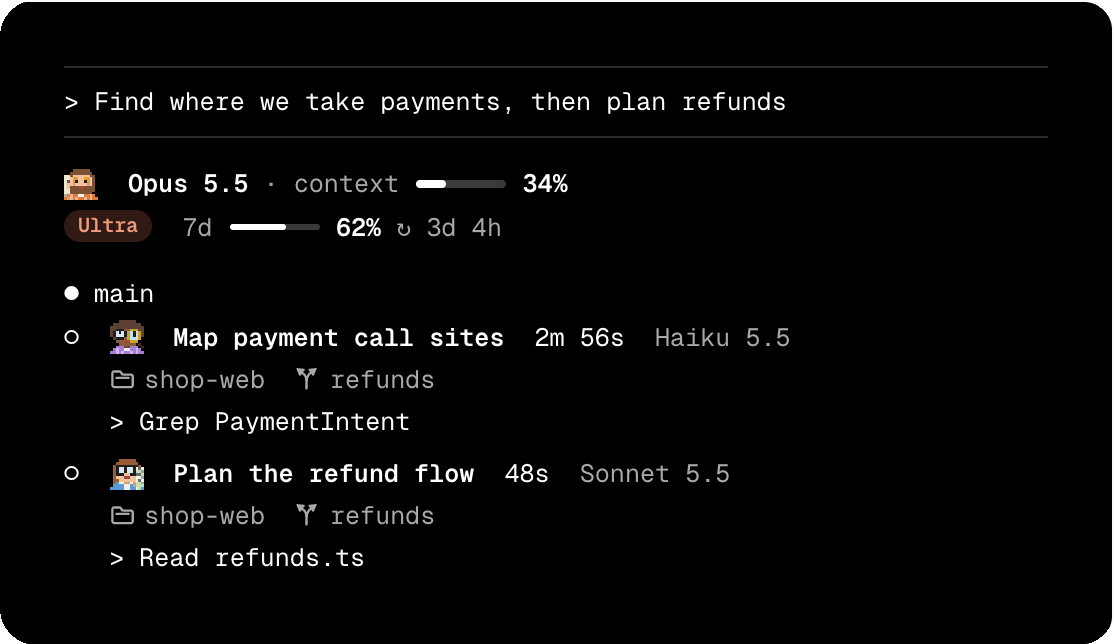
Claude Code's status line gets the face of whoever runs the session, with the model, your plan and your limits. Each sub-agent row under the prompt gets its own face, its model, the step it's on, and the notch's own marks for its folder and branch. Send three or more of us and we each take one line, so nobody drops off the bottom. We hold the same things there as in the notch, but we keep still. Until your first prompt only a coffee waits there, on standby, and when a limit runs out we go fishing, or take the van. One command from the app's Claude Code settings sets it up. With the app closed your limits still show, and the coffee waits. We travel as a font, and we've been seen in Terminal, iTerm2, Ghostty and Cursor.
Also in the panel
- Plan limits. Your Claude 5-hour and weekly limits, with time left until reset. Off until you turn it on. When one runs out we go fishing, or take the van for the weekly one, and a sign says when we're back.
- Token use. Tokens for the last 5 hours and today, with a 12-hour chart.
- Task list. When the lead keeps a task list, its card shows it under the step it's on, in Claude Code's own marks: ✓ done, ■ under way, □ to do. Past five tasks the done ones fold into one line. The list goes once everything is done.
- Jobs left running. When an agent leaves something running in the background, a green screen sits beside the coffee on the bar until it ends. A dev server, or anything else serving on a port, gets a small server sending out waves instead. The session's card lists each one and how long it has run: a screen for a command, a server for a port, an eye for a Monitor. After half an hour they stop and dim.
- Another display. MacBook off to the side, big screen in front? Settings › General › Display moves us to the top of the big one, on any display plugged into your Mac. Unplug it and we go back to the notch. Asked for in issue #1.

Meet the crew
We're seven programmers from a computer room in 1969. We build things because we can't stop, not because anyone told us to. After work there's beer and a stack of records, and a smell in the room the janitor stopped asking about a long time ago. Now we live in your Mac's notch.
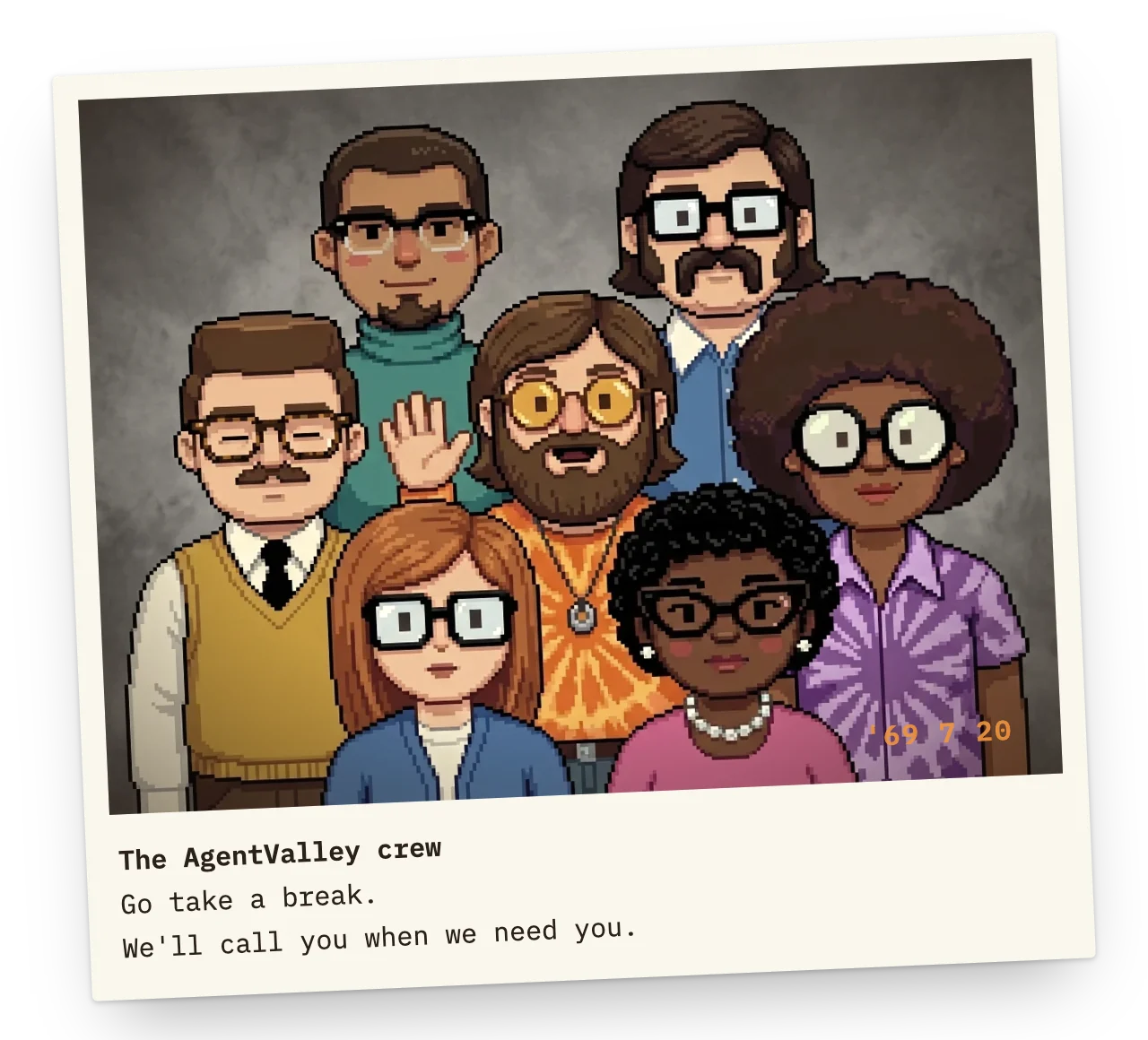
Sunny, Walt, Norm and Pearl run sessions: start Claude Code and one of them takes it. Each project gets a regular, the same one of us every session. Open a second session there at the same time and a colleague takes it, since nobody is in two places at once. Judy, Faye and Felix take the sub-agent jobs a session hands out.
In Claude Code we call each other by name. Norm hands a search to Faye with “Faye takes the search. Sending it now.” and Faye brings it back with “Norm, two call sites, no surprises.” We each talk in our own voice, in the language you write in. Your code, commits and files stay exactly as they would be without us. It comes with the plugin, from your next session on. Crew names in Claude Code, in the Claude Code settings, turns it off.
 | Sunny, the guru · runs a session Yoga at sunrise, then code until the sun goes down again. He believes every bug came to teach him something. When he waves, an agent is waiting for you. |
 | Walt, the walrus · runs a session Friday nights he plays bass in a garage band. A neighbour once asked about the smoke coming out, and Walt said it was a barbecue. Nobody has seen the grill yet. |
 | Norm, the engineer · runs a session The only one of us who irons his shirt for work. He came over from a rocket launch control room and gets through a science fiction novel a night. He blinked in the team photo, and he says he meant to. |
 | Pearl · runs a session She knows the computer better than the people who built it. Detective novels taught her to hunt bugs from the last page back. The pearls stay on, even when she crawls under the machine. |
 | Judy · the Plan sub-agent Nobody touches a keyboard until Judy has the plan on paper. In the evenings she plays folk guitar by the campfire, mostly songs she wrote about flowcharts. |
 | Faye · the Explore sub-agent Faye reads every file until she finds the one you meant. On weekends she disappears into the desert and always comes back with new ideas. What she found out there, she has never said. |
 | Felix · the General-purpose sub-agent Any job without a name goes to Felix. On Thursday nights he reads poetry in a basement coffeehouse, and he plays the bongos while the machine runs. For every other kind of sub-agent he turns up in a different shirt. |
How to read us
How we stand tells you how the agent is doing.
 Working we blink |
Needs you we wave |
 Quiet we look away |
 Done our eyes close |
 Nothing running a cup of coffee |
While the agent works, we hold what it's on. Six seconds in hand, two to put it down.
 Thinking chin in hand |
 Read a printout |
 Edit a keyboard |
 Bash a terminal |
 Grep a magnifier |
 Agent on the phone |
One session from start to finish: Sunny adds a Pro paywall to an AI meeting notes app. He phones Faye and Judy for help, Felix writes the tests and runs them, and Sunny builds the paywall himself.

The Valley Funnies
Between sessions we draw comics about the job. This one is about lunch.
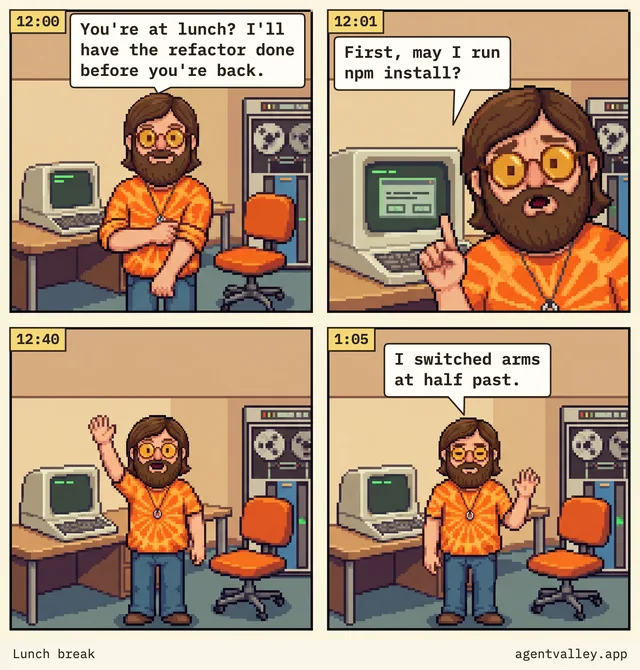
Eight more at agentvalley.app/comics.
It reads. It doesn't touch.
- Reads
~/.claude/projectsand~/.claude/sessions, the files Claude Code writes as it works. - Looks at Claude Code's processes and each project's
.gitto show which app and branch a session is in. From.gitit also reads the address of the project's remote, such as its GitHub page, so History knows a project after you move or rename it. That address stays on your Mac, without any login in it. - Reads your Claude Code login from the Keychain only when you turn on Plan limits, and sends it only to api.anthropic.com.
- Asks GitHub once an hour whether there's a new version. That's the whole conversation. Turn it off in Settings.
- Sends us one count a day, so we know how many Macs run it: the app version, the macOS version, and whether it's this Mac's first day. No name, no ID, nothing about your sessions. Turn it off