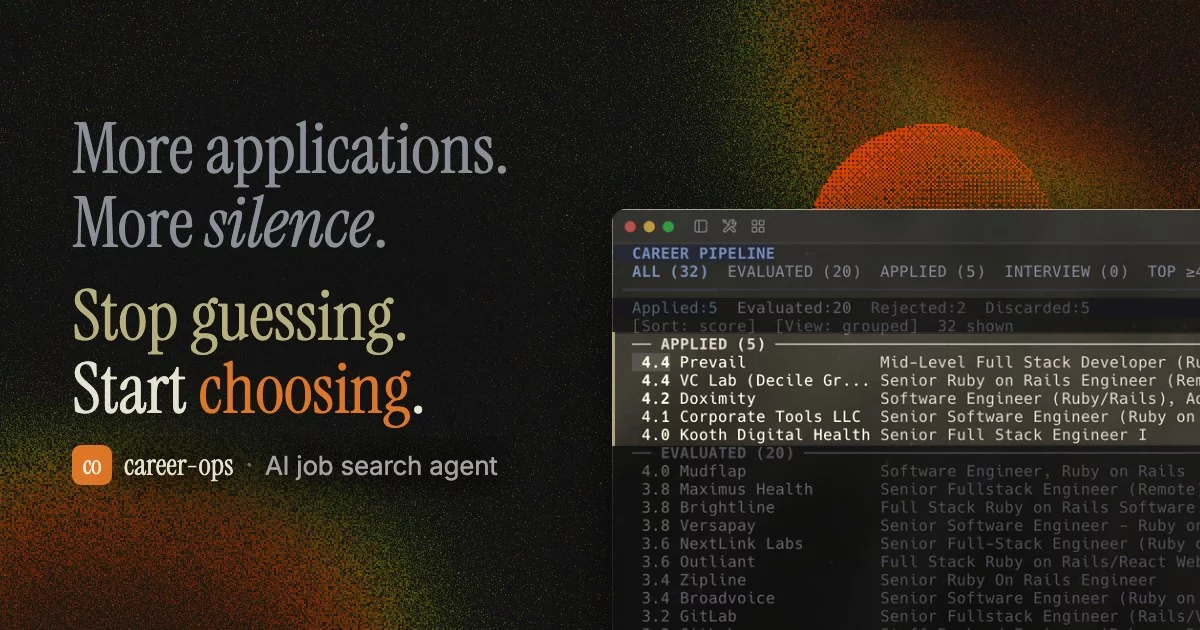


The open-source AI job search agent.
English | Español | Deutsch | Français | Português (Brasil) | 한국어 | 日本語 | 简体中文 | 繁體中文 | Українська | Русский | Polski | Dansk | தமிழ் | العربية | हिन्दी | Türkçe | Tiếng Việt | Bahasa Indonesia
 Created by @santifer, with

Months of sending CVs into silence.
So I built the filter I needed.
740 listings evaluated. 68 applied. 12 interviews. 1 offer.
I was its first user. I got the job. Then I open-sourced it.
Paste a job. On your machine, it tells you if it's still open and if it fits.
It tailors your CV and drafts your answers. You press Submit.
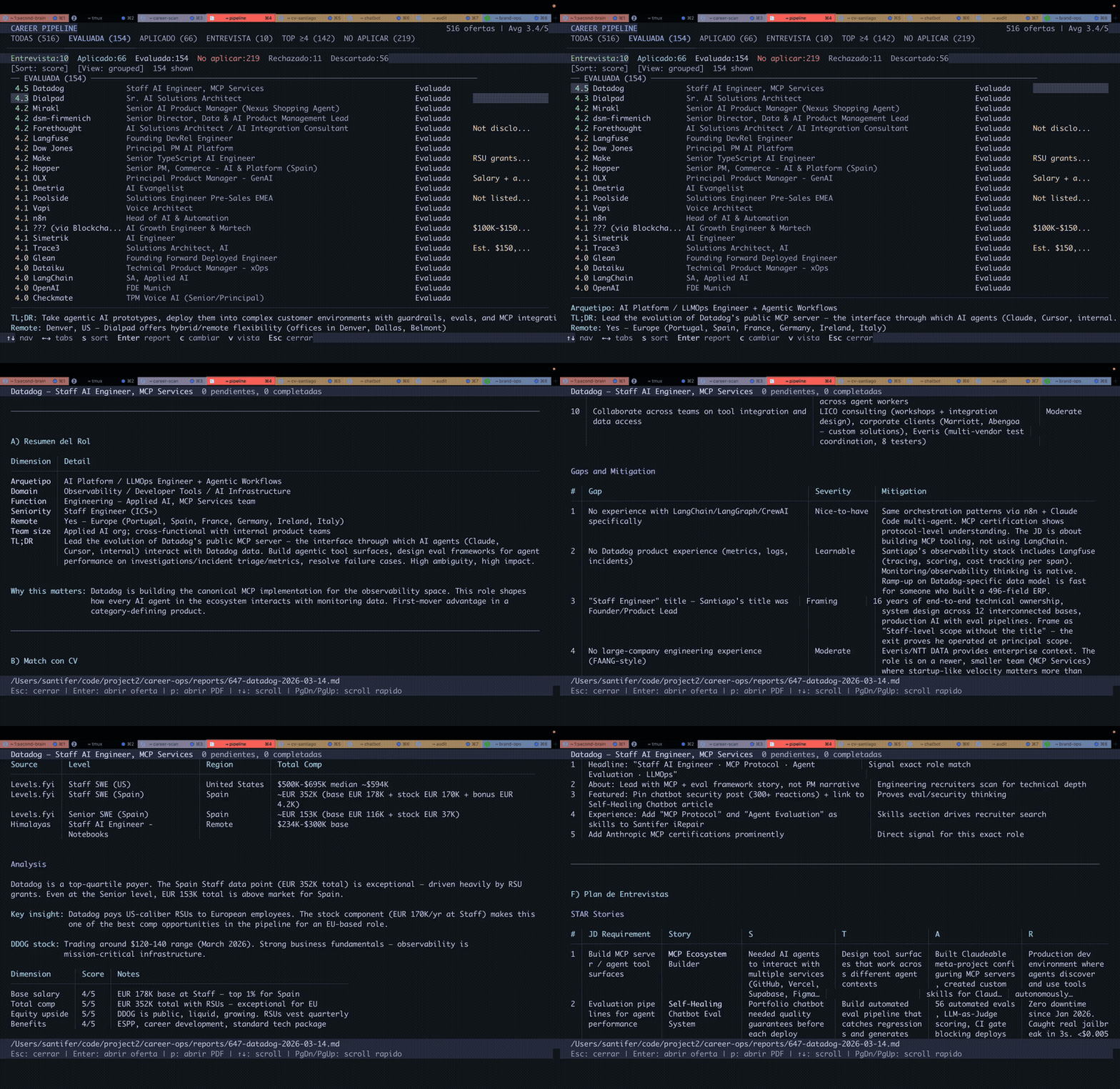
My own search, partway through, with the UI in Spanish.
Companies use AI to filter candidates.
I just gave candidates AI to choose companies.
Six months later, I left that job.
Now we build career-ops, so you can land yours.
Try it on one job ↓ · Read the full story →

The people who came after me wrote down how they got hired.

Every card is a public issue you can open. Landed yours? Leave your card →
⭐ If career-ops helped you, a star helps the next person find it.




Your turn
Paste one job you were about to apply to tonight. If it comes back do not apply, you just got the night back. If it comes back with a plan, you know what to do next.
npx @santifer/career-ops init
Open source. Local. In the AI CLI you already use. Free and local models included.
You don't have to search alone
The silence after you hit send is not about you. Enough people saw the same thing to write the practice down, in six lines:
Apply better to fewer. Signal over volume. Evidence over keywords. A human decides. Local-first. Dignity on both sides of the table.

A few of them, in their own words.

Every signature is a commit you can audit. Read them all, or add yours → · What is AI job search?
Hiring will not fix itself. The people going through it can, and they are already in the room, comparing notes and fixing each other's setups.
This is where the fix gets written. A room, not a club. Let's build together.

Sponsors
career-ops is free for candidates, forever. These companies sponsor the project:

SerpApi · Build a portfolio project with live search data. SerpApi gives developers structured JSON/Markdown from Google Search, Maps, Shopping, and other engines through a simple API call.
Sponsorship buys clearly labeled visibility, never influence: no amount of money changes the roadmap or places anything in the product. Sponsors never appear in evaluations, rankings or recommendations.
What career-ops does for you
Paste a job. It tells you whether that night is worth it.
- Still open? It checks that the posting is still live before you write a word.
- Not you? It scores the role against your real CV and tells you to skip a weak fit. You can override it.
- Worth it? It drafts the CV, the cover letter and the answers. You read them. You send them.
- Who do I talk to? It finds the person and drafts the note. It never sends it.
- Where does it all go? Every application stays on your machine. Nothing is uploaded to us.
- What should I learn? After a run of noes, it names the gap.
The first runs are rough. It does not know you yet. Talk to it: your CV, what you want, what you refuse. Think of it as a recruiter's first week.
On first launch it asks for all that in chat. Nothing to configure by hand.
What career-ops will not do
- Auto-submit an application. It drafts the answer to every field; you review and click Submit. The script never POSTs (
prepare-application.mjs). - Send an email. Drafts only. There is no mail transport anywhere in this codebase.
- Phone home. No telemetry, no backend of ours. Your CV goes from your machine to the AI provider you chose, and nowhere else. The only public ledger is this repo:
HIRED.mdand its issues. - Push you to apply below 4.0/5. It will tell you not to. You can override it, and it will say so.
It reformulates your CV; it must never fabricate it. A check in code stops a PDF whose numbers or facts appear in neither your CV nor your article digest, but it cannot judge every rewording yet. Read every CV before you send it. Details in the FAQ.
Features
| Feature | Description |
|---|---|
| A-H Evaluation | Role summary, CV match (with how much each requirement matters for this posting, and whether that weight came from the JD's own wording, its structure, or an estimate, labelled per requirement; an estimate can never be top-band), level strategy, comp research, personalization, interview prep (STAR+R) -- plus a Block G posting-legitimacy check (is it still open, is it a repost: observations, not verdicts), and a Work-Auth signal that flags an explicit no-sponsorship JD as a hard blocker |
| Human-in-the-Loop | AI evaluates and recommends, you decide and act. The system never submits an application -- you always have the final call |
| ATS PDF Generation | ATS-readable CVs tailored to each JD from your own experience, in Space Grotesk + DM Sans design |
| Cover Letter Generator | Research-backed cover letters with keyword mirroring, four interactive angle prompts (why/problems/approach/tone), draft-in-chat approval gate, and A4 PDF via the same HTML + Playwright pipeline as CVs. Auto-drafts on every evaluation; complete and generate on demand via /career-ops cover |
| Beyond the CV | Company research (deep) surfaces AI strategy, recent moves, engineering culture, and the angle your profile should take. Contact discovery (contacto) identifies the hiring manager, recruiter, or team peer worth reaching out to and drafts a ≤300-character LinkedIn message tuned to each contact type. Formal application email drafts (email) turn an evaluated report or pasted JD into a subject line, body, and attachment checklist without sending, submitting, or clicking anything. Applications get you in the queue; research gets you a conversation. |
| Pattern Analysis | Rejection patterns and per-ATS-channel advance rates (analyze-patterns.mjs), lifetime funnel stats (stats.mjs), repost detection, a possible sign of a ghost job (detect-reposts.mjs) |
Everything else it does
| Feature | Description |
|---|---|
| Auto-Pipeline | Paste a URL, get a full evaluation + PDF + tracker entry |
| Interview Story Bank | Accumulates STAR+Reflection stories across evaluations -- 5-10 master stories you can adapt to the behavioral questions you get |
| Negotiation Scripts | Salary negotiation frameworks, geographic discount pushback, competing offer leverage |
| Application Email Drafts | Formal recruiter/referral/cold application emails from a report or pasted JD, with subject line, attachment checklist, source-backed fit points, and a profile-driven contact block. Draft-only -- career-ops never sends, submits, or clicks anything. |
| Portal Scanner | 100+ companies pre-configured (Anthropic, OpenAI, ElevenLabs, Retool, n8n...) + custom web-search queries across Ashby, Greenhouse, Lever, Wellfound |
| Funded Company Discovery | Review-first company:funded command surfaces recently funded companies and source diagnostics from structured public feeds without editing your data |
| Batch Processing | Parallel evaluation with headless CLI workers (claude -p / opencode run) |
| Dashboard TUI | Terminal UI to browse, filter, and sort your pipeline |
| Pipeline Integrity | Automated merge, dedup, status normalization, health checks |
| Interview Suite | Time-blocked prep plans, practice sessions with feedback, post-interview debriefs (interview/), and a company red-flag detector (interview-redflag) |
| Offer Stage | Contract reading companion -- clause walk plus a lawyer question list (offer-prep) -- and a desired/advertised/actual salary-gap analyzer (salary-gap.mjs) |
| Follow-ups & Replies | Follow-up cadence calculator and seeded reminders (followup-cadence.mjs, followup-seed.mjs); turn them off with follow_ups.enabled: false in config/profile.yml; employer reply classification into tracker updates (reply-watch) |
| Plugin System | Opt-in integrations (Gmail, Notion, Apify + a community registry), disabled by default -- see docs/PLUGINS.md |
Quick Start
Fastest way, one command:
npx @santifer/career-ops init
💡
npxships with Node.js: it runs the installer once, without installing anything globally. No Node yet? Install it first. (Already using a Claude Code / Codex CLI? Then you already have it.)
This clones the latest release into ./career-ops and installs dependencies. Then:
cd career-ops
claude   # or codex / qwen / opencode / agy / grok — open your AI CLI here
On first launch, career-ops walks you through setup (your CV, profile and target roles) just by chatting. Nothing to edit by hand.
Prefer to set it up manually? (git clone)
git clone https://github.com/career-ops-hq/career-ops.git
cd career-ops && npm install
npx playwright install chromium   # only needed for PDF generation
# On a non-Debian/Ubuntu Linux distro (Fedora, Arch, ...), Chromium's system
# libraries aren't installed by the line above — install them yourself with
# your distro's package manager if PDF generation fails to launch the browser
# (Playwright's own docs list the required libraries per platform).

# 2. Open your AI CLI in this directory. On first launch it walks you
#    through setup (your CV, profile and target roles) by chatting
cl