DungeonFlux
AI-powered tabletop adventures for a shared screen and each player's phone.
Website · X · Facebook · Issues
Status: Active development; the local game is playable. Hosted accounts and billing are in development and are not deployed.
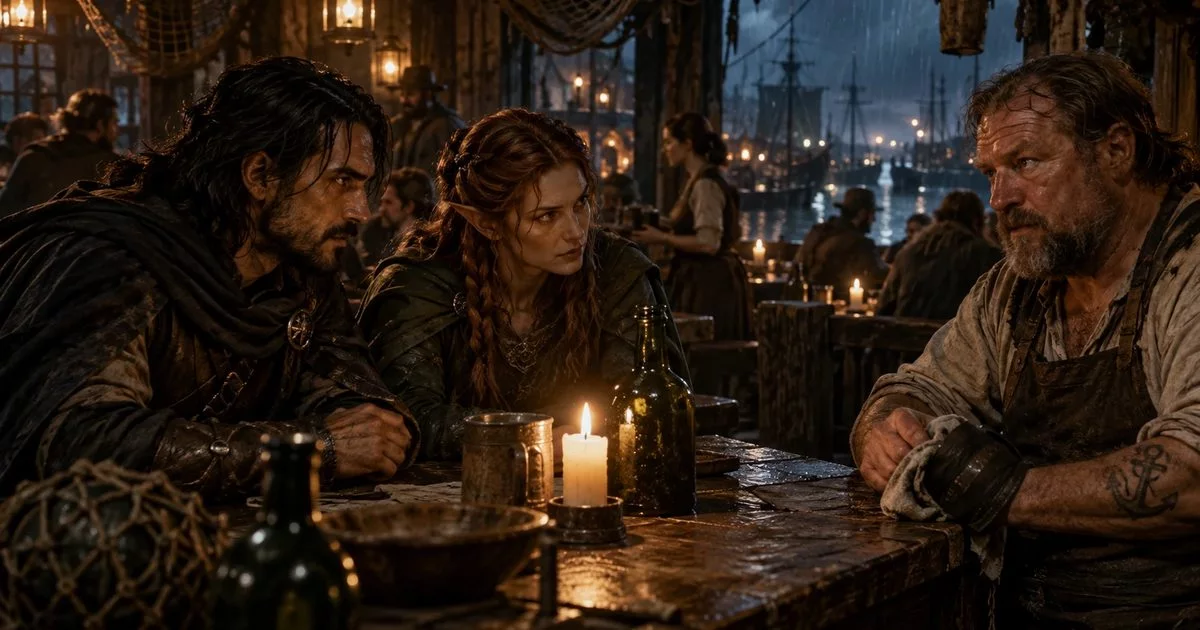
DungeonFlux is an AI Dungeon Master for a living-room table. The adventure plays on a shared TV or laptop display, and each player joins from their own phone, tablet or laptop. A Rust server owns the story, the dice and the rules, which follow the D&D SRD 5.2.1. The look is photographic: scenes, people and places are generated to read like a live-action fantasy TV drama.
The project is in active development. A local game is playable end to end on a
development machine, but there is no packaged release. Hosted account work is underway
in df-hosted, df-portal and df-customer: PostgreSQL accounts and email verification
are in development, with Stripe top-ups in test mode and PayPal and Google sign-in in
progress. The service is not deployed, and production sign-up shows the message "coming soon".
The site publishes customer prices per table-hour at pricing.
What works today
- A local game server with PostgreSQL storage, a shared table display and player screens, run from one script or from a desktop launcher.
- A fixed harbor adventure, randomly rolled adventures and persistent campaigns, plus a free-roam pack. Content lives in content/.
- Level 1 Fighter (Soldier background) character creation with SRD 5.2.1 species, dice rolled by the server, and typed, real-dice combat.
- An AI storyteller, optional spoken narration and character voices, speech input, adaptive music, generated pictures, and optional video and Gaussian-splat battle scenes. Each is behind a switch and needs its own provider key.
- A development command line and structured logs for driving and inspecting a running game (development/README.md).
What is not built: a production df-server binary (the game server today is the
df-transport-fixture binary in crates/df-tools), deployed hosted play, production
sign-in or billing, and rules coverage beyond the SRD 5.2.1 subset the game uses.
The df-server crate directory holds source but is not a workspace member. Detailed
status and open bugs are in planning/issue-triage.md and
planning/implementation-roadmap.md.
Run it locally
Prerequisites, from the scripts and rust-toolchain.toml:
- Rust 1.98.1 with the
wasm32-unknown-unknowntarget (pinned inrust-toolchain.toml). wasm-bindgen0.2.129 (the run script refuses any other version).- PostgreSQL 18.6 built locally by
development/postgres.sh setup, which downloads the official source archive, checks its SHA256 and installs underartifacts/. - A POSIX shell (Git Bash on Windows), plus Python 3 for helper scripts.
The run script keeps its own rustup and cargo homes under artifacts/cache/ and
builds with --offline --locked, so dependencies must already be fetched there. A
from-scratch bootstrap is not scripted.
development/run-gameplay.sh
The script builds the server and the wasm client, starts PostgreSQL if needed, and
prints a READY line. Open the display URL on the shared screen and the player
URL in a browser tab or on a phone. Ctrl-C stops the server. Useful flags:
development/run-gameplay.sh --print-config      # show nonsecret launch inputs, start nothing
development/run-gameplay.sh --lan               # let phones on your network join
development/run-gameplay.sh --no-build --database <name>   # resume a saved game
development/run-gameplay.sh --harbor            # the fixed harbor adventure
development/run-gameplay.sh --campaign <id>     # a persistent campaign
Every flag and environment variable is listed in the launch and configuration reference, and the play walkthrough is in development/README.md. The local preview has no accounts: anyone on your network with the room code can take a seat, so use it on a network you trust.
Desktop launcher (Windows)
crates/df-launcher builds dungeonflux.exe, a window for starting, resuming and
stopping games and editing settings. It is a standalone crate (its own Cargo.lock,
not a workspace member) and uses an existing game build.
cargo build --manifest-path crates/df-launcher/Cargo.toml --target-dir artifacts/build/launcher
artifacts/build/launcher/debug/dungeonflux.exe --help
Provider keys
With no keys the game still runs; features that need a provider stay off. Keys go in the
Git-ignored .env at the repository root, in your shell environment, or in the
launcher's Git-ignored config/dungeonflux.toml (copy options from
config/dungeonflux.example.toml). The names the code reads:
| Variable | Used for |
|---|---|
OPENAI_API_KEY |
Storyteller, story memory, scene pictures, character portraits |
ELEVENLABS_API_KEY |
Narration voices, music, speech input |
DF_JEV_API_KEY |
Reading player actions, sorting portrait requests |
FAL_KEY (or DF_FAL_KEY) |
Generated video clips, the FLUX picture option |
BFL_API_KEY |
Alternate portrait route for mature character appearances |
WORLDLABS_API_KEY |
Explorable 3D places |
Never commit keys or paste them into logs. Generated video is off by default.
Architecture
Player phones and shared display (Rust compiled to WebAssembly)
      |  generated protobuf RPC over one binary WebSocket
      v
Rust server: authorization -> session owner -> rules and engine
      |                                  |
      | PostgreSQL commit                | committed effect intents
      v                                  v
Durable game state                 AI and media services -> provider ports
      |                                  |
      +-------- permitted views, audio and assets --------> clients

Instrumentation -> OpenTelemetry spans and logs -> telemetry store
Key rules:
- The server is authoritative. It owns state, dice, legal actions, rules outcomes and AI orchestration, and filters private information before building a view.
- Clients are thin Rust/WebAssembly presenters. They send input and show server-confirmed results; they never duplicate rules or receive data to hide. Only generated glue is JavaScript.
- Transport is gRPC over a binary WebSocket, ported from the GoGRPCBridge idea
(
df-rpc-bridge, tonic and prost). - One session owner serializes decisions, and PostgreSQL commits state and effect intents atomically. The design requires that replaying a saved game never calls a model or repeats a paid generation (see runtime reliability).
- Telemetry follows OpenTelemetry conventions (
df-observe,df-telemetry).
crates/ holds 41 crates: 39 workspace members plus df-launcher and df-server, which
are outside the workspace. Each keeps its internals private behind a small typed
boundary; the crate map is authoritative.
| Role | Crates |
|---|---|
| Foundations | df-types, df-model, df-content, df-locale, df-testkit |
| Rules and engine | df-rules, df-engine, df-combat, df-encounter |
| Commercial policy | df-commerce |
| World and narrative | df-world, df-knowledge, df-intent, df-interaction, df-narrative, df-experience |
| Presentation policy | df-tempo, df-presentation |
| Session and API | df-auth, df-session, df-api, df-server (contract only, not a workspace member) |
| Transport | df-protocol, df-rpc-bridge |
| AI, media and storage | df-provider-api, df-providers, df-ai, df-media, df-assets, df-persistence |
| Browser clients and render | df-client, df-ui, df-render, df-audio, df-player, df-display, df-web |
| Telemetry | df-observe, df-telemetry |
| Tools and launcher | df-tools (the game server binary, dev CLI and fixtures), df-launcher |
Design documents that explain the larger pieces: client architecture, narrative engine, interaction engine, tempo engine, asset engine, RPC transport, storage, observability and runtime reliability. An LLM only expresses narration and dialogue that the rules engine and story directors have already validated; it never decides dice or outcomes.
Rules
The game targets the 2024 fifth-edition rules and uses the System Reference Document
5.2.1 as its source for species, creatures and mechanics; the PDF is kept in
development/rules-sources/. The SRD is a subset of the full rulebooks, so full
standard coverage is a goal tracked in rules coverage and
rules support, not a current claim. Content that departs
from SRD values is flagged as custom rules in the game.
This work includes material from the System Reference Document 5.2.1 by Wizards of the Coast LLC (https://www.dndbeyond.com/srd). The SRD 5.2.1 is licensed under Creative Commons Attribution 4.0 International (https://creativecommons.org/licenses/by/4.0/legalcode).
Development
Read AGENTS.md and the coding style before
changing code. The style is mandatory: explicit names, private crate internals, typed
errors, bounded async work, no dead code, LF endings, and rustfmt from the root
rustfmt.toml. Application and UI code stays Rust.
Use the shared developer tooling guide for the Rust
workspace commands, focused df-tools tests, local PostgreSQL setup, and optional
pre-commit formatting check.
cargo build --locked -p df-tools --bin df-transport-fixture
cargo build --locked -p df-tools --lib --target wasm32-unknown-unknown
cargo clippy -p <crate> --all-targets -- -D warnings
cargo check -p df-tools --target wasm32-unknown-unknown
cargo test -p <crate>
Test caveats:
df-toolshas thousands of tests. Run filtered tests only, for examplecargo test -p df-tools --lib <name-filter>, as the coding style requires. The fulldf-toolssuite currently has a known crash, so do not rely on it.- Tests must not sleep, spend money on providers or leave processes behind.
python development/test-launch-settings.pychecks the launch scripts with fake tools; it does not start PostgreSQL or call providers.
Where things live:
| Path | Contents |
|---|---|
planning/ |
Design documents; start at planning/README.md |
development/ |
Run and launch scripts, dev CLI notes, schemas, browser checks |
ADR/ |
Decisions on workflow, resources, devlog and evaluation |
content/ |
Adventure tables, packs, voice casting, pricing data |
config/ |
Launcher settings (dungeonflux.example.toml is the clean copy) |
docs/ |
The static project site |
CHANGELOG.md |
Integrated commits in six-hour blocks |
Status and roadmap
The implementation roadmap orders remaining work. The project is still in development, with broader rules coverage, campaign continuity, production service readiness and optional video fidelity among the open work. Open bugs are listed in planning/issue-triage.md, and recent work is in CHANGELOG.md. Concurrency and latency findings are in server concurrency research.
Optional provider features use provider keys. Billing is available in test mode only; the customer prices published on the site are listed here.
License
DungeonFlux is licensed under the MIT License. Copyright (c) 2026 The DungeonFlux authors. See LICENSE for the full terms. Third-party code is credited in THIRD_PARTY_NOTICES.md; the dependency license policy covers dependencies.
Contributing
See CONTRIBUTING.md for build and test commands, the contribution process and the project gate.
Security
Please report vulnerabilities privately. See SECURITY.md for reporting options and what to include.
Community and support
Follow DungeonFlux on X and Facebook, visit dungeonfluxdnd.com, or contact support@dungeonfluxdnd.com. Use GitHub issues for public project work.