
Elixir Phoenix Plugin for Claude Code
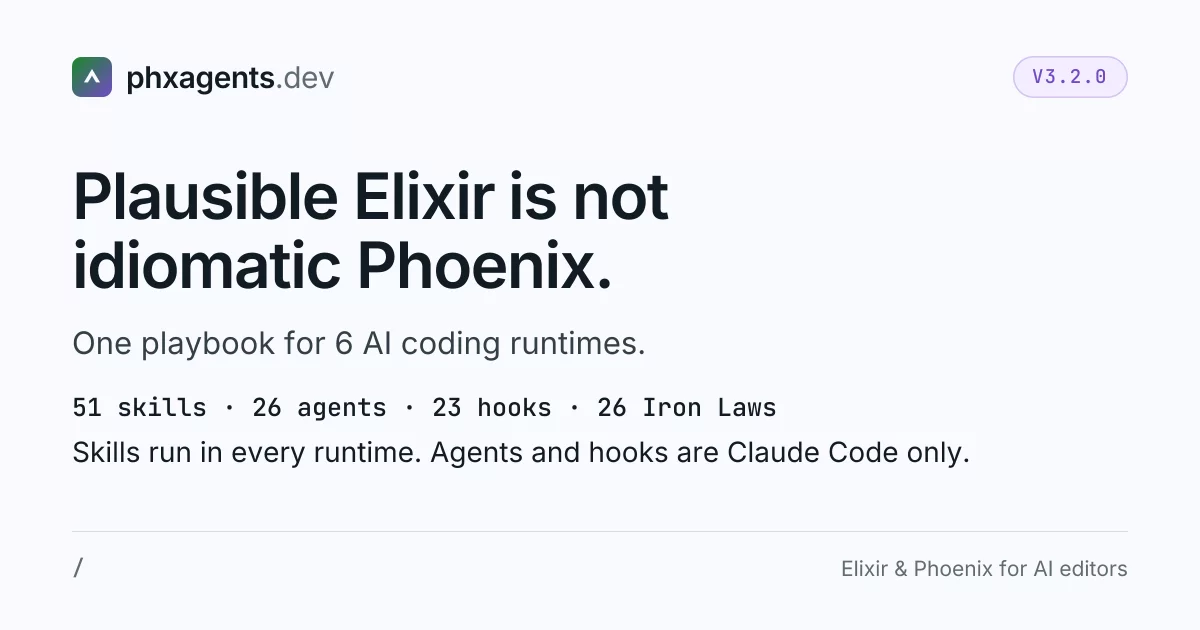
Docs: phxagents.dev -- install guides per runtime, the runtime compatibility matrix, all 26 Iron Laws, and a browsable skill and agent catalog.
Claude Code is great. But it doesn't know that assign_new silently skips on reconnect, that :float will corrupt your money fields, or that your Oban job isn't idempotent.
This plugin does. It coordinates 26 specialist agents that plan, implement, review, and verify your Elixir/Phoenix code in parallel -- each with domain expertise, fresh context, and enforced Iron Laws that catch the bugs your tests won't.
Using Amp? Install the generated edition for the same 51 Elixir, Phoenix, LiveView, Ecto, Oban, testing, and security skills, plus 40 deterministic workflow wrappers, five read-only specialist agents, parallel review/investigation, and native edit/verification guards, and the native PR watch lifecycle plugin. See Use with Amp for the important differences from the full Claude Code plugin, or the Amp install guide on phxagents.dev.
Using Codex? Install the native generated skills plugin for all 51 skills,
including $elixir-phoenix:phx-investigate and
$elixir-phoenix:phx-review workflows. See
Use with Codex or the
Codex install guide; a trust-gated
destructive-command safeguard is included, while custom agents are intentionally
not included and Tidewave MCP registration remains external.
Using Pi? Install the native generated skills package for all 51 skills,
including Pi-compatible /skill:phx-investigate and /skill:phx-review
workflows. See Use with Pi or the
Pi install guide; extensions, prompt
templates, MCP, and custom agents are intentionally not included yet. Tidewave
can be used when the Pi host exposes it independently.
Using OpenCode? Install the generated skills-only target for all 51 skills,
including phx-investigate and phx-review. In the tested OpenCode 1.17.2 setup,
they are also available as /phx-investigate and /phx-review; the skill tool
is the portable explicit interface. See Use with OpenCode, the
OpenCode guide, or the
OpenCode install guide.
Using DeepSeek Harness (dsh)? Install the generated skills-only target for
all 51 skills. A /phx-investigate or /phx-review token anywhere in your
message loads the skill deterministically, and dsh reads your CLAUDE.md
natively. See Use with DeepSeek Harness, the
dsh guide, or the
dsh install guide; hooks and custom
agents are intentionally not included, and Tidewave MCP registration is
external.
Compare native invocation, installation, and deliberately deferred capabilities in the canonical runtime support matrix. Generated skills support does not imply full Claude Code feature parity.
# You describe the feature. The plugin figures out the rest.
/phx:plan Add real-time comment notifications

# 4 research agents analyze your codebase in parallel.
# A structured plan lands in .claude/plans/comment-notifications/plan.md
# Then:

/phx:work .claude/plans/comment-notifications/plan.md
# Implements task by task. Compiles after each change.
# Stops cold if code violates an Iron Law.

/phx:review
# 4 specialist agents audit in parallel:
# idioms, security, tests, compilation.
# Deduplicates findings. Flags pre-existing issues separately.
No prompt engineering. No "please check for N+1 queries." The plugin auto-loads the right domain knowledge based on what files you're editing and enforces rules that prevent the mistakes Elixir developers actually make in production.
┌─────────────────────────────────────────────────────────────────────┐
│  ⚗  Elixir/Phoenix Plugin for Claude Code                           │
│                                                                     │
│  ┌──────────┬──────────┬──────────┬──────────┬──────────┐           │
│  │    26    │    51    │   140    │    30    │    26    │           │
│  │  Agents  │  Skills  │   Refs   │Hook Regs │Iron Laws │           │
│  └──────────┴──────────┴──────────┴──────────┴──────────┘           │
│                                                                     │
│  AGENTS                          COMMANDS                           │
│  ─────────────────────           ──────────────────────────         │
│  Orchestrators (opus)            Workflow                           │
│    workflow-orchestrator           /phx:plan    /phx:work           │
│    planning-orchestrator           /phx:review  /phx:full           │
│    parallel-reviewer               /phx:compound /phx:quick         │
│    context-supervisor              /phx:brief   /phx:triage         │
│                                                                     │
│  Reviewers (sonnet)              Investigation & Debug              │
│    elixir-reviewer                 /phx:investigate /phx:trace      │
│    testing-reviewer                /ecto:n1-check   /phx:perf       │
│    security-analyzer (opus)        /ecto:constraint-debug           │
│    iron-law-judge                  /lv:assigns                      │
│                                                                     │
│  Architecture (sonnet)           Analysis & Review                  │
│    liveview-architect              /phx:audit    /phx:verify        │
│    ecto-schema-designer            /phx:techdebt /phx:boundaries    │
│    phoenix-patterns-analyst        /phx:pr-review /phx:challenge    │
│    otp-advisor                     /phx:research  /phx:document     │
│                                                                     │
│  Investigation (sonnet)          Knowledge (auto-loaded)            │
│    deep-bug-investigator           liveview-patterns  ecto-patterns │
│    call-tracer                     elixir-idioms      security      │
│    xref-analyzer                   phoenix-contexts   oban          │
│    verification-runner             testing   deploy   tidewave      │
│                                                                     │
│  Domain (sonnet)                 Hooks                              │
│    oban-specialist                 auto-format · auto-compile       │
│    deployment-validator            iron-law-verify · security-scan  │
│    hex-library-researcher          debug-stmt-detect · error-critic │
│    web-researcher                  progress-tracking · block-danger │
│                                                                     │
│  ───────────────────────────────────────────────────────────        │
│  26 Iron Laws · Tidewave-aware · plan→work→verify→review→compound   │
│  github.com/oliver-kriska/claude-elixir-phoenix                     │
└─────────────────────────────────────────────────────────────────────┘
v3.0.0 -- all 51 canonical skill trees have generated distributions for Amp, Codex, Pi, OpenCode, and DeepSeek Harness. Nine core workflows are fully adapted: the six flagship lifecycle workflows plus
phx-trace,phx-audit, andphx-research. The remaining projections preserve domain knowledge but may require the runtime to translate Claude-specific orchestration. Claude Code remains the full canonical plugin; hooks, agents, MCP, instructions, and workflow portability intentionally vary by runtime. See the support matrix before assuming feature parity. Issues welcome.
Installation
Claude Code
From GitHub (recommended)
# In Claude Code, add the marketplace
/plugin marketplace add oliver-kriska/claude-elixir-phoenix

# Install the plugin
/plugin install elixir-phoenix
Requires Claude Code 2.1.110 or newer. The install name stays
elixir-phoenix, while its public workflow commands remain /phx:* — Claude
Code namespaces commands by the plugin's manifest name, not its install name.
A fresh install also pulls in two small compatibility namespaces for /ecto:*
and /lv:* automatically; you do not need to install them separately. After an
update, run /reload-plugins before trying the commands in an already-open
session.
Updating from v2.x
Warning
Do not run
claude plugin updateon its own. v3 introduced two compatibility plugins (ecto,lv) that v2 never declared, andclaude plugin updatedoes not install dependencies a new version newly declares. The updated plugin then fails to load entirely — you lose all 36/phx:*commands, not just/ecto:*and/lv:*. Install the two compatibility plugins first, using the exact order below.
claude plugin marketplace update oliver-kriska
claude plugin install ecto@oliver-kriska
claude plugin install lv@oliver-kriska
claude plugin update elixir-phoenix@oliver-kriska
Restart Claude Code afterward. In an already-open session, /reload-plugins
reloads the updated skills, agents, and hooks. Confirm that /phx:help,
/ecto:n1-check, and /lv:assigns appear before continuing work.
Already updated in the wrong order?
If claude plugin list reports ✘ failed to load with
Dependency "ecto@oliver-kriska" is not installed, install the two
compatibility plugins to recover — nothing is lost, and no reinstall is needed:
claude plugin install ecto@oliver-kriska
claude plugin install lv@oliver-kriska
Note that claude plugin install elixir-phoenix@oliver-kriska also repairs the
state, but resolves only one missing dependency per run, so it needs two
invocations here.
Commands are /phx:*, not /elixir-phoenix:*
Plugin versions before v3.0.0 shipped a manifest named elixir-phoenix, so
their commands resolved as /elixir-phoenix:work even though /phx:init wrote
/phx:* into CLAUDE.md. v3.0.0 renamed the manifest to phx, which is what
makes /phx:* correct. If Claude Code reports /phx: commands as unknown,
you are on a pre-v3 version — follow the upgrade steps above, then re-run
/phx:init --update.
Claude Code subagent compatibility
No configuration is required. Claude Code 2.1.219+ defaults to a maximum
subagent spawn depth of 3, so /phx:full, deep /phx:plan, parallel
/phx:investigate, and /phx:trace can use their nested orchestrators. Claude
Code 2.1.217–2.1.218 defaulted to depth 1; on those versions, or when you
explicitly configure depth 1–2, the workflows keep orchestration in the main
conversation and spawn leaf specialists directly. They preserve the same
decisions, artifacts, verification, and review gates; only the agent topology
changes.
To explicitly enable the full nested topology, start Claude Code with depth 3:
CLAUDE_CODE_MAX_SUBAGENT_SPAWN_DEPTH=3 claude
Depth 2 is sufficient for /phx:trace's call-tracer alone. This must be set in
the environment that starts Claude Code; a plugin hook cannot change its parent
process environment.
Multi-stack tip — project-scope enable. This plugin is opinionated for Elixir/Phoenix. If you work across multiple language stacks, prefer enabling it per-project rather than globally — drop this into
<project>/.claude/settings.json:{ "enabledPlugins": { "elixir-phoenix@oliver-kriska": true } }Hooks self-gate on
mix.exspresence (v2.10.1+), so global enable is safe — project-scoping is just a tidiness preference.
Companion plugin: catchup
The same marketplace also ships catchup — a framework-agnostic
/catchup return-from-absence briefing (PRs, reviews, git, Linear,
calendar → one prioritized Context Brief, including which upstream
changes touch your in-flight files). Independent plugin, separate
manifest, install only if you want it:
/plugin install catchup@oliver-kriska
See plugins/catchup/README.md. Not coupled to Elixir/Phoenix.
Companion plugin: rewrite (experimental)
rewrite (Elixir Rewrite Architect) plans a rewrite of an existing app
from any language into idiomatic Elixir: features as goals, why each legacy
mechanism exists, a compatibility bar before any design, then vertical slices
handed to /phx:plan and checked by /rewrite:verify. Stack packs for Rails,
Django, Laravel/PHP, Node, Go and JVM/.NET; a generic method for the rest. It
depends on elixir-phoenix. Version 0.1.0, tested on small apps only:
/plugin install rewrite@oliver-kriska
See plugins/rewrite/README.md.
From Local Path (for development)
git clone https://github.com/oliver-kriska/claude-elixir-phoenix.git

# Option A: Add as local marketplace
/plugin marketplace add ./claude-elixir-phoenix
/plugin install elixir-phoenix

# Option B: Test the plugin and its command namespaces directly
claude \
  --plugin-dir ./claude-elixir-phoenix/plugins/elixir-phoenix \
  --plugin-dir ./claude-elixir-phoenix/plugins/ecto \
  --plugin-dir ./claude-elixir-phoenix/plugins/lv
Keep all three --plugin-dir arguments when testing public command
compatibility. The main directory provides /phx:*; the ecto and lv
directories provide the legacy /ecto:* and /lv:* aliases.
Use with Amp
Amp supports two profiles from the same generated snapshot:
- Hosted-native: publish the skills and plugin independently to Amp personal
or workspace repositories. Use Amp's native
skill: invokecommand. The plugin still provides specialists, parallel analysis, and edit lock, but its filesystem wrappers cannot load hosted-only skills and nativephx-fulldoes not arm the plugin verification gate. - Paired-full: install matching skills and plugin locally. This preserves all
40
phx:*/ecto:*/lv:*wrappers and the wrapper-activatedphx-fullgate.
Project-local paired installation is recommended for reproducible full behavior:
cd /path/to/your-phoenix-project

# Install the 51 skills into this project
amp skill add \
  https://github.com/oliver-kriska/amp-elixir-phoenix/tree/stable/skills \
  --target "$PWD/.agents/skills"

# Add deterministic workflows, read-only agents, and native guards
mkdir -p .amp/plugins
plugin=".amp/plugins/elixir-phoenix.ts"
temporary="$(mktemp "${plugin}.XXXXXX")"
curl --fail --silent --show-error --location \
  https://raw.githubusercontent.com/oliver-kriska/amp-elixir-phoenix/stable/plugins/elixir-phoenix.ts \
  --output "$temporary" && mv "$temporary" "$plugin"
Open Amp's command palette with Ctrl+O, run skill: invoke, choose
phx-investigate, and send the bug details. This native path resolves the
effective skill whether it is local, built-in, personal hosted, or workspace
hosted. With paired-full, the familiar phx: investigate, phx: review,
ecto: n1-check, and lv: assigns wrappers are also available; they inject the
matching local skill for one turn. phx: full activates the plugin verification
gate only through that wrapper, not through native skill: invoke.
amp skill add --global means machine-local, under
~/.config/agents/skills/; it is not personal hosted/account-wide. Personal
hosted artifacts are managed through Amp's Personal Settings or personal Git
repositories and work across machines and orbs. See the complete Amp guide
for hosted publication, source precedence, wrapper limits, updates, fallback
installation, specialists, safety boundaries, and verification.
phx-watch-pr additionally needs the separate phx-watch-pr.ts plugin.
Install it into the project where the worker Orb opens and watches PRs:
mkdir -p .amp/plugins
plugin=".amp/plugins/phx-watch-pr.ts"
temporary="$(mktemp "${plugin}.XXXXXX")"
curl --fail --silent --show-error --location \
  https://raw.githubusercontent.com/oliver-kriska/amp-elixir-phoenix/stable/plugins/phx-watch-pr.ts \
  --output "$temporary" && mv "$temporary" "$plugin"
It holds a bounded Orb keep-alive lease, filters deployment-like checks out of
readiness, persists reload-safe state, and wakes the same worker thread only for
failed/cancelled required CI, unresolved feedback, and terminal outcomes. With
--fix, actionable feedback and branch-owned CI failures are repaired in one
serialized same-thread workflow. It never blindly reruns shared CI, merges, or
deploys.
Use with Codex
Codex installs the generated target as a native skills plugin. Registration and installation are separate steps:
codex plugin marketplace add oliver-kriska/claude-elixir-phoenix --ref main
codex plugin add elixir-phoenix@oliver-kriska
codex plugin list
Start a fresh Codex session, then invoke workflows explicitly with
$elixir-phoenix:phx-investigate or $elixir-phoenix:phx-review, browse them
with /skills, or let Codex select a relevant skill from its description. Codex
namespaces plugin skills; unqualified $phx-investigate is not an explicit
alias. This edition also ships one synchronous native hook that blocks destructive
Ecto resets/drops, unguarded force pushes, and accidental MIX_ENV=prod mix
commands. Codex requires users to review and trust plugin hooks before they run;
the skills work without it. Custom agents, plugin-root instructions, the remaining
Claude hooks remain deferred; Tidewave MCP registration is external. See the
complete Codex guide for updates, uninstall, isolation,
troubleshooting, tested version, and capability details.
Use with Pi
Install the repository as a Pi package globally, or add -l to scope it to the
current project:
pi install git:github.com/oliver-kriska/claude-elixir-phoenix
pi list
Start a fresh Pi session, then invoke workflows explicitly with
/skill:phx-investigate or /skill:phx-review. Pi can also select a skill from
its description automatically. This edition ships skills and their complete
bundled resources only—not extensions, prompt templates, custom agents,
or package-root instructions. Tidewave MCP registration is external. See the
complete Pi guide for project-local installation, updates,
uninstall, isolation, troubleshooting, tested version, and capability details.
Use with OpenCode
OpenCode 1.17.2 discovers the generated skills recursively. Install a sparse checkout into one project (recommended) or the global OpenCode config root:
git clone --filter=blob:none --sparse https://github.com/oliver-kriska/claude-elixir-phoenix.git .opencode/skills/elixir-phoenix
git -C .opencode/skills/elixir-phoenix sparse-checkout set targets/opencode
Start a fresh session and explicitly say “Use the skill tool to load the
phx-investigate skill, then …”. In the tested OpenCode 1.17.2 setup,
/phx-investigate and /phx-review also work when they do not collide with
existing commands, but the skill tool is the documented portable interface. OpenCode
selects the model implicitly. This target contains skills and complete bundled
resources only—not hooks or custom agents. Tidewave MCP registration is
external. Investigation, review, plan, work, PR-review, and full-lifecycle
workflows are explicitly adapted; some other skills