
Eyelingo
An AI-powered language-learning platform — built and shipped to production by one person.
Web · installable mobile PWA · desktop app • 14 languages • ~56,000 learning items • A1–C2
What this is
Eyelingo helps adults actually use a language they already half-know, instead of collecting points. It runs an AI lesson engine, spaced-repetition review over tens of thousands of items, a grammar engine across 14 languages, and a conversation partner — all on a serverless backend with EU-hosted data and a full payment flow wired in (Stripe).
The web app and installable mobile PWA are live and open to anyone at eyelingo.app — free to use. I designed it, built it, and shipped it on my own, from the first idea to a running app people can pick up and learn from today. This repository is that product.
The idea it's built on
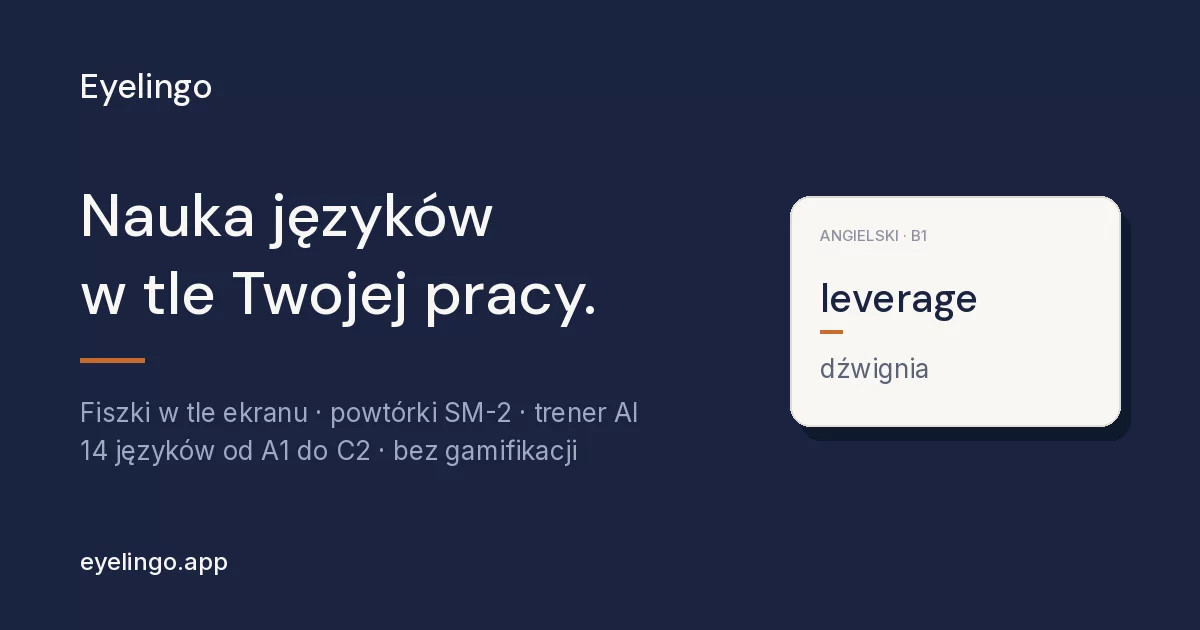
Most vocabulary exposure shouldn't cost you dedicated time. The desktop companion surfaces semi-transparent flashcards in your peripheral vision while you work — you aren't studying, you're just occasionally noticing a word. The lesson engine then knows exactly what the ambient layer has already seeded, and converts that passive exposure into tested, retained knowledge.
Ambient sows, the lesson reaps.
This isn't a feature I bolted on. It came out of my MSc research on peripheral attention in vocabulary acquisition — the product started as the research instrument and grew up. It's also the one mechanism here that isn't commodity: anyone can wrap an LLM in a lesson UI, but the ambient layer is what makes the rest of the system worth building.
The other deliberate decision: no gamification. No XP, no streaks, no leaderboards, no badges — they were designed out, not left out. The user is a working professional aged 30–50 who wants the language, not a daily-engagement habit loop. Removing the retention tricks means the product has to actually teach, which is the point.
https://github.com/user-attachments/assets/878b37f7-b109-4937-8a7a-aec6f8104715
How I work — and what this repo is evidence of
I treat a language model as an executor, not an oracle. My job is to decide what has to exist and how to tell whether it came out right; the model does the producing. Concretely, that means:
- Specification first. Before anything gets built, I write down what should happen, in what order, what the exceptions are, and what to do when it fails. The product is governed by a set of versioned design documents, and every change is designed against them.
- Predictable AI output. The model answers in an enforced format, the output is validated on return, and there is a fallback path when it doesn't match. A model that "says whatever" is useless in production — so it never gets to.
- Decomposition and order. A big goal is cut into pieces each finishable in one pass, sequenced so they don't block each other. "Done" means: I walked the whole path myself, as a user, and it works.
- One source of truth. Progress lives in one place; three clients read from it. New versions ship behind a switch so they can be turned off in seconds. Nothing is deleted that could still be needed.
That discipline — not raw coding speed — is why one person could ship this across three platforms in a few months.
Architecture at a glance
| Layer | What it does | Built with |
|---|---|---|
| AI lesson engine | Multi-step, state-machine lesson flow: start → generate → evaluate answer → complete/resume, with server-side state | Serverless edge functions (Deno / TypeScript), Anthropic Claude via OpenRouter |
| Adaptive review | SM-2 spaced repetition over ~56,000 items, per-item memory model from response-latency and exposure signals, CEFR-keyed difficulty | PostgreSQL |
| Ambient layer | Peripheral flashcard overlays during normal computer work, feeding the same knowledge state the lessons read from | PyQt6 desktop companion |
| Grammar engine | Rule banks A1–C2 across 14 languages, prerequisite graph, progress tracking | JSON grammar banks + grammar-engine.js |
| Data | Normalised schema, Row-Level Security on every table, RPC functions, single source of truth shared by 3 clients | Supabase / PostgreSQL (EU region) |
| Clients | Vanilla-JS single-page web app, installable offline-first PWA, PyQt6 desktop companion | JS / HTML / CSS, Python |
| Integrations | Subscription/payment flow (integrated end to end), text-to-speechh behind a proxy with a Web Speech fallback, first-party event analytics | Stripe, ElevenLabs |
| Delivery | CI build matrix for Windows/macOS, packaged installers, auto-update over the GitHub Releases API. Public distribution is pending a code-signing certificate — the desktop build runs, but an unsigned installer is blocked by OS gatekeepers until then. |
Repository map
| Path | What's inside |
|---|---|
index.html |
The web application (single-page, vanilla JS) |
app.html / eyelingo-app.html |
Mobile PWA surface |
fiszki_app.py |
Desktop companion app (PyQt6) — the ambient overlay layer |
grammar-engine.js, data/grammar/, grammar-bank.*.json |
Grammar engine and per-language rule banks |
.github/workflows/ |
CI: cross-platform build and release automation |
installer/, eyelingo.spec |
Desktop packaging |
service-worker.js, manifest.json |
PWA / offline support |
nauka/ |
SEO content hub |
freak/ |
A standalone interactive piece I built as a job application — separate from the product |
sitemap.xml, robots.txt |
SEO plumbing |
See it in action
A full walkthrough of the app — lessons, review, grammar and the AI conversation partner.
https://github.com/user-attachments/assets/a0bd4199-f0ef-4184-8177-c5f5b3f3b36e
A lesson with Lex, the AI tutor
https://github.com/user-attachments/assets/ffaf20c4-19ca-48f8-bedf-72cbdc790173
A note on scope
This is a real, running product, not a demo — so this public repository is the front-end, client, and engine layer. Secrets, API keys, and paid infrastructure live in server-side environment variables and Supabase Edge Functions, never in the code here.
About
Built by Adrian Wojtasik — English teacher turned AI product builder, now studying Psychology & Computer Science. I turn fuzzy ideas into working, reliable systems by pairing clear specifications with AI as the executor.