
The open electromagnetic workbench. Design, simulate and document antennas and RF circuits on the open-source openEMS FDTD solver, from a ribbon-based 3D designer or from parametric Python models.
Website · Download · Browser demo · Getting started · Documentation
Download
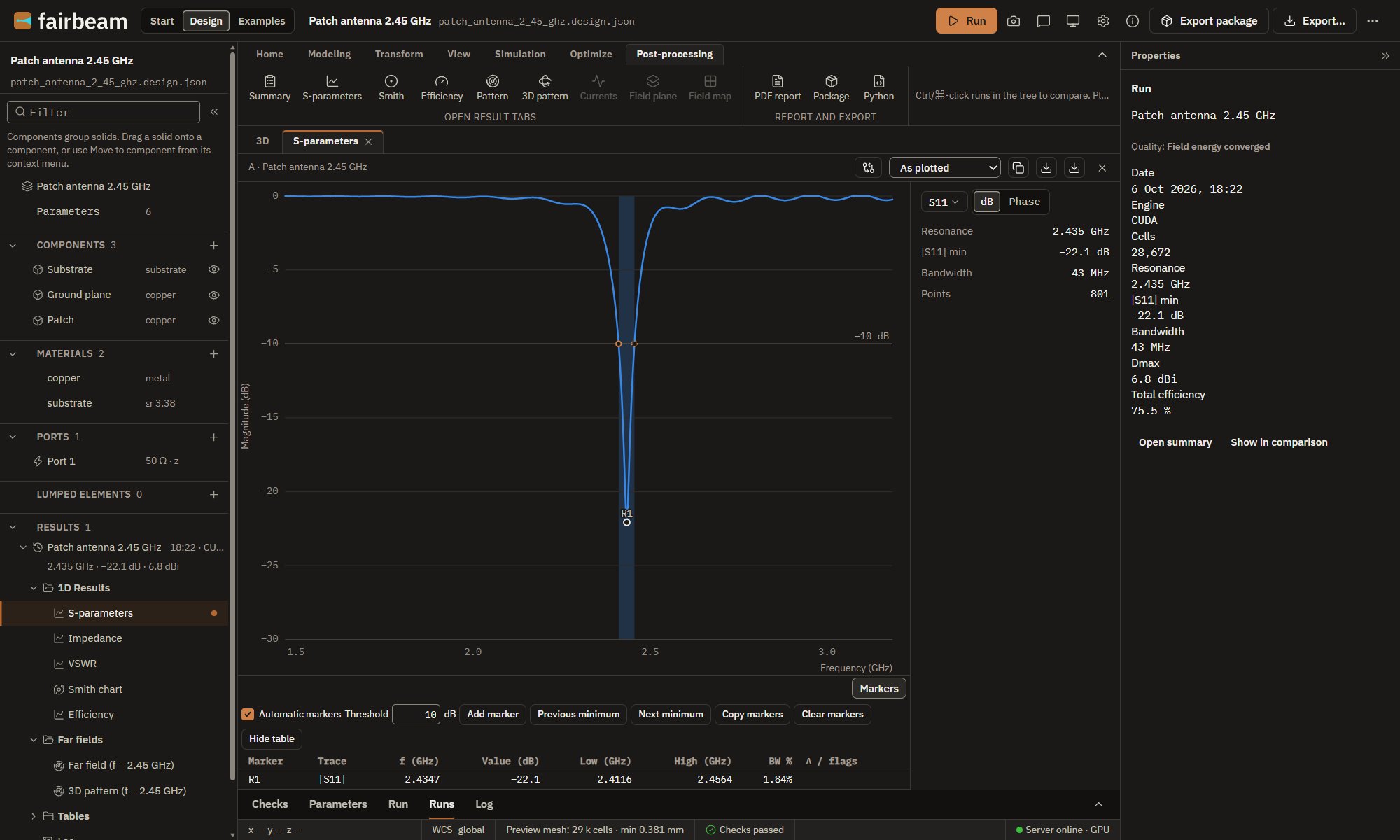
The desktop app is free, for macOS (Apple silicon, signed with a Developer ID and notarized by Apple) and Windows x64. Get the latest version from fairbeam-releases. The app installs its own runtime (Python and openEMS) for your user on first start and offers updates for you to install. Getting started takes you from installing to reading the results of a patch antenna.
The Windows installer is not code-signed. SmartScreen may show "Windows protected your PC": choose More info › Run anyway. The macOS app is signed with a Developer ID and notarized by Apple. The browser demo opens the example projects read-only, without installing anything.
What it does
- Designer. Draw parametric solids and sheets, use Boolean operations, transforms and a working coordinate system, add ports and lumped elements, check the model, mesh it and run it, in one window (designer guide).
- Simulation. openEMS on the CPU, or the optional GPU engine (Metal on Apple silicon, CUDA on NVIDIA cards). Automatic meshing, mesh convergence, parameter sweeps and a goal-driven optimizer (meshing, run server, optimizer, GPU engine).
- Results. S-parameters with markers, impedance, VSWR, Smith and polar charts, 2D and 3D far-field patterns (directivity, gain, realized gain, efficiency), surface currents and field planes, multi-port S-matrices and arrays with beam steering. Supported result plots provide data tables and run comparisons (results, multi-port, arrays).
- Python models and CLI. One Python file per antenna or circuit, with templates; the
fairbeamCLI runs, sweeps, converges and optimizes them (writing models, CLI). - Outputs. B&W technical drawings, publication figures, a PDF report and an export package; Touchstone and CSV; STL, glTF and Blender scenes, with optional rendered images; fabrication files (Gerber X2, Excellon, DXF; preview) (exports).
- File compatibility. CST-compatible VBA macro export (
.bas) and macro import (.bas,.mcs,.txt) (designer guide).
Open and reproducible
Fairbeam supports reproducible workflows through recorded inputs, versioned bundles and documented export formats:
- Findable results: versioned, self-describing project bundles that record the generator, the
versions and the run settings (
fairbeam.project/1). - Accessible: open formats and no licence server.
- Interoperable: Touchstone, CSV, STL, glTF, Gerber/Excellon and VBA macros.
- Reusable: GPL-3.0-or-later project models with recorded inputs; third-party models retain their own terms.
Results are checked against analytical references (validation, how results are computed).
Status
Fairbeam is in active development (0.x releases). The current desktop release is available from the downloads page. The Python pipeline, the designer and the desktop app work end to end on macOS (Apple silicon) and on Windows 11. The project file format is versioned, and breaking changes bump its version. The fabrication outputs have not yet been checked by a fab. Known gaps and plans are in the roadmap, which distinguishes released work, changes awaiting a release and planned features.
Use and limitations
Fairbeam is shared to support education, research and open-source collaboration, without warranties. Results may contain errors and should be independently verified through mesh-convergence checks and suitable analytical references or measurements. To the extent permitted by applicable law, the authors and contributors accept no liability for losses arising from its use; see LICENSE, sections 15–17. This statement does not restrict uses permitted by the license, including commercial use. See Validation for tested cases and their limits.
Privacy
Since Fairbeam 0.7.2, the desktop app asks once whether you want to help count installs. Counting
is off until you choose Allow; No thanks or dismissing the dialog keeps it off. Sign-in
remains disabled. With consent, the app sends a random install ID, app version, operating system,
CPU architecture and report schema to fairbeam.org/api/ping, at most once every seven days.
Designs, files and simulation results are not included. You can turn counting off at any time in
Settings > General > Install counts, which deletes the local install ID and stops future
install-count requests. FAIRBEAM_NO_TELEMETRY=1 also disables counting for that process.
Update checks contact GitHub (fairbeam-releases); app and runtime downloads come from GitHub and upstream hosts. The website and install-count API are hosted on Vercel. Hosting providers see your IP address and request data; their own policies govern infrastructure logs. See the privacy notice for the controller, purpose, processors, retention, rights and international processing details. For privacy questions or rights requests, contact ismail@fairbeam.org. Do not post personal information in public issues.
From source
Requirements: Python 3.10+, Node.js 22.12.0+ and an openEMS build. On macOS (and Linux) a script builds openEMS for you:
scripts/install-openems-macos.sh                              # openEMS + CSXCAD into ~/opt/openEMS
~/opt/openEMS/venv/bin/fairbeam run python/models/patch_antenna.py
npm install
npm run serve &   # the run server on port 5320 (Run panel, sweeps, optimizer)
npm run dev       # the viewer and designer on http://127.0.0.1:5310
- Windows: docs/WINDOWS.md.
- The desktop app: docs/DESKTOP.md.
- Everything else, including the test suite: docs/FROM-SOURCE.md.
Contributing and feedback
- Found a problem or missing something? Use Help › Report a problem in the app, or open an issue at fairbeam-releases. The app fills in the version and the operating system.
- Code and documentation contributions are welcome as pull requests here. Read CONTRIBUTING.md first.
- Fairbeam is developed with AI coding assistance. How that works, and the rules for AI-assisted contributions, are in the AI policy.
Citing Fairbeam
If Fairbeam contributes to published work, please cite it. The Cite this repository button on GitHub gives APA and BibTeX entries from CITATION.cff. Source releases are archived on Zenodo, which gives each version a DOI; cite the version you used. Please also cite openEMS, which computes the fields.
Credits
- Maintainer: İsmail Akdağ.
- Contributors: Cem Göçen:
- the material cell (NRW/NIST extraction);
- dispersive materials (Debye, Lorentz, Drude, Djordjevic-Sarkar);
- waveguide, coaxial, stripline and surface-wave reference fixtures;
- two-line calibration, ideal network and L/C references;
- grouped discrete ports and multiport convergence criteria.
- Solvers: Fairbeam runs openEMS and CSXCAD by Thorsten Liebig and contributors. The optional GPU engine is SeanMollet/openEMS.
- Libraries: the viewer uses SolidJS and three.js, and the desktop shell is built with Tauri.
- Details: selected third-party components and source locations are listed in NOTICE.md.
License
Fairbeam is free software under the GNU General Public License, version 3 or later (LICENSE). openEMS is GPL-3.0-or-later; CSXCAD and fparser are LGPL-3.0-or-later. Project bundles are plain data produced by your own models. Third-party notices are in NOTICE.md.