
 Felan Code
Get the job done. Waste less.
An open-source, model-portable coding agent built for cost-efficient,
verifiable software work.
Felan Code is built around one rule: an optimization only counts when the task still succeeds. It combines model routing, progressive context, compact tool output, explicit task state, and estimated API-equivalent savings for supported optimizations.
Correctness first. Efficiency by design.
Important
The local agent runs with your user's filesystem and process permissions. It is a host application, not a sandbox. Use an isolated host for untrusted projects or commands.
41.9% lower aggregate AI model cost in controlled benchmarks
Across seven controlled, extension-specific comparisons, candidate
configurations used $13.1193 versus $22.5774 for their baselines when
summing median-reduced case costs—a 41.9% reduction. Individual results
ranged from 14.5% to 66.0%. Each extension was measured separately against its
disabled baseline, not as one all-enabled configuration. Every candidate met
its configured quality gate.
| Extension | Quality vs baseline | Cost vs baseline | Secondary result |
|---|---|---|---|
| Subagents | 100% | 23.7% lower | — |
| MarkItDown | 100% | 31.0% lower | 13.8% fewer prompt tokens |
| Concise output | 100% | 14.5% lower | 16.4% fewer output tokens |
| Prewalk | 100% | 66.0% lower | — |
| RTK | 83.3% | 26.6% lower | 40.6% fewer prompt tokens |
| Codebase Memory | 100% | 27.8% lower | 7.8% shorter agent-step duration |
| Session Compaction | 100% | 45.2% lower | 52.1% fewer prompt tokens |
View the methodology, cases, and full benchmark results
Install and run
Felan Code supports Node.js 22.19.0 or newer. Run the published package without a global installation:
npx @felan-ai/felan
Or install the felan command:
npm install --global @felan-ai/felan
felan
Connect a provider inside the TUI with /login, then start working:
felan "inspect this project and explain how to run its tests"
felan --continue
felan savings
felan --diagnostics
felan update
Initial messages attach the interactive TUI to the local daemon by default. Use
--mode text for a one-shot final response or --mode json for Pi-compatible
JSONL session events; both use the same persistent daemon and detach when their
request finishes. CI/headless namespaces must be stopped explicitly. Both modes
support --continue and exact --provider, --model, and --thinking
selection. A verified global npm installation also supports the finite felan update command. See Getting started for first-run
setup and Local CLI for commands, daemon
lifecycle, and local state.
Sessions from Felan Code 0.28.3 and earlier appear in --resume, --continue
and --session <id> for their recorded folder. Opening one adopts it in place:
it keeps its ID and file, and new turns are appended to that file. Exit the old
version first: refusing a session changed in the last few seconds is only a
best-effort safeguard, and running 0.28.3 on an adopted session at the same time
is unsupported. To copy a transcript into a new session ID instead, use
/import. /export remains available.
Efficient by design
Felan Code treats correctness as the constraint and cost as the optimization target. Fewer tokens can support that goal, but they are not the outcome: a cheaper run that fails is not an efficiency win.
| Boundary | What Felan Code does |
|---|---|
| Model routing | Prewalk can start a task with a stronger planner and continue the same conversation trajectory on a configured implementation model. |
| Context control | Progressive nested instructions, scoped subagents, lazy MCP discovery, and bounded research keep context focused on the current work. |
| Tool output | RTK-backed command rewriting and post-tool compaction reduce noisy model input while preserving failures, complete JSON, and recoverable output. |
| Explicit state | Dependency-aware tasks, structured questions, retained subagent records, and local project memory keep decisions and progress inspectable. |
| Measurement | /savings, felan savings, and the Powerline footer report estimated API-equivalent cost avoided by supported optimizations. |
Felan Code is developed against cost per verified task, not token count alone.
The extension evaluations in evals/ hold the task,
starting repository, verifier, timeout, and environment equivalent when
comparing configurations. Correctness is primary; cost, token usage, and
latency are supporting measurements. Read
Efficient execution and savings for the
measurement boundaries and claim limits.
Local agent, portable core
@felan-ai/felan is the package for Felan Code, the account-free local terminal
agent. The Felan cloud
platform at felan.ai and
app.felan.ai composes the same portable core and
extensions as a managed host. Each host owns the boundaries that cannot be
portable:
| Felan Code | Felan cloud platform |
|---|---|
Runs on your machine from @felan-ai/felan |
Runs as managed background agents |
| Uses provider-owned local credentials; no Felan account required | Adds tenant/team workflows, integrations, visibility, and guardrails |
| Stores sessions and project memory under the local agent directory | Provides host-managed storage, credentials, and integrations |
| Applies a fixed source-controlled built-in and resource policy | Chooses the managed host's policy and integrations |
Read Architecture for the ownership boundary and Local memory architecture for the local versus host-managed memory lifecycle.
Built for software work
| Workflow | What Felan Code adds |
|---|---|
| Delegate and inspect | Tracked asynchronous subagents with bounded nesting, live transcripts, steering, continuation, cancellation, and completion notices. |
| Plan and hand off | A shared task graph with prerequisites, ownership, acceptance criteria, ready/blocked views, verified results, and same-session Prewalk model routing. |
| Ask instead of guessing | Searchable one-question and one-to-four-question wizards with multi-select, freeform answers, comments, and timeout handling. |
| Load context where it applies | Cwd instructions plus progressive nested AGENTS.md/CLAUDE.md discovery and explicit Agent Skills. |
| Remember locally | An account-free, project-scoped Markdown wiki with bounded evidence ingestion, validation, citations, and retryable host-owned publication. |
| Retrieve web evidence | Provider-backed URL discovery, bounded matching text/PDF passages, and explicit SSRF-untrusted remote content boundaries. |
| Connect external tools carefully | A lazy OAuth-only remote MCP gateway, explicit credential ownership, and bounded untrusted remote results. |
| Use the right model tools | Shared read/bash tools with background processes, GPT-specific apply_patch, and RTK-backed command/output optimization. |
| Inspect efficiency | Session, project, and retained local estimates through /savings, felan savings, and the default Powerline footer. |
| Keep the TUI readable | Grouped tool activity, full-call inspection, agent/task/process overlays, and an ANSI-aware Powerline footer. |
The extension catalog maps each workflow to its package, host boundary, commands, and runtime conditions.
Explicit host boundaries
Felan Code keeps the local host narrow in some places on purpose:
- only source-controlled built-in extensions, explicitly requested local Pi extension paths, and host-enabled standard Pi extension directories are loaded;
- ambient Pi packages, prompts, themes, project settings, and package resources are filtered;
- model credentials and MCP OAuth tokens belong to the local host;
- web, document, browser, MCP, memory, and model-facing remote content are bounded and treated as untrusted; and
- missing binary dependencies degrade safely and require explicit interactive installation or disablement.
Use repeatable --extension/-e flags to load local Pi extension files or
directories for the interactive TUI, or set piExtensions.user /
piExtensions.project in $FELAN_AGENT_DIR/settings.json to opt in to
~/.pi/agent/extensions and trusted <cwd>/.pi/extensions for all newly created
root sessions, including ACP, headless and web sessions. Children inherit their
root's extension paths. These extensions execute with the current user's
permissions; Felan does not install network/package sources. Only a creating
TUI that supports selection prompts can ask for folder trust. Other creators
skip undecided project directories without saving a decision. Trust decisions
are stored in $FELAN_AGENT_DIR/trust.json.
These controls do not sandbox ordinary shell or filesystem operations. Read the runtime and security guide before using Felan Code with sensitive repositories.
Architecture
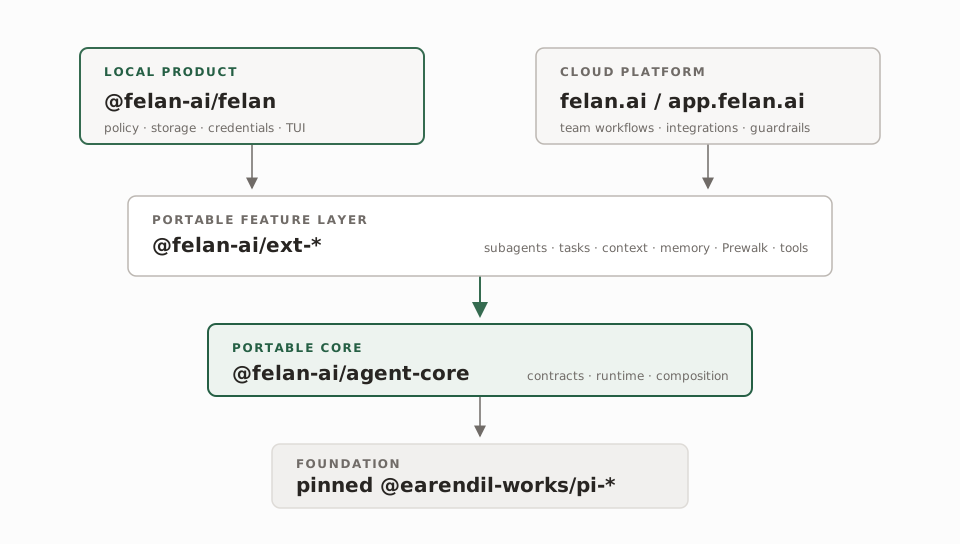
Felan wraps Pi; it does not fork Pi. Pinned Pi packages provide the model, session, extension, and TUI primitives; Felan owns the host contracts, feature behavior, policy, storage, and presentation around them.
Behavior stays in its owning layer: apps/felan owns CLI, TUI, ACP, headless,
client-local themes, local service providers and the default host.json.
apps/daemon owns admission, canonical session/process lifetime, persistence
and interaction arbitration. Providers supply local configuration, credentials
and runtime behavior through explicit contracts. ext-* packages own portable
feature behavior, and Agent Core owns adapter-neutral contracts and base
composition. Clients depend on the daemon; the daemon never depends on clients.
See Extension services and generic UI.
Documentation
The documentation hub routes readers by audience:
- Getting started
- Local CLI
- Configuration
- Commands and shortcuts
- Agents, tasks, and Prewalk
- Context and memory
- Web, MCP, browser, and documents
- Efficient execution and savings
- Architecture
- Runtime and security
- Comparisons with Codex, OpenCode, Claude Code, Pi, and Oh My Pi
- Contributing
- Release process
Repository map
| Package | Purpose | Documentation |
|---|---|---|
@felan-ai/felan |
Felan Code and the felan binary |
Local CLI |
@felan-ai/daemon |
Session daemon, admission and canonical execution lifetime | Services and UI |
@felan-ai/agent-core |
Portable runtime contracts, prompt, tools, model tiers, and Pi composition | Architecture |
@felan-ai/ext-subagents |
Tracked asynchronous subagent protocol | Agents and tasks |
@felan-ai/ext-tasks |
Dependency-aware root-session task graph | Agents and tasks |
@felan-ai/ext-prewalk |
Same-session planner-to-implementation handoff | Agents and tasks |
@felan-ai/ext-ask-user |
Structured one-to-four-question input | Commands |
@felan-ai/ext-context |
Progressive nested project context | Context and memory |
@felan-ai/ext-context-view |
Estimated context-window usage inspector | Context and memory |
@felan-ai/ext-insights |
Local session analytics reports | Commands |
@felan-ai/ext-prompt-history |
TUI prompt-history picker | Commands |
@felan-ai/ext-memory |
Portable local-first memory contracts | Memory architecture |
@felan-ai/ext-output-style |
Validated concise, explanatory, and custom response instructions | Configuration |
@felan-ai/ext-web-access |
Bounded web discovery and matching text/PDF passages | Web access |
@felan-ai/ext-mcp |
Portable OAuth-only remote MCP gateway | MCP |
@felan-ai/ext-felan-api |
Single authenticated Felan API gateway | Configuration |
@felan-ai/ext-browser |
Reviewed agent-browser CLI integration |
Browser |
@felan-ai/ext-markitdown |
Bounded office-document conversion | Documents |
@felan-ai/ext-background-bash |
Background processes, PTY input, and logs | Commands |
@felan-ai/ext-codex |
GPT-specific structured tools and request controls | Configuration |
@felan-ai/ext-rtk-optimizer |
RTK command rewriting and output compaction | Runtime dependencies |
@felan-ai/ext-codebase-memory |
Structural code search, symbol reads, and bounded grep augmentation | Runtime dependencies |
@felan-ai/ext-powerline |
ANSI-aware local TUI footer | Local CLI |
@felan-ai/ext-session-title |
Automatic first-prompt session names | [Local CLI](https://github.com/felan-ai/felan/blob/HEAD/docs/user-g |