Felix is a replicated log over QUIC that serves streams, caches and queues from one system.
- Fanout. Each publish is encoded once, however many subscribers read it, and every subscriber has its own bounded queue. By default a slow consumer drops records instead of holding up a publisher or anyone else.
- Streams, caches and queues. A stream is the log read forward, a cache is its latest value per key, and a queue is a durable cursor over it, with one client, one wire protocol and one access model.
- Replication. Quorum acknowledgement and fenced failover, with the protocol model-checked in TLA+ and fault-injection tests that kill brokers and simulate power loss mid-write.
Try it in one command. A control plane, a broker and development credentials, from the released images:
curl -fsSLO https://raw.githubusercontent.com/GetFelix/felix/main/compose.yaml
docker compose up                                      # Podman: PODMAN_COMPOSE_PROVIDER=docker-compose podman compose up
docker compose run --rm felixctl sub orders            # in a second terminal
docker compose run --rm felixctl pub orders 'hello'    # and a third
The stack prints how to point an installed felixctl at it. The credentials are for local use only;
see Docker Compose.
The Quickstart goes further, and the rest is at docs.getfelix.dev.









Felix is pre-1.0: APIs can still change between releases. The status table marks what is built and what is planned.
System Overview
Felix is a low-latency, QUIC-based replicated log designed for high fanout, high throughput, and predictable tail latency when properly tuned.
Streams, caches and queues are all built on that one log. A stream is the log read forward, a cache is a key → latest-value projection of it, and a queue is a durable cursor over it. A framed protocol (felix-wire) over QUIC streams carries all three, with explicit control over multiplexing, batching, and flow control.
Shards are placed across brokers by the control plane, replicated by leader leases and log shipping, and survive losing a leader; a publish can be made to wait for a quorum of the replica set before it is acknowledged.
Two processes run a cluster: brokers, which hold the data and serve clients over QUIC, and a control plane, which holds the metadata and decides which broker leads each shard. ARCHITECTURE.md maps the code: what each crate is, where things live, and the invariants that hold across them.
Pub/sub data flow (happy path):
- Client opens a bidirectional control stream to publish/subscribe and receive acks.
- Broker validates scope, enqueues publish jobs, and fans out to subscribers.
- Each subscription has a dedicated unidirectional event stream for delivery.
- Events are sent as single frames or binary batches with count/time-bounded batching.
Cache data flow (current architecture):
- Client maintains a cache connection pool with long-lived stream workers.
- Cache requests carry a
request_idand are multiplexed over these streams. - Broker processes request frames in a read loop and replies on the same stream.
- This avoids setting up a stream per request and improves tail latency under concurrency.
Performance
Felix is tuned end to end: QUIC transport (path MTU discovery, congestion
window, socket buffers), a shared-frame fanout path that encodes a publish
batch once regardless of subscriber count, dense stream handles on the
publish hot path, byte-budgeted admission control at both client and broker
ingest, and an opt-in thread-per-core mode (core_shards) for stream
ownership. Measured without loss and with TLS 1.3 always on, it reaches sub-millisecond
p999 latency at low fanout, millions of deliveries/sec for small payloads,
and multi-hundred-MB/s sustained for KB-sized payloads at fanout 10. See
v0.6.0 Performance for
current numbers measured on Azure, Benchmarks
for the loopback harness, and
Environment Variables /
Configuration for
the full set of tuning knobs (transport, queue depths/policies, batching,
admission control, core sharding).
Build with --features telemetry to enable per-stage timings and frame
counters. Default builds compile telemetry out (cfg(feature = "telemetry"),
no runtime branches when disabled) to keep instrumentation off the hot paths.
Measure the overhead on your own workload before enabling it in production.
Use cases
- Real-time streaming with high fanout and tunable latency/throughput trade-offs.
- Event pipelines with batch publishing and batch delivery for efficient fanout.
- Low-latency caching over QUIC with predictable tail latency under load.
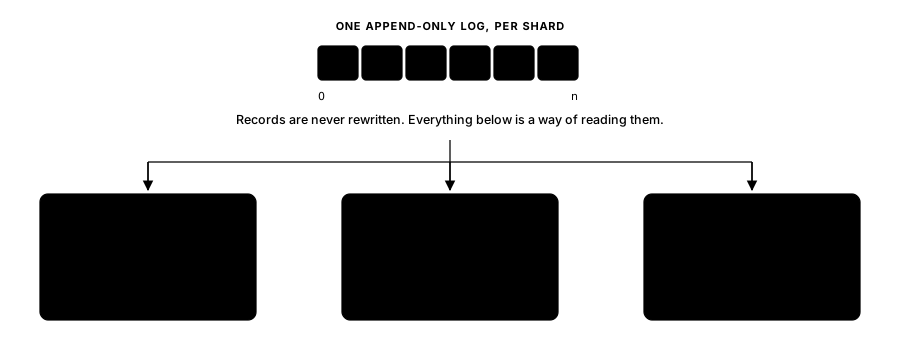
Streams, caches and queues read the same bytes. They share one durability path, one recovery path, one placement rule and one replication path.
For how a cluster fits together, see
docs/architecture.md; for what each reading stores and
the test behind every claim, docs/projections.md.
Current Focus
- Finishing 0.6.0: moving shards between brokers without downtime, backed by
cluster-scale numbers for replicated
Quorumstreams and durable storage - Bounded memory: subscriber queues, QUIC receive windows and the cache key index held to a byte budget instead of growing with load
- Many users over shared connections: gateways that act for their users, with delegation, revocation and shard moves that respect each identity
- A long-running public workload on Felix as stability evidence toward 1.0
Docs
The documentation site at https://docs.getfelix.dev covers the architecture, wire protocol, configuration and environment-variable reference, and benchmarks. For contributors it also walks through the internals of the publish path, the subscribe/fanout path and the backpressure/concurrency model function by function.
In the repository:
ARCHITECTURE.md: a map of the code, for anyone about to change itCONTRIBUTING.md: how to contribute, and how the code is organizeddocs/architecture.md: system architecturedocs/protocol.md: wire protocol specificationdocs/control-plane.md: control plane. It opens with the original Raft sketch, marked as such, then points at the design that was builtdocs/semantics.md: delivery semantics and guaranteesdocs/design.md: product and protocol design notesdocs/auth.md: authentication and authorizationdocs/kafka-compatibility.md: what the Kafka listener speaks and where it stopsdocs/broker-config.md,docs/client-config.md: config field reference with example profilesdocs/demos.md: demo binaries and what each one showsdocs/todos.md: the original MVP checklist, kept as a historical record
The project is building depth before breadth. That means a stable wire envelope and internal data model, and measuring latency and backpressure early to keep p99/p999 predictable.
What works today
- Multi-broker clusters, with every shard of every stream and cache placed on one owner by rendezvous hashing
- Durable log-structured storage with segments, sparse indexes that are always rebuilt from the data, torn-tail repair, and a refusal to start on interior corruption
- Replication with leader leases,
LeaderorQuorumacknowledgement, and failover to a replica that holds the log - A log-backed cache, routed to one owner per key and replicated
- Consumer groups: poll, acknowledge, redeliver, bound the redelivery, dead-letter and redrive
- A control plane over REST, tenant-scoped tokens with RBAC, and capability
negotiation on the wire. Its metadata store is Postgres or an embedded Raft
group (
FELIX_CONTROLPLANE_STORAGE_BACKEND=raft), so availability need not rest on an external database - Online rebalancing: a shard with a live leader is moved by staging the destination as a replica, fencing the leader and cutting over once the copy is level. Draining a broker and adding one both work this way, and an operator can start, cancel and pause moves. The switch-over takes tens of milliseconds. Publishes arriving during it are held and forwarded, and subscriptions follow the shard to its new owner
- Kafka wire compatibility: with
FELIX_KAFKA_LISTENset, Kafka producers (idempotent ones included, with the guarantee holding across a failover) and consumers that assign their own partitions work against durable streams. Consumer groups and transactions are refused with an error that says why, so Connect, Streams and ksqlDB do not work. See Kafka compatibility - Mutually authenticated broker-to-broker QUIC, with each certificate's name
checked against the node id in both directions
(
FELIX_INTERNAL_TLS_CERT/_KEY/_CA). A cluster member refuses to start without them unlessFELIX_INTERNAL_ALLOW_UNAUTHENTICATED=true - Operator-supplied client-facing certificates (
FELIX_TLS_CERT/_KEY, optional client certificates withFELIX_TLS_CLIENT_CA), re-read on rotation, and optional TLS on the control-plane API (FELIX_CONTROLPLANE_TLS_CERT/_KEY)
What does not exist yet
- Per-stream retention: a policy is recorded on the stream and nothing reads it.
Retention itself works, but it is configured per broker
(
FELIX_DURABLE_RETENTION_BYTES/_SECONDS) and is off unless set, so by default a log grows until the disk does - Tiered storage, cross-region bridges, encryption at rest, and audit logging
- Go and mobile clients. Python, TypeScript and the C ABI wrap the Rust client, and the C# SDK binds the C ABI, so none reimplements it. The next language has to pass the conformance catalogue first
The status table is kept current per capability. Trust it when another page disagrees.
Getting Started
You need Rust 1.97.1 and Task. Docker or Podman is
optional: task test uses one to run the Postgres tests (see
Docker or Podman).
Build the workspace:
cargo build --workspace
Run the broker service:
cargo run -p felix-broker-service
Run the wire protocol conformance runner:
cargo run -p felix-conformance
With no arguments the conformance runner drives a real broker over QUIC and
checks publish, subscribe and cache behaviour against the protocol. With
verify <results.json> it checks a client's results against the scenario
catalogue every Felix client is held to, which is how the Python, TypeScript, C and C#
clients prove they behave like the Rust one.
Felix runs as a cluster of brokers over a control plane, and as a single broker for development.
Design Discipline
Felix puts fanout, backpressure and isolation ahead of bundling more features, and clear invariants ahead of feature count. Boundaries are explicit, and performance claims are measured. A feature that cannot be enforced in code is incomplete.
Roadmap (Condensed)
Done: QUIC transport with backpressure, the durable log, the control plane and placement, intra-region clustering with replication and failover, the log-backed cache, consumer groups, tenant-scoped RBAC, control-plane high availability over either Postgres or an embedded Raft group, broker-to-broker mTLS, moving a shard without pausing its publishes or ending its subscriptions, a Helm chart, per-stream retention, offload of sealed segments to a directory, and Python and TypeScript clients over the Rust one.
Next, roughly in order:
- Tiered storage beyond offload: reading the copies back, and a cloud object store as the target
- Explicit cross-region bridges
- Encryption at rest and audit logging
Not planned: end-to-end payload encryption (TLS covers each hop, and a client can encrypt payloads itself) and compliance certification.
Detailed plans live in docs/, and the per-capability status table on the docs
site is the authority.
License
Felix uses a split license: the wire protocol (felix-wire), transport layer
(felix-transport), client SDK (felix-client and its Python, TypeScript, C ABI and C#
bindings), and the shapes the services share (felix-common) are Apache-2.0. The broker,
the control-plane server components and the test tooling (including the
conformance kit, which links the broker) are AGPL-3.0:
open source, but running a modified Felix as a network service means
publishing your changes. See LICENSING.md for the full
breakdown and rationale.
Copyright (c) 2026 Felix Authors