geo-score
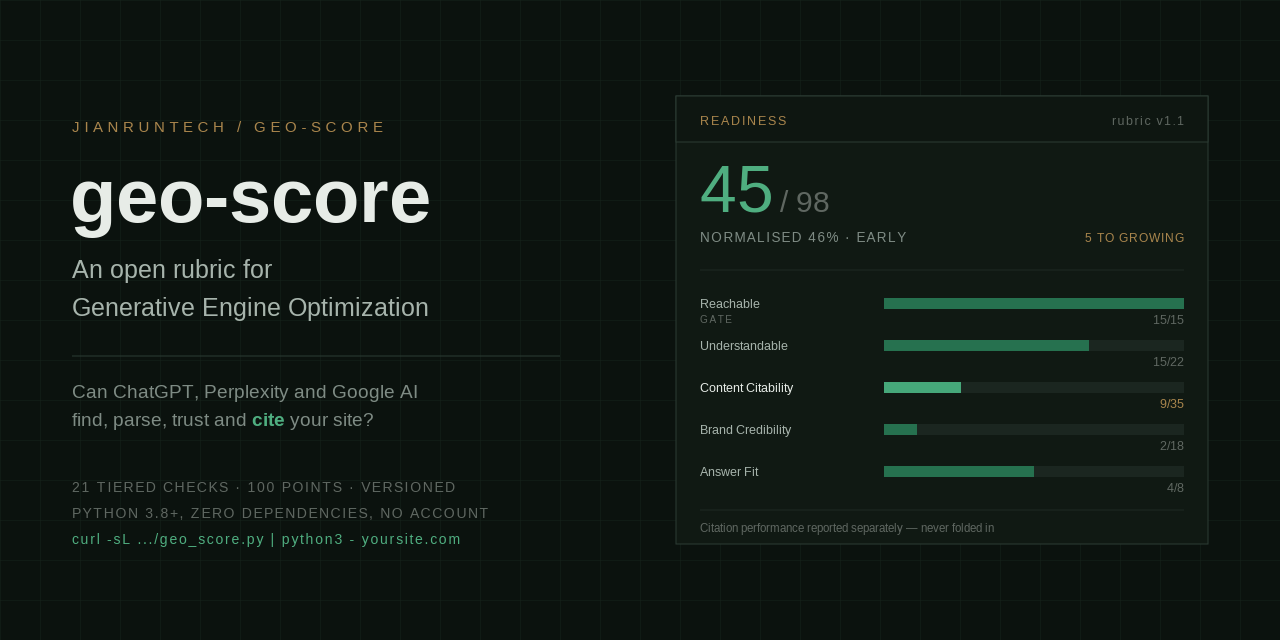
geo-score is an open-source AI visibility (GEO) scorer for websites, by Jianrun Tech (见润科技). Formerly geo-watch: geo-watch merged into geo-score in 1.2.0 and lives on as its levels 2 and 3. Website, docs and a free online check: geo-score.dev.
geo-score in 60 seconds
One command, a 0–100 score, the three gates, the gaps worth fixing first, and why every point can be re-checked.
https://github.com/user-attachments/assets/2270314f-446a-4c2d-b27f-11e1f6d66ff8
English · 60 seconds · Chinese version
Can AI engines cite your site? A free 0–100 score from one command. Do they? Check through their APIs with your own keys.
geo-score scores a website from 0 to 100 on whether AI answer engines can reach it, parse it, trust it and cite it, against a published, versioned rubric that anyone can recompute. Then, with your own API keys, it asks the engines the questions your buyers ask and records whom the answers cite. The score is free and needs nothing installed; the citation results are reported beside it and never added to it.
Quick start · Screenshots · What it checks · How accurate is it? · Docs · Website · Changelog · Public leaderboard






Version: the current release is
geo-score==1.8.3on PyPI, with its tag, wheel and checksums on GitHub Releases; what changed is in the changelog. Every install line on this page is pinned to that release (scripts/release.py --bumpmoves them together), so the tool you run is the one these pages describe. The rubric is versioned separately, and v1.1 is current. main can run ahead of the release: for CI and client work, use the pinned release.
❤️ Sponsors
Want to appear here? · Sponsorship never affects the rubric, any score, the public leaderboard or the technical recommendations in these docs.
Click to collapse
 |
Thanks to CCSub for sponsoring this project! CCSub is an AI API relay platform: one API key for Claude, GPT, Gemini and DeepSeek models, compatible with Claude Code, Codex, Cursor and other coding tools. Register via this link. |
Sponsors have not been tested for geo-score's citation measurements (levels 2 and 3). Those need each engine's own search-enabled API, and a relay may not pass web search and citations through unchanged.
What problem it solves
GEO means Generative Engine Optimization — getting cited by ChatGPT, Perplexity, Google AI Overviews, Gemini and Copilot. Nothing to do with geography or maps.
An answer engine quotes passages from sources it can reach, parse and trust. The reasons a site is left out are often
small and invisible from a browser: a robots.txt line that turns a retrieval crawler away, a page whose text only
exists after JavaScript runs, figures with no source. geo-score finds which of these a site has and what each one is
worth, then checks whether the engines cite it, in three levels:
Score (free, no key) → Ask one question (your API keys) → Watch a question set every week (your API keys).
Three levels, one tool
| Level | What it answers | Needs | Command |
|---|---|---|---|
| 1 · Score | Can AI engines reach, parse, trust and cite the site? 0–100 against the open rubric | Nothing: no key, no install | geo_score.py stripe.com |
| 2 · Ask | Right now, for a question you care about, do they cite it? | An API key for any of OpenAI, Perplexity, Gemini, Anthropic, OpenRouter | geo_score.py stripe.com --ask "payments API for marketplaces" |
| 3 · Watch | How often are you cited, against which competitors and sources, week over week? | Your API keys and a fixed question list | geo_score.py watch run |
flowchart LR
    S[Your site] --> L1["Level 1 · Score<br/>free, no key"]
    L1 --> R["0–100 readiness<br/>5 pillars · 3 gates · biggest gaps"]
    Q[Questions your buyers ask] --> L2["Level 2 · Ask<br/>one question, your API keys"]
    Q --> L3["Level 3 · Watch<br/>a fixed question set, every week"]
    L2 --> C["Who the answers cite<br/>you · competitors · third-party pages"]
    L3 --> C
    R -. reported side by side, never summed .- C
Level 1 is the score. Levels 2 and 3 measure the outcome the rubric keeps out of the score on purpose (two scores, never one): they are reported next to the 100 and never summed into it. A site can score 90 and still lose every answer to a competitor with more third-party coverage, and the reverse also happens, which is why you want both.
Why this is a different question from SEO
Classic SEO asks where do I rank. Answer engines don't rank — they retrieve passages, decide whether a source is worth quoting, and cite it. Different question, different failure modes: a site can sit at position 3 on Google and never be quoted. Because engines retrieve passages, this rubric gives Content Citability the most weight. That is a design choice, not a measured effect: the evidence for how much passage shape matters is thin, and the evidence table says where.
Most of what the rubric checks is mechanical and cheap to fix — a robots.txt line, a
JSON-LD block, a date in a template, a paragraph rewritten so it stands on its own. The
hard part is knowing which of them you are missing, and what each one is worth.
Two guides start here: can ChatGPT read your website?, a check you can do by hand and then with geo-score, and how geo-score differs from a general AI SEO skill.
Screenshots
Every image shows real output, captured for this page.
 Level 1 in a terminal. geo_score.py jianruntech.com (the maintainer's own site), run with geo-score 1.8.3 on 2026-10-17; the output with its colours, rendered to an image. Cut before the observations outside the score. |
 The GitHub Action's job summary for the same report: the Markdown action/summary.py writes, rendered by GitHub's Markdown API. Cut after the check table. |
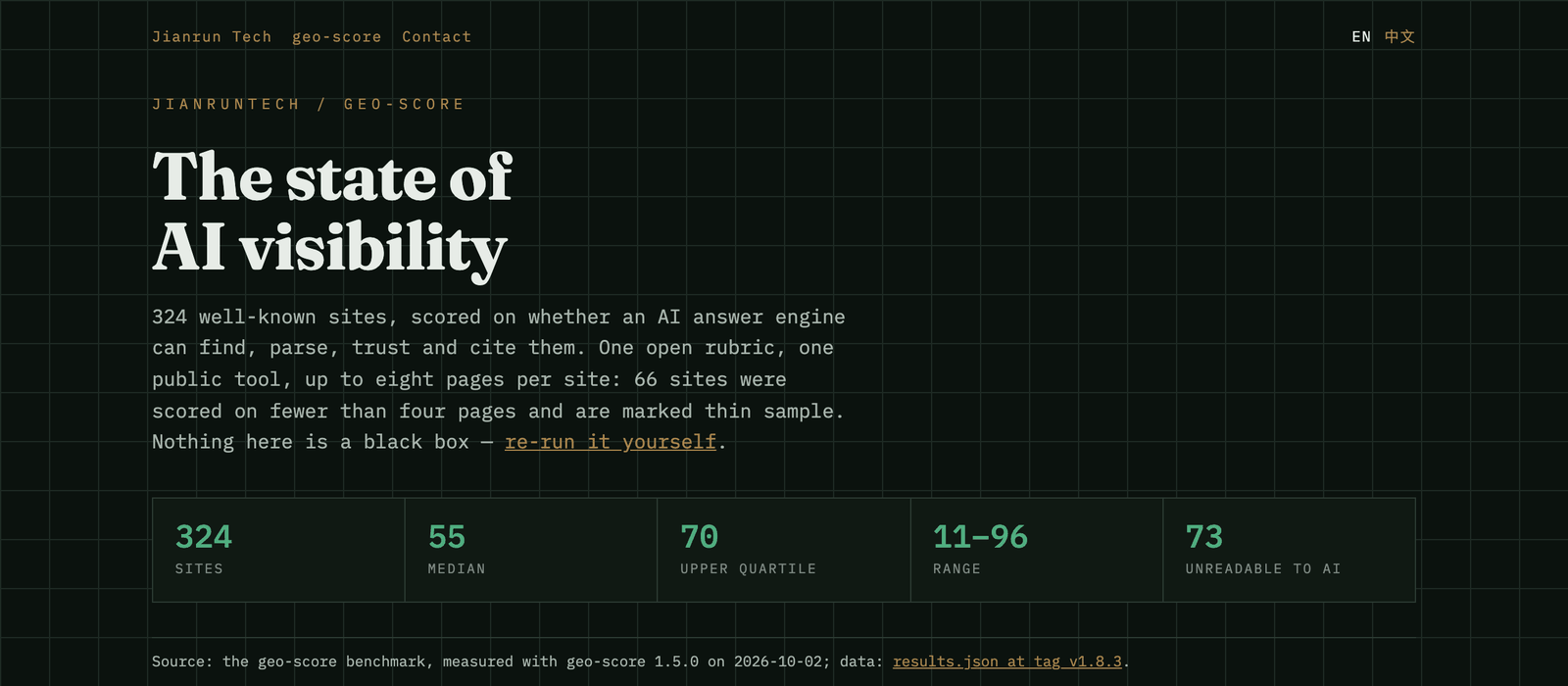 The public leaderboard, captured 2026-10-17. Its figures come from the 2026-10-02 run with geo-score 1.5.0. |
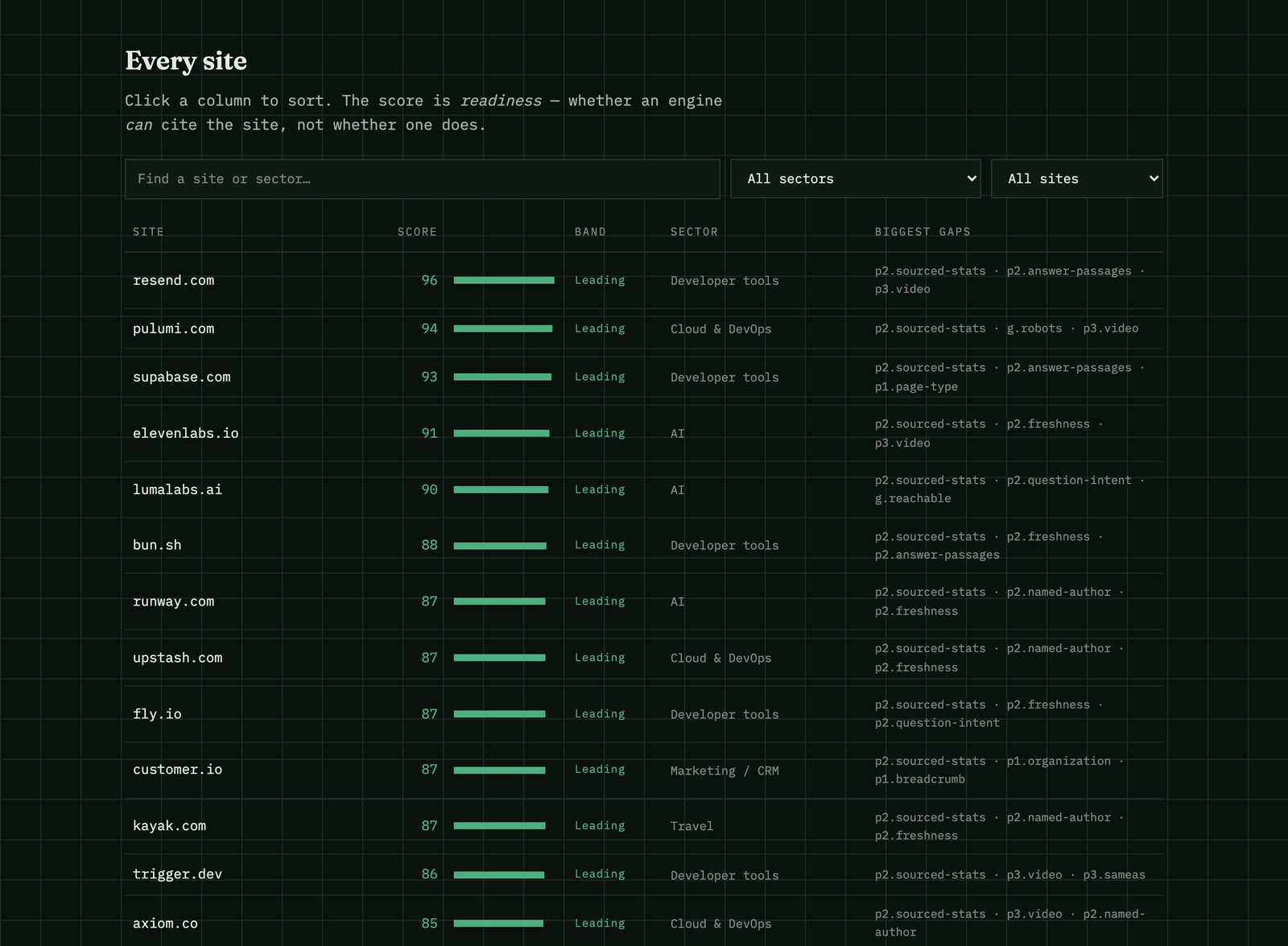 Every site on the leaderboard, sortable, with its band, sector and three biggest gaps by check id. Same page, same capture. |
Core capabilities
| Capability | What it does | More |
|---|---|---|
| Score (level 1) | 21 tiered checks in five pillars, three gates, the biggest gaps first, and what each next tier needs. One file, standard library only, no key | What it checks |
| Ask (level 2) | Puts one question to ChatGPT, Perplexity, Gemini and Claude through their search-enabled APIs, with your keys, and reports whom each answer cites | Levels 2 and 3 |
| Watch (level 3) | A fixed question set, week over week: cited rate with a 95% interval, share of voice, the sources the engines lean on, and a diff that calls a change a change only when a paired test says so |
Watch methodology |
| Reports and diffs | Text, JSON against a published schema, SARIF and JUnit; diff compares two reports check by check, and --baseline re-scores the same pages |
CLI reference |
| MCP server | All three levels as tools for agents over stdio; --read-only gives a server that cannot spend |
MCP server · guide/mcp.md |
| GitHub Action | Scores on every push, fails the build on a regression or a gate at zero, and writes a job summary | GitHub Action · action.yml |
| Badge | An optional SVG, or shields.io endpoint JSON, with your score and band. It never moves a score or a leaderboard place | Badge |
| Claude Code skill | The CLI, plus the three checks that need off-site search or human judgement | Claude Code skill · SKILL.md |
What it checks
21 tiered checks totalling 100 points, plus 4 bonus checks worth up to +6 outside the denominator. Full specification: rubric/v1.1.md · 简体中文
| Pillar | Pts | Asks |
|---|---|---|
| Reachable — gates | 15 | Can a retrieval crawler get the page at all? robots.txt, live reachability across 10 AI user-agents, server-rendered content |
| Understandable | 22 | Can it tell what the page and the company are? Organization + WebSite, llms.txt, sitemap, breadcrumbs, page-type schema |
| Content Citability | 35 | Is there anything here worth quoting? Self-contained answer passages, headings that match how people ask, sourced figures, real bylines, freshness |
| Brand Credibility | 18 | Why should an engine trust it? Knowledge-graph entity, third-party listings, sameAs that resolves, video presence |
| Answer Fit | 10 | Is the content shaped to be lifted into an answer? |
Content Citability carries the most weight by design: answer engines retrieve
passages, not domains. Whether passage shape outweighs domain authority is not
established: the heaviest single check, p2.answer-passages, rests on thin support
(where the evidence is thinnest).
Every scored check is tiered — 2 to 4 tiers, each naming a count out of the 8 sampled pages, so two people scoring the same site agree on the arithmetic. Three checks are gates: score zero on crawler access, live reachability or server-rendered content and the result caps at 40, because until a crawler can reach the content nothing else you change has any effect.
Bands
| 0–30 | 31–50 | 51–65 | 66–82 | 83–100 |
|---|---|---|---|---|
| Not started | Early | Growing | Solid | Leading |
Band names describe a stage, not a verdict. External benchmarks put most business sites in the 30–55 range, so a score in the forties is ordinary, not alarming. In this repository's own benchmark, 85% of 324 sites reach Early and 6% reach Leading (where the cuts fall).
324 sites, scored in public
A quarter of them are unreadable to AI crawlers. 73 sites have a gate check at zero — an
AI retrieval crawler cannot get the content, so it has nothing of theirs to quote. 20 block AI crawlers by name in
robots.txt, which is an editorial choice and reported as such — amazon.com lands at 17
for exactly this reason. 41 serve a page whose body only exists after JavaScript runs.
Their content is there, a browser sees it, and a crawler gets an empty shell. That group
almost certainly did not choose it. At a further 12 the server refuses crawler user-agents (unverified
probes from the auditor's address).
Median 55 (95% CI 51–58, stats.py). Range 11 to 96. 66 sites were scored on fewer than four pages; without them the median is 59.
| Site | Score | Band |
|---|---|---|
| resend.com | 96 | Leading |
| pulumi.com | 94 | Leading |
| supabase.com | 93 | Leading |
| elevenlabs.io | 91 | Leading |
| lumalabs.ai | 90 | Leading |
| … | ||
| qcloud.com | 12 | Not started |
| mercadolibre.com | 12 | Not started |
| keepa.com | 11 | Not started |
The full table, by sector → · markdown · raw data · CSV · every site's full report · re-run it
Two more findings worth the click. Sites in the five China sectors score 22 points lower than everyone else (95% CI 16–30; median 36 against 58; earlier samples measured with 1.1.0 put the gap between 16 and 23 points). Grouped by the language a site serves instead, the 54 Chinese-language sites score 26 points lower than the 270 others (95% CI 22–32), and within matched sector families the gap runs from -8 to 27 points. Counted check by check in raw points, 69% of the gap sits in checks the CLI reads with a heuristic, so at most that share could be the tool misreading Chinese pages (the breakdown). The two largest per-check differences, question-shaped headings and self-contained answer passages, are heuristics the CLI also read lower than a human on the one Chinese site in the hand-audit comparison, so part of the gap may be the tool reading Chinese pages conservatively. From 1.5.0 the CLI reads each page in its own language and counts Chinese task, explanation and comparison headings; the leaderboard above was measured with 1.5.0, so its figures include that change. And statistics that carry a source and a named, verifiable byline are among the three largest gaps on more than half the sites.
Every number here is reproducible with the command in Quick start (the benchmark was run with 1.5.0 on 2026-10-02) — and we measured how reproducible. On 2026-10-12, 1.8.0 scored the whole list three times from one place the same day (the third run re-reading the first run's pages): of the 317 sites scored every time, 99% landed within ±5 between the first two runs and 81% scored identically (ICC 0.99, SEM 1.9; REPRODUCIBILITY.md, derived by benchmark/retest.py). An older 1.1.x build, measured on 2026-09-09, put 96% within ±5 and 45% identical. Read one site's score as ±5 rather than as exact; medians are stable. Most of what still moves is the knowledge-graph lookup, which went unanswered on most sites from that vantage, and the gate checks of sites whose bot protection answers a crawler differently from one run to the next. The band, the control experiment and the per-site pairs are in benchmark/REPRODUCIBILITY.md.
For five reference sites we also publish hand-scored audits covering all 21 checks, with the evidence behind each one: examples/audits/v1.1/.
How accurate is it?
Five questions people ask, and where this repository answers each one:
| Question | Answer | Record |
|---|---|---|
| Score the same site twice: how far apart? | A same-day retest with 1.8.0 on 2026-10-12: 99% of 317 sites within ±5 and 81% identical (ICC 0.99) | REPRODUCIBILITY.md |
| Can anyone recompute it? | Yes: every check, tier and weight is published, so the same pages give the same score whoever runs it | rubric/v1.1.md |
| Does it match a person reading |