

Hybrid retrieval for RAG, fast on any CPU.
BM25 and dense vector search over the same chunks, fused, in one Rust engine.
No server, no vector database, no GPU, and a default tier that needs no model runtime.


Quickstart · Benchmarks · How it works · Documentation · Design records
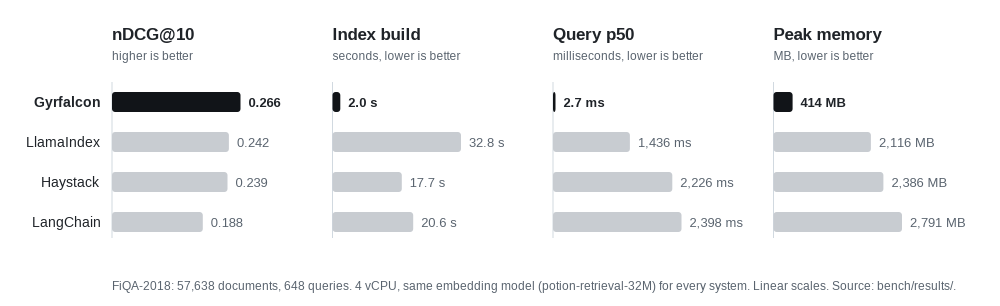
0.266nDCG@10 on FiQAhighest of four frameworks |
2.0 sto index 57,638 docs9 to 16x faster |
2.7 msquery latency, p50over 500x faster |
414 MBpeak memory5 to 7x less |
Lite tier against LlamaIndex, LangChain, and Haystack, same embedding model, 4 vCPU. Details below.
Quickstart
pip install gyrfalcon # add [pdf] for PDF files, [full] for the transformer tier
from gyrfalcon import Collection

with Collection("./my-index") as col:                 # created on first use
    col.add_path("docs/")                              # PDF, HTML, Markdown, and text files
    col.add("note-1", "Gyrfalcons are the largest falcons.", metadata={"topic": "birds"})

    for hit in col.search("largest falcon", k=5, filter={"topic": "birds"}):
        print(f"{hit.score:.3f}  {hit.doc_id}  {hit.text[:80]}")
Note
The first PyPI release is pending. Until then, install from source:
cd crates/gyrfalcon-py && pip install maturin && maturin develop --release. See Installation.
The model (130 MB) downloads on first use. Every write is durable when the call returns, and the
next search sees it. update replaces a document atomically; delete removes it.
Command line
cargo install --git https://github.com/lucasdmarshall/gyrfalcon gyr-cli
scripts/fetch-models.sh                            # from a clone: models into .models/

gyr index ./my-index docs/ --metadata source=handbook
gyr query ./my-index "largest falcon" --filter source=handbook
gyr serve ./my-index                               # HTTP API on 127.0.0.1:7700
Rust
cargo add gyrfalcon --git https://github.com/lucasdmarshall/gyrfalcon
use std::path::Path;
use gyrfalcon::{Document, Filter, RetrieveOptions, Tier};

fn main() -> gyrfalcon::Result<()> {
    let models = Path::new(".models").join(Tier::Lite.model_dir());
    let mut index = Tier::Lite.open(Path::new("my-index"), &models, true)?;

    index.index_documents(&[
        Document::body("falcon", "The gyrfalcon is the largest falcon.").with_metadata([("topic", "birds")]),
    ])?;

    let birds = Filter::new().eq("topic", "birds");
    let hits = index.retrieve_filtered("largest falcon", RetrieveOptions::default(), Some(&birds))?;
    for hit in &hits.hits {
        println!("{:.3}  {}  {}", hit.score, hit.doc_id, hit.body);
    }
    Ok(())
}
HTTP
curl -X POST localhost:7700/v1/documents \
  -d '{"documents": [{"doc_id": "falcon", "text": "The gyrfalcon is the largest falcon."}]}'
curl -X POST localhost:7700/v1/retrieve -d '{"query": "largest falcon", "limit": 5}'
curl -X PUT  localhost:7700/v1/documents/falcon -d '{"text": "Gyrfalcons breed in the Arctic."}'
Every endpoint is in the configuration reference.
Already using LangChain or LlamaIndex? A twenty-line adapter makes a collection their retriever: from LangChain · from LlamaIndex.
Benchmarks
Each framework builds its standard hybrid retriever (BM25 plus dense, fused) over the same BEIR data with the same embedding model, on the same 4-vCPU cloud VM.
Lite tier, all four datasets
| nDCG@10 | Gyrfalcon | LlamaIndex | LangChain | Haystack |
|---|---|---|---|---|
| SciFact | 0.709 | 0.695 | 0.604 | 0.674 |
| NFCorpus | 0.344 | 0.308 | 0.254 | 0.327 |
| ArguAna | 0.491 | 0.473 | 0.387 | 0.441 |
| FiQA | 0.266 | 0.242 | 0.188 | 0.239 |
| Query p50 | Gyrfalcon | LlamaIndex | LangChain | Haystack |
|---|---|---|---|---|
| SciFact | 1.7 ms | 108 ms | 116 ms | 166 ms |
| NFCorpus | 1.6 ms | 79 ms | 69 ms | 117 ms |
| ArguAna | 2.1 ms | 190 ms | 666 ms | 534 ms |
| FiQA | 2.7 ms | 1,436 ms | 2,398 ms | 2,226 ms |
Full tier (bge-small-en-v1.5), SciFact
| Gyrfalcon | LlamaIndex | LangChain | Haystack | |
|---|---|---|---|---|
| nDCG@10 | 0.743 | 0.727 | 0.639 | 0.714 |
| Index build | 193 s | 1,251 s | 636 s | 657 s |
| Query p50 | 9.1 ms | 159 ms | 137 ms | 167 ms |
| Peak memory | 499 MB | 1,520 MB | 1,513 MB | 1,451 MB |
One core, held-out datasets, and run-to-run variance
One core. Every process pinned to a single core: SciFact indexes in 0.9 s against 7.1 to 18.6 s, and queries take 2.2 ms against 110 to 177 ms.
Held-out datasets. Four BEIR sets that were never used to choose any setting. Lite tier, nDCG@10:
| TREC-COVID | SciDocs | Quora | Touché-2020 |
|---|---|---|---|
| 0.680 | 0.165 | 0.834 | 0.318 |
Variance. Five back-to-back runs over eight datasets: nDCG@10 identical to every digit, p50 within 1.5x across runs, p99 under 12 ms at the median on every set (table).
Important
Gyrfalcon's fusion weights were chosen on validation queries of the tuning datasets; the other frameworks run their defaults.[^tuned] With the same fusion rule, Gyrfalcon's full tier and LlamaIndex tie on SciFact (0.727). The speed and memory gaps do not depend on tuning. Read the methodology and disclosures before quoting a number.
Reproduce everything with one command: scripts/reproduce.sh lite or scripts/reproduce.sh compare
(Reproducing). Raw reports are in bench/results/.
How it works
flowchart LR
    Q([query]) --> P[prepare once]
    P --> B["BM25<br/>owned index,<br/>collection-wide stats"]
    P --> E[embed once]
    E --> D["dense cascade<br/>1-bit prefilter, 4-bit estimate,<br/>exact int8 cosine"]
    B --> F{{"rescore every candidate<br/>with its exact cosine, fuse"}}
    D --> F
    F --> H([top k chunks])
- One prepare, two legs. A query is normalized and analyzed once; BM25 and the dense search run in parallel on the same text.
- An owned BM25 index. Bit-packed postings with block skip data, scores identical to Tantivy's, stemming and stopwords, statistics summed across segments so a chunk scores the same wherever it lives.
- A graph-free dense index. Sign-bit codes of rotated vectors, a Hamming prefilter, a 4-bit estimate, and an exact int8 rescore. It finds 0.996 to 1.000 of the exact top 50 with no graph to build, which is why indexing is fast.
- Rescore fusion. Every candidate from either leg gets its exact cosine, so a chunk only BM25 found is not penalized. The lite tier mixes the scores as
$$ \text{score}(d) ;=; (1-w),\frac{\mathrm{BM25}(d)}{\max_{d'} \mathrm{BM25}(d')} ;+; w,\cos(q, d), \qquad w = 0.45 $$
- Writes that survive crashes. Small writes go to a write-ahead log and an in-memory buffer that queries see at once; larger ones seal immutable segments that merge in the background. Every state change is one atomic rename. Updates replace a document in one step.
The full design, with the measurement behind every decision, is in Architecture and the design records.
Two tiers
lite (default) |
full |
|
|---|---|---|
| Embedder | potion-retrieval-32M, a static table | bge-small-en-v1.5, int8 transformer |
| Needs | nothing | ONNX Runtime (pip install "gyrfalcon[full]") |
| Index speed | 15,000 to 30,000 docs/s on 4 cores | about 25 docs/s on 4 cores |
| Best for | large or changing corpora, small machines | corpora where quality outweighs ingest time |
Start with lite; moving to full is one argument and a rebuild.
Choosing a tier has the trade-off in numbers.
Features
|
Files in, chunks out PDF through PDFium with a layout layer that removes running headers and page numbers and rejoins hyphenated words. HTML by its block structure. Markdown and text as they are. |
Metadata filtersfilter={"lang": "en", "tag": ["a", "b"]}. Applied inside both legs, so a selective
filter still returns a full top k.
|
|
Durable and atomic Writes are fsynced before a call returns. An update's new chunks and the removal of its old ones commit together. A crash loses at most the write in flight. |
Never blocks readers Queries read a snapshot. Merges build outside the writer lock, and retired files are deleted in the background once no query needs them. |
|
One format, four interfaces Python, Rust, the gyr command line, and an HTTP server open the same
collections. Models load at run time; nothing is linked at build time.
|
Safe by construction A collection records its model, vector width, and analyzer. Opening it with anything else fails before a file is mapped, instead of returning plausible wrong results. |
Documentation
| Section | Pages |
|---|---|
| Getting started | Installation · Python quickstart · Rust quickstart |
| Guides | Choosing a tier · Large corpora · Custom embedders · Persistence |
| Concepts | Architecture · Hybrid retrieval · Tiers · Planner |
| Reference | Python API · Rust API · Configuration and HTTP |
| Benchmarks | Results · Methodology · Reproducing |
Roadmap
- Owned BM25 index and graph-free dense index
- Python package, command line, HTTP server
- PDF and HTML ingestion, metadata filters
- Held-out evaluation and run-to-run variance
- First release on PyPI and crates.io
- Pruned BM25 and partitioned dense search for collections past a million chunks
- Adaptive per-query planning (design)
- Corpus distillation for the lite tier (v2 design)
Contributing
Bug reports, fixes, and measured improvements are welcome. Read Contributing for how changes are judged, then Development setup and Testing.
License
Licensed under the Apache License 2.0.
[^tuned]: https://github.com/lucasdmarshall/gyrfalcon/blob/HEAD/Weights were chosen on validation splits of SciFact, NFCorpus, ArguAna, FiQA, and Open RAG Bench, which use different queries from the reported test splits over the same documents. The four held-out datasets above had no part in any choice.