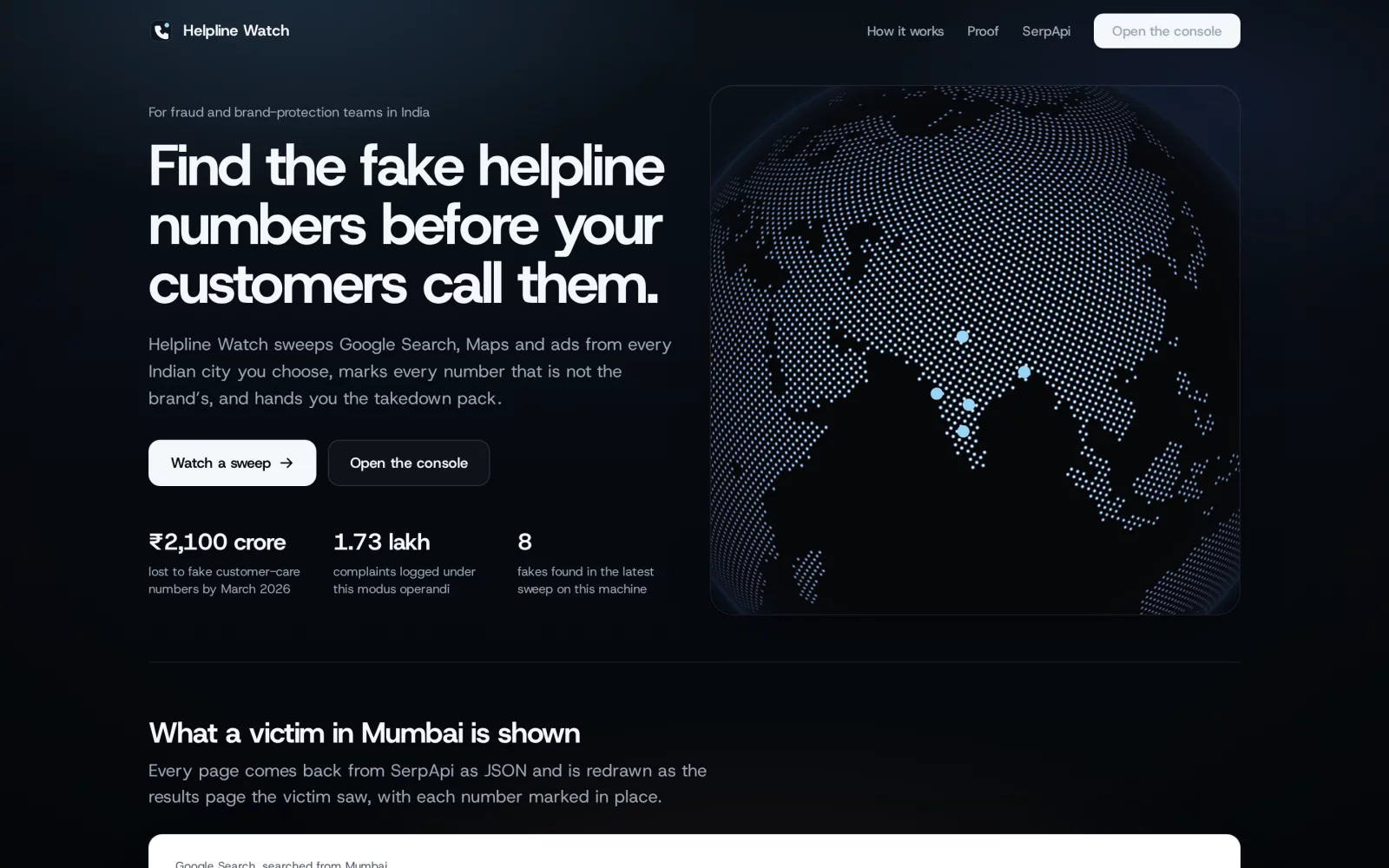

Finds the fake customer-care numbers scammers plant on Google Search, Maps and ads, city by city, before customers call them.
Built for the SerpApi India Hackathon 2026 · track: Knowledge & Public Interest · 3-minute demo video · make verify runs the whole proof with no API key.
The problem
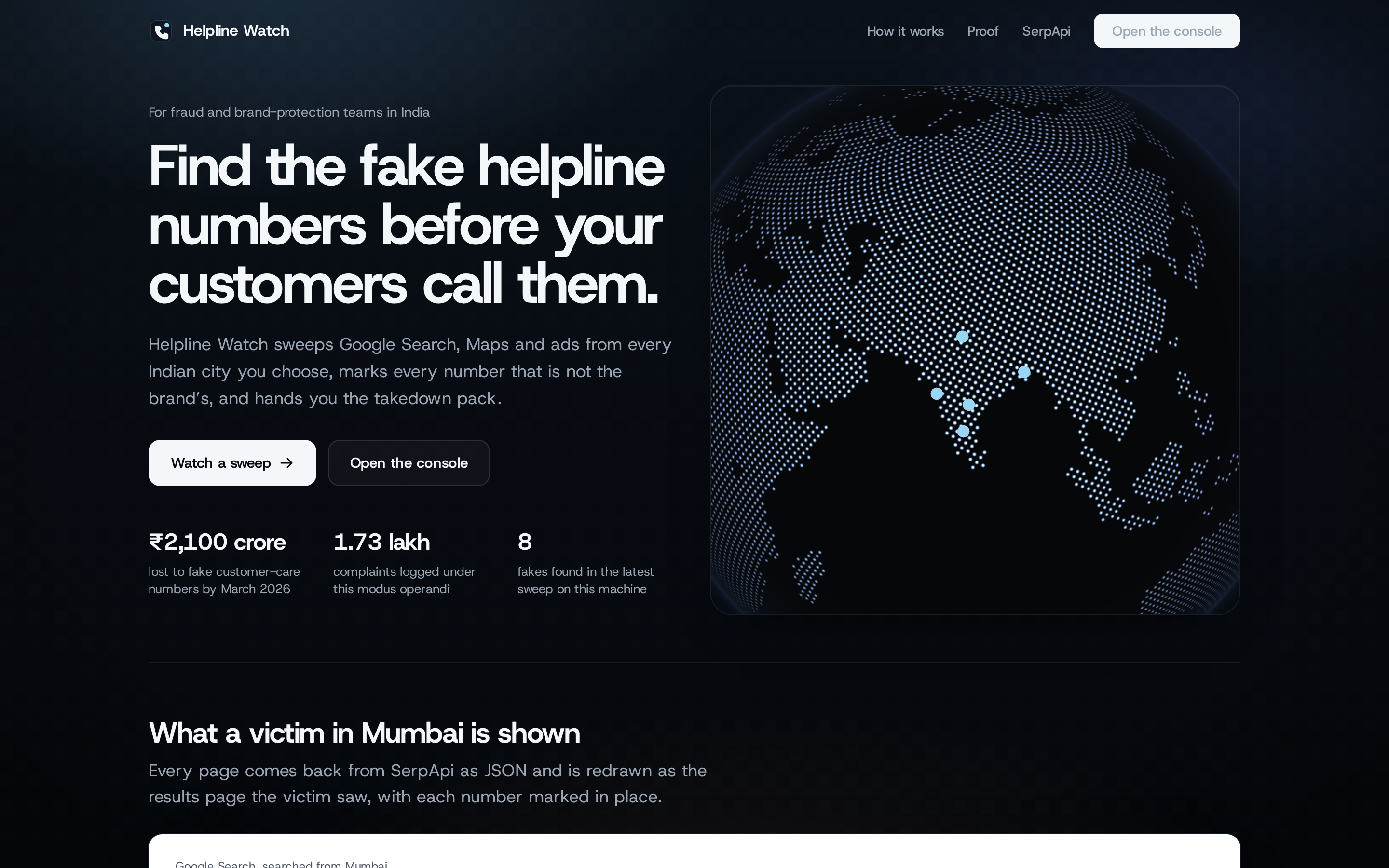
When someone in India needs their bank, food-delivery app or airline, they google "brand customer care number" and call the first number they see. Scammers know this. They plant mobile numbers in Google Maps listings named "HDFC Bank Customer Care Number", buy search ads with one-digit-off helplines, and seed aggregator pages, and they do it per city, so a fraud analyst sitting in Mumbai never sees what a victim in Patna is shown.
- By March 2026 the Indian Cyber Crime Coordination Centre had logged 1.73 lakh complaints under this modus operandi, with losses over ₹2,100 crore; five regions account for 61% of incidents (summary, secondary source).
- All cyber fraud reported on the national portal: ₹55,050 crore across 65.89 lakh complaints as of July 2026 (Ministry of Home Affairs, via The420).
- Named cases: a Bengaluru man lost ₹90,000 calling a fake bank number found on Google; four people were defrauded through a fake number on a sweet shop's Maps listing; Zomato went to the cyber police over a fake helpline.
- Regulators are moving: TRAI's direction of 19 November 2025 makes 1600-series numbers mandatory for RBI/SEBI/PFRDA-regulated entities' service calls, which is exactly the kind of rule a classifier can use.
Today the sweep is a person with a spreadsheet, googling from their own desk, missing Maps and ads, and unable to see other cities. Helpline Watch does it in one click and hands the analyst a takedown pack.
What it does
- Plans the queries victims actually type, using Google Autocomplete, in English and Hindi.
- Sweeps every surface per city through SerpApi with the
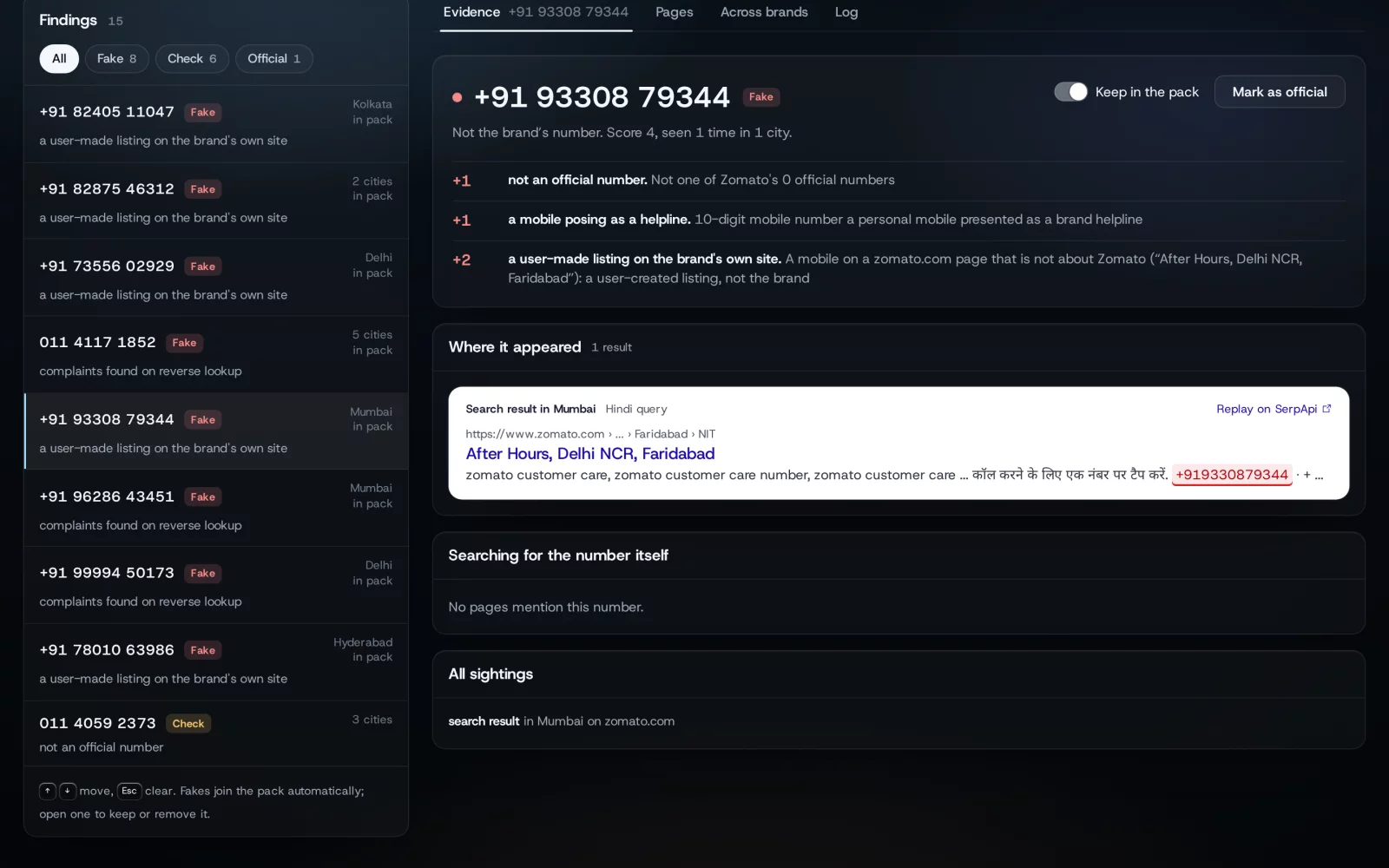
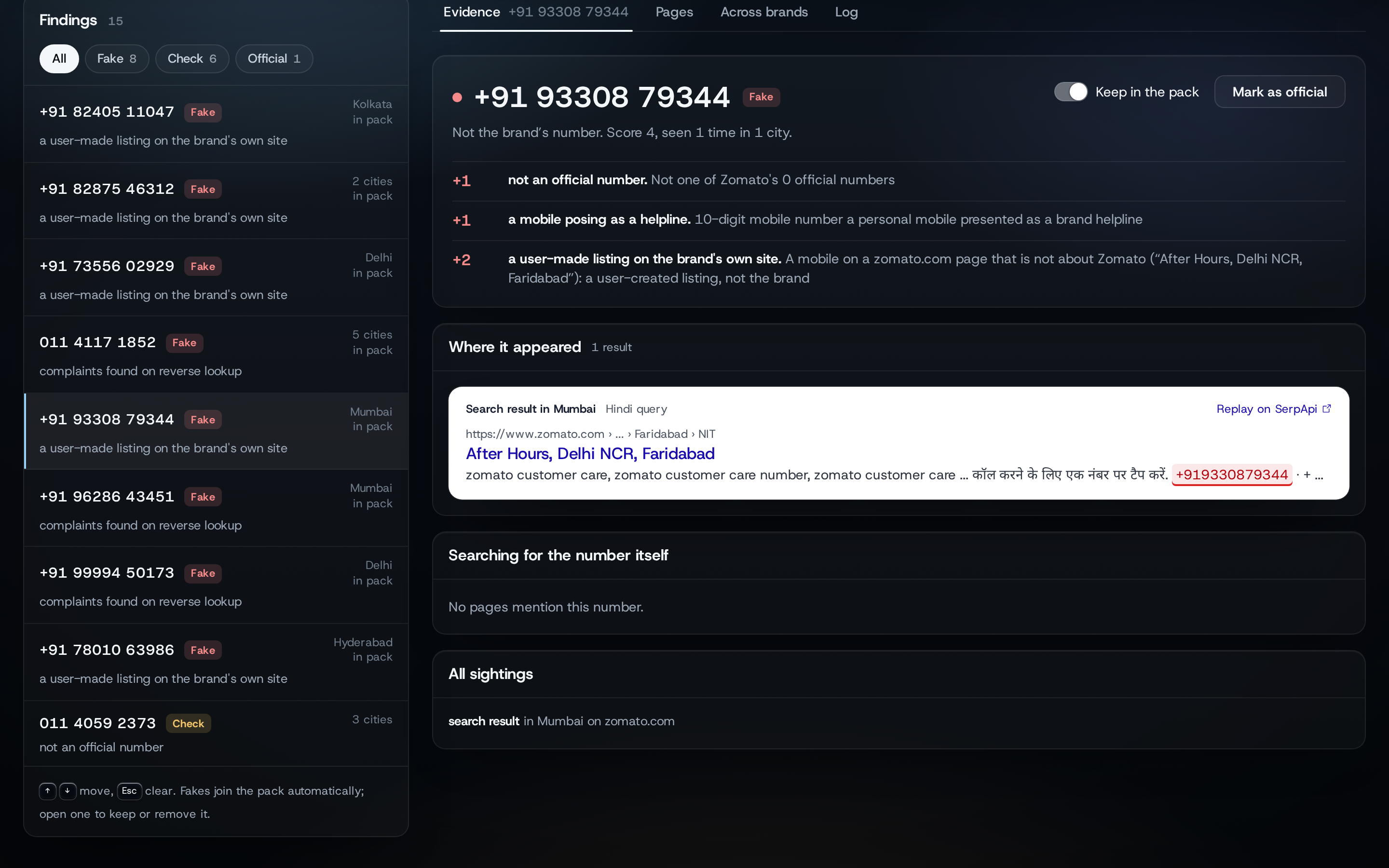
locationparameter: organic results, knowledge panel, answer box, People-also-ask, local pack, Maps listings, search ads, and the Ads Transparency Center for advertisers bidding on the brand name. Each page comes back as a snapshot and is rendered as the page a victim in that city was shown, with the verdicts marked on the numbers themselves. - Extracts and normalises every Indian phone number (mobile, landline, 1800/1860/1600 series, Devanagari digits) and compares each against the brand's official list.
- Scores each number with named, weighted signals and gives a verdict:
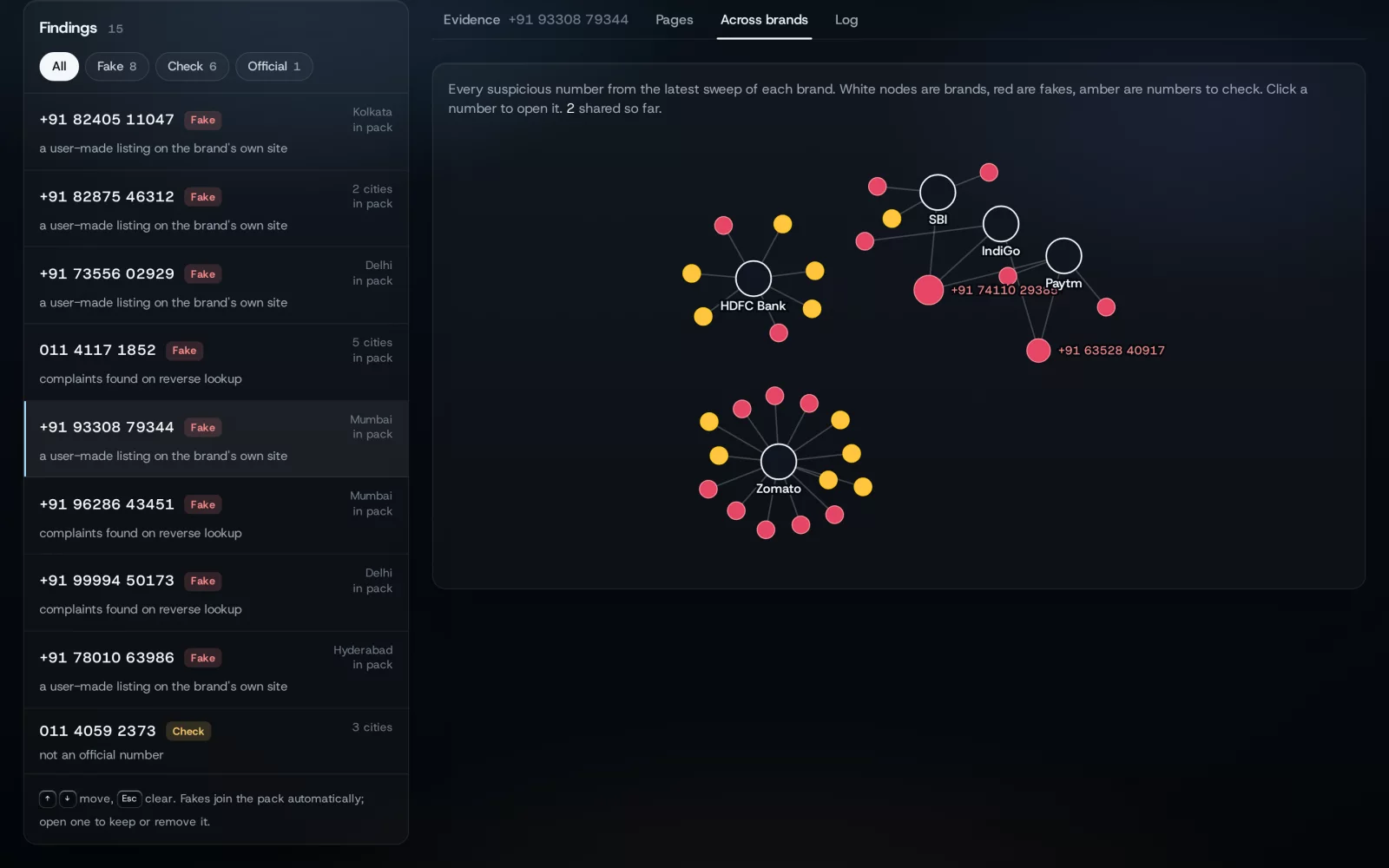
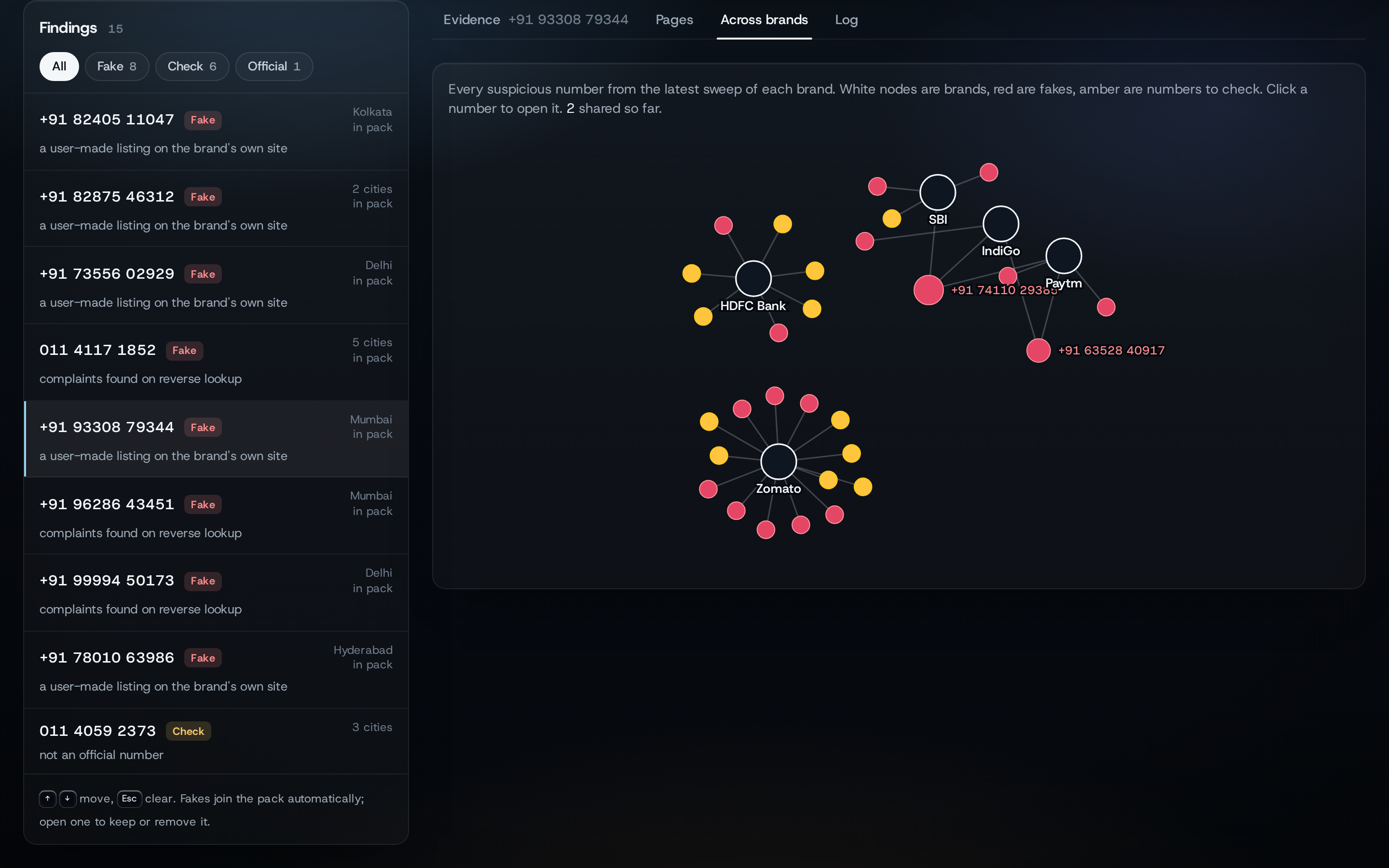
official,official (unlisted),needs review, orfake. No language model anywhere in the verdict path. - Corroborates across brands: the same number posing as SBI, IndiGo and Paytm at once is one operation, drawn as a network.
- Reverse-checks the top suspects by searching the number itself for complaint pages.
- Diffs against the brand's previous sweep: new, persisting, gone.
- Builds the takedown pack the analyst files: CSV, evidence JSON, a report with a replayable SerpApi archive link per sighting, the Maps place link, the right Google report form per surface, and a cybercrime.gov.in complaint template. Nothing is filed automatically; a person keeps or removes every finding.
Quickstart (no API key needed)
Requires Python 3.11+ and uv. Node is only needed if you change the UI.
make setup     # venv + backend install
make demo      # seeds five brands from recorded fixtures, serves http://127.0.0.1:8787 (landing at /, console at /app) and opens it
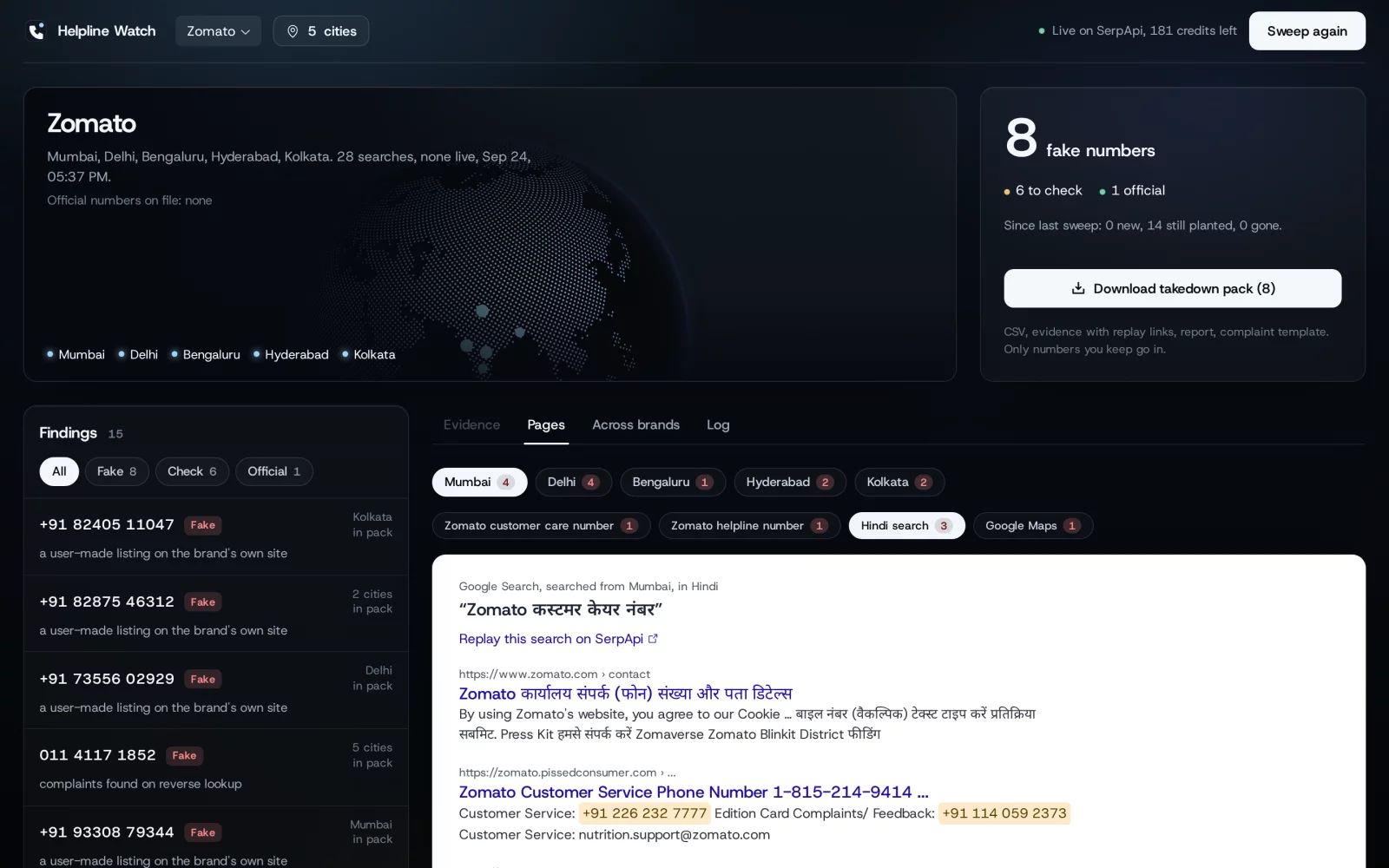
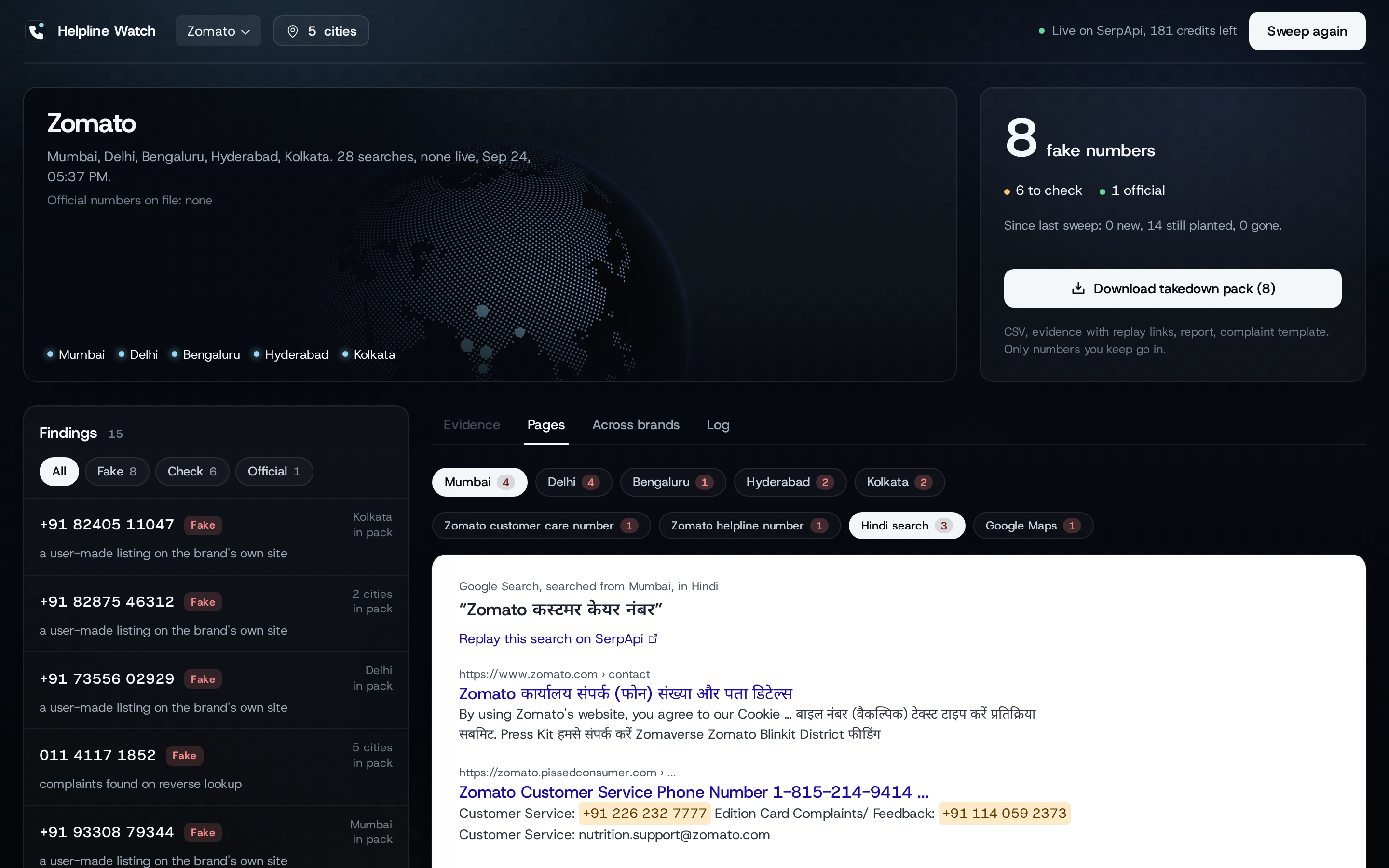
Then press Sweep again, watch the globe's city markers pulse as pages return and the fake count climb, click a number marked Fake, orbit the 3D network under Across brands, and download the pack. Arrow keys move through findings, Esc clears. make verify prints the proof:
  PASS  shared planted number is FAKE  · score=12
  PASS  shared number linked across brands  · other_brands=['IndiGo', 'Paytm']
  PASS  one-digit lookalike is FAKE without complaint evidence
  PASS  official number republished by a third party stays OFFICIAL
  PASS  unlisted number on the brand's own domain is OFFICIAL_UNLISTED
  PASS  unknown landline in a news story stays REVIEW
  PASS  number inside an impersonating ad is FAKE
  PASS  takedown pack has csv, evidence, report and complaint template
  PASS  takedown pack contains only confirmed fakes  · rows=3 fakes=3
  PASS  partial coverage is reported, not hidden  · kolkata 2/3
  PASS  no live SerpApi calls were needed
RESULT: PASS
Go live
cp .env.example .env        # add SERPAPI_API_KEY
make record                 # sweeps every seed brand live and records the responses as fixtures
make demo
Every request is keyed by its parameters, so make record replaces the synthetic fixtures in place and the UI badge flips from "synthetic fixtures" to live. One sweep of one brand across five cities is 23 searches plus up to 10 reverse lookups, so the free plan's 250 searches a month covers about seven sweeps; HELPLINE_MAX_CALLS caps each sweep, and the health endpoint shows credits left. Recorded responses are replayed for free, so a re-sweep of a recorded brand costs nothing.
How it works
flowchart LR
  A[Brand + cities] --> B[Autocomplete<br/>google_autocomplete]
  B --> C[Plan: queries × cities]
  C --> D[google · location=city<br/>organic, ads, local pack, KG, PAA]
  C --> E[google_maps · ll=city]
  C --> F[google_ads_transparency_center<br/>text=brand, region=IN]
  D & E --> G[Extract + normalise numbers]
  G --> H[Classify: named signals → verdict]
  H --> I[Cross-brand index<br/>SQLite]
  H --> J[Reverse lookup<br/>google · number as query]
  I & J --> K[Sweep + diff vs last]
  K --> L[SSE → grid fills live]
  K --> M[Takedown pack ZIP]
  F --> K
Signals (backend/helpline_watch/analysis/classify.py), fake at a score of 3 or more:
| signal | weight | what it means |
|---|---|---|
| NOT_IN_OFFICIAL_LIST | +1 | baseline for any number not on the analyst's list |
| LOOKALIKE_OF_OFFICIAL | +3 | one digit or one swap away from an official number |
| MOBILE_AS_HELPLINE | +2 / +1 | a 10-digit mobile presented as a helpline; +2 for regulated entities (TRAI 1600-series direction) |
| LISTING_NAMED_AS_HELPLINE | +2 | a Maps listing titled like "X Customer Care Number" |
| THIN_OR_UNCLAIMED_LISTING | +1 | unclaimed listing or under five reviews |
| CROSS_BRAND | +3 | the same number seen posing as another brand in an earlier sweep |
| MULTI_CITY | +1 | planted in three or more cities |
| AD_FROM_NON_OFFICIAL_DOMAIN | +2 | shown inside a search ad from a domain the brand does not own |
| SCAM_WORDS_IN_CONTEXT | +2 | the surrounding text already says fraud, scam, fake |
| REVERSE_LOOKUP | +2 | pages about the number mention fraud or sit on complaint sites |
Official matches and numbers found on the brand's own domain short-circuit to green. Everything between 1 and 2 goes to a review queue that never reaches the pack on its own.
Layout
backend/helpline_watch/
  plan.py            the exact SerpApi calls a sweep makes (deterministic)
  serp/client.py     thin client: live / replay / auto, fixtures keyed by params, credit budget
  extract/phones.py  Indian number extraction + normalisation
  extract/surfaces.py  parsers for google, google_maps, ads transparency, reverse lookups
  analysis/classify.py signals → verdict
  sweep.py           orchestrator streaming SweepEvents
  store.py           SQLite: sweeps, cross-brand index, network
  takedown.py        the ZIP the analyst files
  api.py · cli.py    FastAPI + SSE, and the `helpline-watch` command
backend/fixtures/    recorded or synthetic SerpApi responses
frontend/            Vite + React: landing page at /, console at /app, cobe globe, 3D force graph; built into the Python package
docs/adr/            four decisions · docs/demo-script.md the video's narration and shot list
Meaningful SerpApi usage
| SerpApi feature | role in the product | what it would cost to replace |
|---|---|---|
Google Search API with location, google_domain=google.co.in, gl=in, hl=hi |
see the SERP a victim in each city sees, including Hindi queries | a residential proxy network per city |
Google Maps API with ll |
the listings that carry most planted numbers, with phone, reviews, unclaimed_listing, place_id |
scraping Maps, which breaks weekly |
Google Ads Transparency Center API (text, region=2356) |
who is bidding on the brand name in India | manual browsing of the transparency center |
| Google Autocomplete API | the query variants victims actually type | guesswork |
ads, local_results, knowledge_graph, answer_box, related_questions blocks |
every surface a number can hide in, parsed from one response | separate scrapers per block |
search_metadata.id and the Search Archive |
a replayable evidence link for every sighting, valid 31 days | screenshots |
| the full response blocks per call | the Pages tab: every page is redrawn from SerpApi's JSON, in Google's order, so the analyst sees what the victim saw | nothing comparable |
| Reverse lookup: the number as the query | complaint pages and other brands the number poses as | nothing comparable |
What is real and what is simulated
- Real: the pipeline, the parsers (written against SerpApi's documented response shapes), the classifier, the store, the pack, the UI, the tests,
make verify. - Recorded from SerpApi on 24 Sep 2026: Zomato and HDFC Bank. Every one of their fixtures is a real SerpApi response (labelled
recorded, with its Search Archive link), so the demo video and the default console show Google as it was that day. What the live sweeps found:- Zomato (28 searches, 5 cities): 8 numbers flagged fake, 6 to check, 1 official-but-unlisted. Zomato publishes no phone helpline, yet five restaurant listings on zomato.com itself, named to rank for "customer care number", each hand out a personal mobile; an aggregator presents a Delhi landline as Zomato's "toll free" number; two Maps listings ("Zomato office", "BANTI ZOMATO SERVICE") carry mobiles and complaint pages. Every verdict is the tool's; an analyst confirms before anything is filed.
- HDFC Bank (28 searches, 5 cities): 15 official (9 listed, 6 found on the bank's own domain, such as its missed-call numbers), 5 to check, 2 flagged. The real 1800 1600 / 1800 2600 stay green wherever bankbazaar or paisabazaar republish them; the flagged pair are an unclaimed "HDFC Bank" Maps listing in Sarojini Nagar with a personal mobile, and a landline that complaint sites discuss.
- These two brands exposed six real-data bugs that the synthetic world could not (numbers such as "+91 1800 1601" and "1800 1600 / 1800 2600", North American numbers on aggregator pages, house numbers glued to a Maps phone, user-created pages on the brand's own domain, and reverse lookups that land on the brand's site). All are fixed with tests.
- Synthetic for SBI, IndiGo and Paytm, generated by
backend/scripts/make_synthetic_fixtures.pyin the exact response shapes. They are labelledsyntheticin every file and in the UI, never carry an archive link, and their phone numbers are made up. They exist so the cross-brand graph, the lookalike and impersonating-ad cases, and the Paytm-in-Kolkata coverage gap are demonstrable offline;make recordreplaces them with real responses. - Official numbers in
backend/seeds/brands.yamlwere transcribed from public support pages and must be verified by the analyst; the app treats that list as ground truth and lets you edit it from a finding.
Run it anywhere
make docker # builds the image and serves http://127.0.0.1:8787 in replay mode, no key needed
The same image deploys as-is: Deploy to Render uses render.yaml; on Fly, fly launch --copy-config --yes && fly deploy uses fly.toml. Both start in replay mode, so a public instance answers every sweep from the recorded searches and spends no SerpApi credits. Set SERPAPI_API_KEY and HELPLINE_MODE=auto on the instance to go live.
Verify it yourself
make test      # 50 unit + API tests (parsers, classifier, store, SSE stream, pack, patching)
make verify    # end-to-end replay with 11 assertions, prints PASS/FAIL
make eval      # the per-brand table: numbers found, fake, cross-brand, review, calls
make lint      # ruff · oxlint · tsc
Limitations
- The classifier's precision is bounded by its signal set; that is why a
reviewqueue exists and why the pack is gated by a person. On the two recorded brands the known weak spot is the reverse lookup: keyword-stuffed spam blogs that contain the word "scam" next to any number count as complaint evidence, and a brand's second real number (HDFC's 1800 1601 on its own branch listings) is a one-digit lookalike until the analyst adds it to the list. - Numbers inside images (a common scam tactic on Maps photos) are not read; Google Lens or an OCR pass is the obvious next signal.
- Official numbers must come from the analyst; the app suggests additions when it finds numbers on the brand's own domain but does not crawl the site.
- One sweep per brand at a time; a scheduler for weekly re-sweeps is a cron line away but not included.
Demo video
Public link goes here before submission. The video was recorded from the running app (replaying the recorded Zomato and HDFC Bank searches) and narrated by a local text-to-speech model; the narration and shot list are in docs/demo-script.md.
AI disclosure
See AGENTS.md. Built with Claude Code; no model runs inside the product.
License
MIT.