
Klef CLI and core
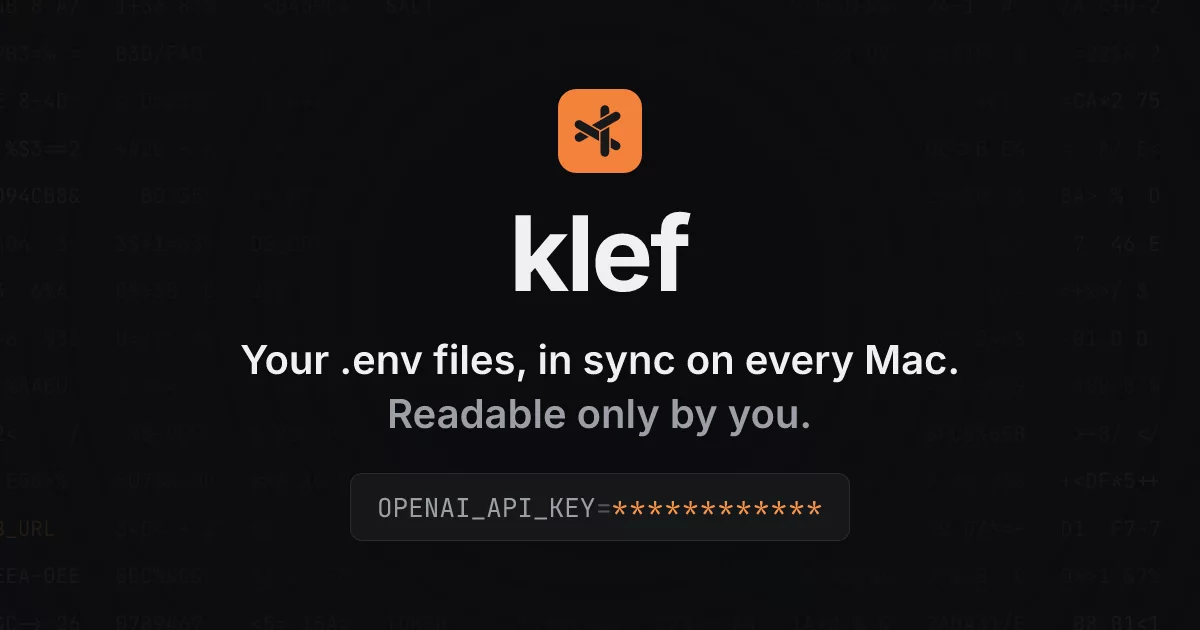
The command line for Klef, personal, end-to-end encrypted
.env sync, and the encryption it shares with the web app. Env files are
encrypted on your device before they leave; the server stores ciphertext it
cannot decrypt. The CLI never prints a secret value, which is what makes it
safe to hand to a coding agent.
This repository holds the code you have to trust:
src/cli:@klefsh/cli, theklefcommand.src/shared:@klefsh/core, the encryption, the blob format and the env-text editing. The klef.sh web app runs this same code in your browser.src/shared/core.tsis its entry, andscripts/core-boundary.test.tskeeps it a closed set that imports nothing buthash-wasm.
The klef.sh server and web app live in a separate repository. This one is exported from it automatically, so every commit here matches what the CLI and the web app actually run.
The CLI
The CLI holds an access token that
reaches ciphertext and plaintext names only, and derives your key locally from
a passphrase read straight from the terminal. It cannot be run unattended by
design: klef unlock lets one passphrase cover a run of commands, held in
memory by a short-lived agent that locks after 15 idle minutes (or
--for 8h, up to 7 days).
One command gets a repo going, and skips whatever is already done:
npx @klefsh/cli setup
It signs you in through the browser, links the repo to a project in your vault
(every env file in it, in .klef.json), unlocks, and pulls the files that are
not on disk yet. It also offers to write a Claude Code skill
(.claude/skills/klef/SKILL.md) and a Cursor rule (.cursor/rules/klef.mdc),
so every later agent session in the repo already knows how to sync these files
and that it must never print a value. setup claude-md agents adds the same
block to CLAUDE.md and AGENTS.md, and setup claude --global installs the
skill for every project. Rerun it to refresh them; it only ever rewrites its
own marked block.
The individual commands:
npx @klefsh/cli login   # approve this machine in the browser
npx @klefsh/cli list    # see what is in your vault (--json for scripts)
npx @klefsh/cli link    # connect this directory to a project in your vault
npx @klefsh/cli pull    # write it to disk (mode 0600), reporting only a count
npx @klefsh/cli run -- npm run dev  # run with the variables; the output is redacted
npx @klefsh/cli unlock  # one passphrase for the next pulls and pushes
npx @klefsh/cli sync    # pull or push each file, whichever side changed
npx @klefsh/cli diff --all  # which keys differ, never their values
npx @klefsh/cli push --all  # every file listed in .klef.json, one confirmation
link records .env.local and .env.production when the project has them
(in the vault or in the directory), so sync, pull --all and push --all
cover both from then on. sync decides per file: a file edited here since it
last matched is pushed, a file changed in the vault since then is pulled over
the untouched local copy, and a file changed on both sides, or one this
machine has never synced, stops the whole run with a key-level diff and the
two commands that settle it. A file the vault does not have yet is created.
klef audit lists which key names Vercel, GitHub Actions and Cloudflare
Workers hold that your local files lack, and the reverse, so you (or an agent)
can ask "OLD_FLAG is on Vercel Production but not in .env.production; still
needed?". It is read-only and prints names only, through your own vercel,
gh and wrangler sign-ins; --json for agents. Klef never writes to those
platforms.
npx @klefsh/cli audit           # every platform set up in this directory
npx @klefsh/cli audit vercel --json
Scripts, CI and coding agents
Every command takes --json and then prints exactly one object on stdout,
{ "schema": 1, "ok": true, "data": ... } or, on failure,
{ "ok": false, "error": { "code", "message", "hint", "next": [...] }, "exit": n }.
Hints and progress go to stderr. klef status --json is the one call an agent
needs first: account, link, lock state, each file's sync state, and the next
commands to run. klef help <command> shows each command's data, and
klef help json lists the error codes.
klef never prompts where nobody can answer. Under --json, --no-input,
KLEF_NO_INPUT, CI, or a detected coding agent, a command that needs a yes
stops with confirmation_required (exit 2) and the exact command to rerun
with --yes; one that needs the passphrase stops with locked (exit 4) and
klef unlock for a person to run. The rest of the exit codes:
| Code | Meaning |
|---|---|
| 0 | Success, including nothing to do |
| 1 | Network, server, or unexpected failure |
| 2 | Usage error, or a confirmation nobody could give |
| 3 | Not signed in, or the token was rejected |
| 4 | Locked: the passphrase is needed |
| 5 | Conflict: both sides changed, nothing written |
| 6 | Not linked, or no such workspace, project or file |
| 10 | Differences found (diff and audit, with --exit-code) |
Colour follows the terminal and respects NO_COLOR, FORCE_COLOR and
--no-color. Shell completion: klef completion bash|zsh|fish. No telemetry,
no update checks.
A new or reset Mac
Clone your repos (their .klef.json is committed), then:
npm install -g @klefsh/cli
klef login              # approve in the browser
klef unlock             # the passphrase, once
klef restore ~/Developer
restore finds every linked checkout under the directory, lists them for you
to confirm, and pulls their files. It only ever pulls: a checkout with a local
file that differs from the vault is left alone and named, for klef sync to
settle there.
A repo with other env files, or files that live elsewhere, lists them in
.klef.json, each with the path it lives at locally:
{
  "workspace": "personal",
  "project": "lensdrop",
  "file": ".env.local",
  "environment": null,
  "files": [
    { "file": ".env.local" },
    { "file": ".env.production" },
    { "file": "mobile.env.local", "path": "apps/mobile/.env.local" }
  ]
}
pnpm build:cli produces @klefsh/cli in dist/cli (one file, no required
dependencies), and pnpm build:core produces @klefsh/core in dist/core.
pull never prints a value. There is no --print and no klef get, which is
what makes it safe to hand to a coding agent. diff and sync name keys,
never values. run goes one further: klef run -- <command> puts the
variables into the command's environment (--from-vault decrypts them in
memory, so nothing need be on disk) and replaces every secret value the
command prints with [klef:redacted], so a key an app logs never reaches the
terminal or the agent that ran it. The agent instructions setup writes
point agents at it. See docs/AGENT_ACCESS.md.
How it works (threat model in brief)
- Zero-knowledge. Env contents are encrypted in your browser with AES-256-GCM under a random per-account data-encryption key (DEK). The DEK is wrapped by a key derived from your master passphrase: Argon2id (19 MiB, t=2, per-account salt), with a PBKDF2-SHA-256 (600k) fallback where WASM is unavailable. The server sees only ciphertext, salts, and nonces.
- Names plaintext, values encrypted. Workspace/project/file names are stored in plaintext for navigation; only env contents are encrypted.
- Auth ≠ unlock. Logging in (Google/passkey) gets you a session; a separate master passphrase decrypts your data. A logged-in but locked client sees only ciphertext.
- No server-side recovery. Lose both your passphrase and your recovery key and the data is gone, by design. There is no reset Klef could perform, because Klef never has the keys.
The full cryptographic contract lives in
src/shared/BLOB_FORMAT.md, the parameters in
src/shared/constants.ts, and a prose
walkthrough at klef.sh/security.
Klef does not protect against a compromised client device (keylogger, malicious extension), a weak passphrase brute-forced offline, or loss of both passphrase and recovery key.
Develop
Node 22.18 or later, and pnpm.
pnpm install
pnpm cli help        # run the CLI from source, no build step
pnpm typecheck
pnpm test
pnpm build:cli       # dist/cli, the npm package @klefsh/cli
pnpm build:core      # dist/core, the npm package @klefsh/core
Contributing
Contributions are welcome. Please read CONTRIBUTING.md
first: it covers how a pull request lands, the rule that the crypto contract
must stay intact, how contributions are licensed, and the DCO sign-off
(git commit -s) that CI enforces.
Security
See SECURITY.md for the threat model and how to report
vulnerabilities.