LARP Detector for LinkedIn
A Chrome extension that detects LinkedIn LARP as you scroll.
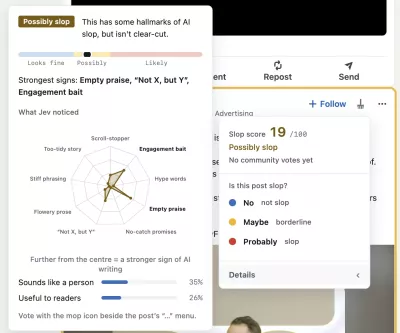
LARP here means identity performance: playing the character of visionary executive, elite expert, or thought leader instead of showing real work. The extension judges each feed post with Jev — TypeSafe AI's "System One" decision model — and stamps it with one of two outcomes:
| Badge | Meaning |
|---|---|
LARP |
Identity performance: persona over substance (vague wisdom, unverifiable claims, engineered bait, AI slop, grind mythology) |
REAL |
Receipts on the table: concrete work, real numbers, real context (off by default) |
SPONSORED |
Paid placement (detected from the page, no API call) |
Each pill looks like • LARP | 73% — a colored dot (red for larp, green for
real, gold for sponsored) plus the label and confidence. Pills are pinned
to the top-right of each post, on the header strip, so they stay legible even
when a post is mostly image; hover for the full probability breakdown.
Install
- Open
chrome://extensions, enable Developer mode, click Load unpacked, and select this folder. - Click the crab icon in the toolbar → Options, paste a TypeSafe API key (join the waitlist at typesafe.ai — access clears in about a day), and hit Test connection.
- Open LinkedIn, scroll, watch the pills appear. If a LinkedIn tab was already open when you installed, reload it first — Chrome doesn't inject into existing tabs.
Prefer a store install? Get the extension from Chrome Web Store or Firefox Add-ons.
No key yet? Set provider to Mock — the heuristics engine runs the whole pipeline offline so you can develop and demo without the API. In mock mode, enable "Also badge the REAL ONEs" in the popup to see every verdict.
Providers
- TypeSafe — Jev direct (recommended). Jev itself: ~100ms per post, $0.042/M input tokens, output free.
- OpenRouter — Jev via the alpha Decisions API. Same model, same pricing,
on an OpenRouter key. Jev does not speak the OpenAI-compatible chat
endpoint — it only answers on the dedicated Decisions router
(
POST /api/alpha/decisions, request shape{model, state, questions}, same answers back), verified Sep 19, 2026. Alpha: may require access on your account. - OpenRouter — chat-model estimate. Fallback for keys without Decisions
access: a cheap structured-output chat model (default
deepseek/deepseek-v4-flash) answers the same question set in JSON. Slower (1–3s per post) and output tokens are billed. - Mock. Heuristics, no network — for development and demos.
How it works
content/content.js        DOM only: MutationObserver + IntersectionObserver,
                          extracts visible posts, renders badges.
background/service-worker.js  Holds the API key, owns the request queue
                          (concurrency 3, retry/backoff), the persistent verdict
                          cache, and all provider calls.
lib/questions.js          The LARP taxonomy — one batched Jev request per post:
                          positive-evidence nouls (work_shown, image_crafted,
                          stat_farming, the tech-LARP composite grandiose_claims
                          vs technical_specifics, headline_larp,
                          headline_supported, is_ai_written) plus the
                          larp_intensity scale, the fabrication/attribution
                          axes, and news_report — the relayed-report
                          exemption axis. Two outcomes.
lib/verdict.js            Composes answers into a REAL/LARP badge. Owns the
                          gap math: image_crafted × (1 − work_shown) for the
                          persona signal, grandiose × (1 − specifics) for
                          tech-LARP, headline_larp × (1 − headline_supported)
                          for the cross-field signal. Thresholds live here.
                          news_report buys relief from the persona/borrowed/
                          costume signals; the relief decays with commentary
                          dress (substance-first).
lib/heuristics.js         Regex fallback + mock mode. Same answer shape as Jev.
lib/jev-client.js         Provider adapter: typesafe (Jev direct) /
                          openrouter (Jev via OpenRouter's alpha Decisions
                          API) / openrouter-chat (structured-output chat-model
                          estimate) / mock. Retries 429/529 with backoff; guards
                          against model IDs leaking across providers.
ui/                       Popup (toggle, sensitivity slider) and Options
                          (key, provider, Test connection, clear cache).
Design decisions worth knowing:
- One batched call per post ("speculative fan-out"): every independent question is asked at once; the code decides which answers matter.
- Cost is a rounding error: ~$0.042 per million input tokens — a whole feed-scrolling session costs less than a cent.
- Identity is
componentkey, notdata-urn(LinkedIn droppeddata-urnfrom feed posts in the 2026-09 UI; verified against the live DOM). Cards are re-rendered with new ids, so content-hash fallbacks keep verdicts attached. - Headlines are parsed from card text lines — the current UI has no stable
selector for the actor subtitle.
dev/test-headline-parser.mjstests the real parser against line arrays sampled from the live feed. - Relayed news is exempt, substance-first. A shared article imports its
substance by design, so the persona gap, borrowed-content bonus, and costume
gap all misread it. The
news_reportnoul measures the relay; the relief scales with it and decays as author commentary (self-focus, bait, moralizing) rides on the post — a news link wrapped in a take is still judged as the take. Exempt posts are REAL, so they only badge when "Also badge the REAL ONEs" is on. - Badges are status pills pinned to the top-right of the post header, plus a
rubber stamp on LARP posts. The 96px right-offset keeps the pill clear of
LinkedIn's own dismiss/menu/Follow buttons (see the measurements in
content/content.css). LARP verdicts also slam aLARPstamp across the card that settles into the header strip after 1.8s (underprefers-reduced-motion, the slam animation is skipped and the stamp starts settled). - API keys stay in the service worker. They live under their own storage key
(
larp_secrets),chrome.storage.localis closed to content scripts (setAccessLevel), and the worker only hands keys to the options page — content scripts gethasApiKeyflags and nothing else. With no storage access, content scripts learn about settings changes from aSETTINGS_CHANGEDpush from the worker instead ofstorage.onChanged.
Tuning the taxonomy
lib/questions.js is the product. Guidelines (from the TypeSafe docs):
- One judgment per question. Split compound questions; compose in code.
- Describe situations, not degrees. "Broken feature, workaround exists" beats "moderately severe".
- Give every Choice an escape hatch (
other), and phrase nouls so a high value means yes. - Pin the model version once you've tuned thresholds (
jev-1.13.0instead ofjev-latest) — set it in Options. - Test against labeled posts before trusting a threshold. The dev harness:
node dev/preview.mjs          # heuristics only, no key needed
TYPESAFE_API_KEY=... node dev/preview.mjs --live                    # through real Jev (direct)
OPENROUTER_API_KEY=... node dev/preview.mjs --live --openrouter     # through Jev via OpenRouter Decisions
OPENROUTER_API_KEY=... node dev/preview.mjs --live --openrouter-chat # through the chat-model estimate
node dev/smoke.mjs            # integration test: real service worker, mocked endpoints
node dev/test-worker-state.mjs  # worker state: cold start, failure caching, cache keys, key isolation
node dev/test-content-script.mjs  # content script: reshares, cache clear, rescans, reduced-motion stamp
npm test                      # headline parser + smoke + worker-state + content-script
node dev/test-headline-parser.mjs   # headline parser vs lines sampled from the live feed
- Bump
TAX_VERSIONinbackground/service-worker.jswhenever the question set changes. The verdict cache is keyedtax-N:<engine>:<hash>, so changing wording without bumping it leaves stale verdicts that fail the composer's missing-noul check. (Cache invalidation uses the same mechanism the chat provider's estimate-confidence guard relies on — change one, check both.)<engine>is the provider and model (orheuristicfor mock mode / no key), so switching provider, pinning a model, or adding a key never serves another engine's verdicts. Verdicts produced because a provider call failed (heuristic-fallback) are shown but never cached.
Browser-test the content script on the real LinkedIn DOM (uses the Browser Control CLI; needs a logged-in LinkedIn tab attached):
node dev/build-test-bundle.mjs                 # real content script + libs + chrome shim
browser-control execute --session <id> --file dev/linkedin-sweep.js
Edit the SAMPLES array in dev/preview.mjs — when you pre-label real feed
posts, label LARP or REAL, not degrees of cringe.
Regenerate icons after editing the crab:
python3 dev/make-icons.py
Roadmap
- Phase 2 — profile mode: third-person "About" sections, Top Voice flexing, follower bragging (all Jev text signals). The black-and-white headshot can be a pixel-saturation check in the content script; "is that the Golden Gate Bridge" needs a vision model — Jev reads text only.
- Feed polish: shared/reposted post attribution, "see more" expansion before judging, per-post score history.
Notes
- Read-only observation of posts already visible in your own feed; no clicking, liking, or scraping. Personal-use tool.
- Badges are judgments, not verdicts. The tooltip always shows the full probability breakdown so you can tell when Jev is unsure.