
liebstoeckel
Status: experimental, pre-1.0. liebstoeckel is an evolving experiment, not yet production-ready. Before 1.0, breaking changes can land in any release without a major-version bump, so pin an exact version if you depend on it.
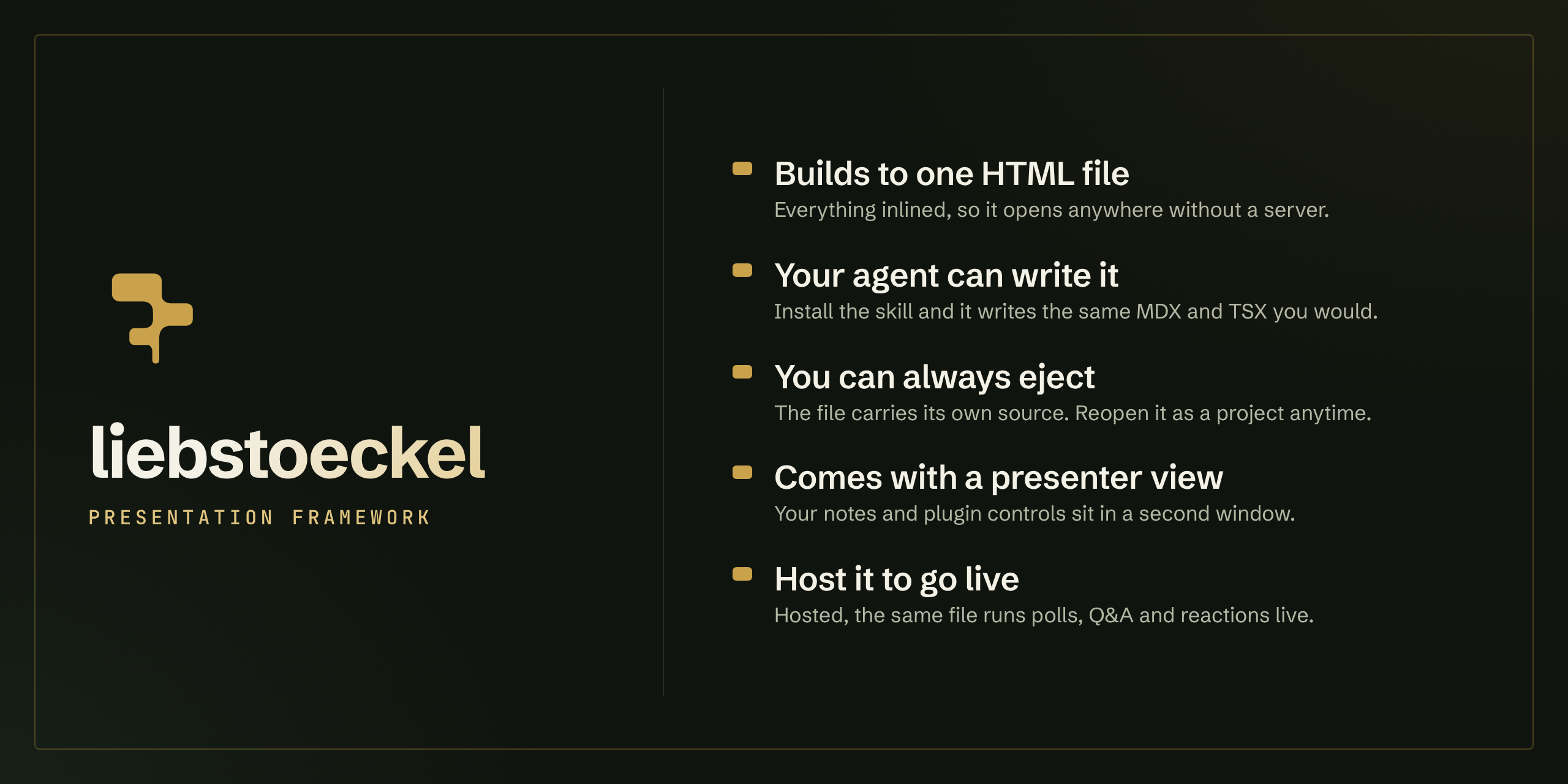
liebstoeckel is a code-first presentation engine. You write slides in MDX for prose and TSX for anything interactive, theme them from one place, and build a single portable .html per deck.
It runs on Bun, React 19, Motion, and Tailwind v4.
Being technical-first is the point: a deck is plain source you edit and own.
That targets a specific problem with AI-built decks. When an agent generates a presentation, the output is usually a finished artifact you cannot open up and edit by hand. liebstoeckel keeps a deck as plain TSX and MDX, and every build inlines its own source into the .html, so the file can be ejected back into an editable project. An agent writes the deck; you still own it and can change it.
Every deck ships with a presenter view and runs offline as a single file. When you want the room involved, the CLI hosts that same file as a live session and syncs state between presenter and audience, so people answer polls, ask questions, and send reactions from their own devices.
The what is liebstoeckel? page covers the reasoning.
Getting started
All you need is Node.js 18+ with npm (or Bun): the CLI brings its own pinned Bun from npm and never uses the one on your machine. A browser is enough to view a deck, and a Chromium is optional for build-time thumbnails.
Install the CLI and hand the authoring skill to your agent:
npm install -g @liebstoeckel/cli   # or: bun add -g @liebstoeckel/cli
liebstoeckel skill install         # teach your coding agent the workflow
Then scaffold a deck and run it:
liebstoeckel new my-talk           # also installs its dependencies
cd my-talk
liebstoeckel dev                   # hot reload + the annotation sidebar
Build to a single file when you are ready to share:
liebstoeckel build # -> dist/my-talk.html
That output is one .html with the JS, CSS, fonts, and assets inlined. No server, no CDN, no runtime deps. Open it directly, email it, or host it on anything static. It also embeds its own source by default, so liebstoeckel eject can turn the file back into an editable project.
Working in this repository rather than a scaffolded deck? Run bun install, then bun run demo:dev for the minimal demo (port 3000) or bun run showcase:dev for the visx data-viz deck (port 3001).
From a prompt to a deck
With the skill installed, ask your agent for a deck:
claude "Create a presentation comparing the glycemic index of different foods"
It reads the component registry, scaffolds the deck, writes the slides, and reruns build --check until the deck compiles. The result is one .html file. Here is the deck that session produced, playing through its slides:
https://github.com/user-attachments/assets/59cb7ff6-0075-4fb7-b03b-fa00a469bb6f
The springs and reveals come from the engine, not the model. The whole deck is one file: open it in your browser, or see the full demo on liebstoeckel.app.
Features
Every command targets a deck by a leading path, --dir <deck>, or the current directory. Run liebstoeckel --help for the whole surface; the CLI reference documents each flag.
| Capability | Command | Reference |
|---|---|---|
| Scaffold a workspace-wired deck | liebstoeckel new <name> |
new |
Build one self-contained .html, thumbnails embedded |
liebstoeckel build |
build |
| Validate a deck without writing an artifact | liebstoeckel build --check |
build |
| Recover a built deck's editable source | liebstoeckel eject <deck.html> |
eject |
| Dev mode: hot reload plus an annotation sidebar an agent applies | liebstoeckel dev |
dev |
Present live over a LAN, or --relay <url> |
liebstoeckel live |
live |
| Run a public relay for WAN sessions | liebstoeckel relay |
relay |
| Export slides to PNG or PDF | liebstoeckel export |
export |
| Regenerate thumbnails for a built deck | liebstoeckel thumbs <deck.html> |
thumbs |
| Add registry items into a deck as owned source | liebstoeckel add <name> |
add |
| Browse the chart and component registry as JSON | liebstoeckel registry list |
registry |
| Install the agent authoring skill | liebstoeckel skill install |
skill |
Cloud commands (login, push, orgs, decks, brand) upload a deck to the hosted service and are coming soon. See cloud commands.
Architecture
liebstoeckel is a Bun monorepo built around engine, which runs a deck: a fixed-canvas ScaledStage, Motion transitions, keyboard and touch navigation, the presenter view, and the live client. theme holds the typed token model and the pipeline from brand tokens to CSS variables, so a deck re-skins by switching data-brand. components provides the themed MDX primitives and Magic Move. plugin-sdk and plugin-ui build the Yjs-synced plugins from typed CRDT state, and live-server and present-relay host that shared document for a LAN room or the public internet. build is the build core on esbuild: it compiles a deck into one file (inlining the JS, CSS, and fonts) and serves it in development with hot reload. thumbnails captures slide previews at build time, dev-server serves a deck with hot reload behind a shell page whose annotation sidebar an agent picks up through a poll loop, and cli is the single command over all of it. Each package has its own README; the architecture and state model pages go deeper.
Documentation
Full guides, concepts, plugin authoring, and the API reference live at docs.liebstoeckel.app. The source is in packages/docs.
License
MPL-2.0. See each package for details.