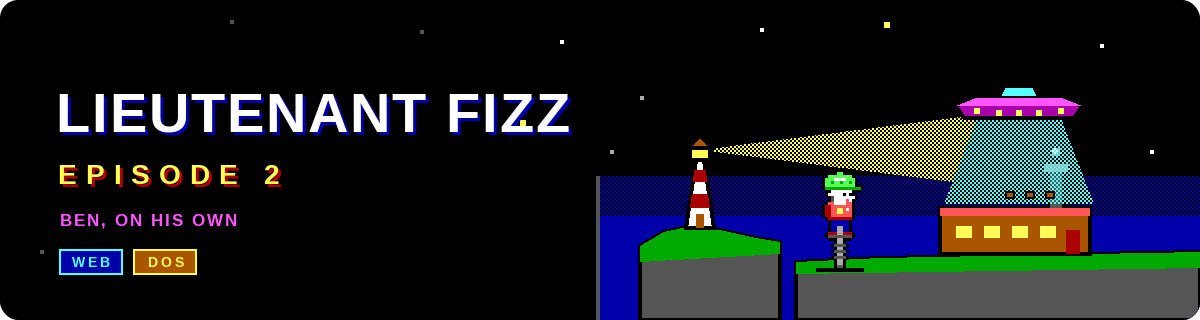
Lieutenant Fizz 2 is the start of Episode 2 of the Keen-style platformer series, and the simulation that Episode 3 will reuse. It is one game with two first-class presentations, Web and DOS, built in parallel from a deterministic Rust core. Fizz 1 stays where it is as the original and the reference; Fizz 2 learns from it.
Status: Milestone 1, the first playable slice, is done on Web and DOS. Ben runs, jumps, pogos, looks up and down and fires; a Zargified chicken patrols, clucks at random and can be stomped or stunned; a red key opens a red door in a 32 by 48 maze whose exit ends the run. Native, Web (WASM) and DOS (headless DOSBox) produce the same state-hash transcript (
PARITY ok 0edebb797e63edff), and Ben and the chicken match Fizz 1's physics bit for bit across eighteen golden traces. Both versions play the cluck and a placeholder song (the Web through Undertone, DOS on an AdLib or a Sound Blaster), draw a small HUD in Fizz 1's look, and open Paused and Options screens with Esc; DOS also takes a frame-rate choice (/FPS30,/FPS60,/FPSAUTO) and saves its settings inFIZZ2.CFG. Everything Fizz is drawn in one accent colour, grape (light magenta). The owner has played the Web build and a DOS preview and heard the cluck and the music; nobody has listened on real sound hardware, and nothing has run on real 486 hardware.docs/PLATFORM.mddescribes the layers and what is not verified,docs/MANUAL.mdthe controls anddocs/ARCHITECTURE.mdthe plan.
The story so far
Ben "Lieutenant Fizz" Blaze followed his cousin Billy to Planet Zargoth, fought through the Crater Fields, the Crystal Caves and Mildred's Citadel, and freed Billy, who left on a lead of his own. Now Ben is on his own. The Zargs are raiding Earth's chocolate, Mildred is back with a bigger plan to drain Earth's cocoa and fill Zargoth's rivers for good, and Billy is only a voice on the comms.
Episode 2 takes Ben through an overworld, an inner world and an underworld, with levels that climb and descend through mazes of keycards and doors, new gadgets beyond the pogo stick, and enemies in the style of the planet, such as a chicken that has been Zargified. One level takes place at a lighthouse. The full story and series plan live in the main game's documents.
What it is for
- One game, two presentations. The Web build is the rich one: real lighting, a zoom-out level map, an Undertone score. The DOS build is the bonus: a 486DX is the floor, and it may cut content but never limits the design.
- A simulation both can trust. Fixed 60 Hz steps, the Fizz 1 numeric model, and a per-tick state hash that native, Web and DOS builds must agree on.
- Intent flows up, lowering flows down. The game describes what is in a scene and what the music means. Each presentation projects that down to what its hardware can do, and offline tools do the lossy conversion.
- Reusable beyond one episode. The rules foundation is built so Episode 3 can reuse it.
Platforms
| Platform | Role | Status |
|---|---|---|
| Web (and Tauri on Linux, Windows, macOS and Android) | Rich presentation, authoring and playtest | Plays the first slice |
| DOS (486DX, VGA, AdLib) | Bonus presentation on a Rust-on-DOS runtime | Plays the first slice |
Repository layout
| Path | What it holds |
|---|---|
crates/fizz-sim |
The deterministic rules foundation: the 60 Hz tick, the state hash and the input types |
crates/fizz-phys |
Fizz 1's tile map, body, platform and rng code as an owned no_std copy |
crates/fizz-ep2 |
The slice's rules, level and hash, and the golden replay transcript slice-replay.txt |
crates/fizz-view |
What both presenters share below the scene: the pixel rule, the follow camera, sprite and tile drawing, the font and the generated sprite data |
crates/fizz-slice-view |
draw_slice, the one routine that draws the slice for both presenters |
crates/fizz-sfx |
Generated OPL2 and PC speaker data for the cluck and the steppers that play it |
crates/fizz-music |
Generated OPL2 and OPL3 register streams for the placeholder level music, and MusicPlayer, the stepper that plays them at 560 Hz |
crates/fizz-hal |
Hardware abstraction traits mirrored from Desk: clock, input, display and the interrupt ring |
crates/fizz-machine |
The pure model of the DOS start-up check: probe data, sound settings and resolver, and the text screen |
crates/fizz-present-dos |
The DOS frame, palette, font and key mapping, with no DOS calls |
crates/fizz-present-web |
The Web presenter, a wasm-bindgen app |
dos/ |
The separate DOS workspace: the runtime, RTSMOKE.EXE and FIZZ2.EXE |
web/ |
The static page for the Web presenter |
docs/ARCHITECTURE.md |
Layers, crate plan, parity policy, and what is mirrored from where |
docs/PLATFORM.md |
The platform skeleton: transcript format, DOS runtime, Web build, checks, toolchain and provenance |
docs/DOS-CHECK.md |
The DOS start-up check: the screen, the three sound states, settings, flags and the probe plan |
docs/SPRITES.md |
The sprite grid format, the sets and the tools that lower them to Rust |
docs/SOUND.md |
Sound: what plays where, the cluck and its downmixes, how a sound is placed, DOS playback, the Web path and how music fits in |
docs/LORE.md |
Episode 2's setting and the proposed lore of its levels |
docs/MANUAL.md |
How to play and run the slice |
docs/POC-1-FINDINGS.md |
What the earlier proof of concept settled and what it did not |
docs/SCENE-CONTRACT.md |
A sketch of the scene boundary between rules and presentations |
tools/ |
The check, build, DOS and parity scripts, the sprite and sound converters and the Fizz 1 trace tool |
tools/progress-report/ |
The generator of the progress archive, its chapters and its captures |
assets/ |
The README banner, the sprite grids and the cluck's sound source |
Getting started
tools/check.sh
This runs formatting, lints, tests, the licence-header and the markdown style checks. The toolchain is pinned in rust-toolchain.toml. It needs nothing beyond that toolchain.
The Web and DOS checks need more:
cargo install wasm-bindgen-cli --version 0.2.125 --locked   # once, for tools/build-web.sh
DOS_TOOLCHAIN=/path/to/toolchain tools/setup-dos.sh         # once, links vendor/
tools/check-dos.sh                                          # builds FIZZ2.EXE and checks it in headless DOSBox
tools/build-web.sh                                          # builds dist/web (needs Bun, to bundle Undertone)
tools/check-parity.sh                                       # prints PARITY ok <hash> when native, Web and DOS agree
DOS_TOOLCHAIN is a directory holding djgpp/, dosbox/ and cwsdpmi/, such as /opt/dos-toolchain in the pinned ci-dos image that CI uses. To try the Web page, serve dist/web with any static file server. docs/PLATFORM.md lists every command and what was not verified.
Progress archive
The Fizz 2 Progress Report is a multi-page archive of what has been built, how each piece was checked, and what is planned, with pull request evidence, CI results, screenshots and diagrams. It is generated from this repository and gh by tools/progress-report/ and published as a private Artifact. To regenerate it:
python3 tools/progress-report/build.py --check             # writes dist/progress-report; --offline uses the committed gh snapshot
python3 -m http.server -d dist/progress-report 9000        # then open http://127.0.0.1:9000/
Standing on other projects
Fizz 2 draws on several Liminal HQ projects and names each one where it uses it.
- Lieutenant Fizz is the behaviour, story and level reference. Its
f64, fixed-step simulation is the numeric model Fizz 2 follows. - Desk is the Rust-on-DOS foundation. Its hardware abstraction ideas are mirrored here for now and swapped for the real crates later.
- Undertone is the audio library for the Web score.
- Fizz Level Studio, an experiment, is the level and overworld authoring tool, with its own script language.
- Waypoint and Spindle set the repository conventions: the README shape, CI, release notes and labels.
Conventions
Lieutenant Fizz 2 follows the Liminal HQ conventions and copyright, and shares Fizz 1's palette, sense of humour and appetite for chocolate.
Licence
Licensed under either of the Apache License, Version 2.0 or the MIT licence, at your option.