🧱 Logo Pile
A physics pile of 2,478 IT & SaaS logos. Ask in plain English, watch the answers fly out.


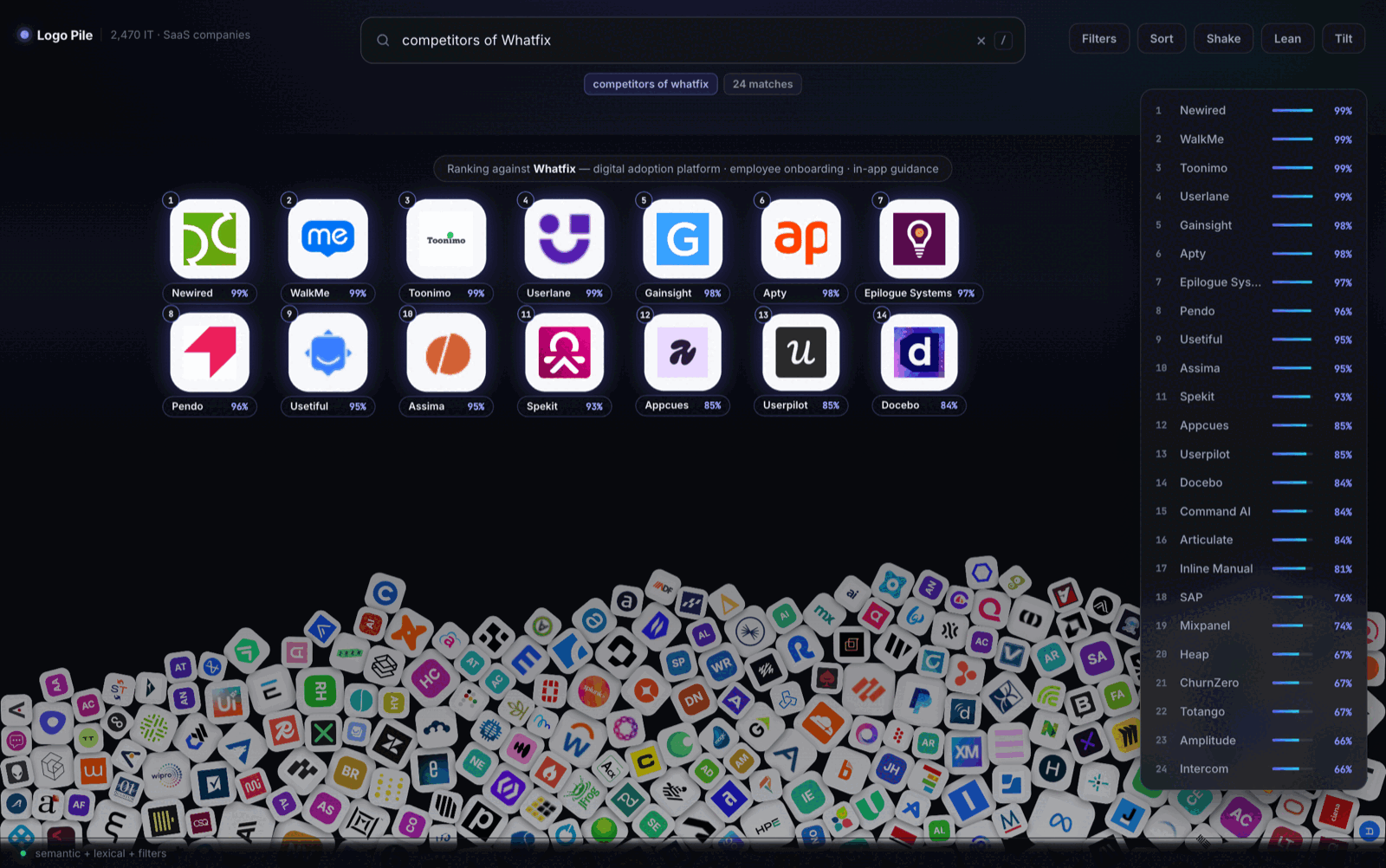
competitors of Whatfix → Newired, WalkMe, Toonimo, Userlane, Gainsight, Apty… the actual digital-adoption category, ranked.
Try these
Paste any of these into the live demo:
| Query | What it exercises |
|---|---|
competitors of Whatfix |
competitor graph + semantic neighbours |
nightfall direct competetors |
typo tolerance + word order (yes, misspelled on purpose) |
competitors of Whatfix with revenue > $1B |
competitor intent and a hard financial filter |
SaaS companies valued over $1B founded after 2015 |
two structured filters, no target |
alternatives to WalkMe in Europe |
competitor intent + region |
observability unicorns with more than 1000 employees |
unicorn flag + headcount |
European data governance companies founded after 2010 |
region + year + semantic topic |
who competes with CrowdStrike |
a third phrasing of the same intent |
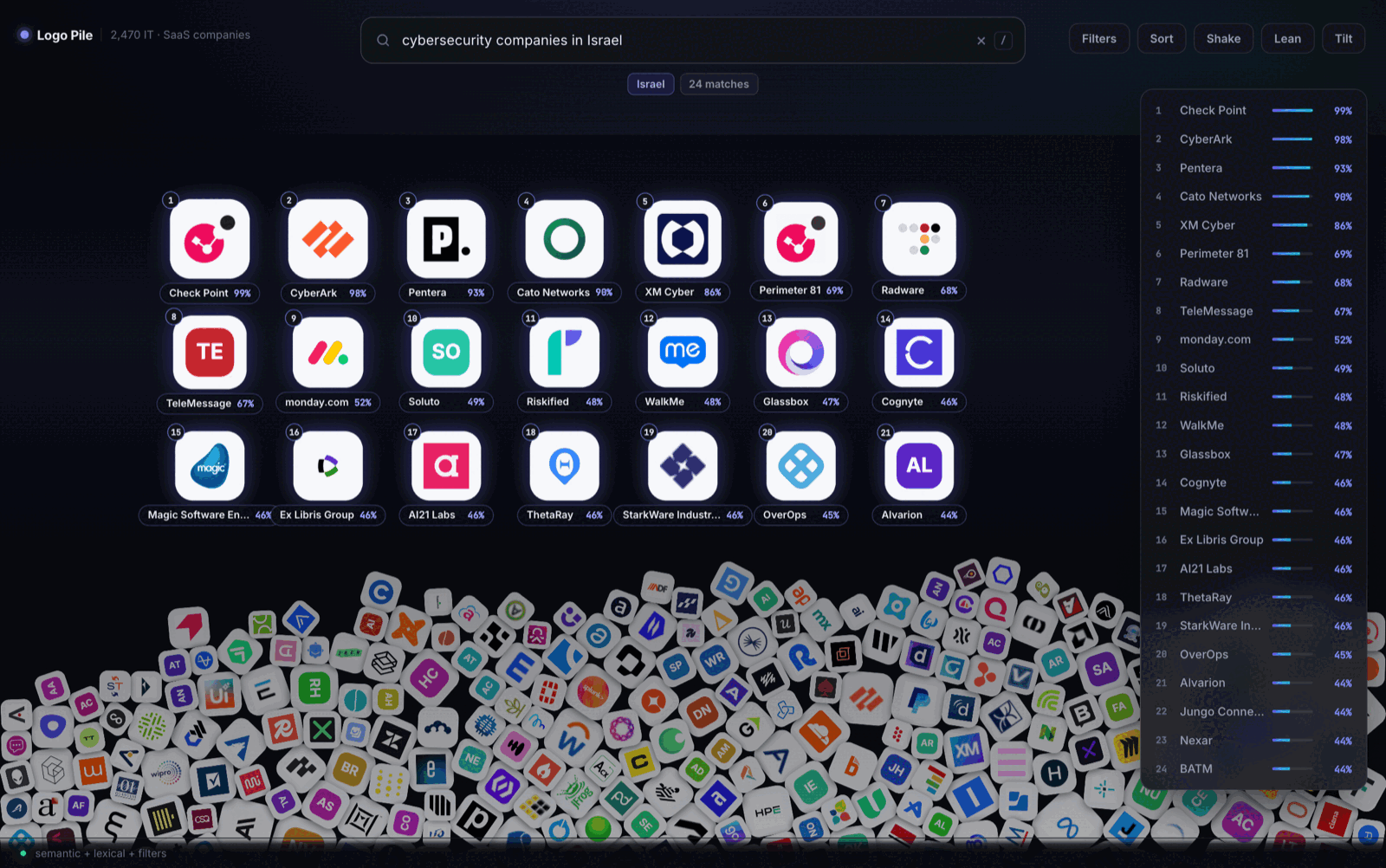
cybersecurity companies in Israel |
breadth — Pentera, Cato, XM Cyber, none of them hand-written |
competitors of ACI Worldwide |
an inferred edge — nobody wrote this graph by hand |
SaaS companies that are not American |
negation, which used to invert the filter |
bootstrapped companies with more than 1000 employees |
a pure-filter query with no search terms at all |
Or press More ↻ under the search box to page through the rest — there are over 600.
Filters turns the same constraints into controls, and every search is a shareable link (?q=…).
Sort splits the heap into zones by what each company does.
Everything runs in your browser. No key, no server, no signup.
The suggestions are generated from the data, not hardcoded
A fixed list goes stale the moment the dataset changes, and can offer a query
that returns nothing. src/search/suggestions.ts builds them from counts taken
off the corpus instead — a category/country pair is only suggested when at least
three companies satisfy it, so "cybersecurity companies in Israel" exists because
nine of them do, not because someone guessed.
Eight showcase queries stay pinned at the front (each exercises a hard code path: typo tolerance, negation, pure filters, competitor intent); the remaining ~600 are shuffled per load, so a reload offers a different slice.
node scripts/validate-suggestions.mjs runs every single one through the ranker
and fails if any returns zero results. Currently 617/617.
Contents
- How it works
- The five signals
- Competitor logic
- Physics
- Run it locally
- Adding companies
- Where to get more data, free
- Making the numbers accurate
- Optional: calibrated confidence with Laya
- Project structure
- Known limits
How it works
query
  │
  ├─ parse ─────────── pull out filters and competitor intent, leave the rest as text
  │                    revenue · valuation · employees · founded · funding · region · stage
  ├─ hard filter ───── drop anything that fails a threshold (and count what had no data)
  ├─ score ─────────── semantic · lexical · category · competitor graph · prominence
  ├─ confidence ────── 40% relative to the best hit + 60% absolute
  ├─ [Laya] ────────── optional calibrated rerank of the top 30
  └─ pile.show() ───── matched bodies leave the collision graph and spring into a grid
Ranking is hybrid on purpose. Pure vector search returns plausible-looking neighbours
for everything; pure keyword search misses "digital adoption" ↔ "in-app guidance". The
filters are hard gates, not score nudges — revenue > $1B means no, not less likely.
Why the search box works before the model loads
The corpus embeddings are precomputed at build time and shipped as a 420 KB Float32
blob. The browser only ever embeds your query, and it pulls transformers.js from a
CDN lazily.
So the app boots instantly, lexical + filter search answers immediately, and the semantic signal folds in when the model lands (the status bar tells you which mode you're in). If the CDN never responds, ranking drops the semantic term and reweights the rest — there is no error state for the user.
How confidence is calculated, and what it isn't
confidence = 0.4 × (score / bestScore)^1.15 + 0.6 × min(1, score / 0.72)
The relative half makes the leader of a good result set read high. The absolute half stops a thin result set from normalising its best bad answer up to 100% — a real bug this had early on, where three weak survivors of a tight filter all printed 99%.
It is still a relevance ordering rescaled to 0–100, not a probability. If you want the number to actually mean something, see Laya.
The five signals
| signal | what it measures | plain query | competitors of X |
|---|---|---|---|
| semantic | cosine of MiniLM embeddings, query vs. product description | 0.54 |
0.28 |
| lexical | BM25 over the same text | 0.25 |
0.07 |
| category | overlap of category tags | 0.14 |
0.25 |
| competitor | 1.0 direct graph edge, 0.55 shared-competitor |
— | 0.32 |
| prominence | log-scaled valuation, 0..1 |
0.07 |
0.08 |
prominence is a deliberate tiebreak, not a ranking signal. Without it, tiny pure-play
vendors outranked WalkMe on competitors of Whatfix — technically defensible, obviously
not what you meant.
Competitor logic
competitors of X · alternatives to X · X competitors · who competes with X · X rivals
- Find the keyword by bounded Levenshtein distance, so
competetorsandalternatvesland. Filler adjectives (direct,main,closest,top) between the name and the keyword get stripped. - Resolve X — exact name → id → domain → prefix → substring.
- Exclude X from its own results.
- Use X's own precomputed vector as the query vector instead of re-embedding its description. It is the exact point in space we want neighbours of.
- Score the graph: direct edges
1.0, second hop0.55— companies fought over by X's own competitors are usually competitors too, even when nobody wrote that edge.
If X isn't in the dataset, you get zero results and a message saying so. The earlier behaviour — ranking everything against nothing, which floated the biggest logos to the top — looked like a confident answer and was worse than no answer.
The graph is symmetrised at build time: write A → B once and B → A appears for free.
Physics
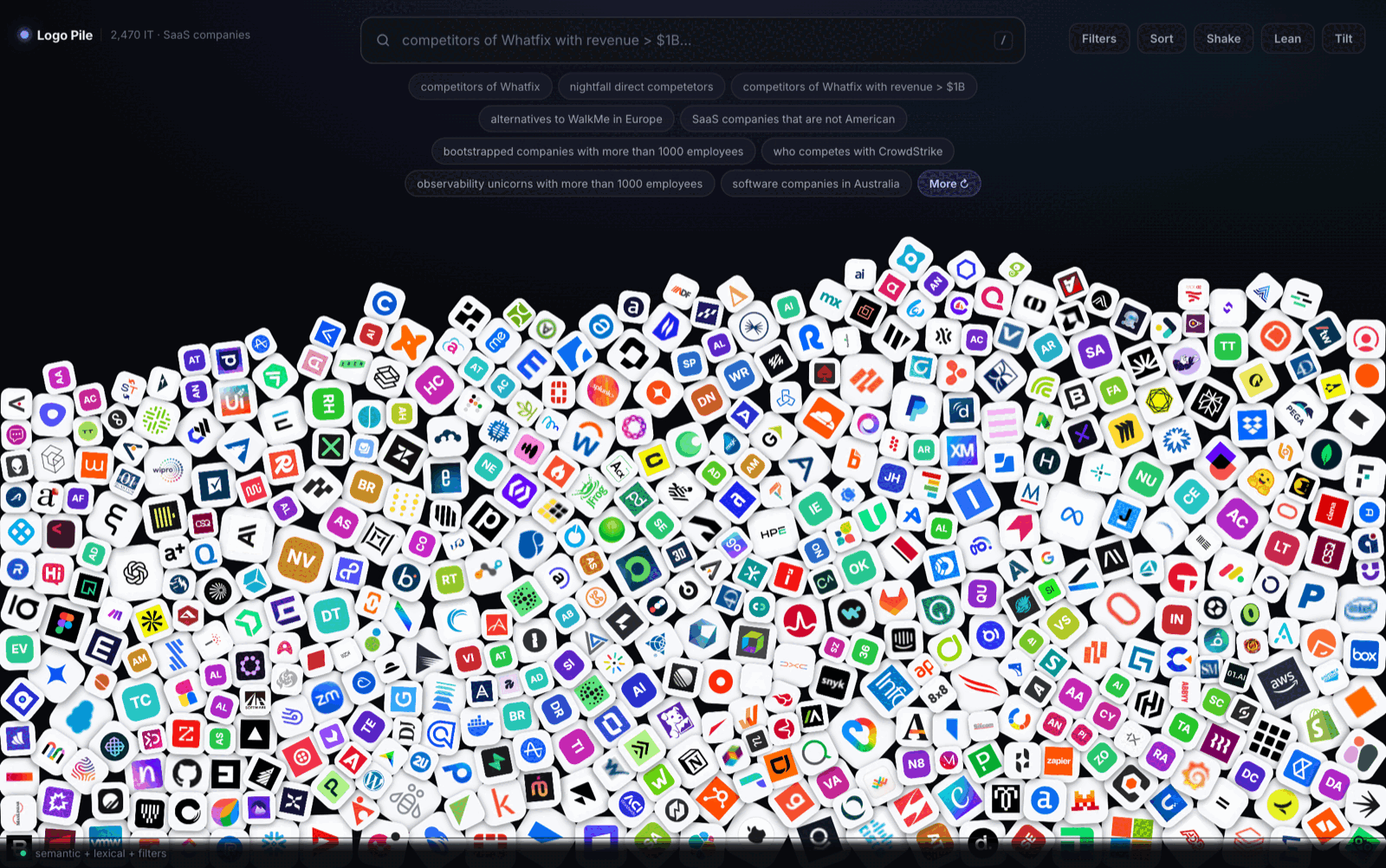
Matter.js runs the heap — 500 chamfered bodies, real collisions, draggable.
The dataset is five times that. Matter is comfortable with a few hundred colliding bodies and not with thousands, so the pile is a viewport, not the whole corpus: it holds the most prominent 500, and anything else that matches a query is spawned on demand from below the floor and removed again on release. Search always covers all 2,478.
Matched tiles do not stay in the simulation. They get collisionFilter.mask = 0 and
are moved by a critically-damped spring integrated outside Matter. Physics for the pile,
deterministic easing for the answer; letting gravity and neighbours near the result grid
turns it into a jostling mess.
The heap sinks to make room. Results need headroom, and the honest way to get it is to move the pile rather than draw the grid on top of it: when an answer comes up, the heap is rendered up to a third of the viewport lower and dimmed behind a scrim, then eases back when the query clears. Physics never sees the offset — it is applied at draw time, and to hit-testing too, so clicks stay accurate while the pile is displaced.
Each flying tile carries its name and score on one solid plate. Text drawn straight over the pile is unreadable the moment a bright logo lands behind it.
Tiles are sized by log10(valuation), so the pile has visual hierarchy even at rest.
Every tile is a pre-baked sprite (rounded plate + drop shadow + logo, drawn once to an
offscreen canvas and blitted thereafter). Re-drawing 500 rounded rects with shadowBlur
each frame cost 34 fps — and none of it showed up in a JS profiler, because the expense is
rasterisation, not script. Frame budget is now ~6.5 ms of the 16.6 ms available.
Interaction reference
/ |
focus search |
Esc |
blur search |
| drag | throw a logo around |
| click | open its detail card |
| two-finger swipe | tip the world; it rights itself |
| Shake | kick the pile |
| Lean | gravity follows your cursor — the pile slides toward it |
| Tilt | real device orientation, on hardware that has a sensor |
Tilting a Mac does nothing, and that is the hardware's fault, not a bug. The Sudden
Motion Sensor existed to park spinning hard drives and left when Macs went all-SSD; an
M-series MacBook reports no accelerometer at all (ioreg -c SMCMotionSensor comes back
empty). Feature detection cannot see this — on a secure origin macOS Chrome defines
DeviceOrientationEvent and simply never fires it, so the button used to light up and do
nothing. It now subscribes for 1.2s and, hearing silence, says so and points you at Lean.
Lean and the two-finger swipe are the desktop substitutes: one makes the cursor the horizon, the other tips gravity and lets it spring back. Real tilt works on a phone or tablet — the live demo is the same URL.
Run it locally
git clone https://github.com/RehmanaliMomin/logopile.git
cd logopile
npm install
npm run dev          # → http://localhost:5188
companies.json and embeddings.bin are committed, so this works immediately — no
model download on the critical path. Total payload is about 1 MB: the corpus vectors are
quantised to int8 (v × 127, rounded), which costs ~0.4% cosine error and cuts the
blob from 3.8 MB to 0.95 MB. Float32 does not compress; int8 does.
All commands
| command | does |
|---|---|
npm run dev |
dev server on :5188 |
npm run build |
typecheck + production bundle |
npm run data |
rebuild companies.json and embeddings.bin |
npm run embed |
embeddings only (~25 MB model download on first run) |
npm run ingest:edgar |
dry-run SEC revenue diff (-- --write to apply) |
npm run ingest:wikipedia |
re-ingest the bulk tier from Wikipedia + Wikidata |
npm run check |
typecheck + all three harnesses, with a trustworthy exit code |
node scripts/stress.mjs |
33 deliberately awkward queries — typos, negation, pure filters, bogus company names |
node scripts/validate-suggestions.mjs |
assert every generated suggestion returns results |
node scripts/smoke.mjs |
run the ranker over example queries in Node |
node scripts/smoke.mjs --semantic |
same, with embeddings on |
scripts/smoke.mjs is the fastest way to judge a ranking change — it prints the parsed
filters and the top 8 hits for a dozen queries in about a second.
Adding companies
The dataset is two tiers. data/seed/0*.json is curated — hand-written descriptions,
category tags, financials and competitor edges. data/seed/90-wikipedia.json is
ingested in bulk and always loses to a curated row on the same id or domain.
- Drop a new
data/seed/06-whatever.json(a JSON array) or extend an existing slice. npm run data
The build validates required fields, symmetrises the competitor graph, and prints every
edge pointing at a company that isn't in the dataset — so the graph tells you what to
add next. If it exists under a different slug, add it to ALIAS in
scripts/build-dataset.mjs instead.
Data schema
{
  "id": "whatfix",                    // stable slug, used for competitor edges
  "name": "Whatfix",
  "domain": "whatfix.com",            // drives the logo URL
  "description": "…",                 // 1–2 sentences; this is what gets embedded
  "categories": ["digital adoption platform", "in-app guidance", "saas"],
  "hqCity": "San Jose",
  "hqCountry": "United States",
  "region": "North America",          // North America | Europe | Asia | Asia Pacific | Middle East
  "founded": 2014,
  "employees": 1100,
  "stage": "series-e",                // public | private | bootstrapped | acquired | seed | series-a…g | late-stage
  "ticker": null,                     // set it and EDGAR can fill real revenue
  "revenueUsd": 100000000,
  "revenueEstimated": true,           // renders an "est" tag in the UI
  "valuationUsd": 600000000,
  "valuationEstimated": true,
  "fundingTotalUsd": 265000000,
  "competitors": ["walkme", "pendo"]  // write each edge once; the build symmetrises
}
Derived at build time, never hand-written: isUnicorn, logo, logoFallback, searchText.
Every field may be null except id, name, domain, description, categories.
A numeric filter excludes rows whose field is null, but the count is reported in the
status bar rather than silently dropped.
Where to get more data, free
| source | what you get | how |
|---|---|---|
| Wikipedia + Wikidata | ~2,200 companies with a real intro paragraph, HQ, founding year | npm run ingest:wikipedia (already run — this is the bulk tier) |
| SEC EDGAR | real annual revenue for every US-listed company, no key | npm run ingest:edgar -- --write (matches on ticker) |
SEC company_tickers.json |
the full list of US public companies + CIKs | seed id/ticker/name, then EDGAR for financials |
| Wikidata SPARQL | founded year, HQ, employees, industry | public endpoint, no key |
| Unicorn lists (CB Insights, Crunchbase) | valuation + funding for private unicorns | published as HTML tables, scrape once into a slice |
| Companies House / OpenCorporates | UK & EU registered entities | free tiers — good for the Europe coverage gap |
Higher-resolution logos, if you have a provider key:
LOGO_CDN='https://cdn.brandfetch.io/{domain}/w/256/h/256?c=YOUR_KEY' npm run data
Default is Google's keyless favicon service (128 px) with DuckDuckGo as backstop and a generated monogram tile if both fail — nothing ever renders as a broken image.
Making the numbers accurate
Financial filters
- Public companies — run the EDGAR ingest. It sets
revenueEstimated: false. Never hand-type these; they go stale every quarter and EDGAR is free. - Private companies — leave
revenueEstimated: true. An estimate that is labelled is useful; one pretending to be reported is not. - Valuation for public companies is market cap, which moves daily, so it's marked estimated on purpose. Wire a quotes API if you need it live.
- Revenue vs ARR — the schema has one field. For SaaS privates the figure is ARR; for public companies it's GAAP annual revenue. Split the field if that matters to you.
Competitor search
The graph is the highest-leverage thing in the whole app — one correct edge beats a lot of embedding tuning. In order of payoff:
- Add edges, especially in the categories you care about. They're symmetrised, so each is one line.
- Make descriptions discriminative. "Cloud software for business" embeds near everything. Name the product, the buyer, and the mechanism.
- Keep categories tight. They carry
0.25weight on competitor queries; twelve loose tags per company dilutes that. - Turn on Laya if you want the percentage to be a real probability.
Optional: calibrated confidence with Laya
Laya (Apache-2.0) is a non-autoregressive
decision engine and an open alternative to TypeSafe's Jev. Its noul head returns a
calibrated yes/no probability in ~33 ms on GPU, which is exactly what this UI's badge
claims to be showing. The integration is wired, working, and off by default — because
I ran it, and on this task it makes the ordering worse.
What it actually scored
laya 0.3.4, convaiinnovations/laya, asking "Is this company a direct competitor of
Whatfix, a digital adoption platform?":
| company | noul |
should be |
|---|---|---|
| Userlane | 0.830 | ✅ high — direct DAP rival |
| WalkMe | 0.814 | ✅ high — the category's pioneer |
| Stripe | 0.770 | ❌ a payments company, should be near zero |
| Toast | 0.586 | ❌ restaurant POS |
| Pendo | 0.506 | ❌ an actual rival, scored at chance |
| NVIDIA | 0.258 | ✅ low |
It separates the obvious extremes but ranks Stripe above Pendo. End-to-end through the
app, reranking demotes WalkMe from #1 to #4 and Pendo from #8 to #7 while promoting
Spekit to the top. The typed-decisions checkpoint was flatter still — every company
between 0.35 and 0.50, with Stripe (0.464) edging out WalkMe (0.459).
This is a zero-shot open-domain judgement about company competition, which is not what the model is trained for; its own examples are ticket triage, moderation and guardrails. A fine-tune on competitor pairs would be the fair test and I have not run one.
Running it anyway
pip install "laya[serve]" advertises FastAPI + uvicorn but installs neither at 0.3.4,
and there is no laya-serve entry point, so tools/laya_server.py is a standard-library
server speaking the documented /v1/systemone API.
python3 -m venv .venv && .venv/bin/pip install laya
HF_TOKEN=<your token> .venv/bin/python tools/laya_server.py
echo 'VITE_LAYA_URL=http://localhost:8000' >> .env.local
The top 12 hits get rescored by P(direct competitor of X), four requests in flight at a
time, since the API scores one company per call. Every failure mode — unset, down, slow,
malformed, all-null — falls back to the local score with nothing surfaced to the user. The
status bar reads Laya calibrated only when a rerank actually landed.
A note on the first version of this adapter: it posted to /v1/decide with a batched
inputs array and read results[].probability. None of that exists — I wrote it from an
assumed API shape and never ran a server against it. It would have failed every call and
fallen back silently, forever, looking like it worked.
Project structure
data/seed/*.json                hand-curated slices — add files, merged in order
scripts/
  build-dataset.mjs             merge, validate, symmetrise the graph, derive fields
  build-embeddings.mjs          MiniLM → public/embeddings.bin (int8, L2-n