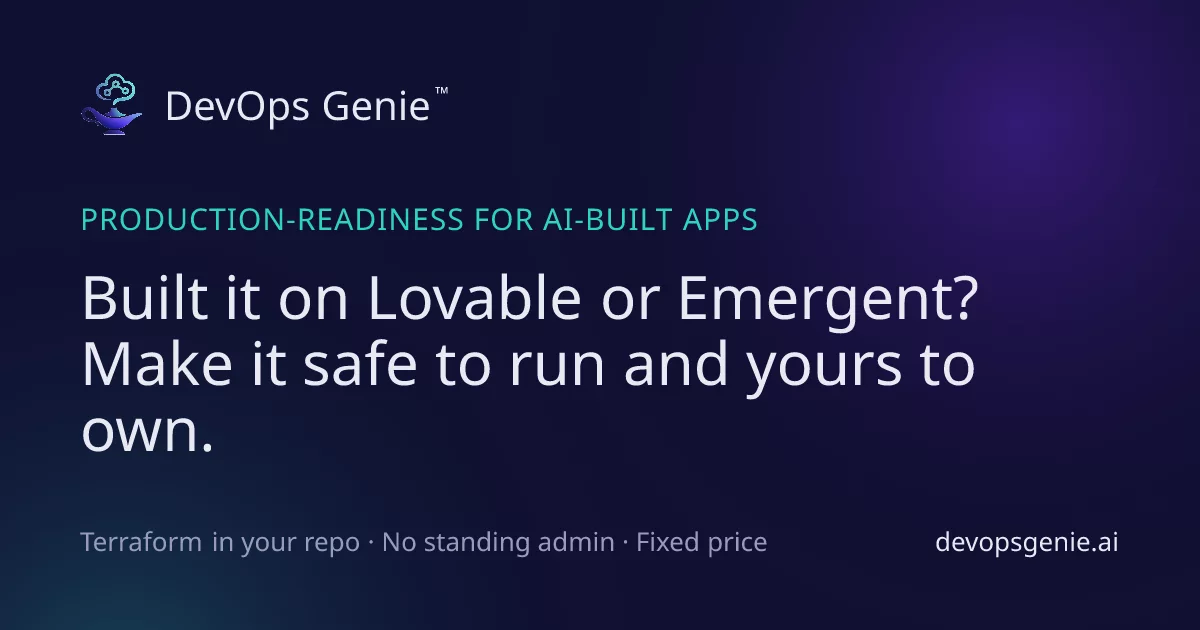

Is the app you built on Lovable or Emergent safe to keep running, and what would it take
to own it? offramp audit reads the repository and tells you. It sends no request to
your app and needs no credentials or account. Nothing leaves your machine.
git clone https://github.com/devopsgenie-ai/offramp
python3 offramp/skills/offramp/scripts/audit.py path/to/your-app --out audit-report
That writes audit-report/report.md for you to read and audit-report/report.json for
tools. It needs Python 3.11 or later and nothing else.
What it checks
| Check | Severity | What it finds |
|---|---|---|
supabase.rls.disabled |
critical | A table the app exposes through Supabase with no row-level security. Anyone with the public key can read and change every row, and every visitor's browser has that key. |
supabase.rls.permissive_write |
high / medium | A policy that lets anyone, or any signed-in user, update or delete rows with a condition of true. An anonymous insert, such as a contact form, is reported as medium. |
supabase.rls.public_read |
medium | A table anyone can read in full. This can be intended; the report asks you to confirm. |
credential.committed |
critical | A password, token or service_role key committed to the repository. Deleting the file does not help, because it stays in the git history. |
frontend.secret_in_bundle |
critical / high | A secret shipped to every browser: a VITE_* or REACT_APP_* variable with a secret's name, or a service_role key in frontend code. |
platform.hardcoded_url |
medium / low | What stops working when you leave the platform: sign-in through the platform's own auth, AI calls through its gateway, a frontend built against its preview URL. |
service.no_health_endpoint |
low | A backend that nothing can ask "are you working?". |
The row-level-security checks replay supabase/migrations/ in order. A table whose RLS
is enabled three migrations later is reported as clean, and a dropped table is not
reported. A publishable or anon key is never a finding. It is public by design, which is
why the RLS checks exist.
What it tells you it could not check
A clean report is only worth something if it says what it looked at. Every check reports one of four results: found, clean, not applicable, or could not assess. When a migration uses dynamic SQL, or your tables were created in the Supabase dashboard rather than in migrations, the RLS checks say so and give no answer. They never give a partial one.
Every report ends with what cannot be seen from a repository at all. That covers policies changed in the dashboard, auth settings, backups, who has access, and the git history. For each one it points to where you can check.
In CI
python3 skills/offramp/scripts/audit.py . --out audit-report --fail-on high
This exits 1 when a finding is at or above the threshold, 0 otherwise, and 2 if the
tool itself fails. The report is byte-stable: the same commit always gives the same
report.
How accurate it is
Before release we ran it over 190 public repositories built on Lovable and Emergent. We read a sample of the findings by hand and fixed every false positive we found. The method and the per-check precision are in the pull request that did it. Results are only ever published in aggregate. No repository is named.
If it reports something wrong about your app, please
open an issue with the finding's id.
A false positive is a bug.
What it will never do
offramp is a code reader and author, not a deployer. It does not hold cloud credentials,
send requests to your running application, or change anything. It reads files; you decide
what to do. The same line holds for the generators on the roadmap: they
write configuration for you to review, and your own pipeline applies it.
It also names no vendor in its reports, including the people who maintain it.
Getting help
The report tells you what to fix and how. If you would rather have someone do it, the maintainers at DevOps Genie offer fixed-price help. The tool itself will never recommend them, or anyone else.
Contributing
Read AGENTS.md first. It applies to humans and coding agents alike. Design changes go through an RFC.
License
MIT. See LICENSE. Maintained by DevOps Genie.