
On-Device Dialogue Summarizer
A LoRA fine-tune of a small language model that runs fully on an iPhone 14 Pro (A16), a device Apple decided was too constrained for Apple Intelligence. The idea was to reproduce Apple's own on-device recipe (small base model, LoRA task adapter, aggressive quantization) with my own model, and actually get it running natively on the phone.
Apple draws the on-device LLM line at the A17 Pro with 8 GB of RAM. This repo shows a scoped, task-specific summarizer working below that line on an A16 with 6 GB, and tries to document why the tradeoffs (model size, bit width, memory) make that possible.
Built with Claude Code. Architecture, training, and evaluation decisions are my own.
What this covers
- QLoRA fine-tuning with PEFT, on a single RTX 3080
- ROUGE evaluation on a held-out test split, base vs fine-tuned
- 4-bit quantization and conversion to MLX
- A SwiftUI app using MLX Swift, running on the GPU (Metal)
- Profiling on real hardware: tokens/sec, peak memory, model size
Stack
Picked mainly for clean licensing and on-device fit.
| Piece | Choice | License | Why |
|---|---|---|---|
| Base model | Qwen/Qwen2.5-1.5B-Instruct |
Apache 2.0 | Apache-licensed (the 3B isn't); 880 MB at 4-bit, fits in 6 GB RAM |
| Dataset | DialogSum | MIT | Dialogue summarization, and repo-safe (SAMSum is CC BY-NC-ND) |
| Training | PEFT + TRL + bitsandbytes | - | QLoRA on the RTX 3080 (CUDA) |
| Runtime | MLX Swift | - | Apple-native, runs on A16, loads models straight from HF |
| Stretch | Core ML | - | More Apple credibility, but only worth attempting after MLX works |
Repo and Hub layout
The code lives here on GitHub. Weights and data never touch this repo; the trained artifacts live on the Hugging Face Hub and are referenced by ID:
- Code (this repo):
osyounis/a16-summarizer - Quantized MLX model (what the app loads):
https://huggingface.co/osyounis/a16-summarizer-mlx-4bit
Quickstart
# On the RTX 3080 box (CUDA):
pip install -r requirements-train.txt
python train/prepare_data.py
python train/train_lora.py
python train/merge.py
python train/eval_rouge.py        # writes results/rouge_comparison.md

# On the M2 Mac (MLX is Apple-silicon only):
pip install -r requirements-convert.txt
python convert/to_mlx.py --upload-repo osyounis/a16-summarizer-mlx-4bit

# App: see app/README.md
Model Card
Model: osyounis/a16-summarizer-mlx-4bit
Base model: Qwen/Qwen2.5-1.5B-Instruct (Apache 2.0)
Fine-tuned on: DialogSum (MIT), dialogue to abstractive summary
Method: QLoRA, rank 16, alpha 32, 2 epochs
Quantization: 4-bit (MLX), group size 64 (4.501 effective bits/weight)
Results
DialogSum test split, 500 dialogues, multi-reference ROUGE (max f-measure over the 3
human reference summaries per dialogue; 10 dialogues end up with 2 after identical
annotations are deduped). All models decoded the same way: greedy, max_new_tokens=96.
| Metric | Base (Qwen2.5-1.5B) | Fine-tuned (fp16 merged) | 4-bit MLX (on-device) | Δ tuned vs base |
|---|---|---|---|---|
| ROUGE-1 | 0.3706 | 0.5581 | 0.5433 | +0.1875 |
| ROUGE-2 | 0.1498 | 0.3101 | 0.2905 | +0.1602 |
| ROUGE-L | 0.2889 | 0.4808 | 0.4622 | +0.1919 |
All three tuned-vs-base deltas have a 95% CI excluding zero (paired bootstrap over
dialogues, 10k resamples). The 4-bit MLX column is the model the app actually ships.
Quantization costs about 1.5 to 2 ROUGE points (biggest on ROUGE-2, -6.3% relative) with
no degeneration: recall is basically unchanged, and the small loss is precision from
slightly looser output. The 4-bit model was scored with identical decoding and scoring,
so the columns are directly comparable. Full reports:
results/rouge_comparison.md (base vs fp16),
results/rouge_mlx_4bit.md and
results/quantization_delta.md (fp16 vs 4-bit).
One caveat worth spelling out: the delta is register calibration more than comprehension.
The base model's ROUGE-1 recall (0.616) is actually a touch higher than the fine-tune's
(0.604). It recovers the reference content fine, and it writes well-formed third-person
summaries without being asked to. But it averages around 68 tokens against 27.8-token
references, so its precision collapses (0.277 vs 0.540). What the fine-tune learned is
DialogSum's length and house style. For a task-scoped summarizer that is exactly the job,
but it would be wrong to read this as "the base model can't summarize". It can; it just
doesn't stop. Side-by-side outputs, including the case where the fine-tune does worst,
are in results/qualitative_examples.md.
On-device (iPhone 14 Pro, A16, 6 GB)
| Measure | Value |
|---|---|
| Model size on disk | 880 MB (4-bit MLX) |
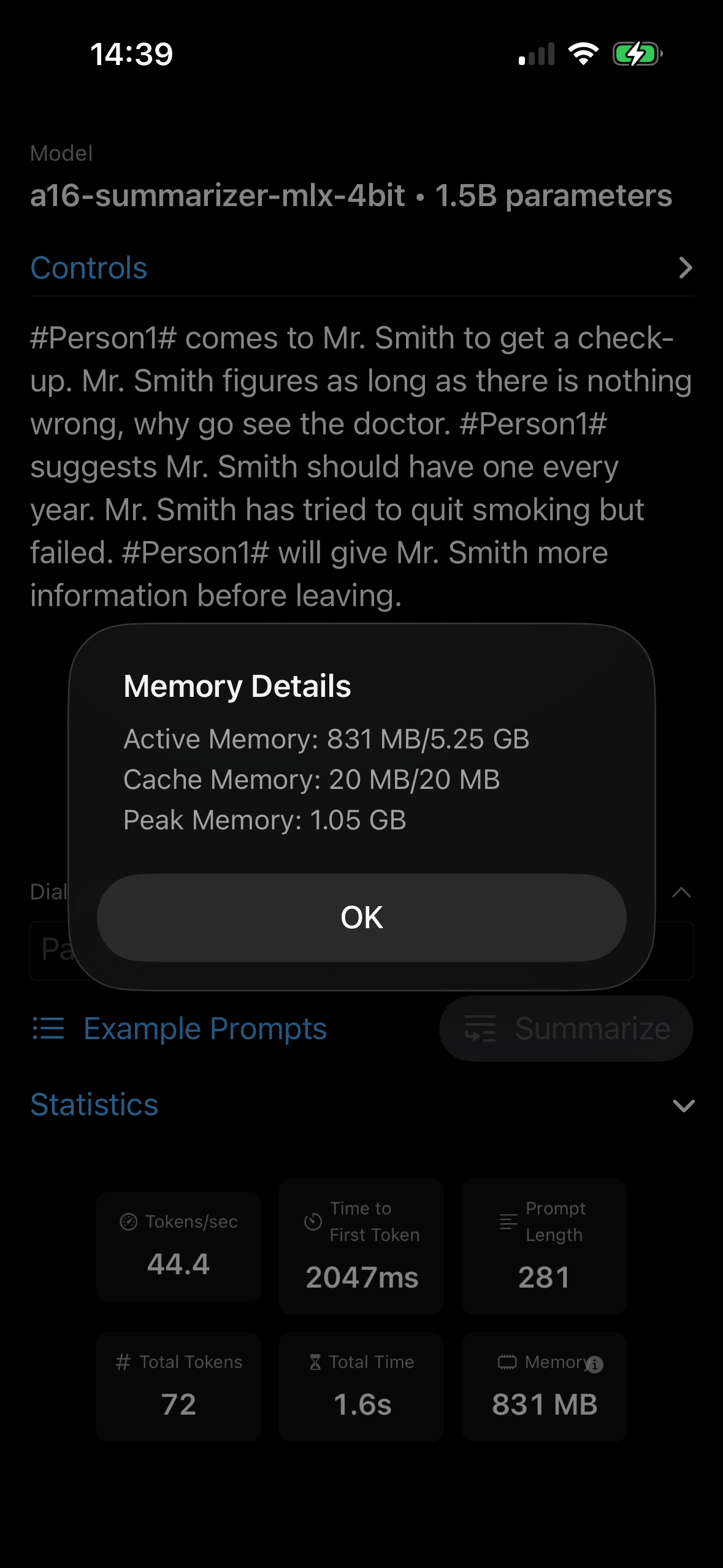
| Prefill / decode tokens/sec | ~137 / 44.4 |
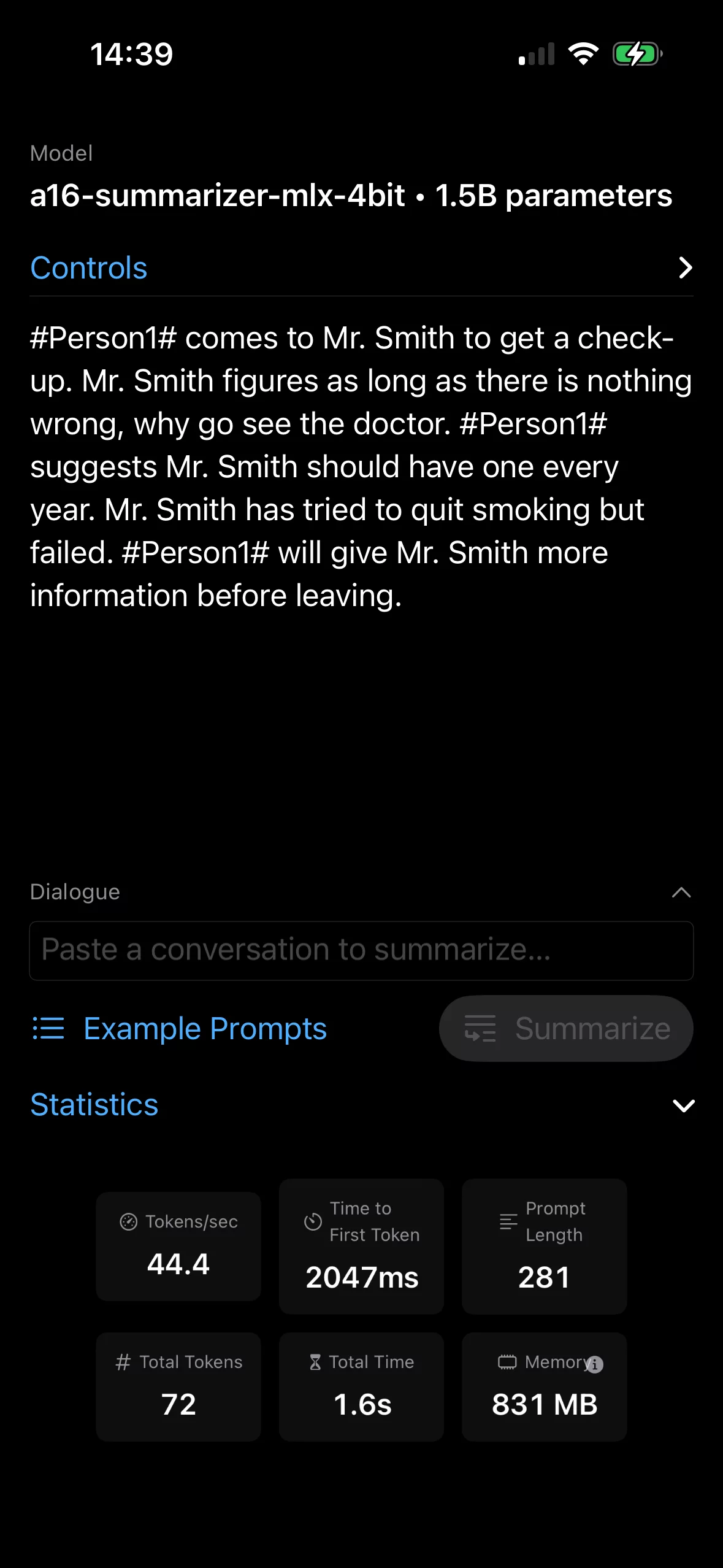
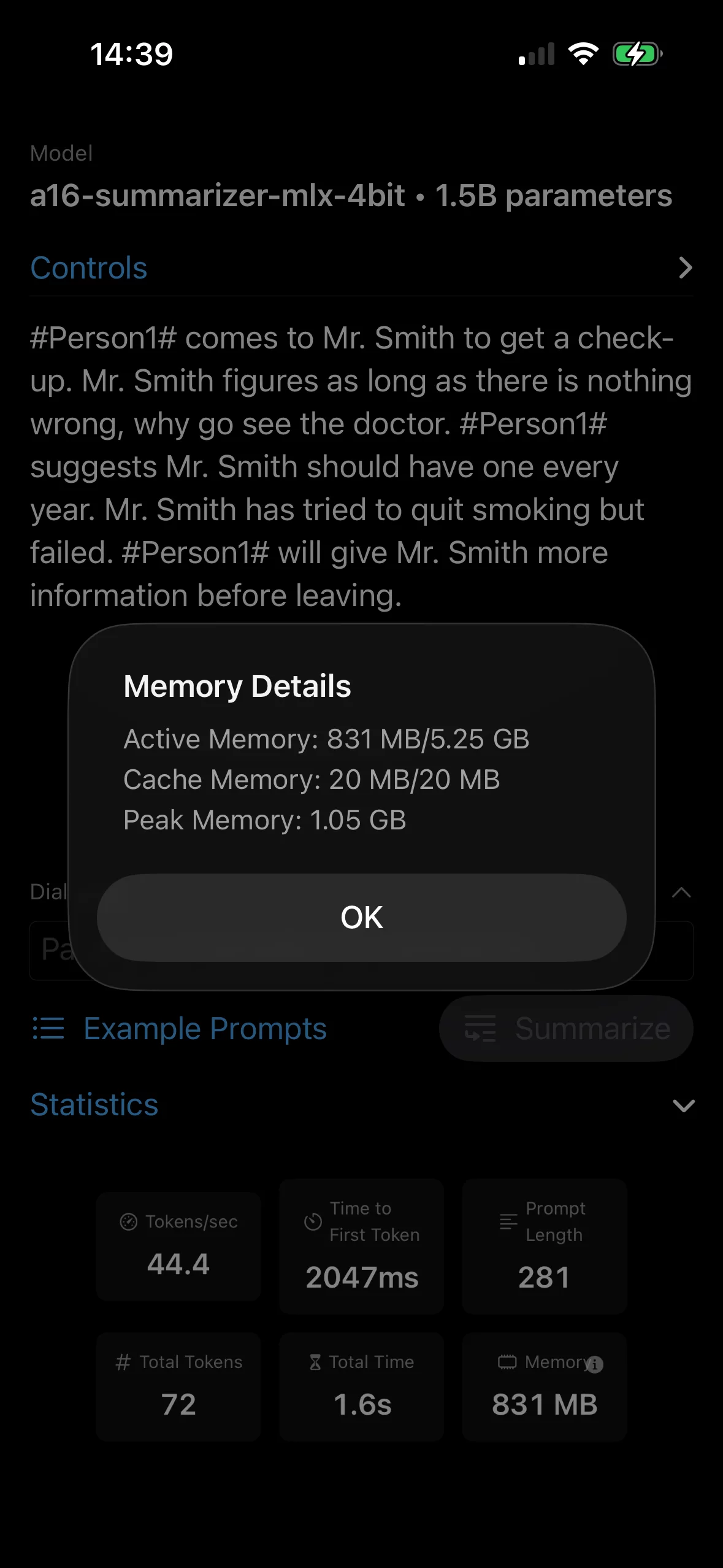
| Peak memory | 1.05 GB (831 MB active) |
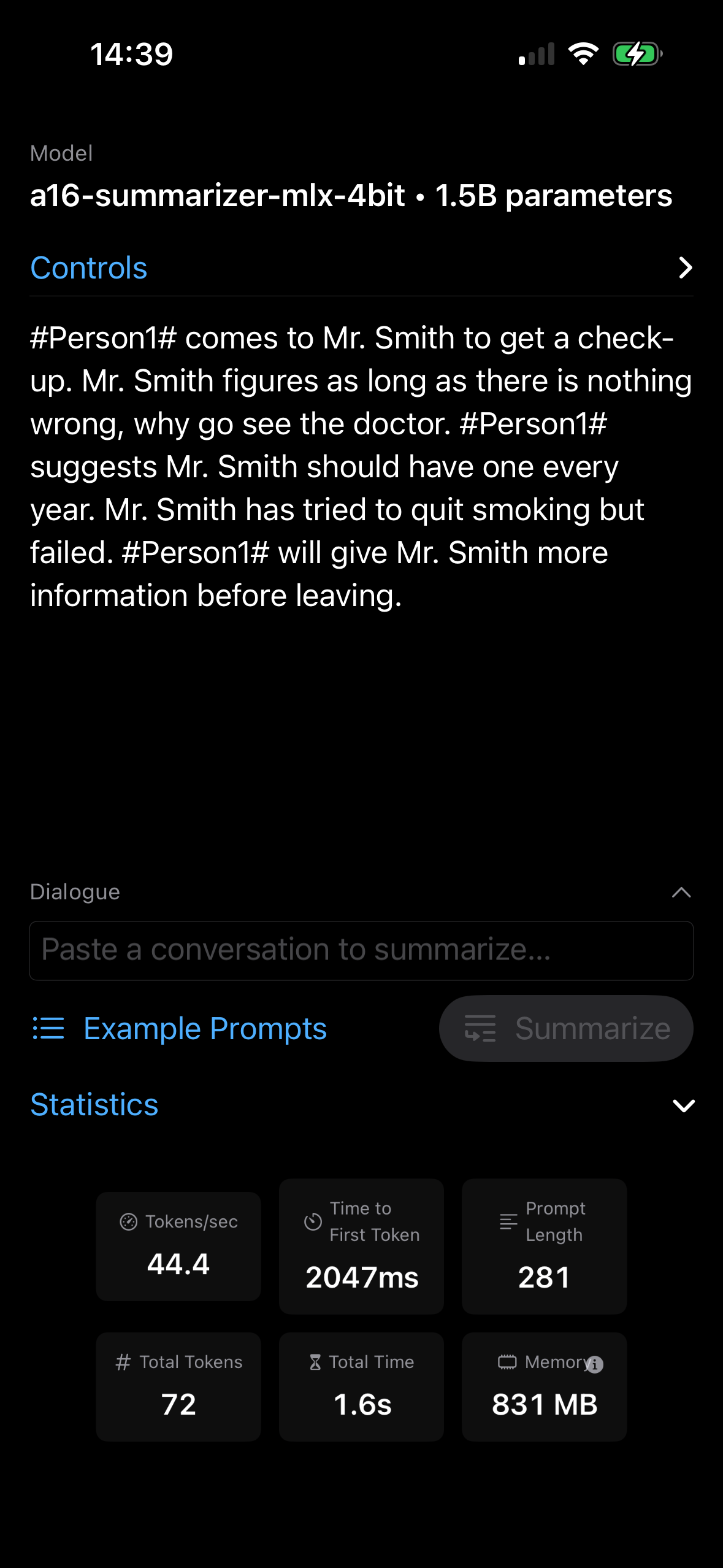
Measured in the on-device app (app/) summarizing the sample dialogue: 281-token
prompt, greedy decoding at temperature 0. Prefill is prompt tokens divided by
time-to-first-token (2.05 s); decode is 44.4 tok/s sustained. The
increased-memory-limit entitlement raises the process ceiling to about 5.25 GB on the
6 GB device (the app reports 831 MB active out of 5.25 GB), so the 1.05 GB peak leaves
plenty of headroom.
| Running on iPhone 14 Pro | On-device memory (active / cache / peak) |
|---|---|
 |
 |
Intended use and limits
Task-specific dialogue summarization, built as a demonstration. It is not a general chatbot, and it inherits Qwen2.5's limitations plus the quantization quality loss. English only, since DialogSum is English.
License
Code: MIT (see LICENSE). Model derivative: Apache 2.0 (inherits Qwen2.5). See NOTICE.