
mcp-name: io.github.OpenOSINT/openosint
OpenOSINT
An OSINT (Open Source Intelligence) agent for security researchers and analysts: 21 investigation tools behind a natural-language interface, plus an MCP (Model Context Protocol) server so any MCP-compatible AI client can drive them directly.
Use it as a REPL, CLI, MCP server, or browser Web UI.
Tool results come from real executions, and every finding is shown with the tool call that produced it. AI summaries are leads to verify, not proof.


Hosted versions, built on this engine:
- Monitor: scheduled external checks of your domain's email authentication, TLS, security headers and lookalike domains, with an email when something gets worse. Free for one domain.
- Diligence: due-diligence signals for UK companies and any company with an LEI, from official registries and sanctions lists, each with its source and retrieval time.
Docs: https://openosint.tech/docs/
OpenOSINT is an open-source engine for passive checks of public information; the hosted products are built on it, and everything below is free and MIT-licensed.
Self-host (free, MIT)
pip install openosint
# Grade a domain's external exposure A-F (no API key, no AI provider)
openosint exposure example.com

# Interactive AI REPL (default)
openosint

# Web interface
openosint web

Try the live demo → — bring your own Anthropic / OpenRouter / Ollama key, no signup.
Usage
Start the REPL and investigate any target — the agent decides which tools to run and chains them on findings:
openosint > investigate example.com

  -> search_dns('example.com')
  -> search_whois('example.com')
  -> search_rdap('example.com')

  Report saved -> reports/2026-05-11_14-32-11_report.md
Features
| Capability | Details |
|---|---|
| AI tool chaining | The agent selects and chains tools based on findings; describe the target in plain language |
| 21 modular tools | Email, username, breach, WHOIS, RDAP, IP, subdomain, dorks, paste, phone, Shodan, VirusTotal, Censys, IP2Location, AbuseIPDB, GitHub, DNS, GDELT news geo, live dork search, URL scraping, SERP footprint |
| Three AI backends | Anthropic Claude (default), local Ollama, or any OpenAI-compatible endpoint (LiteLLM, vLLM, LM Studio, ...) |
| Native MCP server | 16 of the 21 tools are passive and on by default. The server lists 20 by default (those 16 plus 4 graph and batch helpers) and 25 with --allow-active (Passive by default); runs with uvx, no separate install |
| Parallel execution | --parallel runs complementary tools concurrently via asyncio.gather() |
| Reports | PDF + Markdown auto-saved after every investigation (reportlab optional) |
| Session history | All REPL sessions saved to ~/.openosint/history/; browse with openosint history |
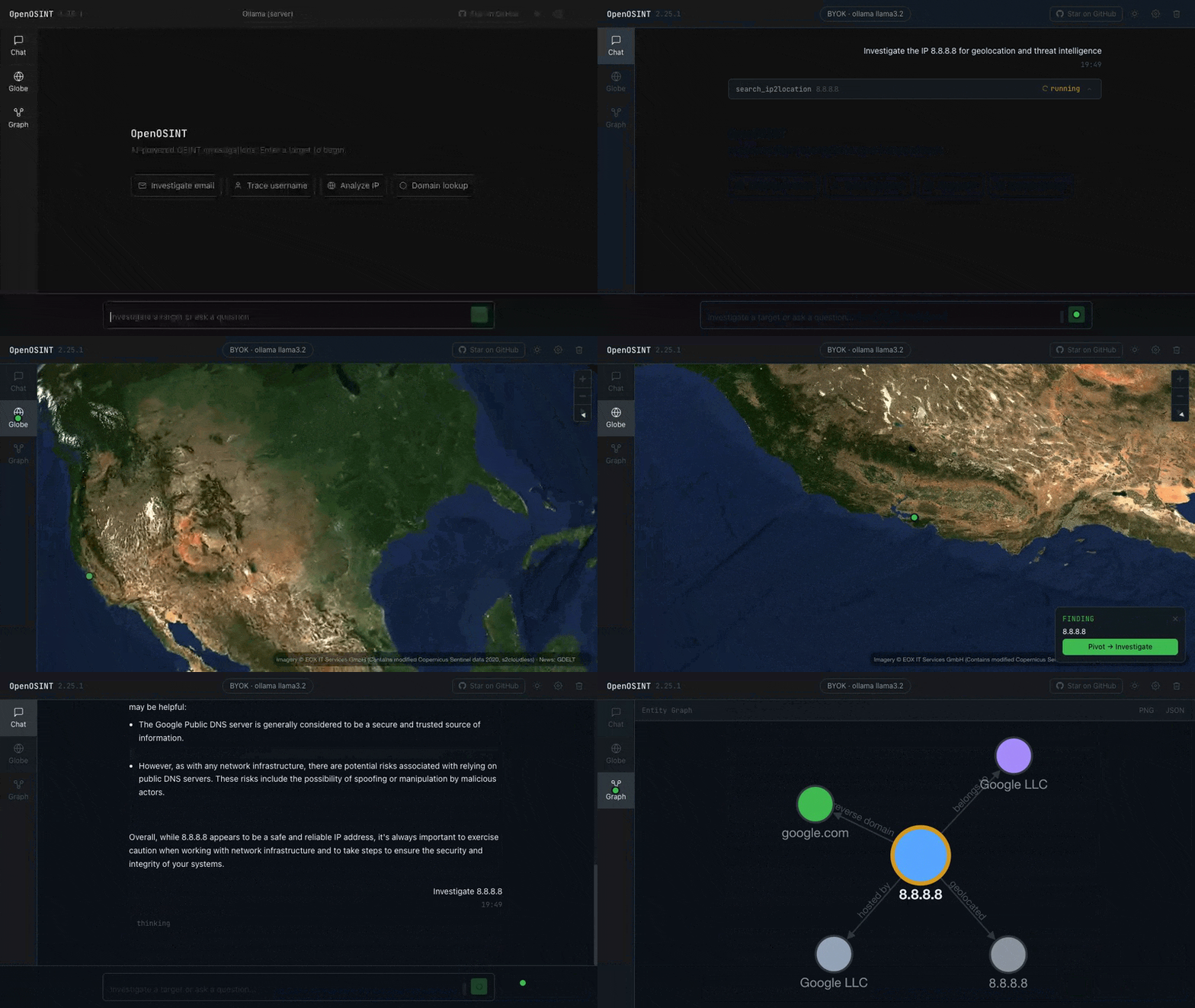
| Web UI | Browser-based AI chat with streaming output, tool cards, light/dark theme |
 Investigation results land live on the globe — click a point to pivot. Watch the sharper MP4.
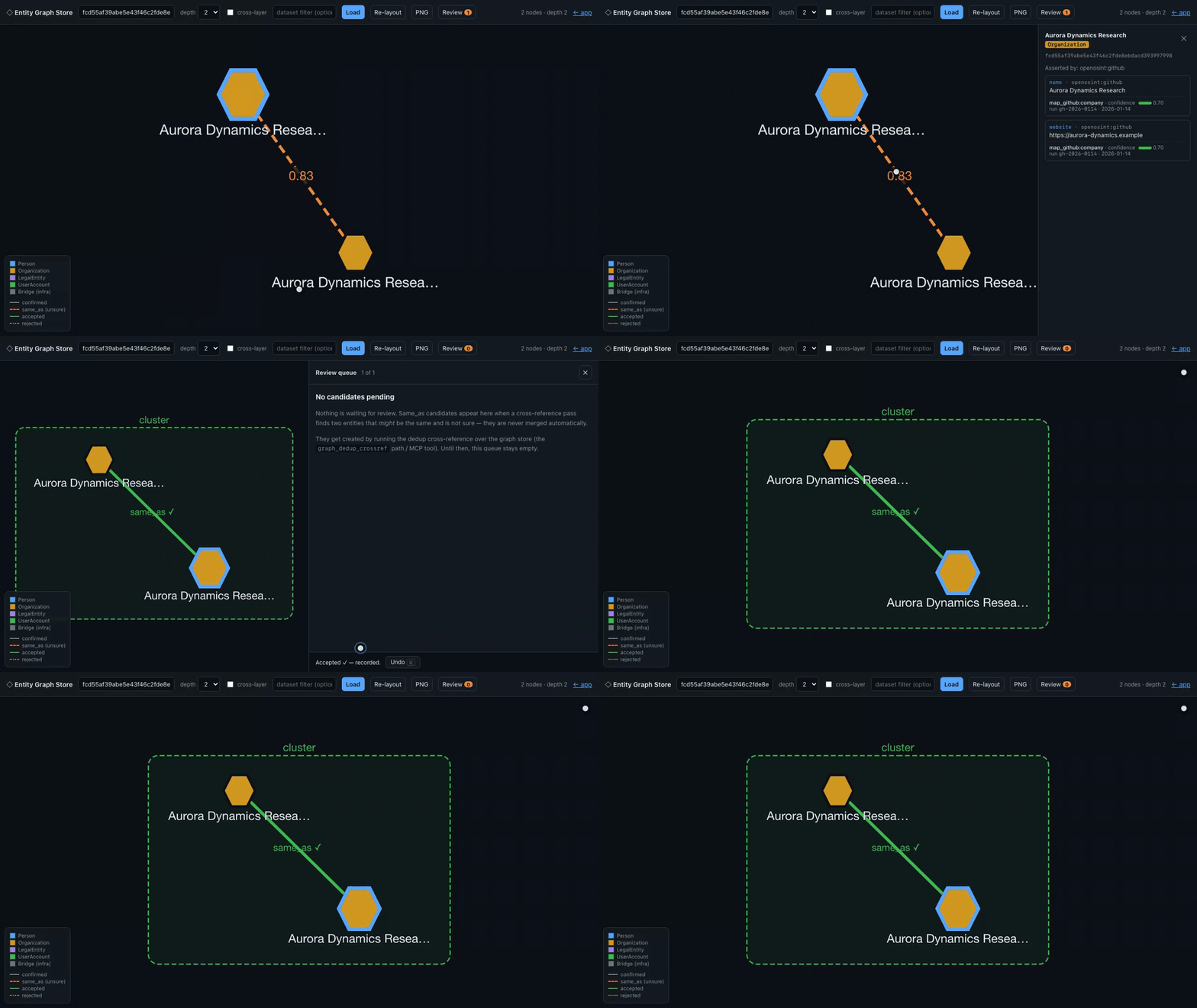
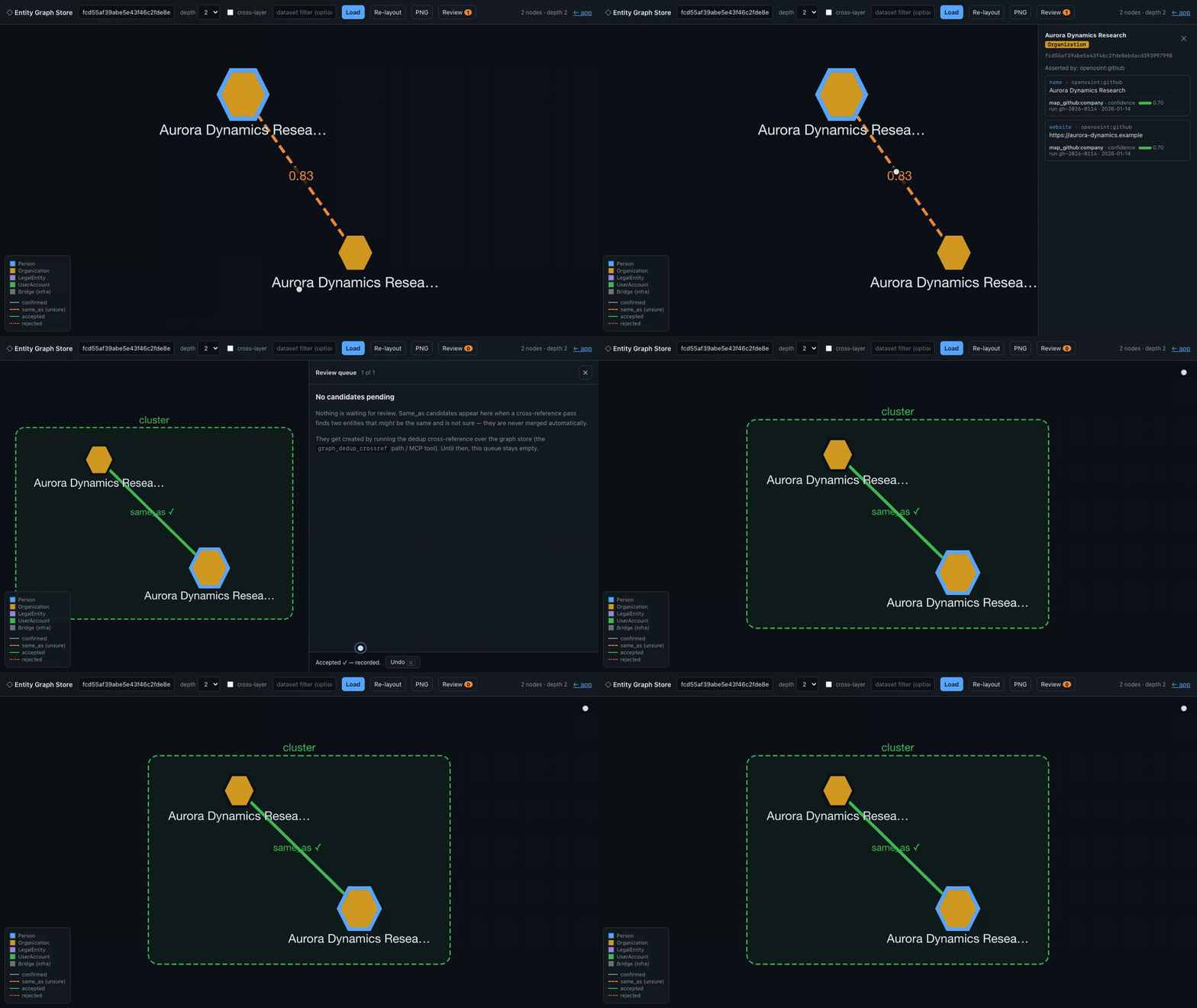
Deterministic, synthetic-data demo — every entity shown is fictional; regenerate with demo/web_demo.py.
The entities are seeded at the statement layer, not produced by today's mappers — see demo/README.md.
Legal Disclaimer: OpenOSINT is intended for legal and authorized use only. Users are solely responsible for ensuring their use complies with all applicable laws and regulations. The authors accept no liability for misuse. See DISCLAIMER.md.
Tools
| Tool | Powered by | What it investigates |
|---|---|---|
search_email |
holehe | Social accounts linked to an email address (noisy, off by default) |
search_username |
sherlock | Username presence across 400+ platforms (noisy, off by default) |
search_breach |
HaveIBeenPwned v3 API | Data breach exposure |
search_whois |
python-whois | Domain registrant and DNS info |
search_ip |
ipinfo.io | Geolocation, ASN, hostname |
search_domain |
sublist3r | Subdomain enumeration (noisy, off by default) |
generate_dorks |
built-in | 12 targeted Google dork URLs (no network calls) |
search_paste |
psbdmp.ws | Pastebin dump mentions |
search_phone |
phoneinfoga | Carrier, country, line type (unverified network behavior, off by default) |
search_shodan |
Shodan API | Open ports, banners, CVEs |
search_virustotal |
VirusTotal API v3 | Verdict from 70+ antivirus engines |
search_ip2location |
IP2Location.io API | Enhanced IP intel: VPN/Proxy/Tor/datacenter flags (sponsored) |
search_censys |
Censys Search API | Internet-facing infrastructure, certificates |
search_abuseipdb |
AbuseIPDB v2 API | IP abuse reputation: confidence score, reports, country, ISP |
search_github |
GitHub REST API | Profile, repos, commit-discovered emails, username/keyword search |
search_dns |
dnspython (built-in) | A/AAAA/MX/NS/TXT/CNAME/SOA records; SPF, DMARC, DKIM analysis |
search_rdap |
RDAP (IANA bootstrap, keyless) | Registrar, registration/expiry dates, name servers, status; registrant contacts redacted by policy |
search_gdelt_geo |
GDELT 15-minute GKG feed (keyless) | Recent worldwide news placed on a map: headline, link, place; GeoJSON output |
search_dorks_live |
Bright Data¹ SERP API | Live Google search results for dork queries (title, URL, snippet) |
scrape_url |
Bright Data Web Unlocker | Fetch any URL bypassing Cloudflare/CAPTCHA — returns clean Markdown (touches the target, off by default) |
search_footprint |
Bright Data SERP API | Entity-type-aware public search-engine footprint: detects email/username/domain/phone/name and returns structured results + Entity Correlation Graph nodes/edges |
Full per-tool documentation, CLI flags, and output formats: openosint.tech.
Passive by default
OpenOSINT starts in passive mode: agents and MCP clients are only offered tools that query third-party data sources or compute locally. Tools that touch the target's infrastructure, or that send many requests about the target from your IP, are off until you opt in. They are not just refused when called; they are not offered to the model at all, and an MCP client does not see them in tools/list.
| Level | Meaning |
|---|---|
| passive | Queries third-party data sources or computes locally; sends no request from your machine to the target's own infrastructure. Standard DNS lookups are the one indirect exception: they reach the target's nameservers through your resolver (see search_dns). |
| touches target | Makes requests the target's infrastructure can see (their web server, DNS probes, or a service fetching their URL for you). |
| noisy | High request volume, or requests to many third-party services about the target; expect rate limits, WAF blocks, and possible alerts. |
| unverified | Network behavior not yet verified with a traffic capture; treated as non-passive. |
| inherits | A fan-out tool; it only runs what the current mode allows. |
Passive is not private. Every third-party service you query sees what you searched for, and usually your API key or IP. Treat queries to Shodan, HIBP, VirusTotal, Bright Data and similar services as visible to those providers.
Enable active tools explicitly (each is labeled with its noise level):
| Where | How |
|---|---|
| CLI / REPL | openosint --allow-active … |
| Any process | OPENOSINT_ALLOW_ACTIVE=1 |
| Web UI | Settings → "Enable active tools" (loopback only) |
| MCP server | uvx --from openosint openosint-mcp --allow-active (or openosint-mcp --allow-active if installed), or set OPENOSINT_ALLOW_ACTIVE=1 in the client's env block |
A publicly reachable or demo instance can never enable active tools, whatever the settings. If a disabled tool is requested anyway it returns a structured disabled_in_passive_mode result that says how to enable it.
Tool-call cap. Each user request is limited by OPENOSINT_MAX_TOOL_CALLS (default: 15 calls; each new message resets it). investigate_multi shares one cap across all targets (OPENOSINT_MAX_TOOL_CALLS_MULTI, default 30). When the cap is reached the investigation stops with an explicit message. An MCP client that drives the tools itself is not capped by the server; only investigate_multi is.
| Tool | Level | Default | What it actually sends, and where |
|---|---|---|---|
generate_dorks |
passive | on | Builds Google search URLs locally; sends nothing. |
graph_export |
passive | on | Reads the local graph database only. |
graph_neighbors |
passive | on | Reads the local graph database only. |
graph_review_candidates |
passive | on | Reads the local graph database only. |
investigate_graph |
inherits | on | Chains tools from a seed; in passive mode it routes only to passive tools. |
investigate_multi |
inherits | on | Runs one agent per target under a shared tool-call cap; passive unless active is enabled. |
scrape_url |
touches target | off | Bright Data fetches the URL, so the target's server logs a request (from Bright Data's IP, not yours). |
search_abuseipdb |
passive | on | One request to api.abuseipdb.com. |
search_breach |
passive | on | One request to haveibeenpwned.com. |
search_censys |
passive | on | Censys API; returns data Censys already holds. |
search_dns |
passive | on | Record lookups go through your DNS resolver; the target's nameservers see the resolver, not you. Active part: DKIM selector probes (enumeration) run only with active tools enabled. |
search_domain |
noisy | off | sublist3r scrapes several search engines and aggregators from your IP; expect captchas and blocks. |
search_dorks_live |
passive | on | Google results via Bright Data; the target is sent to those two services. |
search_email |
noisy | off | holehe probes many sites' sign-up/reset flows with the email from your IP; may notify the account owner or trigger security alerts. |
search_footprint |
passive | on | Up to 3 Google queries via Bright Data; the target is sent to those two services. |
search_gdelt_geo |
passive | on | Downloads GDELT's public news feed and filters it locally; your search term never leaves your machine. |
search_github |
passive | on | A few requests to api.github.com. |
search_ip |
passive | on | One request to ipinfo.io. |
search_ip2location |
passive | on | One request to api.ip2location.io. |
search_paste |
passive | on | One request to psbdmp.ws. |
search_phone |
unverified | off | Runs phoneinfoga; what it sends over the network has not been verified with a traffic capture. |
search_rdap |
passive | on | Queries IANA and the registry's RDAP server, not the target. |
search_shodan |
passive | on | Shodan API; reads Shodan's existing index, requests no new scan. |
search_username |
noisy | off | sherlock sends requests from your IP to hundreds of sites; expect rate limits and WAF blocks. |
search_virustotal |
passive | on | IP, domain and hash lookups read VirusTotal's existing data. URL submission is a separate active mode, off by default: it makes VirusTotal fetch the URL and makes it visible to the VirusTotal community. |
search_virustotal (URL submission) |
touches target | off | VirusTotal fetches the submitted URL, and the URL becomes visible to the VirusTotal community, which can reveal your investigation. |
search_whois |
passive | on | Queries the registry/registrar WHOIS server, not the target. |
This table says what each tool does according to its code. It is not a guarantee about what a remote service, or a third-party binary such as holehe, sherlock, sublist3r or phoneinfoga, does with a request.
search_email
Enumerates online services linked to an email address using holehe. Off by default because it is noisy: it needs the holehe binary installed and --allow-active (or OPENOSINT_ALLOW_ACTIVE=1).
openosint --allow-active email target@example.com
[+] Spotify        https://open.spotify.com/user/target
[+] WordPress      https://wordpress.com/target
[+] Gravatar       https://gravatar.com/target
[+] Office365      email used
search_username
Searches for a username across 400+ platforms using sherlock.
openosint username johndoe99
[+] GitHub         https://github.com/johndoe99
[+] Twitter        https://twitter.com/johndoe99
[+] Reddit         https://reddit.com/user/johndoe99
search_breach
Checks data breach exposure via HaveIBeenPwned v3 API. Requires HIBP_API_KEY.
[+] LinkedIn (2016-05-05) — leaked: Email addresses, Passwords
[+] Adobe (2013-10-04) — leaked: Email addresses, Password hints
search_whois
Retrieves WHOIS data using python-whois.
[+] Registrar: ICANN
[+] Created: 1995-08-14
[+] Expires: 2024-08-13
[+] Name Servers: A.IANA-SERVERS.NET
search_ip
Retrieves geolocation and ASN data via ipinfo.io. Free tier: 50k/month.
[+] Hostname: dns.google
[+] Org: AS15169 Google LLC
[+] City: Mountain View, CA, US
search_domain
Enumerates subdomains using sublist3r.
[+] mail.example.com
[+] dev.example.com
[+] api.example.com
generate_dorks
Generates 12 targeted Google dork URLs for any target. No network calls.
[+] "johndoe" site:linkedin.com
    https://www.google.com/search?q=%22johndoe%22+site%3Alinkedin.com
[+] "johndoe" leaked OR breach OR dump
    https://www.google.com/search?q=%22johndoe%22+leaked+OR+breach+OR+dump
search_paste
Searches Pastebin dumps via psbdmp.ws.
[+] https://pastebin.com/aB1cD2eF (2023-04-12)
[+] https://pastebin.com/xY3zA4bC (2022-11-08)
search_phone
Gathers phone intelligence using phoneinfoga. Use E.164 format.
[+] Country: United States
[+] Carrier: AT&T
[+] Line type: Mobile
search_shodan
IPv4 input → host lookup (open ports, org, CVEs). Any other query → banner/keyword search. Requires SHODAN_API_KEY.
openosint shodan 8.8.8.8
openosint shodan "apache port:80 country:DE"
[+] Org: Google LLC | Open ports: 53, 443
search_virustotal
Checks an IP, domain, URL, or file hash against VirusTotal's 70+ engines. Auto-detects input type. Requires VIRUSTOTAL_API_KEY.
openosint virustotal 8.8.8.8
openosint virustotal example.com
openosint virustotal 44d88612fea8a8f36de82e1278abb02f
[VirusTotal] Malicious: 0 / Harmless: 72
search_ip2location
Queries IP2Location.io for enhanced IP intelligence: geolocation, ISP, ASN, and — on the Security Plan — VPN/Proxy/Tor/datacenter detection. Sponsored integration. Requires IP2LOCATION_API_KEY.
openosint ip2location 8.8.8.8
[IP2Location] City: Mountain View, CA, US  |  ISP: Google LLC
[IP2Location] VPN: No  |  Proxy: No  |  TOR: No  |  Datacenter: Yes
search_censys
IPv4 → host view (open ports, services, ASN). Domain → certificate search (SANs, issuer). Requires CENSYS_API_ID and CENSYS_SECRET.
openosint censys 8.8.8.8
openosint censys example.com
[Censys] Open Ports: 53, 443, 853 | ASN: AS15169 Google LLC
search_abuseipdb
Checks an IP against AbuseIPDB v2. Returns abuse confidence score, total reports, country, ISP, and last reported timestamp. Requires ABUSEIPDB_API_KEY.
openosint abuseipdb 198.51.100.1
[AbuseIPDB] Abuse Confidence Score: 87%  |  Total Reports: 143
⚠️  HIGH ABUSE CONFIDENCE — flagged by AbuseIPDB
Warning appears when abuseConfidenceScore exceeds 50%.
search_github
Queries GitHub REST API. Username → profile, repos, commit-discovered emails. Keyword → user/repo search. Optional GITHUB_TOKEN raises rate limit from 60 to 5000 req/h.
openosint github johndoe99
[GitHub] Repos: 42  |  Followers: 128
[GitHub] Commit email: johndoe@example.com
search_dns
Queries A/AAAA/MX/NS/TXT/CNAME/SOA records and analyzes SPF, DMARC, and DKIM configuration using dnspython (no external API).