
An agent hypervisor — the trust kernel for delegated computing.
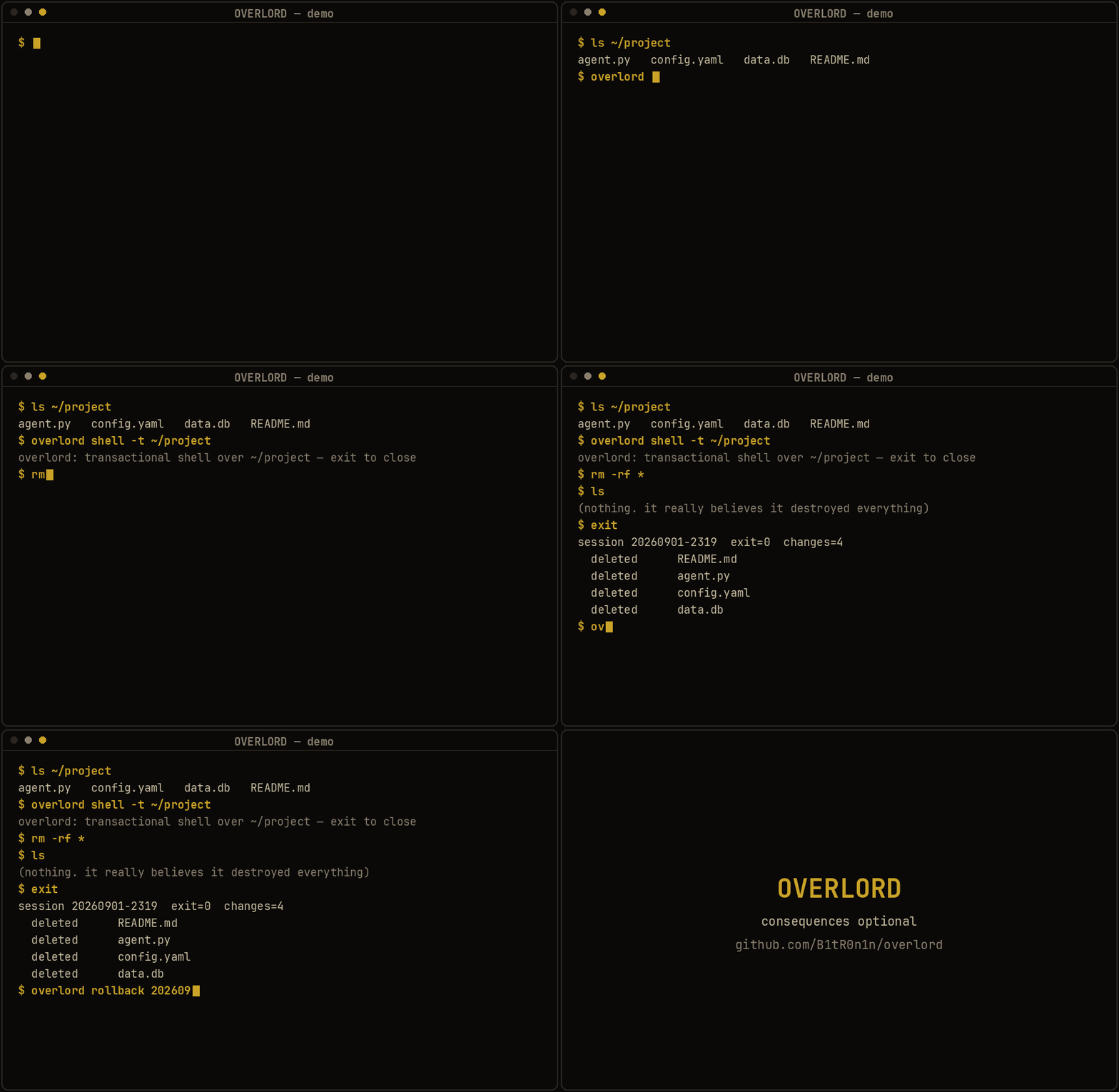
Hand a program — or an AI agent — a fully writable copy of a directory. Let it
run. Then review every change it made as a hashed, attributed manifest and
commit or roll back, all or nothing. Transactional isolation, provenance,
and arbitration for untrusted execution — in dependency-free Python, on the
kernel's own primitives. It ships with a built-in agent (overlord agent) that
runs a model with its hands jailed, so you can watch the whole loop happen
inside the transaction and sign off on the diff. For people who just want to
use it, overlord ui opens a chat workspace where you talk to that agent and
press Commit when you like what it did — nothing on disk changes until you do.
Thesis
Computing is transitioning to a new operator: machine agents. The OS has no native concept of a machine actor. Every agent today runs with its principal's full authority on infrastructure that cannot distinguish the principal's intent from the agent's behavior. Every harness vendor duct-tapes around this independently and badly.
OVERLORD is the missing layer between the agent harness and the operating system. Not an AI. Model-agnostic. A boring, load-bearing primitive — the SQLite pattern, not the Windows pattern.
The Four Primitives
- Capability, not identity — an agent receives a scoped grant (paths, budget, network egress, time window), not a user account. Commander's intent expressed as kernel-enforced constraints.
- Provenance — every mutation traceable to actor, instruction, and the reasoning artifact that caused it. A flight recorder for machine action.
- Reversibility — agent action is transactional: snapshot, execute, inspect, commit or roll back. The keystone. Delegation is blocked on "what if it breaks something"; this removes the question.
- Arbitration — when N agents contend for a resource, authority is scheduled the way CPU is scheduled.
Install
sudo bash packaging/install.sh
overlord doctor
Installs the engine to /usr/local/lib/overlord/, a compiled ELF launcher to
/usr/local/bin/overlord (the AppArmor attachment point), the AppArmor profile
that enables the kernel backend on Ubuntu 24.04+, and the runtime deps
(fuse-overlayfs, strace).
Windows and macOS
The engine is Linux kernel machinery — overlayfs, user namespaces,
mount(2) — so OVERLORD does not run natively on Windows or macOS, and a
port would be a different product. It runs in the Linux those systems
ship or host:
- WSL2 (Windows):
wsl --install -d Ubuntu, then the install above inside Ubuntu (the AppArmor step skips itself) andoverlord ui; WSL2 forwards localhost, so a Windows browser openshttp://127.0.0.1:7777. Keep the project folder in the Linux filesystem (~/projects/…, seen from Windows as\\wsl$\Ubuntu\home\…), not under/mnt/c/, where the overlay is slow anddoctormay fall back to the fuse backend. - Docker Desktop (Windows, macOS): the
Dockerfilebuilds an image on the fuse backend; its header has the run line (--device /dev/fuse --cap-add SYS_ADMIN, a data volume, accounts and a certificate first).
On WSL2 the per-session systemd user scope is skipped automatically (its user
D-Bus is unreliable and would stall sessions with "Failed to connect to bus");
limits fall back to rlimits, and OVERLORD_NO_SYSTEMD=1 forces that anywhere.
overlord doctor is the ground truth on any machine: it names the
backend it found and what each grant will mean there.
Use
overlord run -t /srv/app -- some-agent --do-things   # transactional execution
overlord run --jail --net none --timeout 300 -t /srv/app -- <cmd>   # scoped grants
overlord run --manifest cap.json -t /srv/app -- <cmd>               # grants from file
overlord run --trace -t /srv/app -- <cmd>            # + syscall flight recorder (strace)
overlord run --trace ebpf -t /srv/app -- <cmd>       # kernel-side recorder (root-only)
overlord run --merge-base -t /srv/app -- <cmd>       # keep base copy for commit --merge
overlord shell -t /srv/app                           # interactive transactional shell (full job control)

overlord agent -t /srv/app "add a Makefile with a test target"   # jailed by default
overlord agent --net none -t /srv/app "<task>"       # ...and offline too
overlord agent --net proxy --net-allow github.com --net-allow "*.pypi.org" -t /srv/app "<task>"  # recorded, allowlisted egress
overlord agent --no-jail -t /srv/app "<task>"        # opt out: tools reach the real fs
overlord agent --provider openai-compatible --base-url http://127.0.0.1:11434/v1 \
               --model llama3 -t /srv/app "<task>"   # a local model, same jail
overlord agent --effort xhigh --max-tokens 64000 -t /srv/app "<task>"   # generation knobs
overlord models --provider anthropic                 # what the endpoint serves right now
overlord mcp add github --command npx --arg -y --arg @modelcontextprotocol/server-github \
                 --env GITHUB_TOKEN=…                # register an MCP connector (stdio)
overlord mcp add docs --url https://host/mcp --header 'Authorization: Bearer …'   # (http)
overlord agent --connector github -t /srv/app "<task>"   # grant it; actions ask you first
overlord agent --audit -t /srv/app ["focus"]         # containment audit of its own jail
overlord memory show -t /srv/app                     # what the agent is told before message one
overlord memory user --add "Prefers pytest."         # a note about you, across every folder
overlord memory accept <session> --all               # keep the notes an agent proposed
overlord users add alice --role admin                # accounts: the UI now asks who you are
overlord tls selfsign --host overlord.lan            # a certificate for --bind
overlord sso set --issuer https://login.example.com --client-id … --client-secret-stdin \
    --domain example.com --admin alice@example.com   # OpenID Connect; accounts provisioned on sign-in
overlord ui --bind 0.0.0.0 --tls-cert ~/.overlord/tls/cert.pem --tls-key ~/.overlord/tls/key.pem
overlord skills add skills/python-testing            # packaged know-how, loaded when it fits
overlord skills new release -t /srv/app              # a project skill: part of the tree, reviewed like code
overlord webhooks add team https://hooks.slack.com/… # tell the channel when work waits for a person
overlord secrets set-command 'vault kv get -field=value secret/overlord/{name}'   # then secret://NAME anywhere
overlord export <session> -o review.ovl              # one signed file: record, retained versions, pending changes
overlord import review.ovl -t /srv/app               # replay its changes here as a new pending session
overlord cost                                        # what the models spent, by model / account / day
overlord cost budget --day-usd 20 --month-usd 500    # lines no conversation crosses
overlord audit verify                                # walk the signed chain
overlord audit checkpoint pin.json                   # witness the head off-box
overlord audit verify --pin pin.json                 # prove the live log still carries it
overlord audit witness https://witness.example/log --auto   # send a signed head off-box on every act
overlord audit verify --witness                      # check the live log against the witnessed head
overlord audit verify                                # the hash chain of every consequential act
overlord gc --dry-run                                # what retention would prune

overlord sessions                # pending/committed history with command provenance
overlord diff <session>          # added / modified / deleted / replaced-dir
overlord log <session>           # per-change sha256 before -> after, syscall count
overlord savepoints <session>    # the layer stack: one savepoint per command that wrote
overlord rewind <session> --to 3 # discard everything above savepoint @3
overlord resume <session> --note "..."   # agent carries on from there, reading the note
overlord fork <session> --at 3   # a second continuation of the same moment, as a new session
overlord compare <sess-a> <sess-b>   # where two continuations diverge, per path
overlord review <session> --provider openai   # a second model countersigns the diff
overlord commit <session>        # verify no external drift, replay onto real tree
overlord commit --countersigned <sess>       # ...only with a fresh approval on record
overlord commit --drop tool:shell <sess>     # replay all but the shell tool's layers
overlord commit --only turn:2-4 <sess>       # replay only what turns 2–4 did
overlord commit --merge <sess>   # three-way merge non-overlapping drift (needs --merge-base)
overlord commit --force <sess>   # commit despite drift (explicit override)
overlord rollback <session>      # discard — target byte-identical
overlord revert <session>        # undo a COMMITTED session as a new reviewable session
overlord blame <path>            # which session, turn, tool call, instruction put each line here
overlord doctor                  # backend / dependency diagnostics
The wrapped command sees a fully writable tree and exits believing everything
happened. Nothing touches the real tree until commit. Commit re-verifies the
snapshot fingerprints (size + mtime_ns of every file) and refuses to clobber
external changes made while the session was pending. If the session was run
with --merge-base, commit --merge three-way merges non-overlapping drift
(git merge-file against the kept base) and still refuses overlapping edits.
Models
The model thinks on your machine; only its hands are jailed. Every way to
reach one is in providers.py, stdlib only, behind one contract, and the
workspace, the CLI, the daemon and the SDK all share it:
| provider | reaches | auth |
|---|---|---|
anthropic |
Claude, native Messages API: streaming, adaptive thinking, effort, refusal handling, opt-in server-side refusal fallbacks |
ANTHROPIC_API_KEY or the key store |
openai |
OpenAI Responses API (/v1/responses): streaming, reasoning.effort, function tools with reasoning, encrypted reasoning carried across tool turns, nothing stored server-side; --api chat for the old shape |
OPENAI_API_KEY |
azure |
Azure OpenAI deployments (--base-url https://<resource>.openai.azure.com, deployment as the model, --azure-api-version) |
AZURE_OPENAI_API_KEY |
openai-compatible |
anything speaking the Chat Completions shape behind a base URL: Ollama, vLLM, LiteLLM, Groq, Together, your gateway; --api responses once it grows the new shape |
optional |
gemini |
Google Gemini REST: streaming, function calling | GEMINI_API_KEY |
Every provider takes a base URL and extra headers, which is how a
proxy or an enterprise gateway sits in front of it. overlord models lists
what an endpoint serves right now, and the workspace's Settings shows the same
list. Keys live in ~/.overlord/keys.json (mode 600); environment variables
win over the store.
Generation knobs — --max-tokens, --temperature, --top-p, --stop,
--effort low|medium|high|xhigh|max, --thinking summarized|off,
--api responses|chat, --system (appended instructions), --no-stream,
--no-fallbacks — are
model-aware: nothing is sent unless you set it. That matters because the
current Claude family rejects temperature and top_p outright and takes
its depth from effort; blank means the model's own default. Replies stream
as they are generated (the CLI prints them live; the workspace renders them
into the bubble), tool inputs that stream in are parsed strictly and handed
back as an error rather than run when malformed, and a reply cut off at
max_tokens or declined by a safety classifier never executes its tool
calls. The knobs and the endpoint a conversation ran with are recorded on
the session, so resume uses the same model the same way.
Connectors (MCP)
mcp.py is a Model Context Protocol client, stdlib only: stdio servers
(a command) and streamable-HTTP servers (a URL), configured in
~/.overlord/mcp.json. Their tools are offered to the model next to the
built-ins, namespaced mcp__<server>__<tool>, and a call is routed back to
the server that owns it.
Connectors are different from everything else here, and the design says so:
- They run on the host, outside the jail and outside the transaction. A
connector that sends an email has sent it; Discard cannot unsend it. So a
session must be granted each connector by name (
--connector, or the checkboxes on a new conversation), policy can list the connectors a brokered session may have ("connectors": ["github"]or"*"), and every call is written to the transcript with the server that served it and shown to the countersigning reviewer as an external action. - Actions ask first. A tool declares itself read-only through MCP's
readOnlyHint; anything else goes through the approval gate. Inaskmode (the default) the run pauses: the CLI prompts on the terminal, the workspace shows an approval card with the exact input, a brokered run with no one to ask is denied.autoallows,readonlyrefuses every action. Each decision is recorded in the transcript. - The call is bound into the record, like a commit. Because it cannot be
rolled back, each connector call is written to the keyed audit chain, not
only the transcript:
connector.callnames it by a fingerprint of the server, tool and arguments;connector.decisioncarries that fingerprint and, when a person approved, the account that approved it;connector.resultrecords the result's hash and size. So an approval authorizes one exact call — a different call has a different fingerprint — and the whole effect is tamper-evident under the audit key. - A stdio server gets only the environment you configure for it plus PATH,
HOME and LANG, never the whole process environment, so one connector's
token is not another's.
overlord mcp test <name>connects and lists its tools with their read-only status.
Memory
What the agent knows before your first message, and how that is allowed to
change (memory.py). Three sources, all injected into the system prompt,
all capped, and the session records what the model was told:
- Project notes —
OVERLORD.mdat the root of the working folder: conventions, commands, things learned about this codebase. The agent may extend it with theremembertool, inside the transaction: the note is a file change in the diff with a savepoint and a cause, committed or discarded with everything else. Memory is a file the person reviews. - Your notes —
~/.overlord/memory.md, about you and your preferences, across every folder. The agent cannot write it.rememberwith scopeuseronly proposes a note; you accept it (a Save button in the workspace,overlord memory accepton the CLI) and the acceptance is recorded in that session's transcript. - The journal — one line per committed agent session in a folder: the task, what the model said it did, which files changed. Derived from the engine's own records at commit time, never written by the model, so "recent work in this folder" is always true. Rolled-back sessions and plain command sessions leave no entry.
Nothing outside a transaction changes without a human hand, which is the same rule as everywhere else in OVERLORD.
Accounts, TLS, a team on one machine
overlord ui binds loopback with no accounts: the person at the keyboard
is the operator — proven by a launch token, not by loopback. Red team
A13: a session granted net: host shares the host's loopback, so
"reachable on 127.0.0.1" would include the agent, which could then read
every session and commit its own. overlord ui prints
http://127.0.0.1:7777/?token=…; the token lives in ~/.overlord/ui.token
(mode 600, outside the jail), the page keeps it as a strict cookie, scripts
send it as Authorization: Bearer, and a request with neither is refused. The first overlord users add turns
sign-in on (auth.py), and from then on every request names a principal —
a login cookie (HttpOnly, SameSite=Strict, Secure under TLS) or a bearer
token for scripts (Authorization: Bearer ovl_…, hashed at rest,
revocable one by one, overlord users token). Five wrong passwords in five
minutes lock that address+name for a minute; passwords are scrypt hashes in
a mode-600 file.
Three roles, checked on every route:
| role | may |
|---|---|
| admin | everything: accounts, policy, connector config, every record on the machine |
| operator | their own conversations — start, commit, discard, rewind, fork, review — and their own settings, API keys and notes; connectors may be used, not configured |
| viewer | read every record, change nothing (an auditor) |
Each account has its own ~/.overlord/users/<name>/ with its ui.json,
keys.json (a key you set is yours; the machine's shared key is the
fallback an admin can provision) and memory.md. A session records its
owner; sessions opened from the CLI have none and are the admin's to see.
Single sign-on (oidc.py): OpenID Connect, authorization code with
PKCE, state and nonce. overlord sso set names the issuer and client;
accounts are provisioned on first sign-in when the e-mail domain is
allowed, with the role from a listed e-mail (--admin, --viewer), a
groups claim (--role-claim groups --role-map auditors=viewer) or the
default. SSO accounts have no password and the password form refuses
them; local accounts coexist. What the trust rests on, stated plainly:
the TLS channel to the provider's token and userinfo endpoints plus the
state / nonce / PKCE round-trip — the ID token's claims are checked, its
signature is not (no RSA in the standard library), and the same identity
is confirmed by userinfo directly from the provider.
Logins outlive a restart of overlord ui (a mode-600 file keyed by the
cookie's hash, never the cookie), and a per-address rate limit
(--rate-limit, 3000 requests a minute by default) answers 429 to a
runaway script.
Beyond loopback the server refuses to start without both accounts and TLS
(--bind 0.0.0.0 --tls-cert … --tls-key …; overlord tls selfsign makes a
certificate with openssl for a private deployment). A --host name
allowlist backs the Host check, HSTS is sent, and a plain-HTTP probe at the
TLS port is shrugged off. A workspace that can commit an agent's changes to
a real tree is not something to leave on a LAN behind a Host header.
Skills
Packaged know-how the agent pulls in when it fits (skills.py). A skill is
a folder with a SKILL.md — front matter name, description, an optional
when — and any supporting files. Two homes, one rule:
- Project skills live in
.overlord/skills/<name>/inside the working folder. They are part of the tree, so part of the transaction: an agent may write or improve one, and that change is a diff a person reviews, committed or discarded with everything else. The next conversation in that folder is offered it. - Machine skills live in
~/.overlord/skills/<name>/, installed by a person (overlord skills add <path>, or Settings → Skills), offered to every conversation, capped per folder by the policy rule"skills": [...] | "*" | [].
The model is told the catalogue — names and descriptions only — and loads a
skill with the skill tool when its description fits the task, so the text
is not in the prompt until it is needed. A project skill shadows a machine
skill of the same name entirely. Every load is a transcript event; the
session records what it was offered. Two examples ship in skills/.