pen16
Next-generation penetration testing.
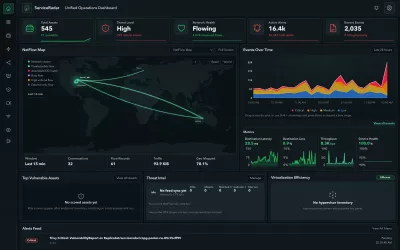
A security dashboard for your homelab and home network. See what’s exposed, what changed, and which new vulnerabilities may affect what you run. Set it up, let it monitor, tune it when you want.
In development: M1 is partway. A nightly nmap scan runs from a contained runner, unexpected open ports alert over ntfy, and a minimal dashboard marks services expected. There is no release yet; the roadmap says what comes next.
What it will do
- Show your attack surface. Browse assets, services, changes, and evidence in one dashboard.
- Catch unexpected exposure. Compare reachable services with what you intended, inside the network and from an external probe.
- Surface relevant threats. Connect new advisories and known exploitation to your software, with source links.
- Hold your hosts to a STIG. Each host evaluates itself with OpenSCAP and pushes the result. See its pass rate and failing rules, waive what fails on purpose, and download a STIG Viewer checklist and an Ansible playbook for the fixes.
- Check your fixes. Request a bounded verification and see what the scanner actually observed.
- Work with your assistant. Give an assistant such as Hermes restricted API access to read status and request approved scans.
- Stay out of your way. Run scheduled checks, handle routine housekeeping, and alert on useful changes or monitoring failures.
For example: a new container on your server exposes an admin port. pen16 shows it on the dashboard and alerts you. You restrict access, ask for verification, and review the result. A later advisory for that software can warn you even without an active vulnerability check.
Built for a homelab
One owner, self-hosted infrastructure, and almost no routine work. Core operation needs no LLM or paid cloud service.
The first release delivers the dashboard and internal monitoring loop. Lightweight vulnerability awareness and the outside view complete v1. See the specification and roadmap.
Running it
You need uv and Docker.
make db      # throwaway Postgres for the checks
make check   # everything CI runs
To run it on a Debian 13 host, put a deployment config like examples/pen16.toml and its
secrets in /etc/pen16, then start deploy/compose.yaml and the
pen16-egress service. For backups, mount off-host storage at /mnt/pen16-backup and
enable the pen16-backup timer. For compliance, serve the intake on the tailnet
(tailscale serve --bg --https=8444 http://127.0.0.1:8444), import the DISA STIG's manual XCCDF with
pen16 stig-import, and install deploy/compliance on each host with a token from
pen16 token --kind compliance <host>. The image builds on the host, because nmap's license limits
redistributing it. A private deployment repository with Ansible normally does all of this; the
architecture says what it owns.
Contributing
Start with AGENTS.md and the coding standards.
Use pen16 only on networks you own or are explicitly authorized to assess.
MIT. See LICENSE.