Agent-driven parametric CAD for 3D printing. A human and an AI coding agent design mechanical parts as Python, prove them with automated geometry checks, review them in an interactive 3D page, then slice and print them on a Bambu Lab P2S. Measurements from the real parts go back into the specs.

flowchart LR
  S[YAML spec] --> V{validate}
  V -->|BLOCKED: unknowns| S
  V --> C[build123d CAD]
  C --> K{geometry, clearance<br/>& motion checks}
  K -->|FAIL| C
  K --> R[interactive 3D review]
  R --> H{human approval}
  H --> P[slice → print on P2S]
  P --> M[measure the real part]
  M --> S
Every step reports PASS / FAIL / BLOCKED. Unknown engineering values stay unknown instead of being guessed, and nothing gets printed without the human saying so.
What's been built
Geared string winch for the BLDC stand · CAD complete
▶ Open the interactive 3D review: run the winch, drag the weight up, cut it open. It's about 7 MB and needs WebGL.
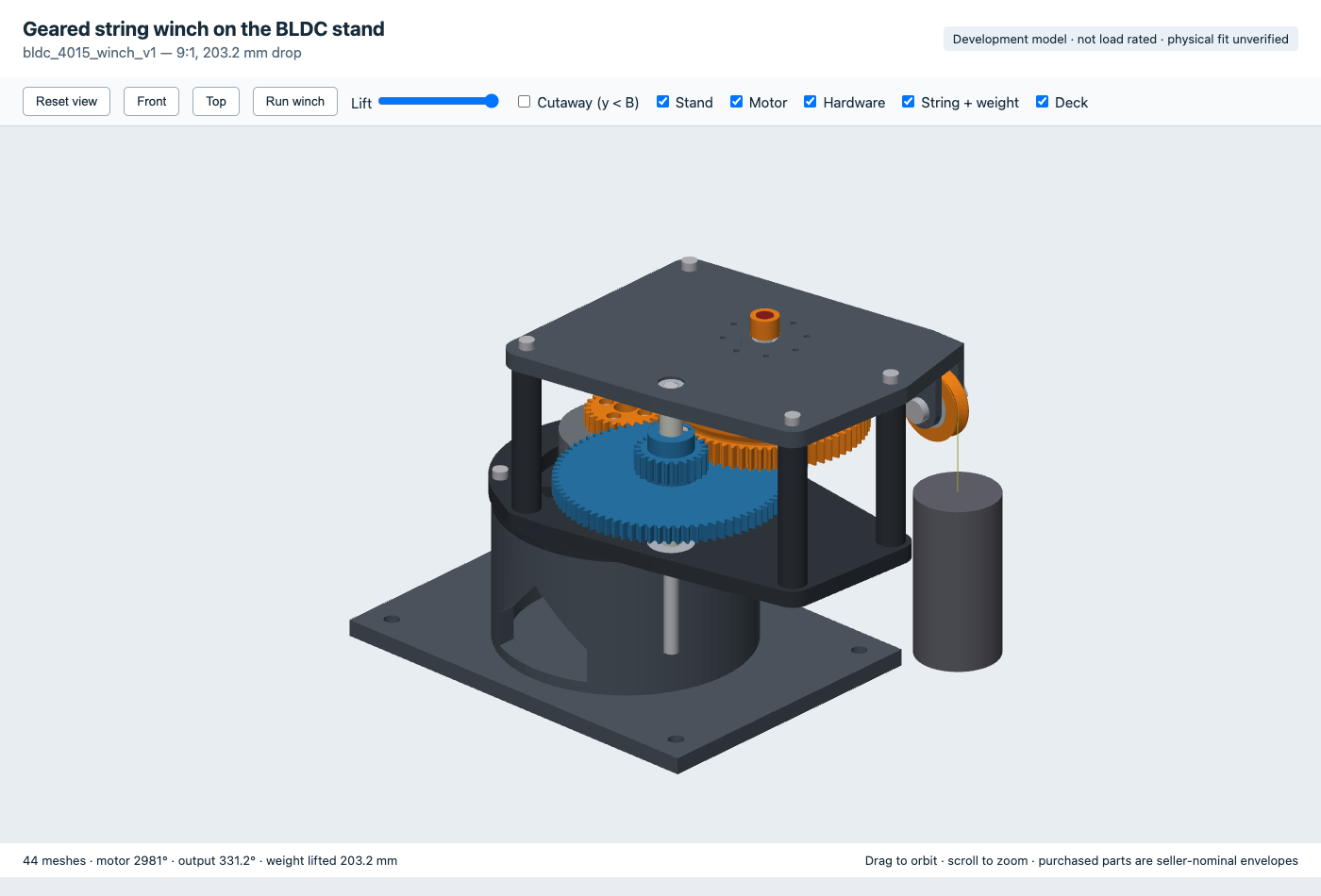
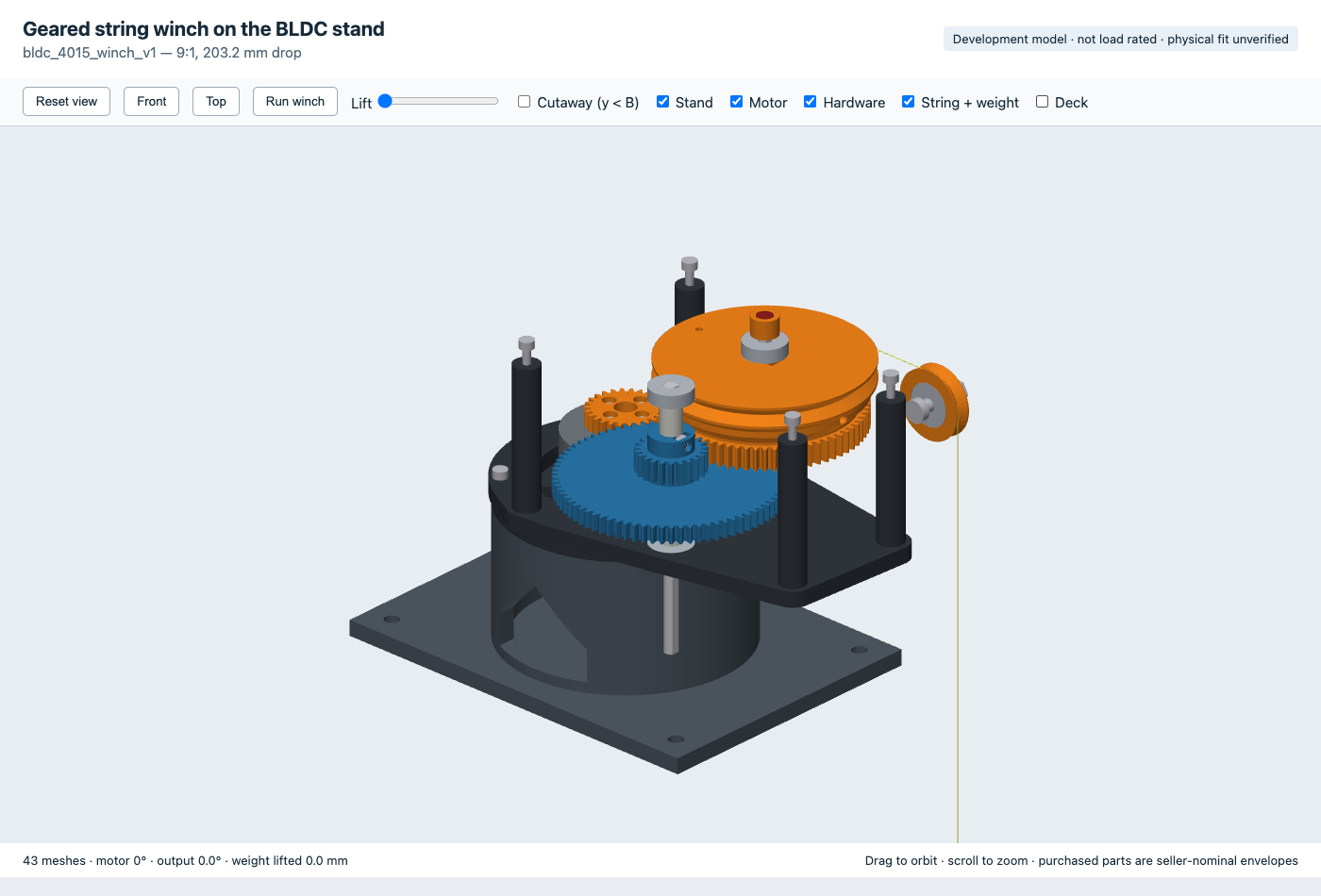
A controlled torque load for developing a motor driver on the stand below. A 26T gear screws to the motor's rotor and drives a 9:1 two-stage spur train (26→78, 23→69) to a Ø70 string drum, which lifts a hanging weight over a pulley that overhangs the base edge.
- Absolute output position. The 8 inch (203.2 mm) drop takes 0.92 of an output turn, so a single-turn magnetic encoder on the output shaft knows where the weight is without homing. The motor encoder sees about 8.3 turns; comparing the two shows the backlash.
- Bolts onto the existing stand. The frame uses the motor plate's four M3 holes with longer screws; nothing on the printed stand changes. Bearings are 625ZZ on 5 mm D-shafts.
- Load is about 38 mN·m at the motor per kg hanging, before friction. The printed teeth are not load rated, so a driver current limit comes first.
- 365 automated checks. Both meshes are swept through a full pinion tooth (contact ratios 1.72 and 1.70) and a seeded quarter-pitch phase error has to fail. Every rotating part has to stay inside its rotation envelope with 1 mm clearance to fixed parts and other axes, and the string and weight must stay clear over the whole travel. Screw engagement is checked too.
- 10 printed parts, no supports. Not sliced or printed yet.
Design notes, BOM and assembly →
Face-up BLDC motor evaluation stand · printed
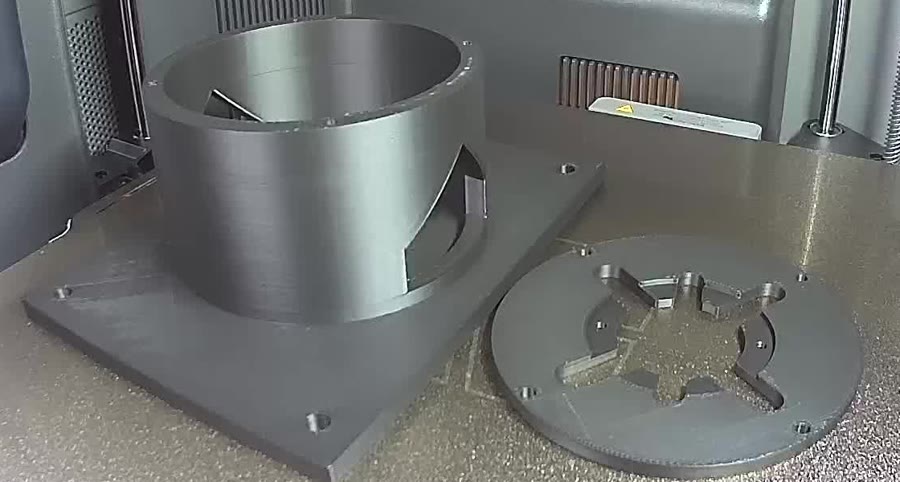
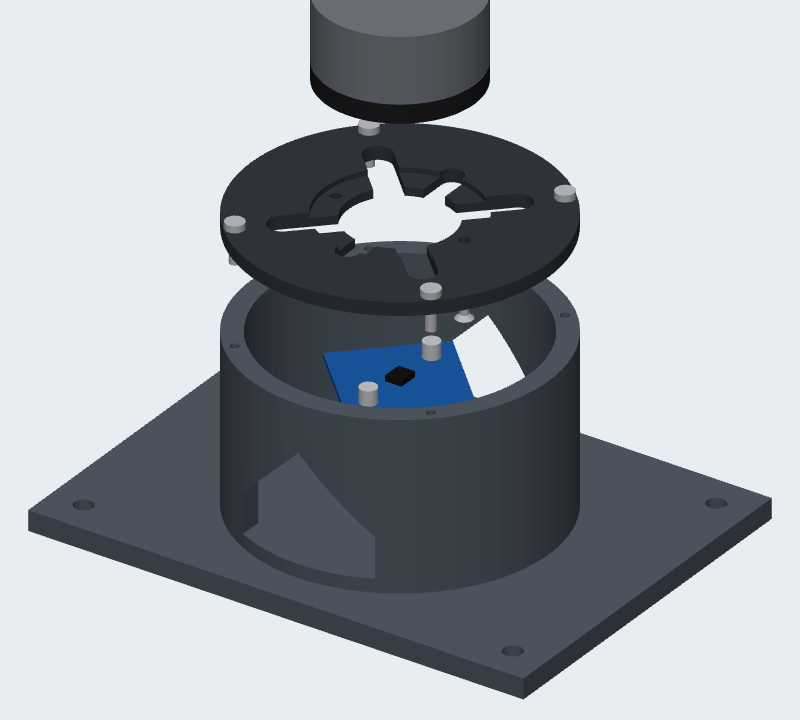

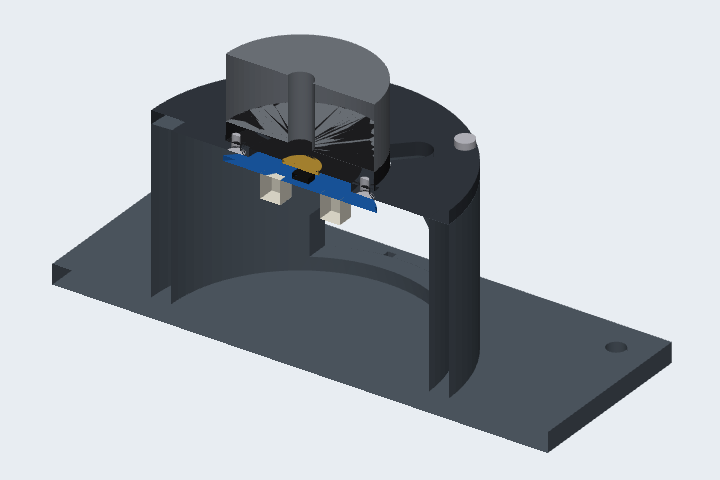
A desktop holder for developing a motor driver and FOC control loop with a 4015 hollow-shaft gimbal motor (24N22P, 11 pole pairs).
- The encoder board stays swappable. The motor's two hole circles lie on the same four axes, 5.5 mm apart, so a stand screw and an encoder standoff can't share an axis. The stand uses one opposite pair of holes and the encoder the other. Below the motor is an open Ø78 × 50 mm cavity for any board up to 53 mm square, on standoffs from 3 to 8 mm. It fits both the supplied MT6701 board and a retrofitted 33 mm AS5600.
- Two printed parts. A motor-specific plate (Ø90 × 4 mm) sits on a common tower and base (150 × 110 × 56 mm), so supporting another motor means printing a new plate.
- 84 automated checks. Keep-outs for the rotating bell and boss, an encoder envelope swept across the standoff range, standoff passage through the slots, motor seat and tower support, screw engagement against the 3 mm thread depth, window/base integrity, STEP round trips and manifold STLs.
- Prints without supports: 2 h 16 min, ~100 g PLA.
27:1 compound gearbox · CAD complete
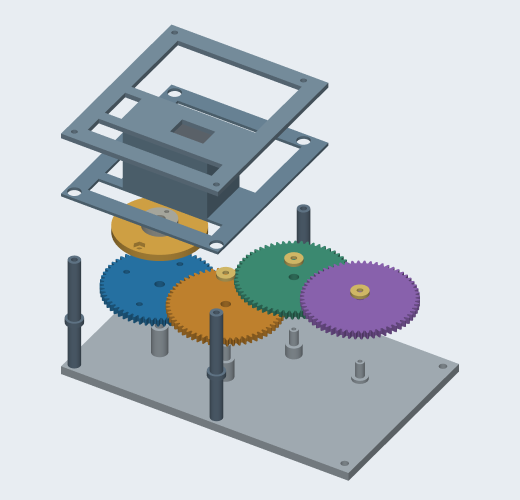
Four 60T/20T module-1 compound gears on plastic shafts printed with the back plate, driven by a Waveshare ST3215 servo through its metal horn. Three meshes give −1/27. 15 printable parts, 174 × 109 × 75.9 mm. Checks include involute mesh profiles, tooth-phase sampling over a full tooth period (contact ratio 1.67), full-revolution moving envelopes and static interference. The vendor servo STEP contained an invalid solid, so the assembly uses dimensioned reference envelopes, and the limitation is documented rather than hidden.
Assembly guide and BOM → · Design decision D003 →
First print · one gear, October 2026
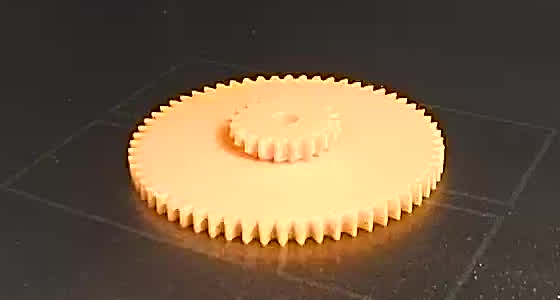
A test gear printed large-face-down so the 60T teeth need no support. Getting there turned up two traps worth knowing if you script Bambu Studio:
- The CLI does not resolve system presets. Passing stock P2S profiles directly produced
G-code with a generic
G28start: no AMS filament load, no bed leveling. It would have printed air. Flatten each preset'sinheritschain andincludetemplates first. - The P2S wants the H2-style
project_filecommand over LAN. It needs aftp:///cache/<file>URL and non-zero task IDs. The older P1/X1 form fails with0500-4002 Unsupported file path or name.
Rotor indicator disc · on hold
An orange disc with flush black inlaid markers at 0/90/180/270° (circle, triangle, square, cross) for eyeballing position-control tests. Designed and checked as a two-color print; waiting on a second motor type so one disc can fit both.
How the checks work
Each design type has its own builder in src/mech_lab/ and its own independent checks:
| Check | What it proves |
|---|---|
| Valid single solids | The CAD kernel considers every printed part a closed, valid solid |
| Envelope and placement | Dimensions, origin and marker/hole positions match the spec, not the CAD code's intent |
| Interference and keep-outs | Zero overlap with moving parts, purchased-part envelopes and swept ranges |
| Motion | Tooth clearance across sampled mesh phases; full-revolution swept volumes |
| Export round trip | STEP reopens with identical volume and bounds; STL is edge-manifold and grounded |
| Seeded defects | Tests break the geometry on purpose (shifted marker, thick floor, notched base…) and require the matching check to fail |
Software tolerances (1e-6 mm, 1e-8 relative volume) prove the model is self-consistent. They are not print tolerances. Printed fit is only established by measuring real parts. Changing an acceptance threshold to make a design pass is against the rules here. When the stand's arched windows failed the STEP round trip by 3.6e-8, the window shape changed instead.
Quick start
Requires Python 3.12. Commissioned on native arm64 macOS; other platforms are untested.
python3.12 -m venv .tools/uv
.tools/uv/bin/python -m pip install --disable-pip-version-check --no-cache-dir uv==0.12.10
.tools/uv/bin/uv sync --locked
.tools/uv/bin/uv run --locked pytest -q          # 92 tests, about three minutes
If uv is already installed, use it in place of .tools/uv/bin/uv. Build a design into a
new directory, then open its interactive review:
uv run --locked build_design specs/bldc_4015_stand_v1.yaml --output builds/my-stand
open builds/my-stand/review.html                  # orbit, cutaway, explode, spin the rotor

uv run --locked build_design specs/gearbox_v1.yaml --output builds/my-gearbox --timeout 600
open builds/my-gearbox/review.html                # animated 27:1 gear train + BOM

uv run --locked build_design specs/bldc_4015_winch_v1.yaml --output builds/my-winch
open builds/my-winch/review.html                  # run the 9:1 winch, lift slider, cutaway
The gearbox build needs Waveshare's ST3215 STEP, which isn't redistributed here. Download it from the source listed in components/drawings/README.md; the build verifies its SHA-256. Without it, the one test that needs it is skipped.
Each build writes parts/*.step, print-oriented print/*.stl, assembly.step,
geometry_report.json and a build_manifest.json that records source, dependency and
artifact hashes. builds/ is git-ignored; everything in it can be regenerated.
Tools
Every command emits JSON plus a short summary. Exit codes: 0 PASS · 1 FAIL · 2 BLOCKED.
| Command | Scope |
|---|---|
validate_spec SPEC [--scope schema|build|release] |
Strict schema, explicit unknowns, readiness. Release is always BLOCKED. |
build_design SPEC --output DIR |
Smoke block, cube/sphere, compound gearbox, indicator disc, BLDC stand, BLDC winch |
inspect_geometry STEP --spec SPEC |
Independent re-inspection of an exported assembly (smoke, cube/sphere, gearbox; the stand, disc and winch check inside their builders) |
render_review MANIFEST --output DIR |
Hash-checked SVG projections (isometric, top, front, right) |
environment_report |
Python/package versions and desktop app inventory |
Specs reject unknown fields, duplicate YAML keys, missing units, infeasible geometry and
inconsistent approval metadata. specs/finger_joint_v1.yaml deliberately returns BLOCKED
to show that unresolved inputs stop a build rather than getting invented.
Repository layout
cad/           authoritative parts and assemblies (Python, build123d)
specs/         validated YAML design inputs
src/mech_lab/  schema, CLI, builders, checks, review generators
tests/         rebuilds, seeded defects, schema rejections
components/    purchased-part registry and provenance
measurements/  user-reported and measured values; never overwritten
decisions/     design decision records
docs/          status, proposals, assembly guides, print records
validation/    software geometry policy
docs/status.md is the running record of what has actually been verified.
AGENTS.md holds the operating rules the AI agent follows: keep assumptions
proposed until approved, never invent component facts or calibrations, preserve
measurements, and treat a development build as no authorization to print.
Status and limits
- Motor, servo and encoder geometry comes from supplier drawings plus reported measurements. Physical fit is confirmed only by printing and measuring.
- No load ratings, no powered tests, no releases. Release packaging reports BLOCKED by design.
- Prints so far were sent with one-off LAN scripts (status reads, FTPS upload, start command), each approved by the human beforehand. No printer-control tool lives in this repo.
License
Free for personal, educational, research and other noncommercial use.
- Software (code, CAD scripts, specs, tests, tools): PolyForm Noncommercial 1.0.0
- Documentation, images and designs: CC BY-NC-SA 4.0
Commercial use requires written permission. Contact @analogjedi. Third-party supplier drawings and CAD are not included, and neither license covers them.
Built with
build123d on the OpenCascade kernel · uv · Pydantic · Bambu Studio CLI · OCP CAD Viewer · designed in collaboration with AI coding agents.