
Quadratic Vote
Find out what your group cares about most — without one loud voter deciding for everyone.
A group-prioritization tool for retros, roadmaps, budgets and trips, powered by quadratic voting. Pick a template, share a link, everyone votes on their phone in 90 seconds. No signup, nothing to pay, no math degree.
🔗 Live: quadratic-voting.com · 🧠 The thinking: docs/pm/ · 🏗️ Next.js 16 · Drizzle · Postgres
This is a portfolio piece. I'm a product manager, and I built this to do the whole loop myself — research, scope, design decisions, build, ship to a real domain, then watch real people use it and fix what broke. The README below is the case study; the
docs/pm/folder has the PRD and research that came first.
The problem I went after
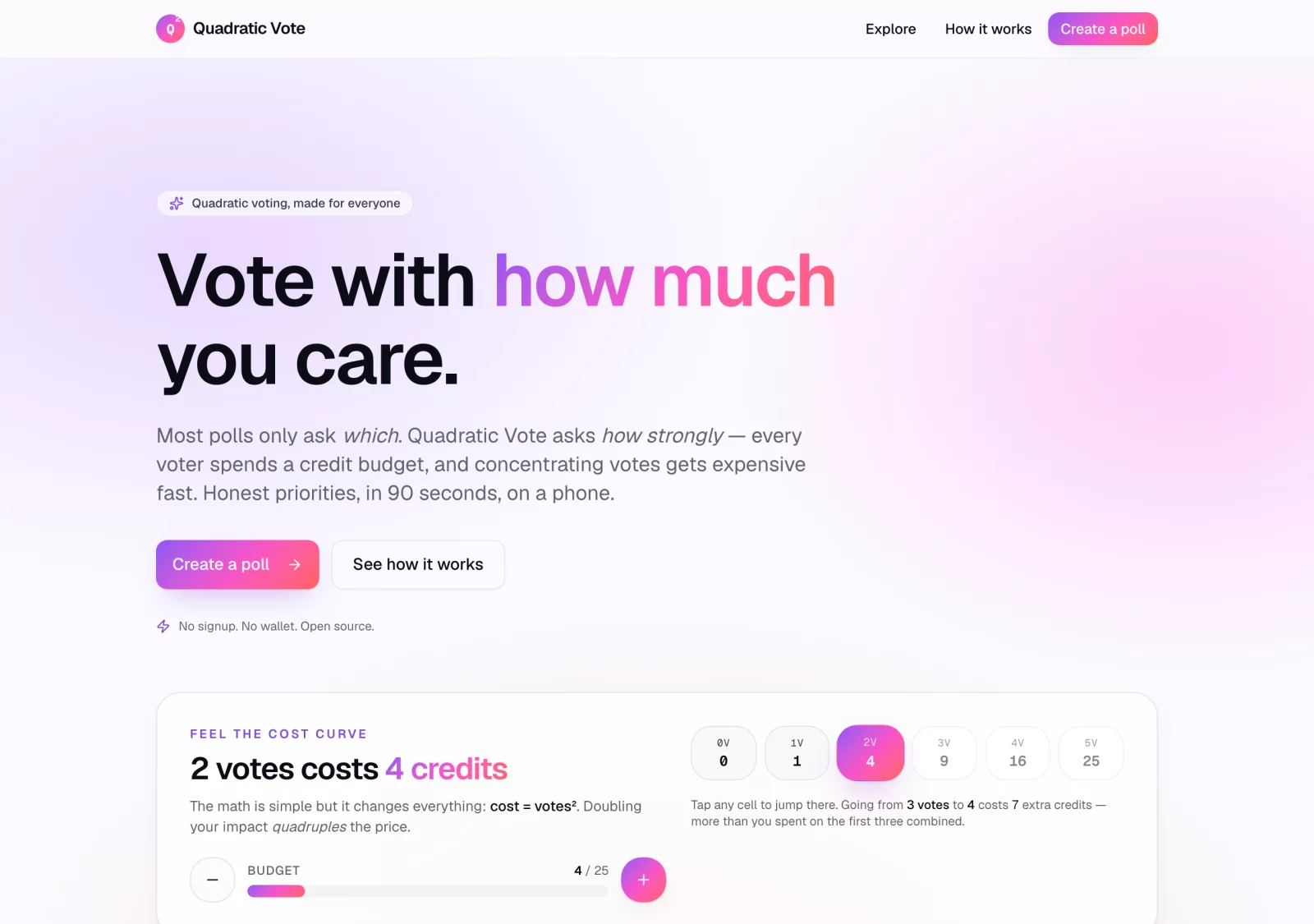
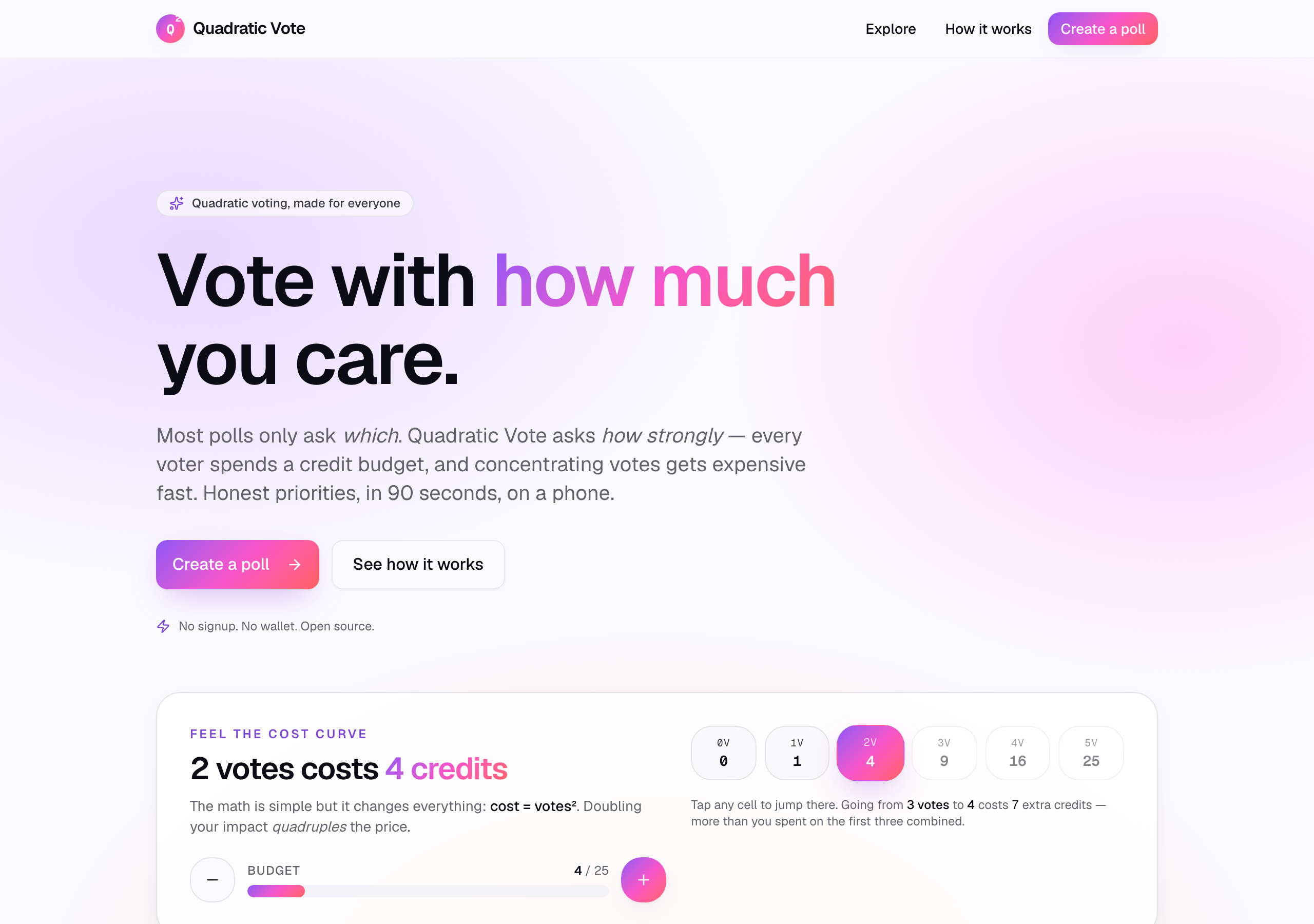
Quadratic voting is a genuinely better way to make group decisions: instead of one-vote-per-option, every voter gets a credit budget, and concentrating votes on one option costs more (N votes = N² credits). So caring deeply about something means spending real budget on it — the system captures intensity of preference, which normal polling throws away.
The mechanism has real-world use: Colorado House Democrats ranked budget bills with it for five years (until a judge stopped it in 2024, over secret ballots rather than the method), and Gitcoin has run quadratic funding rounds for years. But it's trapped in the world of people who already know what it is. Every existing tool (RadicalxChange, Snapshot, Civicbase) is built by and for the QV community: wallets, governance jargon, desktop-first.
The gap: there's no QV tool for the person who's never heard of QV. The one a team lead drops in Slack without explaining the math. The one that teaches you the mechanism by letting you do it, on your phone, in 90 seconds.
That's the bet this product makes.
The positioning bet
| Existing QV tools | Quadratic Vote | |
|---|---|---|
| Audience | QV insiders, DAOs, governance | First-timers who've never heard of QV |
| Onboarding | Read the theory first | Learn by feeling the cost curve as you vote |
| Friction | Wallet / signup / config | Link is the product — zero account |
| Surface | Desktop-first | Mobile-native (links travel in Slack/iMessage) |
The whole UI is the explainer: you tap +, you watch your budget drain faster than you
expected, and you get it — that's the teaching moment, no tooltip required.
See it
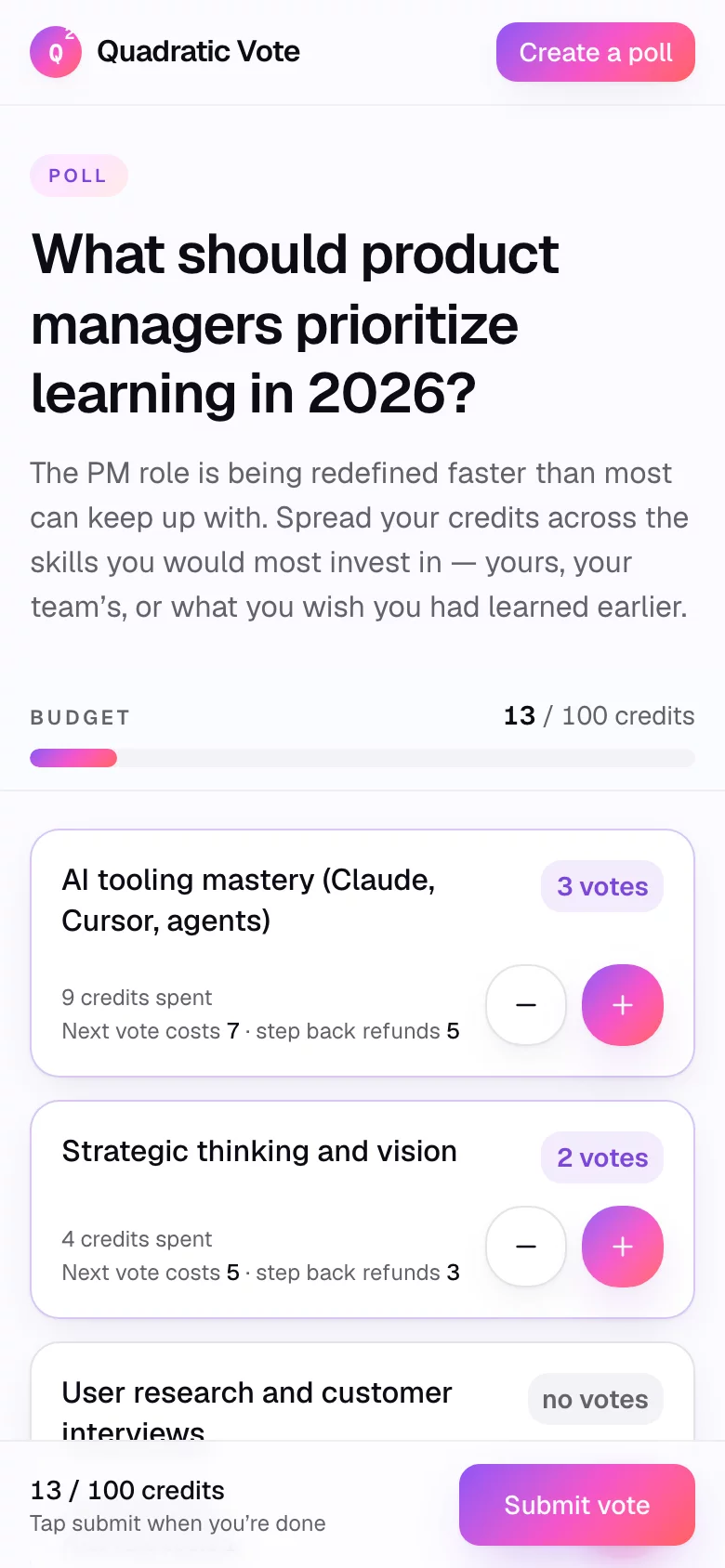
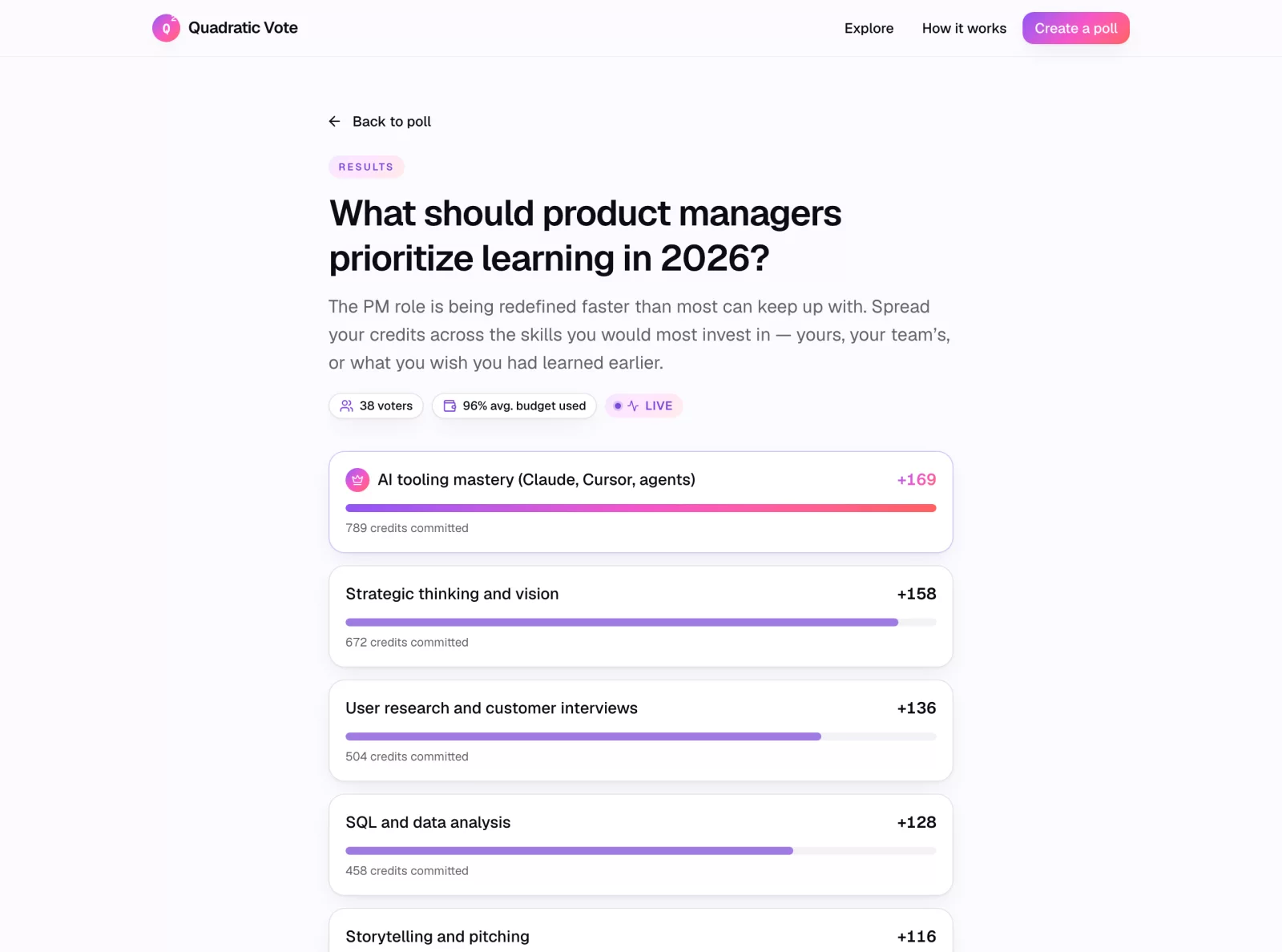
| Voting (mobile) | Live results |
|---|---|
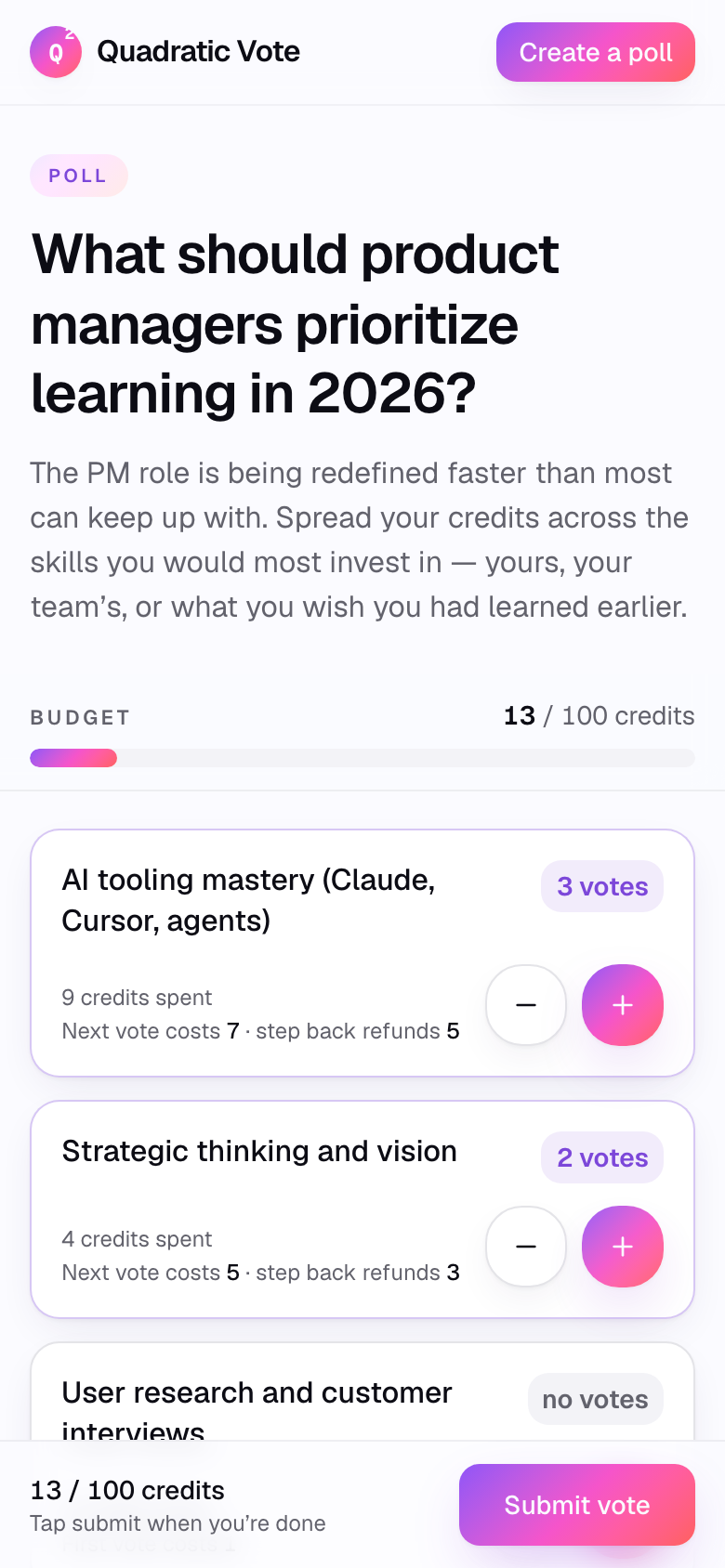 |
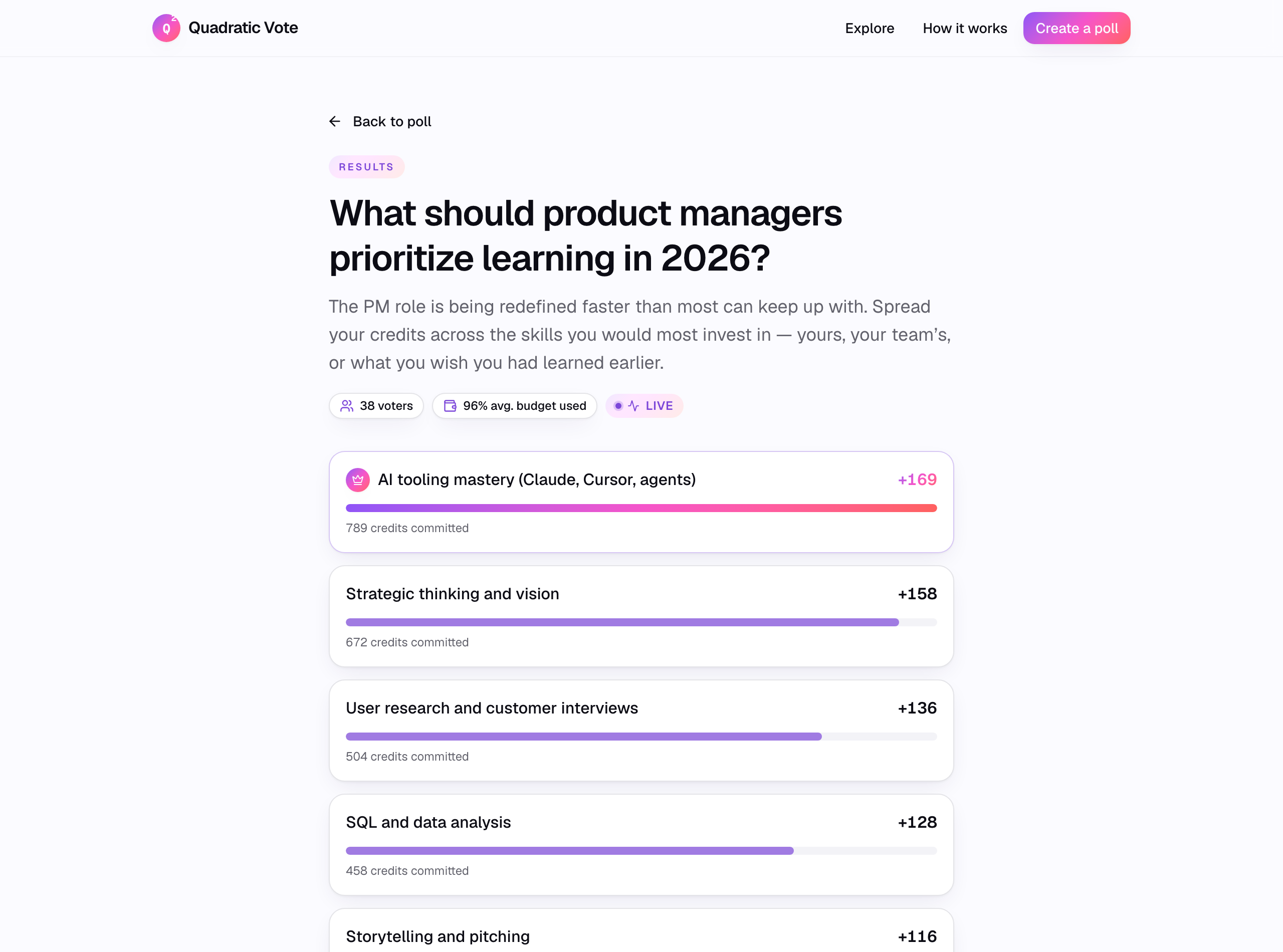 |
The budget bar fills as you spend; each card shows the cost of the next vote so the quadratic curve is visible in the moment. Results refresh live while a poll is open.
V2: what community research changed
After shipping, I researched demand on Reddit and Hacker News (write-up). The finding that reshaped the product: nobody searches for "quadratic voting". Outside crypto and voting-theory circles, the term barely appears, and when it does, it gets "I have zero faith people would understand it" or "snake oil". But everyone runs retros, ranks roadmaps and splits budgets, usually with dot voting, where one person can pile every dot on their pet idea.
So V2 sells the job, not the mechanism:
| Research finding | What shipped |
|---|---|
| People search for the job, not "QV" | Landing, metadata and /create lead with group prioritization; QV is the explanation of how it works |
| The real competitor is dot voting | /vs/dot-voting comparison page (it says when dot voting is the better choice), plus sitemap and robots |
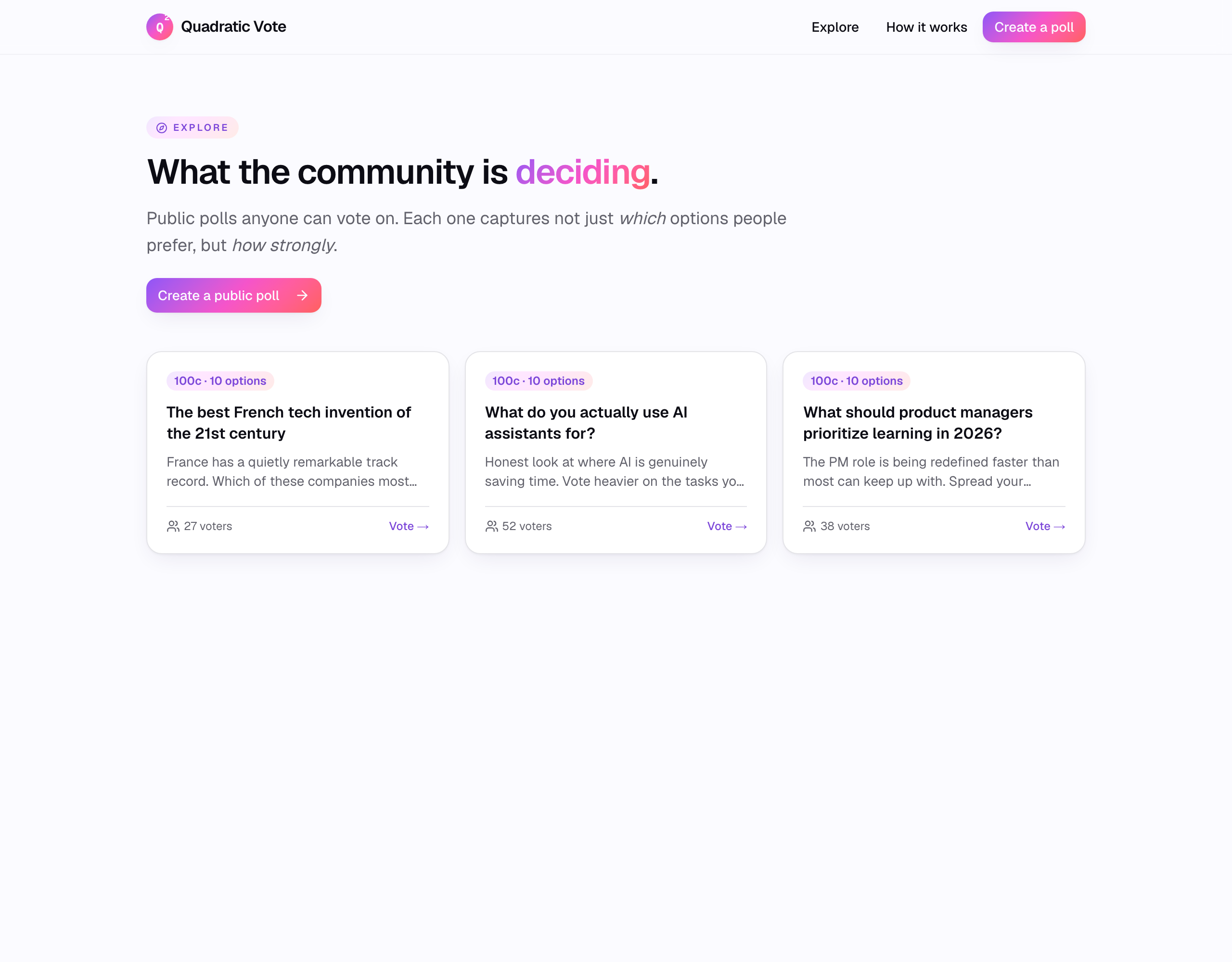
| Blank forms, unfamiliar method | 5 templates (retro, roadmap, offsite, budget, trip), one tap from the landing page |
| Credits voters can't spend with small budgets | Budget recommendation follows the option count; 25 credits dropped |
| Real users couldn't tell if results were plausible | Every option shows backed by N of M voters and an expandable breakdown you can add up by hand |
| People assume votes cost money | "Credits aren't money, nothing is bought", on the voting page, create form and FAQ |
| Colorado's QV use was banned for being secret | Optional named ballots (tokenized polls): results show who voted what, and voters are told first. Plus turnout ("7 of 12 invited voted") |
| The product's growth comes from voters | Voters see "Got a decision of your own?" with templates after voting; poll creation records whether the creator was a voter first |
Product decisions & trade-offs
The interesting part of any product is what you decide not to do, and which risks you accept on purpose. The calls I made and why:
| Decision | Why | Trade-off I accepted |
|---|---|---|
| No accounts — cookie identity | Signup is the #1 drop-off. The link had to be the product. | A voter can re-vote in incognito. Fine for team/classroom polls; a known, documented limit. |
| Cut negative votes | The math supports "vote against," but in real testing it confused first-timers more than it helped. The teaching moment lives entirely on the positive cost curve. | Lost the opposition signal. Kept the primitive in quadratic.ts so a future poll-creator toggle can re-enable it without a rewrite. |
| Two voter models | "Anyone with the link" for casual polls; pre-issued per-voter tokens for when one-vote-per-person actually matters (board votes, hiring panels). | More schema + UI. Worth it — it's the feature no free QV tool offers. |
| Admin = secret URL token | No accounts means no login to manage a poll. A CUID2 token in the admin URL is the key. | If leaked, the poll can be closed by anyone. Mitigated with a "save this link" flow + local recovery, never logged (sent as Authorization: Bearer, compared in constant time). |
| Deliberate 1.5s creation overlay | The create call is fast — too fast. Users couldn't tell anything happened and worried they'd double-submitted. | Added latency on purpose. Reassurance > raw speed for an irreversible action. |
| Static OG card over dynamic per-poll images | The dynamic next/og route timed out on Vercel's Edge runtime in production. |
Per-poll cards (with the poll title baked in) became one generic brand card. Reliable share previews > broken clever ones. |
| Votes drawn as literal squares (the gnomon grid) | "Quadratic" means square: N votes render as an N×N grid, and the next vote's cost is visibly the L-shaped shell of 2N+1 cells around it. The form teaches the mechanic — no prose required. | More pixels per option card, and cells shrink past 5×5 votes. Shipped without baseline comprehension data (near-empty prod) — a bet on embodiment, to be validated by the next dogfood. |
📋 Full reasoning, including the engineering and process calls, in the decision log.
What I deliberately did NOT build
Scope discipline from the PRD's non-goals: no real-time websockets (results poll on an interval instead), no per-voter analytics, no third-party integrations, no white-labeling, no email collection, no multi-round runoffs. Each one is defensible later — none earned its place in the first shippable loop.
What dogfooding taught me
I shipped, then watched colleagues actually use it. Reality immediately corrected my assumptions — the most valuable part of the whole project:
- A colleague clicked
+once and hit submit — treating it like a pick-one poll, spending 1 of 100 credits. The mechanism failed silently. → Added an inline hint banner (replacing a dismissible modal nobody read) and a low-spend warning on the submit dialog. - The walkthrough was a modal → people reflex-dismissed it. → Made it an inline banner that stays until you've actually voted.
- 40-voter admin lists hid 30 rows behind an invisible inner scroll. → Let the page scroll naturally.
/exploreshowed "0 voters · 0 options" on polls with real data — a Drizzle correlated-subquery bug returning the string"0". → Rewrote withcount()+groupBy; verified against seeded data.
None of these showed up in tests. They showed up in 30 minutes of real use. That's the lesson.
What I'd do next (ranked)
- Measure the voter → creator loop now that it's instrumented (
signup_start.from,signup_complete.wasVoter), and iterate on the post-vote CTA before any other channel. - Answer "how do we decide X as a group?" threads in r/agile, r/scrum, r/ProductManagement and facilitation communities, rather than posting launch announcements.
- One "run-a-poll" partnership — get a newsletter/community to run a real vote through it.
- Rate limiting + a GDPR cookie notice before any real volume.
- (Longer shot) QV as a headless decision primitive for AI agents — the API-first architecture already leaves this door open.
How it's built
- Next.js 16 (App Router, Server Components by default) · TypeScript strict
- Tailwind v4 + shadcn/ui + Radix · framer-motion micro-animations
- Drizzle ORM + Postgres · Zod schemas shared client/server · SWR for live polling
- Vitest (unit) + Playwright (e2e) · deployed on Vercel + Neon
Race-safe voting: every invariant (poll open, budget, valid options, single ballot per
voter, token unconsumed) is enforced inside one Drizzle transaction. The
UNIQUE(poll_id, voter_id) index on ballots is the atomic gate — it even covers abstention.
Data model
polls         id, title, description, credits_per_voter, admin_token,
              visibility ('public' | 'unlisted'), voter_mode ('open' | 'tokenized'),
              ballot_visibility ('anonymous' | 'named' — named needs tokenized),
              is_closed, created_at, closes_at
options       N labels per poll
voter_tokens  pre-issued per-voter URL tokens (tokenized polls only).
              consumed_at + ballot_id form the audit trail.
ballots       one row per submission. UNIQUE(poll_id, voter_id) = the atomic single-vote gate.
votes         one row per (ballot × option) with a non-zero allocation. UNIQUE(ballot_id, option_id).
For open polls voter_id is the cookie; for tokenized polls it's the token id,
and submitting burns the token in the same transaction.
Routes & API
| Route | What |
|---|---|
/ |
Landing: templates, cost-curve demo, dot-voting comparison, FAQ |
/vs/dot-voting |
Dot voting vs quadratic voting comparison page |
/explore |
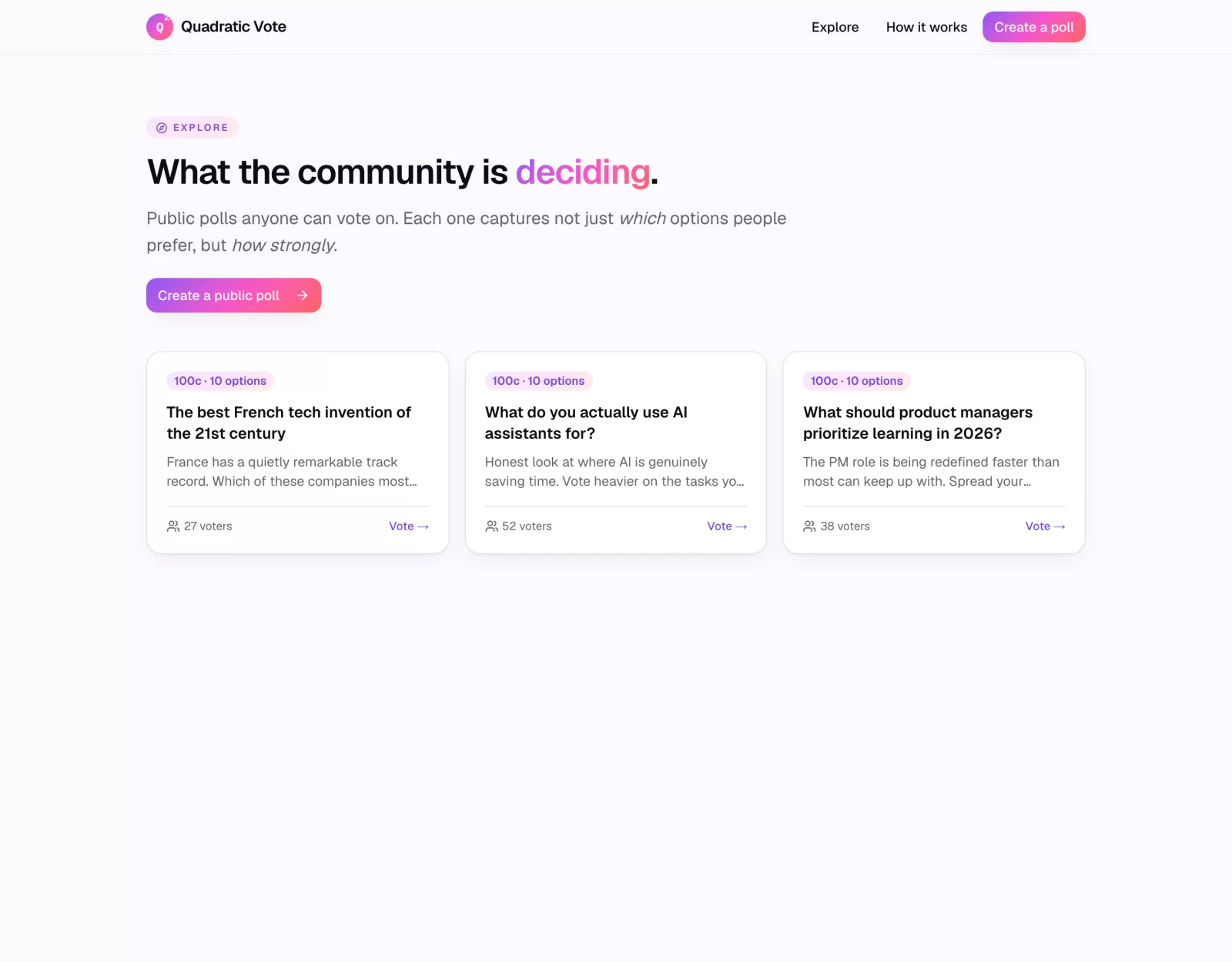
Grid of public polls |
/create |
Poll creation (?template=retro pre-fills, ?from= attributes) |
/poll/[id] |
Voting (open polls) |
/poll/[id]/v/[token] |
Personal voter link (tokenized) |
/poll/[id]/results |
Live results (SWR) |
/poll/[id]/admin/[token] |
Admin: close/reopen + voter-link copy |
/my |
Polls created from this browser (local admin-link recovery) |
| API | Notes |
|---|---|
POST /api/polls |
Create (open or tokenized) → { id, adminToken, voterUrl, adminUrl, voterTokens[] } |
GET /api/polls/[id] |
Poll + options + caller's allocations. Strips adminToken. |
POST /api/polls/[id]/vote |
{ allocations[], voterToken? }. Identity from token or cookie. Atomic. |
GET /api/polls/[id]/results |
Aggregate results + per-option breakdown, turnout (tokenized), named ballots (if enabled). force-dynamic, polled every 3s. |
PATCH /api/polls/[id] |
Admin only. Token in Authorization: Bearer. |
Run it locally
Requires Node 20+ and Docker.
npm install
npm run db:up        # Postgres on :5433, isolated from any system pg
npm run db:migrate
npm run db:seed      # optional — populates /explore with example polls
npm run dev          # http://localhost:3030
npm run check runs lint + typecheck + tests. Full script list in package.json.
The thinking behind it
Before any code, I scoped this as a PM would. That work lives in docs/pm/:
- PRD — problem framing, vision, plan of record, non-goals
- Research — key findings, a competitive analysis of 10 tools, QV theory + real-world case studies
- Perspective agents (
.claude/agents/) — engineer / designer / qa / stakeholder lenses I ran the design through
Built with Claude Code
The product decisions, scope, and design direction are mine; the implementation was
AI-assisted (Claude Code), shipped over a weekend. The .claude/ folder includes
the skills and review agents I used. I think "a PM who can scope and ship with AI" is the
honest, interesting version of this story — so I'm not hiding it.
Contact
Questions or feedback: contact@quadratic-voting.com.
© Quadratic Vote. All rights reserved.