
Recipely
Talk, import, cook.
A recipe app for iOS, Android and the web, built from one codebase.
Import a recipe from any video, site, photo or PDF, have AI write one for you,
and cook it with a voice assistant that uses the app on your behalf.




Website · About · Features · Architecture · Getting started · Security
✨ Features
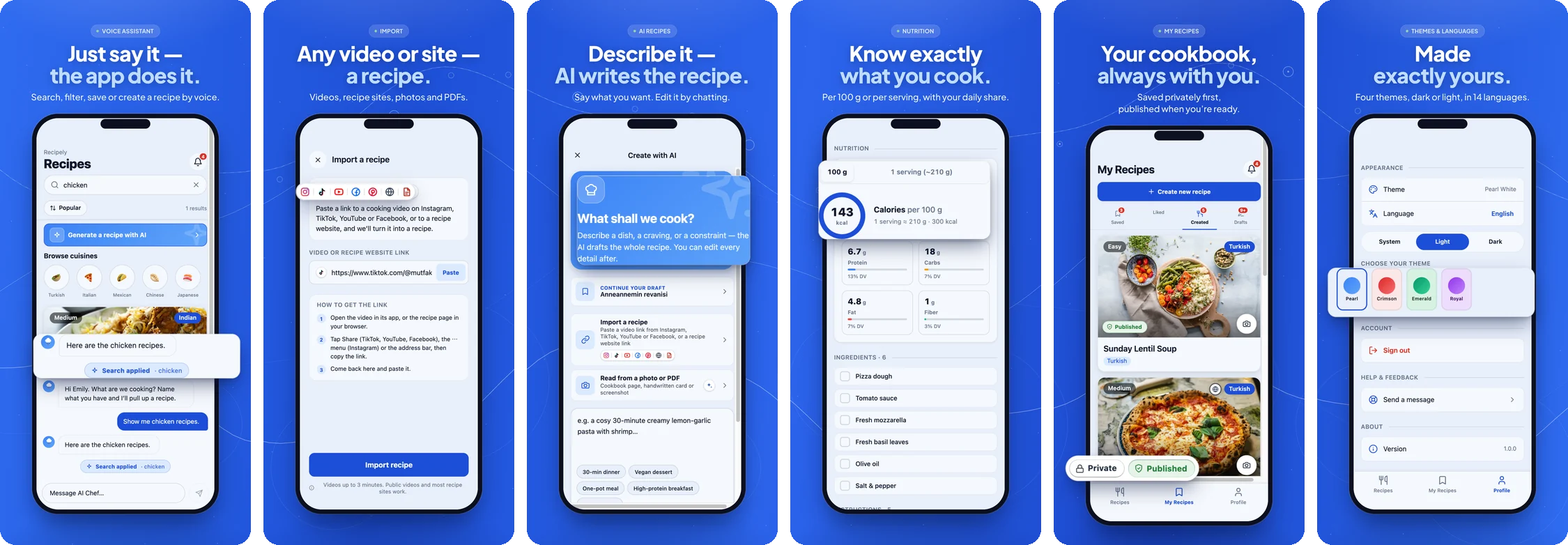
🎙️ Voice assistantTap the chef and talk. It searches, filters, opens and creates recipes on screen while you watch, and answers out loud. Siri and Android shortcuts reach it too. |
📥 Import anythingShare a recipe from Instagram, TikTok, YouTube, Facebook or Pinterest, paste a recipe site, or photograph a cookbook page or a PDF. Every import links back to its source. |
✨ Create with AIDescribe a dish or list what is in your fridge. AI drafts the recipe and you refine it by chatting. |
🍳 CookAn ingredient checklist, numbered steps, timers inside the step that mentions them, a cooking mode, and metric or US units. |
🛒 Plan and shopPlan the week from saved recipes and get one shopping list. The list and saved recipes open offline. |
📊 TrackA food diary with nutrition per 100 g or per serving, and your daily share of each nutrient. |
🔎 DiscoverA recipe feed with search, filters, sorting, cuisines and trending recipes. Guests can browse without an account. |
⭐ CreatorsCreator pages and tags, stats, and Instagram comment-to-DM recipe delivery. |
🌍 EverywhereFour themes in light and dark, 14 languages, and a web app with its own desktop layout and prerendered recipe pages. |
The app talks to its own API at api.recipely.net (the separate recipely-backend repository) and uses
Firebase for Google and Apple sign-in, push, analytics and crash reports.
🧱 How it is built
Four layers on a shared core. Arrows point the only way imports may go.
flowchart LR
  P["<b>presentation</b><br/>screens · hooks · theme"] --> A["<b>application</b><br/>stores · use cases"] --> D["<b>domain</b><br/>entities · ports"]
  I["<b>infrastructure</b><br/>API · storage · Firebase"] -. implements .-> D
  classDef pres fill:#0f7f93,stroke:#0f7f93,color:#ffffff
  classDef app fill:#2747d6,stroke:#2747d6,color:#ffffff
  classDef dom fill:#1d7a4c,stroke:#1d7a4c,color:#ffffff
  classDef infra fill:#b45a0c,stroke:#b45a0c,color:#ffffff
  class P pres
  class A app
  class D dom
  class I infra
Underneath them all, core holds Result, Failure, the base classes, the DI container and the named constants; every layer may use it.
| Idea | In practice |
|---|---|
| Dependencies point down | A screen never calls the API: it calls a store, which calls a use case, which asks a port. check:structure fails a commit that imports the wrong way. |
| Ask for an interface, get an implementation | Use cases depend on ports such as FavoritesRepositoryInterface; the DI container plugs in the real class at start-up and a fake in tests. |
| Failures are values | Business code never throws. Every call that can fail returns Result<T, Failure>, and the API sends a message key the app shows in the user's language. |
| State in stores, rendering compiled | Components read one slice with useStore(store, selector), and the React Compiler memoizes, so only what changed re-renders. |
| Rules are checked by machines | Strictest TypeScript, type-aware lint, about fifty structure rules and coverage minimums run on every commit. |
The stack
| Area | Choice |
|---|---|
| Framework | Expo SDK 57 · React Native 0.86 (New Architecture) · React 19.2 with the React Compiler |
| Language | TypeScript, strict plus noUncheckedIndexedAccess and exactOptionalPropertyTypes |
| Routing | expo-router (file-based) with a custom route context |
| State | Zustand 5, vanilla stores |
| Network | Axios with an AES-256-GCM envelope, session renewal with single-use refresh tokens |
| Security | TLS with pinned roots, the envelope, Play Integrity and App Attest |
| Web | react-native-web, static export to Firebase Hosting |
| Voice | @live-assistant/* on Gemini Live |
| Tests | Jest + jest-expo (4,512 tests), Playwright and Maestro in recipely-tests |
Pages live in src/presentation/app/<route>/index.tsx, with their parts beside them in body/, items/,
sheets/, hooks/ and model/. The full rules, with the reason for each, are in
architecture.md and CLAUDE.md.
🚀 Getting started
You need Node.js 20+ and npm. For iOS, Xcode 16+ and CocoaPods; for Android, Android Studio with JDK 17.
npm install
npm run start:dev    # Expo dev server against the dev API
npm run web          # in a browser
npm run ios          # simulator or device
npm run android      # emulator or device
Tip
Simulators, emulators and the browser work for development as they are. They cannot produce an app attestation proof, so the app sends none and development servers only log its absence.
Environment keys for .env.local
Every key is EXPO_PUBLIC_* because the app reads it on the device; the full list is declared in
process-env.d.ts.
EXPO_PUBLIC_API_AES_KEY=             # 32-byte hex; must match the backend's API_AES_KEY
EXPO_PUBLIC_API_BASE_URL=            # optional: overrides the per-variant API host
EXPO_PUBLIC_GOOGLE_WEB_CLIENT_ID=    # Firebase → Auth → Google sign-in
EXPO_PUBLIC_FIREBASE_API_KEY=
EXPO_PUBLIC_FIREBASE_APP_ID=
EXPO_PUBLIC_FIREBASE_PROJECT_ID=
EXPO_PUBLIC_FIREBASE_STORAGE_BUCKET=
EXPO_PUBLIC_FIREBASE_MESSAGING_SENDER_ID=
EXPO_PUBLIC_FIREBASE_MEASUREMENT_ID=
EXPO_PUBLIC_FIREBASE_VAPID_KEY=      # web push only
EXPO_PUBLIC_PLAY_INTEGRITY_PROJECT_NUMBER=  # optional: Android attestation
Warning
The AES key ships inside every app and the web bundle. It detects tampering; TLS is what keeps traffic private. See
docs/security.md.
Build variants: development and production side by side
APP_VARIANT picks the whole environment, so both variants can sit on one phone.
| development | production | |
|---|---|---|
| Name | Recipely (Dev) | Recipely |
| Android package | com.recipely.app.dev |
com.recipely.app |
| iOS bundle id | net.recipely.app.dev |
net.recipely.app |
| API | dev-api.recipely.net |
api.recipely.net |
| Web | dev.recipely.net (team only) |
recipely.net |
✅ Checking your work
Four commands must pass before a commit, and CI runs them again:
npm run lint                 # type-aware ESLint, React Compiler rules
npx tsc --noEmit             # TypeScript at its strictest
npx jest --ci --coverage     # tests, with per-layer coverage minimums that only go up
npm run check:structure      # about fifty architecture rules, unused code, unused translations
A Husky pre-commit hook runs them on staged files. After adding or moving files, run npm run map: it
regenerates PROJECT-MAP.md, and the structure check fails while that file is stale.
Important
A bug fix ships the test that would have caught it: a regression test that fails without the fix, a mechanical guard where one is possible, and a row in
docs/regressions.mdnaming the class of mistake.
Where things are
src/
  presentation/    app/ (one folder per route), base/ (shared widgets, theme, hooks), i18n/, navigation/, bootstrap/
  application/     stores, use cases, DI registration per feature
  domain/          entities, value objects, ports
  infrastructure/  repositories, DTOs, mappers, HTTP client, crypto, attestation, storage, Firebase, native bridges
  core/            Result, Failure, base classes, DI container, constants
modules/           the native assistant kit (Swift and Kotlin)
plugins/           Expo config plugins: certificate pinning, signing, R8, crash symbols
scripts/           the structure check, project map, typed routes, web export steps
public/            static web pages (about, legal)
Path aliases: @core/*, @domain/*, @application/*, @infrastructure/*, @presentation/*, @assets/*.
For anything else, PROJECT-MAP.md says where each kind of file goes.
📦 Shipping
Work goes feature branch → PR → dev → release PR → main. main is release-only.
| On | CI does |
|---|---|
| Every PR | Lint, type check, tests with coverage |
dev |
Deploys the dev web app; mobile builds only when the merge commit's subject asks with [dist], [dist:android] or [dist:ios] |
main |
Tags a version, uploads to Play internal and TestFlight, deploys recipely.net |
Release notes live in distribution/whatsnew/ and fastlane/metadata/, in English and Turkish. The steps
are in WORKFLOW.md.
🔒 Security
| Layer | What it does |
|---|---|
| TLS, pinned | Release builds allow no plain HTTP and pin api.recipely.net to the Let's Encrypt root keys. |
| Envelope | Every JSON body and reply is sealed with AES-256-GCM, so tampering is detected. |
| Sessions | Short-lived access tokens; refresh tokens are single-use, stored as hashes on the server, and kept in the Keychain or Keystore on the phone. |
| App attestation | Play Integrity (Android) and App Attest (iOS) prove that a costly request came from the genuine app. Built on both sides, switched off until the store set-up is done. |
| The server decides | The app's checks are for a good experience; authorisation and limits live in the API. |
The threat model, and what the shipped keys do and do not protect, are in
docs/security.md. Please report a vulnerability privately to recep@recipely.net
rather than in a public issue.
🗺️ Roadmap and contributing
Planned features and engineering work are in docs/roadmap.md, each with why it
matters and what is still open; released changes are in CHANGELOG.md.
To contribute, read WORKFLOW.md for the steps and CLAUDE.md for the rules
every change follows: branch from dev, keep the four checks green, add a test for every behaviour you
change, and open a PR to dev. Questions and bugs go to
GitHub issues.
📄 License
The code is released under the GNU AGPL-3.0: you may read, run, change and redistribute it, as long as your version is released under the same licence with its source available to its users, including over a network.
The name Recipely, the logo and the store listings are reserved separately in
TRADEMARKS.md. This repository is the client only: the backend is private, and no key
or credential is committed here.