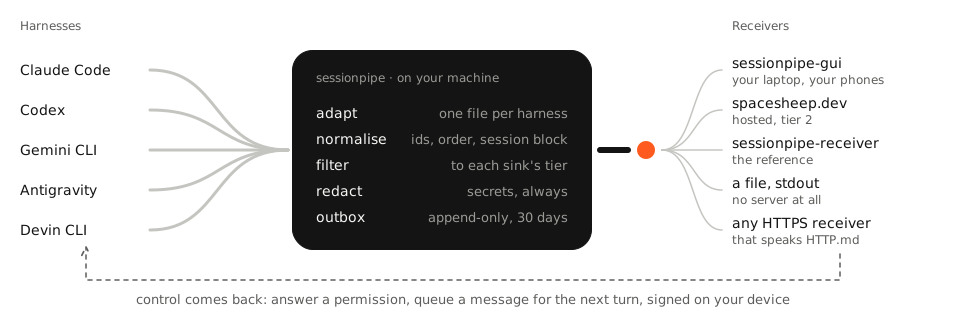
An open protocol, and a client, for what your coding agents are doing. One install hooks Claude Code, Codex, Gemini CLI, Antigravity and Devin; every event is filtered to a privacy tier you choose per destination, secrets are removed on your machine before anything leaves it, and it goes to your server, to a file, or nowhere at all. Messages come back the same way: answer a permission or queue the next prompt from your phone, signed by your passkey and checked on the machine.
Status: pre-release, spec Draft until two independent receivers pass the conformance suite. On npm:
sessionpipe(the CLI),sessionpipe-core,sessionpipe-receiver,sessionpipe-conformance, published unscoped until the@sessionpipeorg exists. See ROADMAP.md and the changelog.
Install
To a receiver that offers pairing, one command per machine:
npx sessionpipe connect your-receiver.example
It shows six digits; approve them on any phone or computer where you're signed in to
the receiver (it doesn't have to be this machine). That one approval is the whole
setup: the hooks for every agent and every Claude Code account here, a sink at tier 2,
signed messages from your devices, the keys in your keychain when this session has one
unlocked, a background daemon that keeps running after you log out, and the last 30
days backfilled. It asks nothing else; run it again and it only fixes what's missing.
The daemon keeps sessionpipe up to date by itself, installing a new release once a day
at most and only when it's idle (sessionpipe update off stops that; see
the CLI's README).
In the Claude desktop app, ask the session to run sessionpipe wait as a background
command. Messages from your devices then arrive in that session, in the app, with no
claude command or separate sign-in
(Get started).
Or only the hooks, with nothing sent anywhere:
npx sessionpipe install
That detects the harnesses on your machine, writes their hooks, and backfills the last 30 days of sessions into a local outbox. Nothing is sent anywhere until you add a sink:
sessionpipe sink add https://your-receiver.example --tier 1
sessionpipe tail            # watch events locally, no server needed
From source
git clone https://github.com/spacesheep-dev/sessionpipe && cd sessionpipe
npm ci --ignore-scripts && npm run build && npm test
npm pack -w sessionpipe
npm install -g --prefix ~/.local sessionpipe-*.tgz     # ~/.local/bin on PATH; never the clone itself
sessionpipe install
The CLI tarball bundles core, so it needs no other package. Don't npm link the
clone: the hooks would point into it, and moving the clone would break every harness.
What a session looks like
$ sessionpipe tail --tier 1
sessionpipe tail · tier 1 · ~/.local/state/sessionpipe/outbox (Ctrl-C to stop)
02:56:19 codex       01a0…  session.started   source=startup  ~/spacesheep main
02:56:20 codex       01a0…  turn.started      prompt_chars=147
02:56:20 codex       01a0…  tool.started      Bash
02:56:21 codex       01a0…  tool.ended        Bash ok
02:56:21 codex       01a0…  turn.ended        stop
02:56:22 codex       01a0…  session.ended     reason=other
(A real Codex 0.157.1 run on 28 Sep 2026, through the hook, the worker and the outbox.)
Harnesses
One adapter file each, under packages/core/src/adapters/,
the only vendor-specific code in the tree. A harness is in the registry once it has
fixtures recorded from real hook payloads (conformance/harness/).
| Harness | Hooks | Transcript (tier 2) | Facts read | Fixtures |
|---|---|---|---|---|
| Claude Code | 14 events | the session's .jsonl, mid-turn messages included |
title, url, model, account, per config dir | 21 |
| Codex CLI, Codex Desktop | 12 events + notify |
the thread's rollout; forks, never subagents or ephemeral threads | title, model | 15 |
| Gemini CLI | 8 events | the chat log | title, model | 14 |
| Antigravity | 4 events | brain/<id> messages |
title, url to the conversation, in a git checkout too | 8 |
| Devin CLI | 8 events | its SQLite session store, read-only | title, model, times | 8 |
Next in the registry (ADAPTERS.md): Cursor, Copilot CLI, Droid, Kiro, OpenCode.
Privacy tiers
Each sink is configured at a tier; the receiver declares its maximum; the lower wins.
| Tier | What leaves | Who it is for |
|---|---|---|
| 0 | Session ids, state, timing, machine, repo, branch, model, title; attention kind | A presence board: "working / needs you / done" |
| 1 | + tool names, durations, ok/error, file paths, attention message, subagents, compactions | An activity feed |
| 2 | + your prompts and the assistant's text (turn.transcript), a running turn as it runs (turn.progress) |
Memory, search, recaps |
| 3 | + tool input and output, thinking, raw hook lines | Full replay, your own server only |
The secrets ruleset runs on every string above tier 0 and cannot be turned off; PII
reduction is a second, opt-in pass. sessionpipe tail shows exactly what a tier
sends. Provided as-is; check what a sink receives with sessionpipe tail before
you point it anywhere.
Control: the channel back
A receiver carries commands; it can never forge one. Every command is signed on your device with a passkey, or with a desktop or phone app's device key held in hardware (or a day key either one vouched for), and the machine checks the exact bytes against keys enrolled at its own terminal, the nonce, the age, the folder allowlist, and that a permission you answer is still open. Then it delivers through the harness's own documented hooks: a message for the next turn, a permission answer while the terminal shows its prompt (nothing is ever auto-allowed), a cancel, or a new session started headlessly for any harness the machine can drive, with files if the command carries them. CONTROL.md has every rule and refusal code; 136 shared vectors pin them.
sessionpipe control pair https://your-receiver.example   # once, at the machine's own terminal
sessionpipe control folders add ~/work                   # where messaged sessions may run
sessionpipe control mode safe                            # or auto or inherit; what a messaged session may do
Three promises
- No telemetry. sessionpipe reports to the sinks you configured and to nobody else. The website has no analytics.
- Secrets never leave. Redaction runs on your machine, before the outbox.
- Your server or none. A file sink,
stdout, the reference receiver on your laptop, or any HTTPS endpoint that speaks the protocol.
Receivers
| Receiver | Where it runs | max tier |
|---|---|---|
| sessionpipe-gui | your laptop; a board for every phone on the LAN, control included | 3 |
| spacesheep.dev | hosted; sessions across machines, messages from anywhere | 2 |
| sessionpipe-receiver | the reference, one process and JSONL files | 3 |
| any HTTPS endpoint | that speaks HTTP.md: one well-known file, one endpoint, a dedup key | yours |
The full list: sessionpipe.org/receivers.
How it's tested
The fixtures are the contract, and CI refuses what they don't prove.
- Every registered harness has fixtures recorded from real payloads, run through its adapter on every PR, and a mutation suite that feeds every fixture 40 to 60 broken shapes (dropped keys, wrong types, nulls, truncated JSON, unknown events) and proves no adapter can throw: a harness's next release can't crash a hook.
- 100 % line and branch coverage of every source file in every package, enforced as a threshold, with dead code deleted rather than ignored.
- The invariants are tests: append-only outbox, a cursor that moves only on a 2xx, two processes appending at once, every HTTP status the spec names driven against an in-process receiver, the 19 delivery scenarios, the control vectors, redaction idempotent on 66 vectors, the hook under 300 ms on a shared runner (it's about 35 ms).
- Gates on the PR: a spec change carries a fixture, an adapter change carries a fixture or a test, every commit is signed off, every test worker runs in a sandbox home and fails if it touches a real one.
Pieces
spec/ |
The protocol: envelope, events, tiers, HTTP binding, control channel, adapters, versioning (CC BY 4.0) |
schemas/v1/ |
JSON Schemas, generated from the code; also served at https://sessionpipe.org/schema/v1/ |
conformance/ |
Real hook payloads per harness, redaction vectors, delivery scenarios, control vectors |
packages/core |
sessionpipe-core: types, adapters, privacy filter, outbox, sinks, the control verifier (zero dependencies) |
packages/cli |
sessionpipe: connect, install, sink, status, doctor, tail, forget, replay, update, the control daemon |
packages/receiver |
sessionpipe-receiver: one process, JSONL files, a page you can answer from a phone |
packages/conformance |
sessionpipe-conformance: scores a receiver or an adapter |
website/ |
sessionpipe.org, rendered from spec/ |
Contributing
Read CONTRIBUTING.md. Every commit is signed off under the DCO; there is no CLA. A new harness is one adapter file plus fixtures for every event it handles and a row in ADAPTERS.md. A protocol change starts as a spec proposal with a fixture, then seven days of lazy consensus. Security reports go through SECURITY.md.
Code is Apache-2.0 (LICENSE, NOTICE); the spec is CC BY 4.0 (spec/LICENSE). "sessionpipe" is a mark of Michael Makarov; see TRADEMARKS.md. Governance: GOVERNANCE.md.