A Rust framework for audio signal processing whose effect kernels run unchanged in CLAP and VST3 plugins, a browser node-graph editor and guitar-pedal firmware. CLAP is an open plugin format for audio workstations; the pedal is an Electrosmith Daisy Seed (a 480 MHz Cortex-M7) in a Hothouse enclosure. The 36 effects are kernels that allocate and smooth nothing while processing; every target builds them through the same registry, wrapped in the same adapter that smooths their parameters, and every effect is level-matched by measurement, so at its defaults it plays at the loudness of its input. The pedal plays rigs through the same runtime as the graph-player plugin, and a knob at noon selects the same default a freshly opened plugin starts at. The distortion kernel on the pedal is the same code as the one in the plugin, compiled for a different target. What differs is the input and output around it: the pedal sums its input to mono and clips at 0 dBFS on the way to its codec, so a pedal and a plugin set to the same values can still sound different at the edges.
Status: working. The API may change; nothing is published to crates.io, so the git dependency under Usage is the only install. CI builds, lints and size-checks the ARM firmware, but I test it by flashing it and playing.
Live: https://ampactor.dev/sonido/
Quick start
The editor runs in the browser with nothing to install: https://ampactor.dev/sonido/ (CI rebuilds it from main). Building locally needs Rust 1.85 or later (the workspace uses edition 2024); on Linux the GUI, the CLI and the workspace tests also need the ALSA and X11 development packages listed under SYSTEM_DEPS in .github/workflows/ci.yml.
git clone https://github.com/ampactor-labs/sonido
cd sonido
cargo run -p sonido-effects --example chain_demo   # prints two effect chains; needs no audio device
cargo run -p sonido-gui --release                  # the node-graph editor, native
On the command line, generate a tone, list the effects, and run the tone through a distortion:
cargo run -p sonido-cli -- generate tone tone.wav --freq 220 --duration 2
cargo run -p sonido-cli -- effects
cargo run -p sonido-cli -- process tone.wav out.wav --effect distortion --param drive=15
Usage
[dependencies]
sonido-core = { git = "https://github.com/ampactor-labs/sonido" }
sonido-effects = { git = "https://github.com/ampactor-labs/sonido" }
Both crates default to their std feature; an embedded build adds default-features = false.
The first block calls the kernel directly, as firmware can. from_knobs takes six readings between 0 and 1, as an ADC (analog-to-digital converter) delivers them; parameters arrive by reference on every call and the kernel holds only its DSP (digital signal processing) state:
use sonido_core::kernel::DspKernel;
use sonido_effects::kernels::{DistortionKernel, DistortionParams};
let mut kernel = DistortionKernel::new(48_000.0);
let params = DistortionParams::from_knobs(
adc_drive, adc_tone, adc_output, adc_shape, adc_mix, adc_dynamics,
);
let (out_l, out_r) = kernel.process_stereo(in_l, in_r, ¶ms);
The second block is the desktop path: the registry wraps the same kernel in Adapter<K, SmoothedPolicy>, which owns per-parameter smoothing and implements the dynamic effect interface; parameter 0 of the distortion is drive in dB:
use sonido_registry::EffectRegistry;

let registry = EffectRegistry::new();
let mut effect = registry.create("distortion", 48_000.0).unwrap(); // Box<dyn EffectWithParams + Send>
effect.effect_set_param(0, 15.0); // drive, dB
let output = effect.process(input_sample);
Both blocks compile against this commit (checked by hand on 2026-10-22); CI does not compile them, see Testing.
How it works
Every effect is three layers; the third differs by target:
XxxParams            typed params; from_knobs(), lerp(), from_normalized()
    │
XxxKernel            pure DSP; process_stereo(l, r, &Params) -> (l, r)
    │                no allocation in the audio path, no parameter ownership, no smoothing
Adapter<K, Policy>   SmoothedPolicy everywhere a rig plays (plugins, editor, pedal): per-parameter smoothing, 5 to 50 ms ramps by parameter
                     DirectPolicy for firmware examples that drive one kernel: zero-sized, a value is live on the next call
The kernel is the part every target shares, and so is the adapter: the pedal firmware builds its effects with EffectRegistry::create, as the plugins do, and plays every rig through sonido_patch::PatchPlayer, the graph-player plugin's runtime (crates/sonido-daisy/examples/sonido_pedal.rs). A freshly loaded rig snaps its parameters to their values instead of sweeping there. XxxParams doubles as the preset format, which is why morphing between presets is lerp() and nothing more.
Every kernel also declares its level (const LEVEL: Level, crates/sonido-core/src/level.rs): a trim and the measured correlation between its wet signal and its input. Mixing goes through Self::blend, a sine/cosine constant-power law normalized for that correlation, so turning a mix knob does not change the loudness; an effect without a mix control applies the trim itself, before its output knob and safety limiter. The numbers are never hand-tuned: cargo run -p sonido-effects --example calibrate --release plays a synthetic strummed guitar peaking at −20 dBFS (the measured median of a humbucker into the Hothouse) through every effect, measures integrated loudness (LUFS) and regenerates crates/sonido-effects/src/calibration.rs, and the level_contract test fails when the table is out of date.
The distortion, tape and amp kernels use first-order ADAA (antiderivative anti-aliasing, Parker et al., DAFx-2016), which cuts the aliasing that waveshaping creates without oversampling; filters use the RBJ Audio EQ Cookbook formulas; the reverb is an 8-line feedback delay network with a Hadamard mixing matrix (Jot and Chaigne 1991, Dattorro 1997) on Freeverb's delay tunings. sonido-core also ships Oversampled<N> (2x, 4x, 8x) with a 48-tap Kaiser-windowed sinc downsampling filter, raised from 16 taps to clear 80 dB of stopband attenuation (crates/sonido-core/src/oversample.rs), but no shipping path applies it: the registry, plugins, editor and firmware run every kernel at base rate, and only the bench and the core tests exercise the wrapper.
A rig is a directed acyclic graph (DAG): effects are nodes and audio connections are edges, so parallel legs and merges are ordinary topology. ProcessingGraph compiles a rig with Kahn's topological sort and buffer liveness analysis (crates/sonido-core/src/graph/processing.rs), so a 20-node linear chain runs on two ping-ponged buffers instead of twenty (crates/sonido-core/src/graph/buffer.rs). The same topology is scriptable through sonido-graph-dsl, with split(...) for parallel legs: split(distortion:drive=20 | chorus; phaser | flanger) | reverb.
Longer write-ups: docs/writeup/ (the project from the top down, a build log of the pedal, and decision notes on the DSP), docs/KERNEL_ARCHITECTURE.md (the three layers), docs/ARCHITECTURE.md (the crate graph and data flow), docs/DESIGN_DECISIONS.md (32 architecture decision records), docs/EMBEDDED.md (Daisy hardware, memory budgets, flashing over USB DFU, the device firmware update protocol), docs/EFFECTS_REFERENCE.md (all 36 effects and their parameters), docs/GETTING_STARTED.md (library, CLI, GUI and WebAssembly walkthroughs), docs/DESIGN_SYSTEM.md (the look every Sonido UI shares: tokens, effect families, the plugin cabinet, the CRT pass).
Benchmarks
Per-effect cost on an Intel i5-6300U (3.0 GHz turbo), measured 2026-10-22 and recorded with the method in docs/BENCHMARKS.md: every one of the 36 effects at its default parameters, one stereo 256-frame block of a 440 Hz sine at 48 kHz, through Adapter<K, SmoothedPolicy> (the plugin and editor path), timed with criterion. Reproduce with cargo bench -p sonido-effects --bench all_effects. The five most expensive, then the cheapest for scale:
| Effect | 256 frames | ns/frame | One core at 48 kHz |
|---|---|---|---|
| Tuner | 183.99 µs | 718.7 | 3.45% |
| Reverb | 179.76 µs | 702.2 | 3.37% |
| Cabinet | 92.52 µs | 361.4 | 1.73% |
| Amp | 88.61 µs | 346.1 | 1.66% |
| Drone | 81.65 µs | 318.9 | 1.53% |
| Looper | 2.78 µs | 10.9 | 0.05% |
So every effect takes at most 3.5% of one core at 48 kHz on that laptop chip; the full table is in the same file (the amp's row predates a soft-clipper precision fix later that day, which added about 6% to it). Mono costs the same as stereo (the adapter runs the stereo kernel either way, within 2%; ping-pong delay 1.17×), and oversampling the distortion costs 2.11×, 3.86× and 7.50× the base rate at 2×, 4× and 8×.
On the pedal's chip all 36 effects are measured too: crates/sonido-daisy/examples/bench_kernels.rs on a Daisy Seed (Cortex-M7 at 480 MHz), loaded over SWD, timing 128 32-sample blocks per effect with the cycle counter against the 320,000-cycle block budget, each effect as a rig runs it (registry-built, smoothed, with the pedal's control tick). Its worst blocks (2026-10-22) are the pedal's cycle table, crates/sonido-platform/src/cycle_table.rs, regenerated from the benchmark log by scripts/update_cycle_table.py (full table and procedure in the same file). Every effect fits a block alone, worst block included; the reverb is the heaviest pedal effect at 62% of the budget, the tuner the heaviest overall at 64%. One rule, shared by the editor's export check and the pedal, decides what runs: the effects' worst blocks plus 400 cycles per node within 80% of the budget. The whole pedal running distortion → reverb → ringmod (79.4% under that rule) in a Hothouse, audio and controls included, measured 74% on average and 83–85% at its slowest callbacks, with none over budget (docs/EMBEDDED.md). The ×25 desktop-to-M7 estimate the repo used before (median +14% against the first run's bare-kernel means, 28 of 36 within its ±50%) remains documented there for kernels added later.
Sound quality
Measured by in-repo tooling at 48 kHz through a 16384-point fast Fourier transform (FFT) with a Blackman-Harris window, and regenerated by cargo run --release --example dsp_report -p sonido-effects, which rewrites docs/DSP_MEASUREMENTS.md and the spectrum plot beside it; the run is deterministic.
- Distortion THD (total harmonic distortion) tracks drive on a 1 kHz tone: 13.19% at 10 dB, 33.37% at 20 dB, 41.43% at 30 dB, 43.20% at 40 dB.
- The soft-clip curve is odd-symmetric, as the theory says it should be: at 30 dB drive the third harmonic sits at −9.6 dB relative to the fundamental and the fifth at −14.5 dB, while every even harmonic stays below −114 dB.
- Reverb decay is an RT60 (the time for the tail to fall 60 dB, by Schroeder backward integration) of 3.38 s measured from the kernel's output, with a fit correlation of 0.997.
Project layout
crates/
  sonido-core        DSP primitives, DspKernel and Adapter, Oversampled, the DAG graph engine,
                     true-peak limiting, up-conversion, counter-based random numbers            no_std
  sonido-effects     the 36 kernels and their parameter structs                                no_std
  sonido-registry    create-by-id factory; wraps each kernel in an Adapter                     no_std
  sonido-synth       PolyBLEP (band-limited) oscillators, envelopes, voices, modal banks       no_std
  sonido-platform    hardware control abstractions (knobs, toggles, MIDI)                      no_std
  sonido-patch       the patch format: JSON, binary sector, runtime; pedal state, USB link     no_std
  sonido-rigs        the factory rigs (one set for the pedal and the graph player) and the pedal guide
  sonido-daisy       Daisy Seed firmware and the pedal examples; outside the workspace         no_std
  sonido-analysis    FFT, THD, RT60, GCC-PHAT and other offline analysis
  sonido-io          WAV files and cpal (cross-platform audio) streams
  sonido-config      presets and chain configuration
  sonido-graph-dsl   the text rig format and its builder
  sonido-gui-core    shared egui (GUI toolkit) widgets, theme, parameter bridge
  sonido-gui         the node-graph editor, native and WebAssembly (wasm32)
  sonido-cli         the `sonido` command
  sonido-plugin      the CLAP adapter; every plugin in one bundle
docs/                guides, measurements, decision records
presets/             five example preset chains (TOML); the 8 factory presets live in sonido-config
scripts/             bundle-clap.sh, bundle-vst3.sh, update_cycle_table.py, demo and QA scripts
Sixteen crates: fifteen are workspace members, and sonido-daisy is excluded because its own .cargo/config.toml pins the build to thumbv7em-none-eabihf. Seven build without the standard library: six carry #![cfg_attr(not(feature = "std"), no_std)] and sonido-daisy is #![no_std] outright; math goes through libm. The applications on top:
- CLI, 12 subcommands (
process,realtime,generate,analyze,compare,devices,effects,info,play,presets,patch,pedal): offline processing through a chain or graph string, live input, signal generation, spectrum and impulse-response analysis, rig files (patch), and the pedal over USB (pedal: list, send, read back and play rigs, update the firmware;pedal controlsopens an illustrated guide to playing it, drawn from the code the firmware runs).cargo install --path crates/sonido-cli. - GUI (
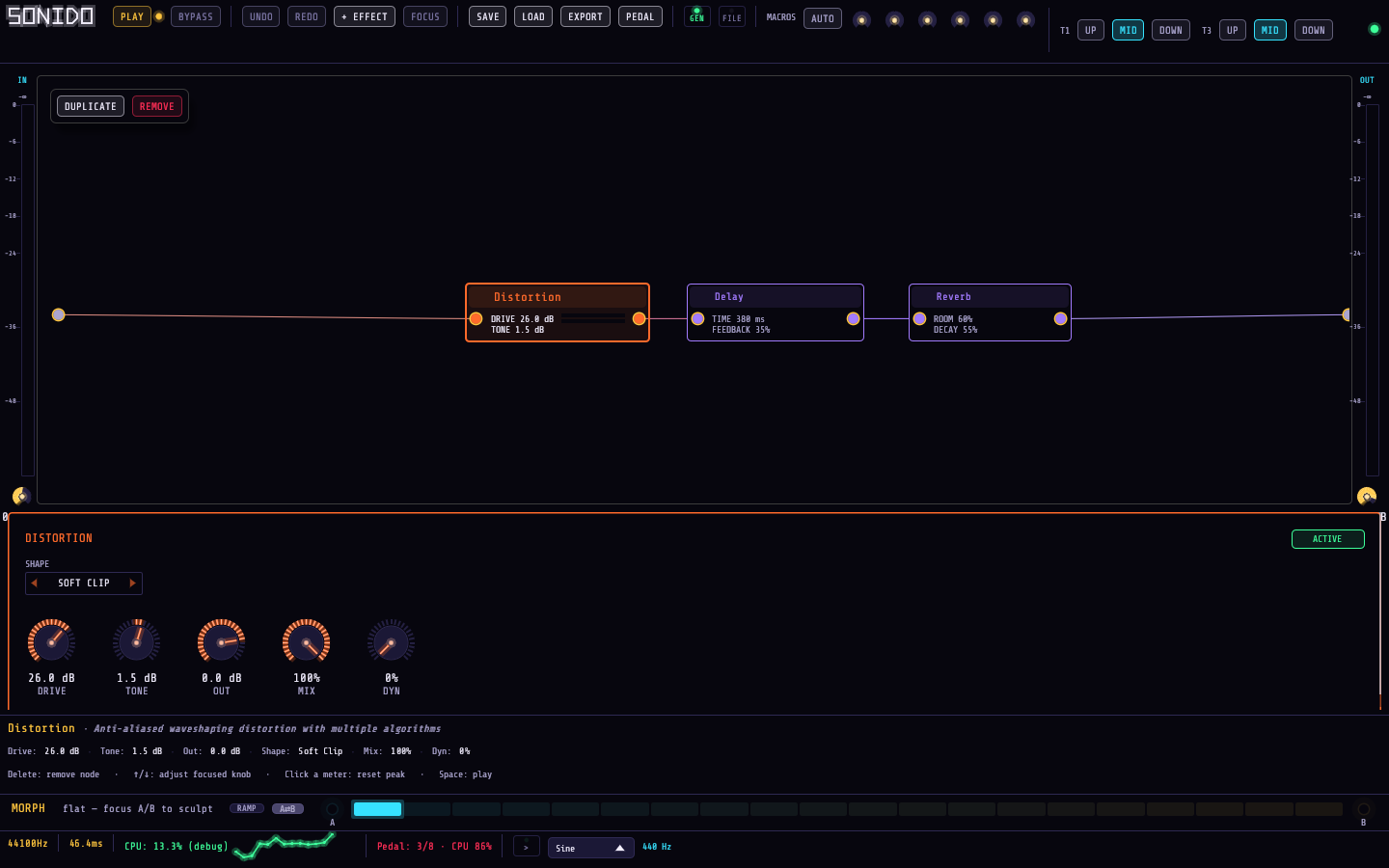
cargo run -p sonido-gui --release): the node editor with six macro knobs, the rig's T1/T3 toggles, whole-rig A/B morph, undo, a status bar that applies the pedal's CPU rule as you build, and export to a CLAP preset, a JSON patch or a pedal binary sector, or straight to the pedal over USB (Export ▸ Send to pedal, or Web Serial in the browser), under the rig's name. Its PEDAL window opens the controls guide and plays or erases the pedal's rigs. - Plugins: one
sonido.clapbundle holding 37 plugins: all 36 effects, plusSonido Graph Player, which runs a whole rig as one plugin, picked from its built-in factory rigs or the rigs the editor exports. A matchingsonido.vst3shim exposes the same set as VST3. Every plugin draws the same cabinet UI, lit in its family's color, with live meters and a scope of its own signal. See Plugins below. - Pedal firmware:
sonido_pedalfor the Cleveland Music Co. Hothouse, a rig player: a jam of three slots, each picked with a knob from eight effects (JAM_EFFECT_IDS), in three topologies (linear, parallel, fan) selected with a toggle, up to 15 rigs in its QSPI flash bank, and the six factory rigs (crates/sonido-rigs). One control rule everywhere: the left footswitch is on/off, the right one tap tempo (with the A/B toggle in the middle, a glide between A and B), and holding either changes rig; the top row of knobs is levels, with the top right always a volume, and the bottom row the sound. It powers on into the last rig played, saves its state to flash, and takes rigs and firmware-update requests over a USB serial protocol (sonido_patch::link). 48 kHz in 32-sample blocks (BLOCK_SIZEincrates/sonido-daisy/src/lib.rs).
Plugins
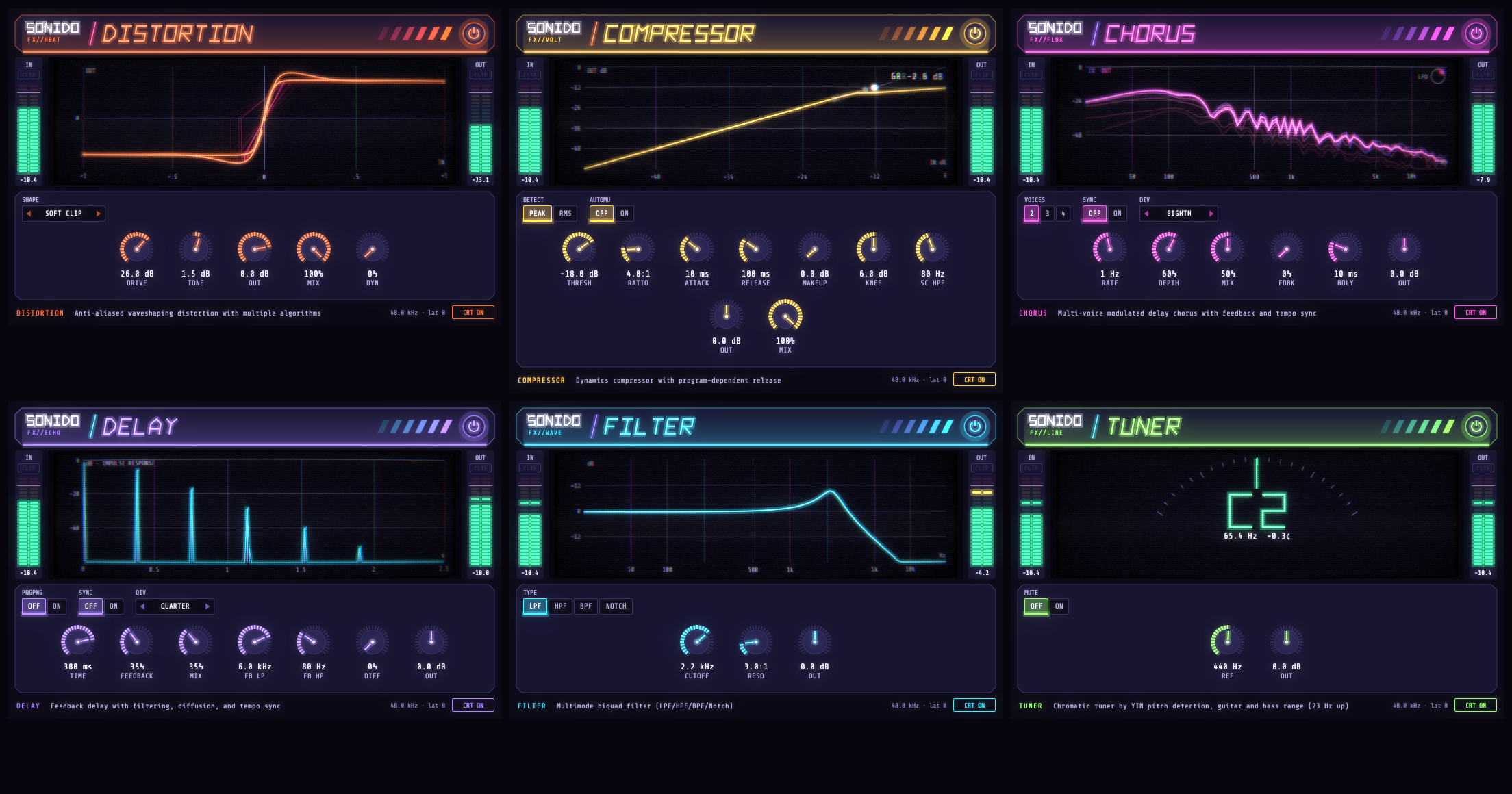
make plugins builds the bundle and installs ~/.clap/sonido.clap; make plugins-vst3 also builds the VST3 shim and installs ~/.vst3/sonido.vst3. Rescan plugins in the host afterwards. Each plugin keeps its own ID (com.sonido.<effect>), which is what a host saves in a project.
On Linux the plugin window needs the X11 and OpenGL development files, and the VST3 shim needs a C++ compiler and cmake. On Fedora:
sudo dnf install mesa-libGL-devel libX11-devel gcc-c++ cmake
The editor, the CLI and the full test suite additionally need the ALSA headers (alsa-lib-devel): on Linux, cpal (the audio I/O library) always builds its ALSA backend, and on a PipeWire system pipewire-alsa carries that audio into PipeWire. Debian package names are under SYSTEM_DEPS in .github/workflows/ci.yml. To keep these off a base system, run the build inside a toolbox or distrobox container; the plugins it produces load in a host outside it.
The graph player lists the factory rigs, the same six the pedal ships (sonido_rigs::factory_rigs), and the rigs in the rig library folder, which the editor's Export ▸ CLAP writes to: ~/.local/share/sonido/patches on Linux ($XDG_DATA_HOME if set), ~/Library/Application Support/sonido/patches on macOS, %APPDATA%\sonido\patches on Windows. Choosing a rig in its RIG selector asks the host to restart the plugin, which rebuilds the rig off the audio thread; the rig is saved with the project.
Why the VST3 needs C++: the shim is clap-wrapper, a VST3 front end that finds sonido.clap by name at load time and hosts it, so Sonido's DSP and UI exist once, in the CLAP. Building it pulls the VST3 SDK, which is C++. Two ways around the toolchain were considered and not taken. The release workflow already builds the shim per platform, so a script could download it instead of compiling it; that saves a one-time C++ build at the cost of a network dependency and a binary nobody built locally. Writing VST3 natively in Rust would remove C++ entirely, but means maintaining a second plugin-format adapter beside the CLAP one. Because the shim is a loader, a VST3 install only works next to the matching .clap: install both.
To see a plugin's UI without a host, cargo run -p sonido-plugin --bin sonido-preview -- <effect> opens the same editor in a window, driven by a test signal.
Deploy
The web editor deploys from .github/workflows/pages.yml: on a push to main that touches crates/** (or a manual dispatch) it runs trunk build --release --public-url /sonido/ (trunk is the WebAssembly bundler) in crates/sonido-gui and publishes dist/ to GitHub Pages at https://ampactor.dev/sonido/.
Releases come from .github/workflows/release.yml on a v* tag: it builds the CLI, the GUI, the CLAP bundles (scripts/bundle-clap.sh) and the VST3 shims (scripts/bundle-vst3.sh, clap-wrapper v0.15.1; VST3 is Steinberg's plugin format) for linux-x64, macos-x64, macos-arm64 and windows-x64, exports the factory presets, and attaches one archive per target to a GitHub release. Releases also carry the pedal firmware, sonido_pedal.bin