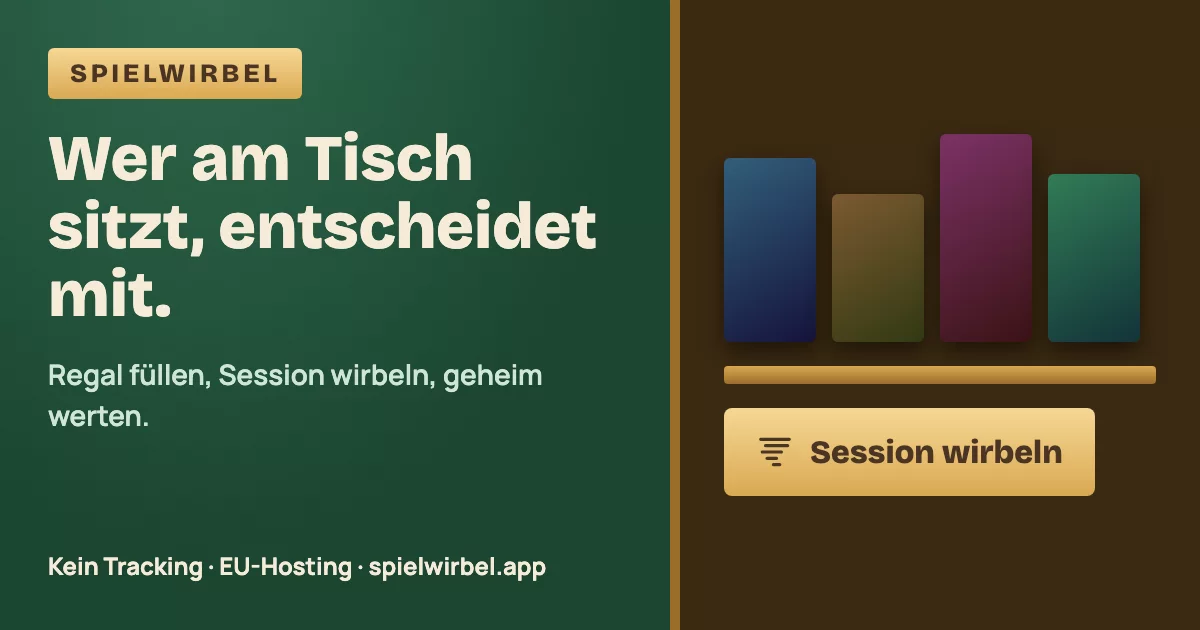


Spielwirbel
"What should we play tonight?" — Spielwirbel draws a few games from your group's shelf, collects everyone's rating — on one shared device, on their own phones, or through a link — and remembers what your round actually likes.

Self-hostable, German + English + Spanish + French + Italian + Dutch + Portuguese + Finnish + Korean UI, no tracking. Try it without an account at spielwirbel.app.
ℹ️ Status: live as a public multi-tenant SaaS — registration has been open at spielwirbel.app since 2026-07-24, and a guest demo lets you look around without signing up at all. Self-hosting defaults to local-only with no authentication — if you run it that way, keep it on a trusted network you control, since there is no access control until you configure one (
docs/configuration.md).
Quick start
Node.js 22 or newer is the only prerequisite (get it from https://nodejs.org/; developed and tested on Node 26).
npm install
npm start          # or: node server.js
Open http://localhost:3000 — that's it. From another device on your network,
use http://<your-computer-ip>:3000 (find the IP with e.g.
ipconfig getifaddr en0 on macOS).
Use a different port or data folder: PORT=8080 npm start,
DATA_DIR=/path/to/data npm start.
Everything else — PostgreSQL, object storage for covers, user accounts, the
guest demo, rate limits, the operator panel, Docker and deploying — is optional
and documented in docs/configuration.md.
What it does
- Rounds — a group with a name and any number of member seats.
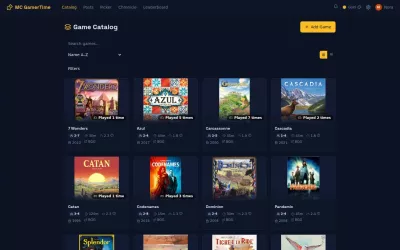
- Games — title, player range, custom tags, cover art. Adding one searches BoardGameGeek and fills in the details; or import your whole owned BoardGameGeek collection in one go.
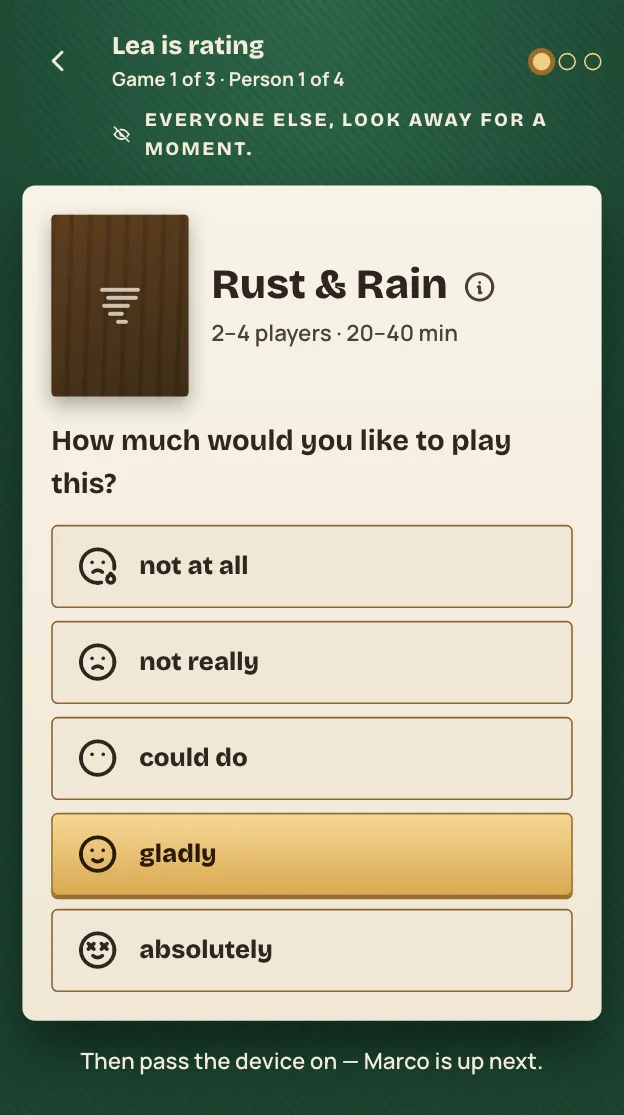
- Sessions — pick who's playing, draw candidate games that fit the player count, then everyone rates them on five faces, from "not at all" to "absolutely". Pass one device around the table, rate from your own phone, or send a link to people with no account — mix all three in one evening. Votes stay sealed until the reveal.
- Guests — someone outside the group can join one session without becoming a member.
- Teams — members and guests can pair up for a session: a team counts as one player when the games are drawn, and wins together.
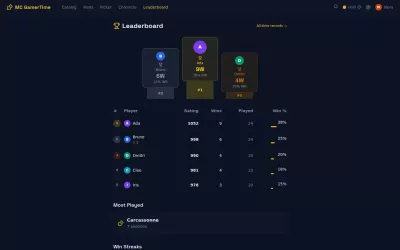
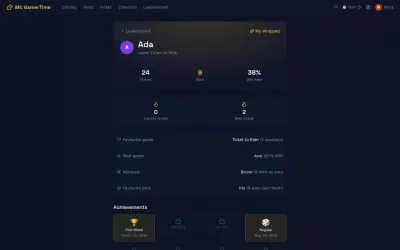
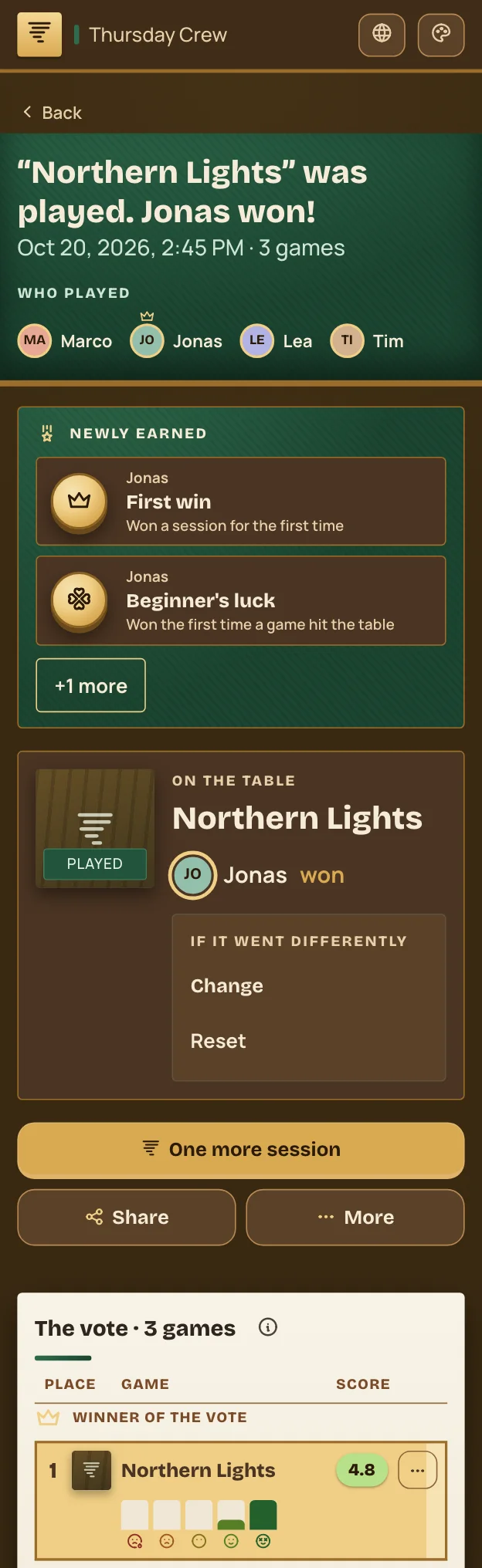
- Ratings & trophies — scores are computed live from session votes, with a winners' podium, streaks, a "gathering dust" tile and a taste retrospective.
- Two archives — games are never deleted by accident: retired (done with it) and completed (finished its content), both restorable.
- A Wunschliste — games and expansions the group wants but does not own yet, kept beside the shelf without ever turning up in a vote, importable from a BGG wishlist, and — where the instance enables it — showing what each one costs right now.
- Recommendations — "das könnte euch auch gefallen": games the round does not own, ranked against its own shelf, its own ratings and what it actually plays, using a local BoardGameGeek corpus. Plain weighted arithmetic — no AI, nothing invented — and every card says why it is there.
- A design of your own — Der Tisch (dark felt and brass), the light Ocean, the printed Programmheft, the dark Brücke, the leafy Forest or Klassisch, per person, with a colour marker per round — custom tags, an installable PWA that works offline, shareable deep links, a Freundeskreis feed between accounts, and passkey sign-in (fingerprint, face or device PIN — alongside the password, never instead of it).
→ Full detail in docs/features.md.
Documentation
| Document | What's in it |
|---|---|
docs/features.md |
Every feature in detail |
docs/architecture.md |
How it's built, and what every file is for |
docs/configuration.md |
All environment variables, Docker, deployment |
docs/deploy-railway.md |
Step-by-step production deploy |
CLAUDE.md |
The architecture constraints new work must respect |
CONTRIBUTING.md |
How to contribute, and the licensing terms |
SECURITY.md |
Reporting a vulnerability |
docs/legal/ |
Operator records: DSA workflow, retention, DSAR |
Development
npm test              # automated tests (Node's built-in runner + supertest)
npm run coverage:ci   # tests + the coverage thresholds CI gates on
npm run lint          # ESLint (flat config)
npm run check:syntax  # node --check over all JS files
npm run build         # optional: content-hash + minify js/css into dist/
npm run migrate       # apply pending Postgres migrations (needs DATABASE_URL)

npm run dev           # the server, restarted on every backend file change

node scripts/seed-dev.js   # fill a throwaway .devdata/ with the demo's rounds
There is no build step for development — npm start serves public/
directly. npm run build is optional and only for production; see
docs/architecture.md, and
docs/configuration.md for npm run dev and the
env-file loading.
Contributing
This project is built and maintained with
Claude Code, and the repository ships the
workflow with it: skills in .claude/skills/ and rules in
.claude/rules/ that encode how work gets done here. Whether you contribute by
prompting Claude Code or by hand, that is the intended path.
See CONTRIBUTING.md for where to start, the skill
workflow, translations, and the contribution-licensing terms — inbound
contributions are licensed under Apache-2.0 and every commit must be signed off
under the Developer Certificate of Origin (git commit -s).
Data & backup
By default everything lives in the data/ folder (data.json + uploads/) —
copy it to back up, delete it to reset. The whole folder is git-ignored, so your
group's data is never committed.
Set DATABASE_URL (and optionally S3_BUCKET) and your data lives in Postgres
and object storage instead — then backups are your provider's job, and they are
usually not switched on by default. Check, rather than assuming a managed
database backs itself up; see docs/configuration.md.
About this project
This project was developed entirely by Claude (Anthropic's AI models, via Claude Code), through an interactive, conversational process: a human described the desired features and gave feedback, and Claude designed and wrote all of the code, comments and documentation. It stands as a small example of what agentic, AI-assisted development can produce end to end.
Note the distinction: the app's development was AI-driven, but the app itself contains no AI and sends no data anywhere when you run it.
License
PolyForm Noncommercial License 1.0.0, © 2026 Julian Zenker — the sole rights holder and licensor. The source is public and you are free to use, study, modify and share it for noncommercial purposes (personal use, hobby projects, education, research). Commercial use — including running it as a paid or revenue-generating hosted service — is not granted by this license; contact the maintainer for commercial terms.