
Accepted product direction — implementation pending: EraseMe remains an independent privacy product. Browse/Operate becoming optional Brain modules and credential UI moving to Brain must not introduce a mandatory Brain dependency into privacy workflows. See PB-2026-09-09.
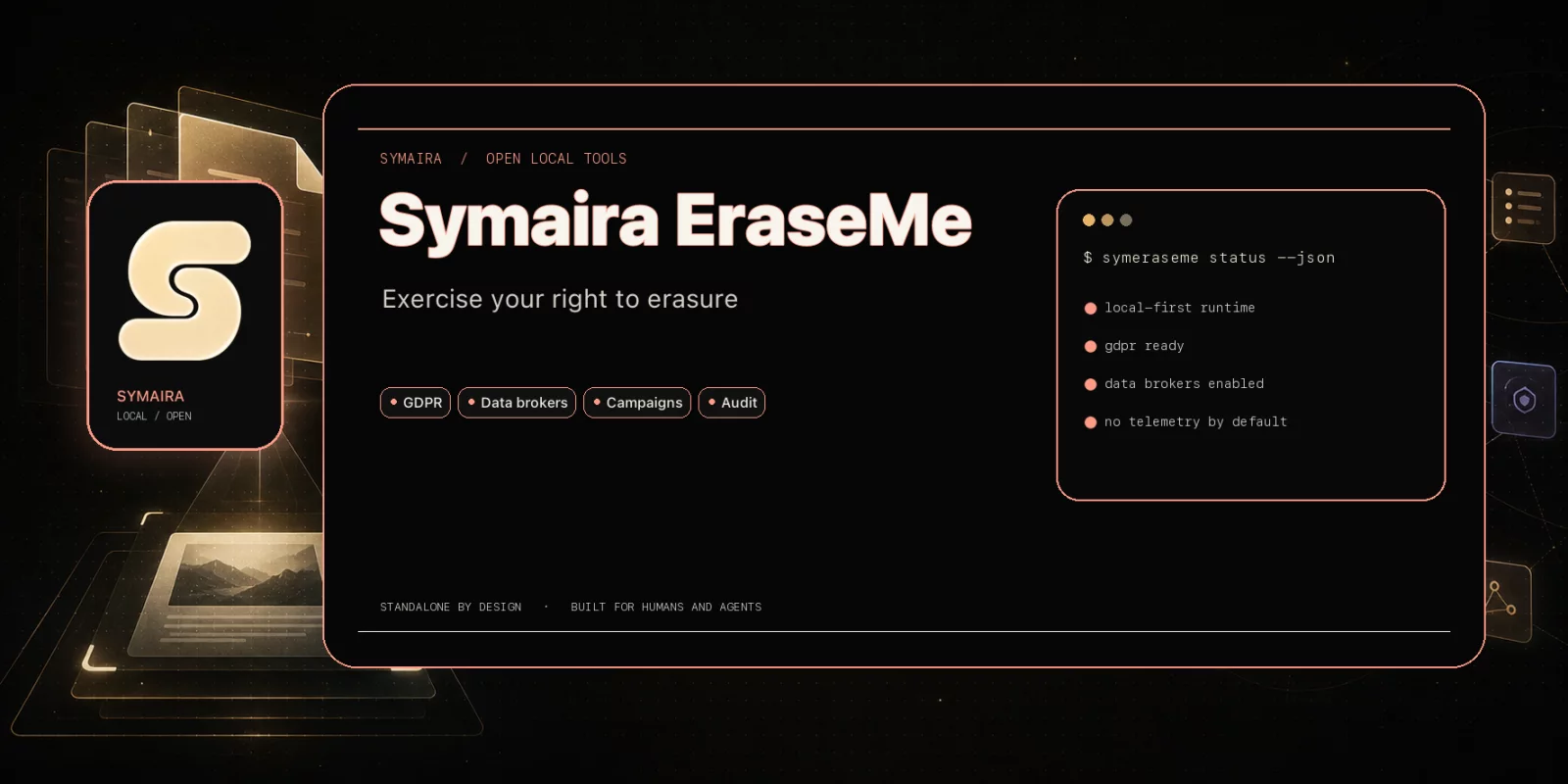
Symaira EraseMe helps you exercise your GDPR/CCPA right to erasure against data brokers. It is a local-first Rust CLI with a native SwiftUI macOS app and an authenticated MCP JSON-RPC interface.
Current source tree: Rust-only CLI and native SwiftUI macOS app, version 0.14.1.
This patch preserves identity keys, enforces single-use consent and completes
all release assets before immutable publication. The Rust-only package layout
was introduced in the
v0.14.0 canary prerelease.
The historical v0.13.0 prerelease remains dual-backend, and v0.12.1 is the
last Go-only stable release. Check GitHub releases
for published versions and channels. The maintainer waived the seven-day
post-stable observation period and authorized Go-source retirement on 2026-10-12.
The Go implementation and module files are removed from this source tree;
frozen Go observations and their immutable source history remain for conformance.
CUT-004/CUT-005 technical acceptance and release gates are not waived.
Status: Beta. Core planning, event tracking, deadline handling, registry validation, inbox triage, reports, and the MCP/CLI contracts are implemented. Some broker-specific web flows still require manual review.
Features
- Curated registry of more than 1,200 data brokers with jurisdiction and law metadata.
- Event-sourced SQLite storage with projections and an audit trail.
- CLI commands for profile setup, planning, execution, inbox polling, triage, rebuttals, scheduling, reports, and manual fallback tasks.
- Explicit web-form previews and durable manual fallback tasks; browser execution is an injected boundary and is not a compile-time dependency.
- Shared Rust LLM provider layer for reply classification and rebuttal generation.
- Local MCP HTTP JSON-RPC server with 26 catalogued tools and Bearer-token auth.
- AES-256-GCM encrypted identity profile, standard Fernet encrypted database at rest, and explicit destructive-operation consent.
- Native SwiftUI dashboard for macOS. Rust-only release DMGs bundle the Rust CLI/MCP server.
Platform support
Product scope is Apple (macOS on Apple Silicon, iOS) plus Web. The current implementation ships the macOS app and CLI; this scope does not claim an existing iOS app or Web client. Linux remains supported for CLI/server use and CI.
| Platform | Current support |
|---|---|
| macOS arm64 (Apple Silicon) | Native app, CLI, PR parity and release gates |
| Linux amd64 / arm64 | CLI/server, native CI and release archives |
| iOS / Web | In product scope; no installable client shipped here |
| Windows, including ARM64 | Unsupported; no native CI or new release artifacts |
| macOS Intel | Unsupported; no native CI or new release artifacts |
Historical release assets and frozen platform observations stay immutable. Windows-only source and fixtures are retained as unsupported historical code; their later removal is separate from this CI/release change. See #1274.
Install
macOS Apple Silicon and Linux
brew tap danieljustus/tap
brew install symeraseme
symeraseme version
Release archives
Download the macOS arm64 or Linux amd64/arm64 archive for your chosen version from
GitHub releases.
Rust-only archives contain only the Rust CLI; no Go rollback binary
or legacy backend selector is distributed. The historical v0.13.0 prerelease
is dual-backend and its assets must remain unchanged; v0.12.1 is the last
Go-only stable release. Canary builds reach Homebrew only after stable promotion and the
release gates pass.
macOS GUI
For a published Rust-only version, download its versioned macOS DMG from
GitHub releases.
It bundles only the Rust CLI/MCP server. The release workflow requires Developer
ID signing, notarization, stapling and attestation before publication. Local builds may be ad-hoc signed
and are not equivalent to that published artifact. Historical v0.13.0 assets
remain unchanged. No GUI Homebrew cask is configured.
Migration from the pre-cutover installation
The last pre-cutover implementation is preserved at the annotated Git tag
python-final. Existing installations should migrate their local data before
removing the old runtime:
symeraseme migrate \
  --source /path/to/old-state \
  --destination /path/to/rust-state \
  --dry-run
The migration is explicit, creates a backup before writing, never deletes the
source, and can resume from .migration-state.json. See
TROUBLESHOOTING.md for the full rollback procedure.
Quick start
# Create an encrypted local identity profile
symeraseme init-profile

# Inspect the embedded broker registry
symeraseme registry validate
symeraseme brokers list --law GDPR

# Plan, review, and dry-run a campaign
symeraseme plan create --campaign initial --max 5
symeraseme plan show --campaign initial
symeraseme plan execute --campaign initial --dry-run

# Track deadlines and view reports
symeraseme tick --dry-run
symeraseme generate-report
Destructive execution requires explicit consent. Review the plan first and use
symeraseme grant execute --ttl 3600 for a short-lived automation token.
MCP server
Start the local authenticated HTTP server:
symeraseme mcp
# Default: http://127.0.0.1:8000
Use --host and --port to change the loopback endpoint. Non-loopback binds
require --allow-remote. Use --stdio when an MCP client needs
newline-delimited JSON-RPC over standard streams.
The token is generated on startup and written with restrictive permissions to
the configured data directory (mcp_token). Send it on every HTTP request as:
Authorization: Bearer <token>
Never put the token in source control, issue reports, shell history, or logs. The complete transport and tool contract lives in docs/mcp-contract.md.
Configuration and secrets
The event store defaults to ~/.local/share/symeraseme/symeraseme.db; it never
falls back to a temporary directory in production. Configuration precedence is
built-in defaults, ~/.config/symeraseme/config.toml (or
$XDG_CONFIG_HOME/symeraseme/config.toml), the project
.symeraseme.toml, then environment variables. SYMERASEME_DATA_DIR selects
the base data directory, SYMERASEME_DB_DIR overrides only the database
directory, and SYMERASEME_ENCRYPT_DB accepts 1|true|yes|on or
0|false|no|off. Invalid values fail closed. When encryption is enabled, the
SQLite file is written as a standard Fernet envelope and decrypted only into a
private temporary directory during use; switching modes is atomic.
Credentials should be referenced through the canonical symvault:// form or a
platform secure store; resolved values are never logged. Provider-specific
configuration is consumed by the shared Rust LLM provider layer.
Development
Requirements: Rust 1.98.0 (pinned in rust-toolchain.toml). The Rust build,
test suite and frozen-observation checks do not require Go. A full Xcode
installation is required for the macOS GUI.
# Prepare immutable producer history once, before the first test run
python3 scripts/prepare-frozen-history.py --fetch

# Rust CLI and frozen-observation conformance suite
make build-rust
make rust-gate
make parity

# Additional Rust acceptance gates (require cargo-llvm-cov and pinned Miri)
make coverage
make miri

# macOS app
make app-test
./app/SymairaEraseMe/build.sh

# Local development packaging example only; not a release-version claim
VERSION=0.14.1 ./scripts/package-dmg.sh
Use a full-history clone. Even then, squash merges and deleted feature branches
can leave pinned producer commits outside ordinary branch/tag history. The
explicit preparation above fetches only missing immutable producer objects;
it does not change the checkout, fixtures or recorded source identities.
Subsequent replay is offline with respect to that history. Without --fetch,
the preparation command only checks availability and fails if an object is missing.
make parity replays recorded Go observations through Rust without a Go
executable. Keep the frozen observations and their source-provenance checks
intact. make build, make test, make lint, make vet and make fmt-check
now run Rust tooling. make coverage enforces 80% project line coverage and
90% aggregate critical-code line coverage. make miri runs the pinned Rust
interpreter contract; it is not a substitute for native concurrency tests.
The old live-oracle Make targets are retired. Native platform, security and
release-artifact gates remain separate from the local make rust-gate.
Registry contributions
Add a verified YAML broker entry under registry/brokers/, then run:
make build-rust
./build/rust/debug/symeraseme-rust registry validate
Do not fabricate endpoints or include personal data. The registry is embedded in the Rust CLI and is not rewritten by normal CLI operation.
Project layout
crates/                 Rust CLI, core, and engine
rust-tests/parity/      Conformance suite and frozen Go observations
registry/               Broker/law/schema source data
skills/                 Agent skill bundle and workflow documentation
app/SymairaEraseMe/      SwiftUI macOS client
scripts/                 Build, packaging, and verification tools
Releases
Tags matching v* trigger .github/workflows/release.yml:
- The Rust prerelease workflow builds natively on macOS arm64 and Linux
amd64/arm64, packages three static Rust CLI archives, and verifies the
archives,
checksums.txtand the per-archive CycloneDX SBOMs. - The staging job attests build provenance for the three archives and creates a draft prerelease, then reads every asset back without publishing it.
- The macOS job builds the SwiftUI app with the Rust CLI/MCP server and uploads the versioned DMG to that draft. It is signed, notarized, stapled and attested.
- After all assets and attestations are complete, the final job verifies both checksum manifests, publishes the canary and requires GitHub to report it as immutable. Enable the repository's Immutable releases setting before pushing a new tag. Published releases can no longer accept asset changes.
- When an immutable canary is promoted to stable after its acceptance checks,
the Homebrew publisher downloads the exact release archives, verifies their
checksums, and updates
danieljustus/homebrew-tap/Formula/symeraseme.rb.
No GUI Homebrew cask is configured; the macOS GUI is distributed as a DMG.
Previously published v0.13.0 dual-backend prerelease assets remain unchanged;
v0.12.1 is the last Go-only stable release. The v0.14.0 canary introduced
the Rust-only package layout; version 0.14.1 adds identity/consent safety fixes
and complete-asset immutable publication. Canary publication alone does not
complete stable acceptance or Go-retirement technical gates. The maintainer's
2026-10-12 decision separately authorizes source retirement and waives only
the seven-day observation period. The historical python-final tag remains
available for migration and recovery.
Documentation
- Contributing
- Troubleshooting
- MCP contract
- Event-store contract
- Registry contract
- Historical Python test classification
- Agent skill bundle
License
Apache-2.0 — see LICENSE.