Toronto Transit Reach
How far can you get from any point in Toronto in 30 minutes? Click the map and find out — plus how to make a specific trip, and what time you'd actually arrive.
▶ Try it now — runs in your browser, nothing to install
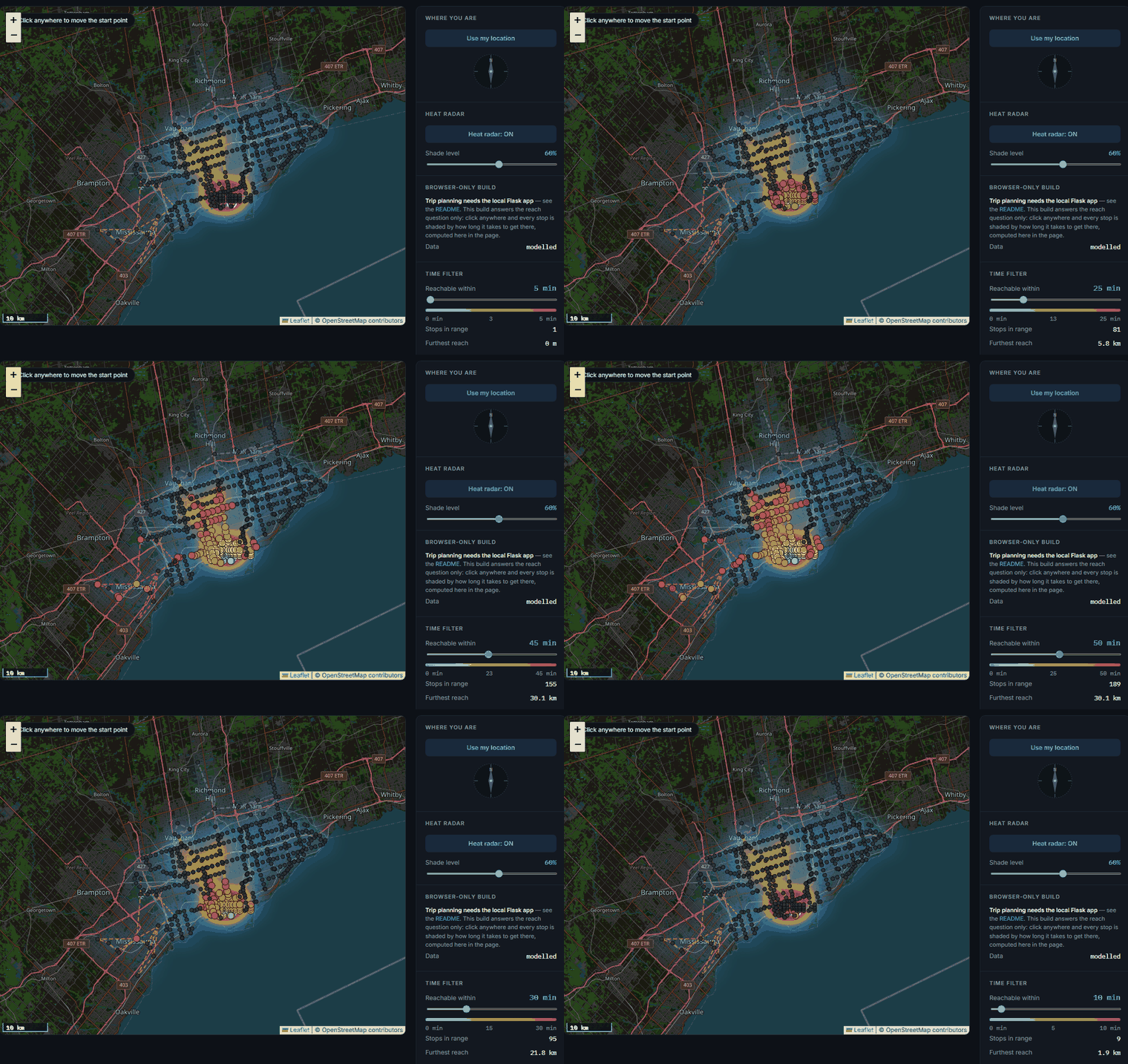
Above: the reach window widening from 5 to 60 minutes. Every stop is shaded by how long it takes to get there — computed live, in the page.
Read the full write-up →
— where each number comes from, the graph it searches, and every bug this has
had. (Or open docs/index.html locally.)
Run it
pip install -r requirements.txt
python app.py                      # http://127.0.0.1:5000
python tools/build_schedule.py     # optional: adds timetabled departures
Four years ahead, labelled as a projection. TTC publishes one board period
at a time, six to eight weeks ahead. build_schedule.py therefore also runs
tools/project_schedule.py, which repeats the latest published week with no
holiday in it for four years past the feed's last date. Ontario's statutory
holidays and Civic Holiday go on the feed's own holiday service, and a weekend
holiday is also observed on the next free weekday. Projected dates are kept
apart from published ones (projected in the index), and a wait read from them
is labelled projected timetable, never "timetabled". Board-period changes
and summer service are not known in advance, so a projected wait can be wrong
by however much those change. Rebuilding after TTC's next release replaces
projected dates with published ones. python tools/project_schedule.py --years N
redoes only the projection.
No API key, no billing account. OpenStreetMap tiles in the browser; every travel time is computed locally against TTC's own open timetable and live feed.
How it runs with no server
The live demo above is docs/app/ — the same page with
the server taken out. The graph is small enough (97 KB) to inline into the page,
and the reachability search is a port of trips/routing.py's Dijkstra that runs in
JavaScript. It's generated, not hand-forked:
python tools/build_static.py
The build refuses to write if the JS port and the Python disagree at any of the 516 stops. Two things it deliberately doesn't do: waits are modelled rather than measured, since GTFS-realtime needs a backend to fetch it, and there's no trip planner — an approximated arrival time is worse than none. Run the Flask app for both.
Every wait says where it came from
Three kinds of number share one screen and they don't deserve equal trust, so each one is labelled:
| Source | Means | Covers |
|---|---|---|
| timetable | the next actual departure | subway + 6 streetcar routes |
| headway | half the observed gap, live | surface routes |
| modelled | half an assumed headway | YRT, MiWay, GO |
Live service alerts apply on top — a closed line drops out of the graph, so trips route around it.
Layout
app.py        the Flask entry point, and the only module left in the root
network/      the graph: subway, streetcars, buses, regional, and the
              add_node / add_edge primitives they all use
feeds/        what TTC publishes: the GTFS archive, the departure index
              built from it, and the live vehicle feed
trips/        coordinates and a graph in, travel times and itineraries out
tools/        the two GTFS builders, the browser build, the figure refresh
Data in, graph, routes out — and the arrows only point one way, so feeds/
never imports trips/. feeds/schedule.py resolves the departure index two
levels up, because getting that wrong does not raise: the departures simply
stop being found and the app falls back to average headways as though no
timetable had ever been built. A test pins the path.
notes/ holds the long-form write-ups — CODE_AUDIT.md — and
CONTRIBUTING.md is in .github/, which is where GitHub looks for it.
Tests
pytest -q --cov --cov-branch --cov-fail-under=100 # what CI runs
317 tests, 100% of 1,844 statements — and that figure is itself checked, because it had already gone stale once. The suite never touches the network: the realtime tests run against recorded feeds, one containing a real Line 2 closure. The figure is the whole repository, lines and branches, the GTFS build tools included: they are tested against feeds of a few rows written by the test.
License
MIT — see CONTRIBUTING.md for setup and test conventions.