Agents build. The other lab reviews. A deterministic decision table merges only the reviewed commit.
vigia is a small AI software factory: it takes GitHub issues to merged pull requests with coding agents from two AI labs, Claude Code (Anthropic) and Codex CLI (OpenAI). An agent from one lab builds each change, a model from the other lab reviews it on its exact commit, and a pure function, with no model in it, decides whether it merges. Every step is one line in an append-only ledger.
Before you point it at a repository
- Agent sessions run as your OS user and can run shell commands: vigia is not a sandbox (SECURITY.md).
- vigia pushes, comments and merges with your own
ghlogin. The agent sessions never get that login.- It needs both CLIs logged in to a paid plan or an API key; every pull request uses sessions from both labs.
- The riskiest tier, T2 (money, auth, personal data), adds the strongest reviewer and waits for you to add
vigia:human-ok.
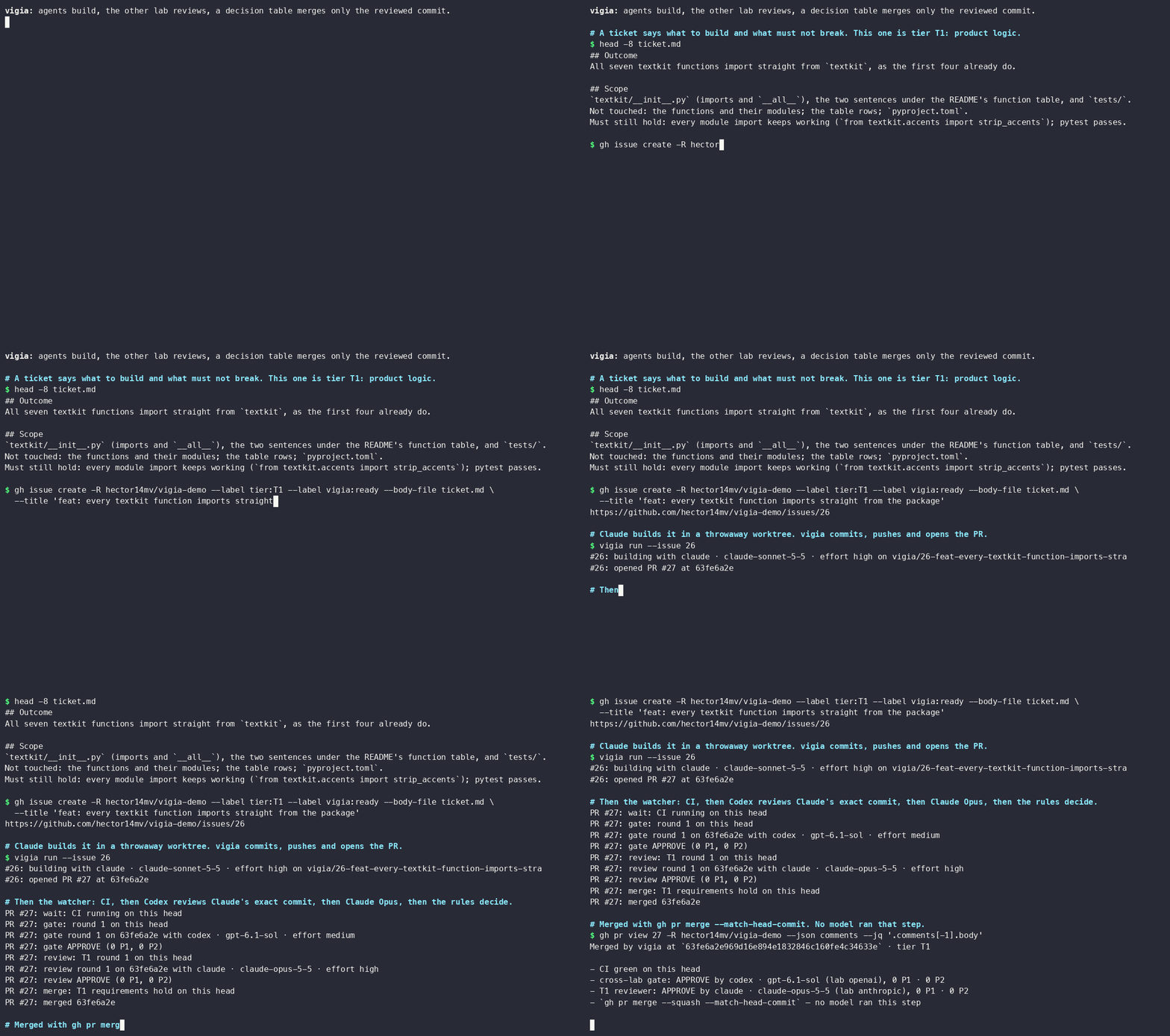
Recorded live on vigia-demo: issue #26, a T1 ticket, became PR #27,
built by Claude Sonnet, gated by Codex on its exact commit, reviewed by Claude Opus and merged by vigia watch.
Idle time is compressed; nothing else is edited.
Three rules
- Review depth is set by damage. Every ticket has one tier, T0 to T2, defined in the operating model: T0 for docs, tests and cosmetic changes, T1 for product logic, T2 for money, auth, personal data, migrations and the process itself. The tier, not the model that wrote the change, decides how much review it gets.
- The gate is always from the other lab. A model from the other lab (the other company's model) reviews
every change on the exact commit, in a read-only checkout: Codex gates Claude's work, and Claude gates
Codex's work when a tier's builder is Codex (
vigia init --builder codex). T1 and T2 add a second reviewer after the gate, and T2 waits for a person's label. No verdict means no merge. - The merge is a decision table, not a judgement.
rules.decide()is a pure function (no model, no I/O) over CI status, verdicts and labels on the exact head, tested row by row intests/test_rules.py. vigia merges only when it says so, withgh pr merge --match-head-commit.
flowchart LR
    I["Issue<br/>vigia:ready + tier"] --> B["Builder<br/>lab A · own worktree"]
    B --> P["Pull request<br/>+ handoff"]
    P --> CI{"CI green<br/>on head?"}
    CI -- red --> F["Fix round<br/>fresh session"]
    F --> CI
    CI -- green --> G["Gate<br/>lab B · exact head · read-only"]
    G -- P1 --> F
    G -- approve --> T{"Tier"}
    T -- T0 --> M["vigia watch merges<br/>--match-head-commit"]
    T -- "T1 · T2" --> R["Stronger reviewer<br/>exact head"]
    R -- "approve · T1" --> M
    R -- "approve · T2" --> H["Human label<br/>on exact head"] --> M
    G -. "two rounds used" .-> K["Parked<br/>with a written reason"]
On a pull request's path only four steps run a model, each in a fresh, headless session capped in time: build, fix, gate and the second review. Everything else is deterministic code: ticket validation, commit, push, PR and handoff, verdict parsing, caps and parking, the merge decision, and the ledger.
Quickstart
What you need
- macOS or Linux and git. vigia needs Python 3.11+, which uv installs for it if needed.
- GitHub CLI, uv (or pipx), Claude Code and Codex CLI, each logged in. vigia uses those logins and never asks for or stores a token.
- A GitHub repository you can administer, with a CI workflow that runs on
pull_request: vigia merges only when CI is green on the head (vigia doctorchecks it).
On macOS:
brew install gh uv
curl -fsSL https://claude.ai/install.sh | bash          # Claude Code
curl -fsSL https://chatgpt.com/codex/install.sh | sh     # Codex CLI (or: npm install -g @openai/codex)
gh auth login && gh auth setup-git                       # setup-git lets git push with that login
claude auth login
codex login
On a Linux server, docs/server.md has the same steps over SSH. With the tools logged in, setting up a repository takes a few minutes, and a small T0 change then takes about five minutes from issue to merge (on vigia-demo, issue #20 became merged PR #21 in 5 min 27 s).
Let an agent do it. Paste docs/agents/install.md into Claude Code or Codex on the machine that should run vigia. It installs and configures everything and stops for you at every login.
Install and set up a repository
uv tool install git+https://github.com/hector14mv/vigia
# or: pipx install git+https://github.com/hector14mv/vigia
If uv warns that its bin directory is not on your PATH, run uv tool update-shell and open a new terminal.
Then, in a clone of the repository vigia will work on:
vigia init
vigia doctor
init checks the four tools, asks which lab builds (the other one reviews), proposes models per tier, writes
vigia.toml, adds .vigia/ to .gitignore, writes the ticket template to
.github/ISSUE_TEMPLATE/vigia-ticket.md, and creates the labels on GitHub. Commit and push those files:
GitHub shows the template only once it is on the default branch. doctor checks the tools, vigia.toml, the
repository, the labels, CI and the test command (not branch protection), and prints the fix for each problem.
Then protect the base branch on GitHub (branch rules need a public repository, or a paid plan for a private
one). In Settings → Branches, add a rule for main with:
- Require status checks to pass before merging, with the checks your CI reports (each job is a check, so pick the job names, not the workflow name);
- Require branches to be up to date before merging;
- Do not allow bypassing the above settings: vigia merges with your login, and an admin's merge would otherwise skip the rule.
Do not require approving reviews: vigia's reviews are comments, and a T2 approval is a label. With these rules GitHub refuses to merge a PR whose base moved after its review; you press Update branch and vigia reviews the new head like any other (see Limitations).
Your first ticket
A ticket is a GitHub issue in a fixed shape: Outcome, Scope with Not touched: and Must still hold:,
acceptance criteria, a done-test and risks. The body is the builder's whole prompt, so it says what, not how.
Click New issue on GitHub and pick the "vigia ticket" template, or write ticket.md yourself. A small T0:
## Outcome
`slugify()` has tests for empty text and for text with no letters or digits.

## Scope
`tests/test_textutil.py` only.
Not touched: `src/` and every public function.
Must still hold: every existing test passes unchanged.

## Acceptance criteria
- [ ] `slugify("")` returns `""`
- [ ] `slugify("!!!")` returns `""`

## Done-test
`pytest -q tests/test_textutil.py`

## Risks
None: tests only.
gh issue create --title "test: slugify() on empty text and text without letters" \
  --body-file ticket.md --label tier:T0 --label vigia:ready
vigia run       # build the oldest ready issue into a pull request, then stop
vigia watch     # the loop: CI → gate → fix → review → merge or park, until Ctrl-C
vigia status    # the queue, every open PR with its next step, parked reasons, recent events
vigia:ready is what starts a build: vigia builds an issue only when someone with write access to the
repository added that label, and removing it withdraws the approval. vigia watch runs until you press Ctrl-C, and it also builds ready issues. vigia watch --once
does a single tick and exits; vigia watch --no-build only moves PRs that are already open and builds nothing
new.
hector14mv/vigia-demo is a tiny library where every pull request
went through exactly this: open any merged PR and read the handoff, the gate's verdict and the merge comment.
Write tickets with Claude Code
The vigia-ticket skill turns a rough idea into an issue vigia accepts. Install
it for every project with:
git clone --depth 1 https://github.com/hector14mv/vigia "${TMPDIR:-/tmp}/vigia-src" && mkdir -p ~/.claude/skills && cp -R "${TMPDIR:-/tmp}/vigia-src/skills/vigia-ticket" ~/.claude/skills/
(or copy skills/vigia-ticket/ into one repository's .claude/skills/), then ask Claude Code to "turn this
into a vigia ticket". vigia ticket ticket.md checks a body before you file it.
How it works
The builder (vigia run, or vigia watch when the queue has work) takes the oldest ready issue, creates a
git worktree from the base branch under the system temp directory, and runs the tier's builder engine headless
(claude -p … or codex exec …) with the ticket as its brief. The engine only edits files and runs tests.
vigia commits, pushes, opens the PR with Closes #N, and posts a handoff: a comment with what changed, the
tests run, deviations from the ticket, risks and follow-ups. Its first line is ## Handoff <full sha> and its
second is the Engine: line.
The gate is a fresh, read-only session from the other lab on a checkout of the PR's exact head. It gets the ticket, the handoff and the diff, and must answer with a JSON verdict:
- P1: a defect on the changed path with a scenario that fails on this commit. It blocks the merge.
- P2: real, but not blocking.
- No parsable verdict is
GATE_UNAVAILABLE: it holds the merge and is never read as a pass.
A P1 starts one fix round: a new builder session from the same lab, with only the findings as its brief. The gate then reviews the new head. There are at most two gate rounds per PR; after that the PR is parked for a person.
Gate evals (vigia eval gate) replay a fixed set of past PRs, each with a known defect or known to be clean,
through the tier's gate and report how many defects it caught and how many clean changes it blocked, so a gate
model or prompt change can be compared before it touches real PRs. It never touches GitHub or the ledger; the case
format is in evals/gate/README.md.
T1 and T2 add a second reviewer on the same exact head, by default from the builder's lab: when Claude builds,
Claude Opus 5.5 on T1 and Claude Fable 5.1 on T2; when Codex builds, GPT-6.1 Sol (the builder's own model, in a
fresh read-only session) on T1 and GPT-6 Astra on T2. T2 also waits for a person to add vigia:human-ok on that head. The label counts only if
GitHub recorded it after vigia first saw the head, so an approval never carries over to a later push (vigia also
removes the stale label, as a courtesy).
The merge is rules.decide(), a pure function tested row by row in
tests/test_rules.py. In order: closed, parked or draft PRs are left alone; a PR that targets
a branch other than the base, a missing tier, an unknown builder, a same-lab gate or a conflict parks; CI must
be green on the head before any review; then the gate, the reviewer and the human label, each on the exact head
and each counted only for the PR's current tier; then gh pr merge --squash --match-head-commit <sha>. Right
before merging, vigia re-reads the PR and decides again. When a PR merges, each follow-up its handoffs list is
filed as a vigia:follow-up issue, never as ready: you decide whether it becomes a ticket.
Crashes are expected, not exceptional. Every paid step writes the ledger before its side effects on GitHub, so a verdict is never paid for twice; at the start of each tick vigia parks a build that was interrupted, finishes enrolling a PR whose labels failed, and removes review worktrees a killed session left behind.
The ledger is .vigia/ledger.jsonl: one JSON line per action (pr_opened, verdict, fix_started,
pushed, parked, merged, …), opened in append mode only. It is what the decisions read; the comments on
GitHub are the public copy.
The seven rules behind all of this, and where each one lives in the code, are in docs/operating-model.md.
Failure modes
- No parsable verdict:
GATE_UNAVAILABLE. It holds the merge and is never read as a pass. - The head moves: verdicts and a T2 label count only for the commit they were given on, so a new head is reviewed again from CI on.
- A cap is hit (gate rounds, fix rounds, review passes, failed sessions, session length): the PR is parked with the reason written on it, and a person decides.
- A crash mid-step: every paid step is in the ledger before its effect on GitHub, and the next tick repairs from it: an interrupted build is parked, a half-enrolled PR is finished, leftover worktrees are removed.
- No CI: with
require_ci = true(the default) a PR waits for a green CI result on its head, so a repository without a CI workflow never merges.vigia initandvigia doctorsay so up front. - The base moves after the review: v0.1 does not review the PR again; GitHub's "Require branches to be up to date" rule is the guard (see Limitations).
- The issue body is the builder's prompt, so
vigia:readyis the trust boundary. vigia builds an issue only if that label was added by someone with write access, and only if the body and title have not changed since; otherwise it refuses the ticket and says why. Anyone who can add the label still decides what an engine is told to do. - It is not a sandbox: engine sessions run as your OS user, with your files and your other logins. Read SECURITY.md.
Configuration
vigia init writes a vigia.toml like this one (every model is an exact id, never an alias):
[repo]
name = "you/your-repo"
base = "main"

[tiers.T0]
builder = { engine = "claude", model = "claude-sonnet-5-5", effort = "medium" }
gate = { engine = "codex", model = "gpt-6.1-sol", effort = "medium" }

[tiers.T1]
builder = { engine = "claude", model = "claude-sonnet-5-5", effort = "high" }
gate = { engine = "codex", model = "gpt-6.1-sol", effort = "medium" }
reviewer = { engine = "claude", model = "claude-opus-5-5", effort = "high" }

[tiers.T2]
builder = { engine = "claude", model = "claude-opus-5-5", effort = "high" }
gate = { engine = "codex", model = "gpt-6.1-sol", effort = "high" }
reviewer = { engine = "claude", model = "claude-fable-5-1", effort = "high" }
human = true

[caps]
gate_rounds = 2       # heads the gate may review per PR
fix_rounds = 2        # fix sessions per PR
review_rounds = 2     # stronger-reviewer passes per PR
attempts = 3          # failed sessions on one head before parking
session_minutes = 30  # wall-clock cap for one engine session

[checks]
require_ci = true
test_command = "python3 -m pytest -q"   # vigia runs it after each build and reports the result
humans = ["your-login"]                 # who may add vigia:human-ok (empty: anyone with write access)

[watch]
build = true             # `vigia watch` also builds ready issues
interval_seconds = 120   # between ticks
slots = 2                # engine sessions at once (gate, review, fix or build)
checks.test_command runs in the builder's worktree with whatever interpreter is on your PATH, not in your own
virtual environment, so the project's dependencies must be installed there (or the command must install them,
for example uv run --with pytest pytest -q).
To make Codex build and Claude review, run vigia init --builder codex. vigia refuses a config in which a tier's
gate comes from the same lab as its builder, a T2 without the human label, or a model given by alias.
Parallel sessions and several repositories
watch.slots is how many engine sessions run at once. vigia init proposes a number from the machine (about
two cores and two GB of RAM per session, at most six) and from Codex's weekly quota when its CLI has recorded
one. With one slot, each tick runs at most one session inline. With more, the watcher starts each gate, review,
fix or build as its own vigia job process and moves on; a job holds a lock on its PR or issue for its whole
life, so no two sessions ever work on the same PR, and it re-reads GitHub and decides again before it spends a
session. Every PR still spends one gate from the other lab, so slots are also a quota decision.
To drive several repositories from one place, clone them side by side in one folder, run vigia init in each,
then in the folder itself:
vigia workspace            # writes vigia.workspace.toml: the clones below it and the slots they share
vigia watch                # every repo, sharing the slots
vigia status               # every repo
Planning: from a goal to tickets you ratify
vigia plan "Article titles become short, readable URL slugs: a maximum length that never cuts a word, no accents"
A planner session (Claude Opus by default) reads the base branch, read-only, and writes tickets in the template,
with what it verified in the code under ## Facts. vigia files every ticket as vigia:proposed, never as
ready: you read it and swap the label for vigia:ready, because what vigia builds next is your call. A
ticket that needs an earlier one of the plan merged first says which. Work only a person can do (an account, a
secret, a product decision) becomes a vigia:human-task issue. The Mesa shows both under "Your turn". A title
that is already an open issue's is not filed twice. --dry-run prints the plan without filing it.
The Mesa
vigia mesa serves the Mesa (Spanish for "desk"), a read-only status page at http://127.0.0.1:8790 for a
laptop or a phone:
- Your turn: only what needs a person. A T2 change waiting for
vigia:human-ok, with the evidence on its exact head; a parked PR, with the reason and what was tried; a ticket refused for missing sections. - Factory: per repository, the sessions in use and every open PR on its path (build, CI, gate, review, human, merge) with its next step, plus the queue.
- Feed: what just happened, one ledger row per line.
- Fuel: what vigia has spent and has left. Codex's weekly quota (Claude Code keeps no quota file: read
it with
/usage), merges, P1s caught and engine sessions.
It is read-only on purpose: every action is a link to GitHub, where your login decides, because a button that
labels or approves would let any process on the machine act as you. It listens on 127.0.0.1 only; to open it
from your phone, put it behind tailscale serve (see docs/server.md). Run it in a workspace
folder to see every repository.
Commands
| Command | What it does |
|---|---|
vigia init [--repo OWNER/NAME] [--builder claude|codex] [--yes] [--force] [--no-labels] |
check tools, choose engines per tier, write vigia.toml, create labels; --repo defaults to the clone's GitHub repo, --yes accepts the defaults, --force overwrites an existing vigia.toml, --no-labels skips creating labels |
| `vig |