

VigieVuln is a polyglot dependency auditor built for professional code audits.
It scans 10 ecosystems + 9 CMS/Frameworks (WordPress, Drupal, Symfony, Laravel…) in one pass, with no build tools, support air-gapped workflows using transferred caches, private package detection, committed binaries & certificates, then produces clean HTML reports + json baseline + (DOC/XLSX/SARIF/CycloneDX/etc) .
Terminal demo recorded with VigieVuln 1.0.1.

Features
- 10 ecosystems in one pass; Maven, Gradle, npm/Yarn/pnpm, Composer, PyPI, NuGet, Go, Ruby — plus vendored JS, committed native binaries (identified by checksum) and embedded JARs (fat-jars/war/ear, opened in-memory).
- No build tools; No
mvn/gradle/npm/pip/dotnet/go, nonode_modules/→ how - CVE from multiple sources, merged & prioritised; CVEProject + OSV.dev + Packagist security advisories + NVD, ranked CISA KEV → EPSS → CVSS.
- European references on every CVE: ENISA EUVD id + ENISA's exploited flag, GCVE id, and the CERT-FR advisories citing it. Hosted proxy lookups send relevant CVE identifiers to the proxy.
- Beyond CVEs; Report EOL and out-of-active-support frameworks, deprecated/abandoned/yanked, outdated, SPDX licenses, and private/internal packages
- CMS & frameworks audited as instances; Symfony, Laravel, WordPress, Drupal, Joomla, PrestaShop, TYPO3, Magento/Adobe Commerce and SPIP with per-instance inventory (core, plugins, themes, bundles, components) → the dedicated guide
- Crypto material; committed certificates, private vs public keys across PEM/OpenSSH/PuTTY/PGP and JKS/PKCS#12 keystores.
- Air-gapped flow; zero network under
--offline→ Benchmark · Air-gapped - Hosted proxy with a verified account;
--set-proxy-cache vigievuln→ hosted proxy - Project monitoring;
vigievuln watch ./project --name 'My Project'— one free project with up to 100 distinct direct dependency coordinates → monitoring guide - Shared cache for a scanner fleet;
vigievuln serve-cache+--proxy-cache→ cache usage - Supply-chain risk; known-malicious advisories and suspected typosquats (
--typosquat). - Audit-grade; every report carries a provenance manifest and a Methodology & limitations chapter; a
SHA256SUMS; - Differential audits diff against a prior run (
--baseline) and CI can gate on new findings only. - Reports in English or French (
--lang fr) - Outputs & CI; Pro HTML report + JSON baseline by default + Word, Excel, CycloneDX 1.6 SBOM, CSAF 2.0 VEX, SARIF 2.1.0, JSON; gate with
--fail-on, triage with--ignore/--vex. - Report made for productivity; every table / chart has a Copy for word button.
📖 Usage & all flags · Architecture · Comparison vs other tools · Data sources
Quick start
npm install -g vigievuln
vigievuln scan ./code             # → ./vigievuln-report/cve-report.html
A free NVD API key (instant) gives 10× faster enrichment: vigievuln --set-nvd-key YOUR_KEY. A few common runs; full list via vigievuln --help or docs/USAGE.md
Monitor a project
Create and verify your account, then sign in and explicitly accept the terms of service dated 2026-10-28 when prompted:
vigievuln login
vigievuln whoami
vigievuln watch ./project --name 'My Project'
vigievuln project status
vigievuln logout
watch collects the inventory locally and uploads it once. Run it again with the same unique project name to update that project's inventory; it does not run a background watcher. login selects the official proxy if none is configured; an existing proxy remains selected.
The free tier watches one project, up to 100 direct dependencies and a 0.5 MB descriptor, for one month renewed by each upload; expiry deletes the monitoring data and triggers an email.
If the current terms have not been accepted, the CLI displays their link and asks for explicit acceptance in an interactive terminal. For non-interactive use, run vigievuln login interactively and accept the terms first.
To review the inventory before uploading, export it locally:
vigievuln watch ./project --export fichier.json
--export writes an offline descriptor without uploading; review package names and versions, including private packages, before sharing it.
Enable alerts in your account to receive new high, critical or known exploited vulnerabilities affecting your direct dependencies; refresh the inventory when dependencies change. Monitoring guide.
Existing commands remain supported: vigievuln -s ./code, auth login|status|logout, --prepare-project and project push.
Official Vigie Vuln proxy cache
Vigie Vuln DB hosts vulnerability data and the official proxy cache in Europe.
Configure the proxy once, then sign in with your verified Vigie Vuln account when prompted:
vigievuln login  # selects the official proxy if none is configured
vigievuln scan ./code
The selection and the proxy key created during proxy sign-in are saved in ~/.vigie-vuln/config.json and reused on subsequent scans. This proxy key is separate from the account session used by watch. Alternatively, save an existing key with vigievuln --set-proxy-cache-token <key>, or provide it via VIGIEVULN_PROXY_CACHE_TOKEN (useful in CI). Remove the selection or key with --unset-proxy-cache or --unset-proxy-cache-token. --proxy-cache <url> overrides the saved selection for one scan. The hosted proxy receives requested package coordinates and CVE identifiers; it does not receive your source code. Proxy documentation.
Interactive HTML samples
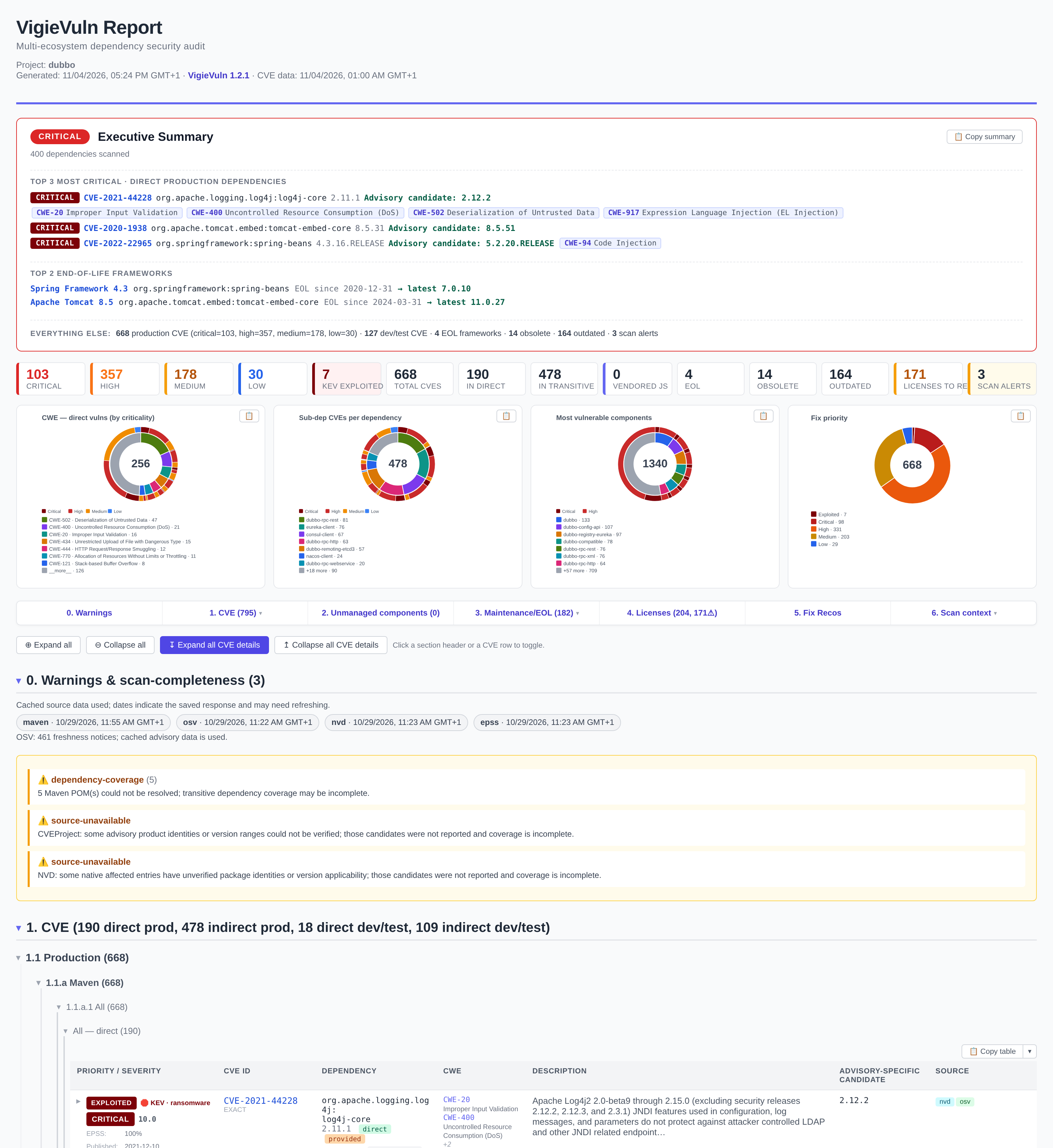
- Apache Dubbo 2.7.8 — open the report: the project used for the report screenshot below, rescanned with VigieVuln 1.1.3; 105 Maven descriptors, direct/transitive CVEs, KEV matches, EOL and fix recommendations.
- Multi-instance CMS & frameworks — open the report: WordPress 6.4.2, Drupal 8.5.0, Symfony Demo (Symfony 7.1.1) and BookStack v24.10 (Laravel 10.48.22), with findings attributed to each instance.
These are standalone reports from real source scans, generated on 2026-10-29 using the hosted proxy and local caches. The CMS sample focuses on PHP dependencies; WordPress advisory coverage is explicitly incomplete without a Wordfence feed. Sample scope, sources and reproduction commands.
Warning
vigievuln is new and may still contain ( rare ) bugs. Treat its output as a strong first pass, double-check anything critical, and please report issues; they get fixed fast.
Why use vigievuln for code audits?
What it does for an audit that the others don't. Same column set and sourcing discipline as
docs/COMPARISON.md — ⚠️ is partial and says how, cells are meant to be
checkable.
| What an auditor actually needs to do | fad | OSV | Trivy | Grype+Syft | OWASP DC | Snyk |
|---|---|---|---|---|---|---|
| Audit a 100-module polyglot monorepo in one command, with no toolchain installed | ✅ 105 modules | ⚠️ reactor skipped | ⚠️ needs ~/.m2 |
⚠️ opt-in | ⚠️ Java build | ⚠️ mvn build |
| Scan offline / air-gapped without dropping transitive deps | ✅ 657/657 | ❌ | ⚠️ ~/.m2 |
⚠️ opt-in | ⚠️ mirror | ❌ |
| Identify the private/internal deps across a big project | ✅ | ❌ | ❌ | ❌ | ❌ | ❌ |
| Extract cleaned deps descriptors into an external directory | ✅ -t |
❌ | ❌ | ❌ | ❌ | ❌ |
| Report EOL / deprecated frameworks & deps, transitive ones included | ✅ | ⚠️ deprecated only | ⚠️ OS distros only | ❌ | ❌ | ⚠️ web UI only |
| Report committed keys & certificates | ✅ | ❌ | ⚠️ key rule | ❌ | ❌ | ❌ |
Spot committed binaries (.dll, .exe, …) and check them against their checksums |
✅ | ❌ | ⚠️ some | ⚠️ patterns | ❌ | ❌ |
| Clearly list what was not scanned — before the client asks | ✅ warnings + method | ⚠️ log | ⚠️ log | ⚠️ log | ⚠️ log | ⚠️ log |
| Answer "against what data?" six months later | ✅ | ❌ | ❌ | ⚠️ DB date | ⚠️ NVD date | ❌ |
| Send a report, not a JSON dump | ✅ HTML + .doc |
⚠️ HTML list | ⚠️ template | ❌ | ⚠️ HTML list | ⚠️ snyk-to-html |
| Charts, per-CVE drill-down and a pasteable Word copy | ✅ | ❌ | ❌ | ❌ | ❌ | ❌ |
| Make delta reports showing only what changed | ✅ --baseline |
❌ | ❌ | ❌ | ❌ | ⚠️ cloud |
| Audit CMS/framework instances as such — plugins, themes, publisher advisories | ✅ 9 products | ❌ | ❌ | ❌ | ❌ | ❌ |
| Share one cache across the fleet, API keys server-side | ✅ serve-cache |
❌ | ⚠️ local DB | ⚠️ local DB | ⚠️ local DB | ⚠️ cloud |
Deliberately not a goal: reachability. A finding is a vulnerable version on the dependency graph, and the report says exactly that (in Methodology) instead of guessing at call paths. Deciding whether the vulnerable code is reachable in this application is the auditor's call, made with application context no scanner has.
More basic exemples :
vigievuln -s ./proj -e "^com\.acme\."                        # exclude private libs (coord regex)
vigievuln -s ./proj -t ../clean -e "^com\.acme\."            # extract only: normalised descriptors, private modules flagged
vigievuln -s ./proj -t ../clean -e "^com\.acme\." -a snyk   # same extraction + scan + merge Snyk
vigievuln -s ./proj --offline                                # fully offline (zero network, needs a warmed cache)
vigievuln -s ./proj -a osv-db,typosquat                      # offline-complete OSV + typosquat
vigievuln -s ./proj -a licenses --fail-on high               # license chapter + CI gate
vigievuln -s ./proj --report-json --baseline last.json --fail-on-new   # differential audit: fail CI on NEW findings
vigievuln diff last.json this.json                           # standalone diff of two findings JSONs
vigievuln -s ./proj -r html,json,xlsx                        # include the Excel workbook
vigievuln -s ./site --app-plugins wordpress --private-component wp-content/plugins/acme --offline
Important
--offlinereads the cache, it doesn't replace it. On a cold cache there is nothing to match against, so an offline first run legitimately reports 0 CVE / 0 EOL / 0 outdated; that's an empty cache, not a clean project. Warm it once (a normal online run on any project, or--import-cache), then--offlinereturns the full result set with zero network calls. Air-gapped machines get their cache via--export-cache/--import-cache.
What it finds
The report keeps the six root chapters. Sub-chapters appear only when they contain results and are numbered consecutively; application inventory and methodology remain available in scan context:
| Chapter | Source | What it catches |
|---|---|---|
| 0. Warnings (top) | local heuristics | Missing lockfiles, unresolved Maven versions (BOM-managed), private packages absent from configured registries |
Δ. Changes since baseline (top, with --baseline) |
diff vs prior JSON | New / fixed / unchanged findings per category + the list of new production CVEs; for repeat audits and --fail-on-new CI gating |
| 1. CVE (X direct, Y indirect, Z dev) | CVEProject + OSV.dev + Packagist + qualified publisher feeds + NVD/CPE | Applications first when findings exist; CMS/framework findings by instance and owner · Production; public CVE / GHSA in other prod deps, per ecosystem, per manifest, prioritised by CISA KEV + EPSS + CVSS · Vendored JS vulns (retire.js) — one row per physical library, linked CVEs + CWEs on the row, every advisory behind a click · Dev (test/provided, dev/optional/peer) · Likely false positives (CPE-filtered) |
| 2. Unmanaged / unversioned components | deps.dev + CIRCL (by checksum), retire.js, built-in X.509 | Embedded binaries; CVEs in libs shipped inside committed .jar/.war/.ear (fat-jars, shaded uber-jars) · Native binaries (.dll/.exe/.so/.dylib) identified by hash, flagged should-be-managed / name≠checksum / unknown / malicious · Vendored JavaScript inventory (jQuery, Bootstrap, …) vulnerable or not · Certificates & key material; committed certs (expiry / weak key / weak signature / self-signed), private vs public keys (PEM/OpenSSH/PuTTY/PGP/SSH) and keystores, all parsed offline |
| 3. Maintenance / EOL (X EOL, Y obsolete, Z outdated) | endoflife.date · curated + registry flags · Maven Central / npm / Packagist / PyPI / NuGet | End-of-Life frameworks (+ an "Out of active support" band with --eol-support; Symfony/Laravel grouped as one row per framework; PHP runtime when the Composer constraint proves it), split direct (declared / parent-POM-inherited — bump these) vs transitive (bump the dep that pulls them in) · Obsolete / deprecated / abandoned / yanked · Outdated (newer version available, with release dates; direct deps only) |
4. Licenses (opt-in: --licenses) |
registry metadata + Maven POMs → SPDX policy | Each dep's license normalised to SPDX and classified; copyleft (GPL/AGPL/LGPL/MPL), proprietary and unknown flagged for review |
| 5. Fix Recommendations | computed | Per-ecosystem pin recipes: Maven <dependencyManagement>, Gradle constraints { }, npm overrides, yarn resolutions, composer require, pip install, dotnet add package |
| 6. Scan context & limitations | provenance manifest + walk | Scanned descriptors (every manifest parsed) · Ignored directories (pruned paths + rule) · Methodology, data sources & limitations (data-source freshness, run config, explicit statement of what vigievuln does not assess) · Application inventory & coverage (also shown when no CVE matches) |
| Supply-chain risk (cross-cutting) | OSV MAL-… + name heuristic |
Known-malicious packages (always block the CI gate, any --fail-on level) and suspected typosquats (--typosquat: an npm/PyPI name one edit from a popular package; lodahs↔lodash) |
The HTML report opens in any browser, contains every detail (CVSS vectors, references, full descriptions, CPE configurations, via-paths for transitives) and ships a Word-compatible .doc twin. Every match carries a composite priority (KEV-exploited > EPSS likelihood > CVSS severity), and the run can additionally emit a CycloneDX 1.6 SBOM (--report-sbom, vulnerabilities inline) and a CSAF 2.0 VEX (--report-csaf) for downstream tooling.
CMS & frameworks
See the CMS coverage limits and shared-cache operating limits.
vigievuln doesn't just read the composer.json under a WordPress or Drupal site — it inventories the instance: core, plugins, themes, bundles and framework components with their observed versions, attributes every dependency CVE to the component that ships it, and reports each instance in its own sub-chapter — synthesis included even when it comes out clean. Any recognized layout is activated by the default --app-plugins auto; none opts out.
| Product | Inventory | Advisory lane |
|---|---|---|
| WordPress | core (wp-includes/version.php), plugins (public or private by Update URI), themes |
Wordfence production feed (API key, or a warmed catalogue offline) + core checksums integrity (api.wordpress.org) |
| Drupal | core (lock + Drupal.php marker), modules incl. modules/contrib, themes, profiles, Drupal 7 branch |
packages.drupal.org per-package security advisories |
| Symfony | framework, framework-components, bundles, libraries; Symfony Flex recipes (symfony.lock) |
the dependency lanes (OSV.dev, Packagist, NVD) — no publisher feed exists, and the coverage says so |
| Laravel | framework, bundles, libraries | the dependency lanes (OSV.dev, Packagist, NVD) |
| PrestaShop | core (_PS_VERSION_), modules, themes |
the publisher's GitHub security-advisories feed |
| TYPO3 | core, extensions | the publisher's GitHub security-advisories feed |
| SPIP | core ($spip_version_branche in ecrire/inc_version.php), dist plugins (paquet.xml), user plugins (paquet.xml/legacy plugin.xml) |
NVD product CVEs (cpe:2.3:a:spip:spip) — the only machine-readable SPIP source; plugins stay honestly not-qualified |
| Joomla / Magento (Adobe Commerce) | core, extensions/modules, themes | no machine-readable publisher feed exists; components locked as Composer packages read as covered by the dependency lanes, the rest stays honestly not qualified. A Magento source distribution reports its exact version from the root composer.json |
Every advisory snapshot a live lane fetches is stamped and cached in ~/.vigie-vuln/advisory-snapshots/, carried by --export-cache/--import-cache, **warmed from the air-gapp