
Area: Water Security · TRL: 3 of 9 (proof of concept on paper) · Value-engineering target: USD 300 (estimated cost of the constructable design: USD 325) · Difficulty: 3 of 5
Solar sentinel sensor that logs turbidity, free chlorine and temperature at a tap or tank and alerts over GSM or LoRa.
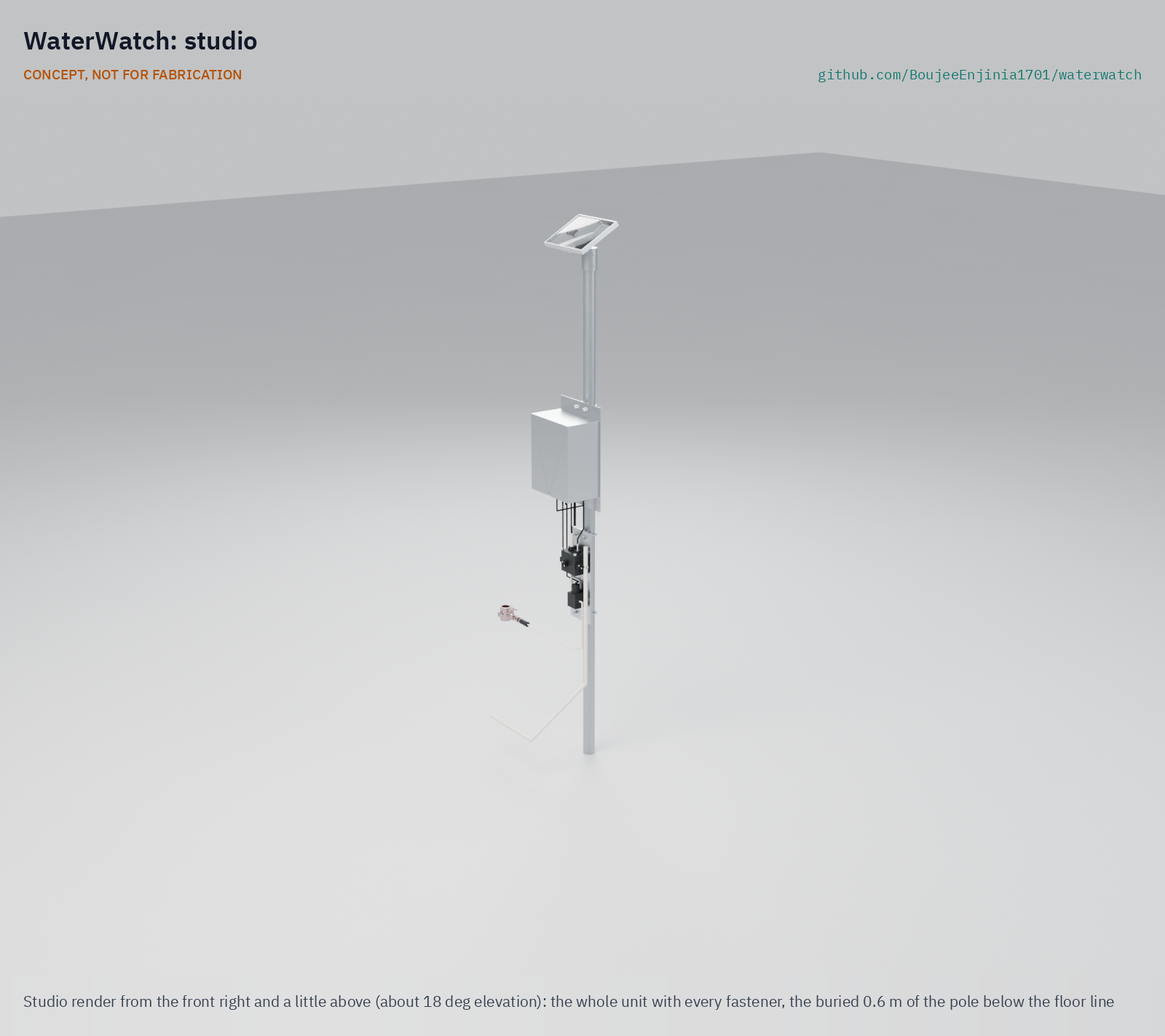
Studio render · Interactive 3D model · Concept blueprint (PDF) · General arrangement WWT-DWG-001 (PDF) · STEM check WWT-STM-001 · Concept options WWT-OPT-001 · Requirements WWT-PRS-001 · Traceability WWT-RTM-001 · Sizing note WWT-CAL-001 · Prototype build plan · Decisions · Review note
Concept rationale
The two readings that tell a rural operator most about treated water at the tap are free chlorine residual and turbidity, and both can be measured without reagents. WaterWatch therefore pairs a membrane-free graphite chlorine sensor and an open-source infrared turbidimeter with a timed hourly flush, a small solar supply and plain SMS alerts, rather than a mains-powered utility analyzer whose chlorine probe alone costs about $1,900. It watches indicators and raises an alert; it does not dose, and it never declares water safe.
Keeping the design open and garage-buildable matters because the people who would install and maintain it are small scheme operators, maintenance service providers and caretakers, not utility instrument technicians. Every part is off the shelf or made from simple stock, the calibration is a monthly DPD comparator check that caretakers already know, and the CERN-OHL-S license lets a regional workshop build, repair and adapt the unit without a vendor.
Burning platform
In 2024, 2.1 billion people still lacked safely managed drinking water (WHO and UNICEF JMP, 2025). WHO estimates that at least 1.7 billion people use a drinking water source contaminated with faeces, and that contaminated drinking water causes about 505,000 diarrhoeal deaths each year (WHO, drinking-water fact sheet, 2023).
Chlorination is the cheapest defense a piped rural scheme has, but it only protects people when a residual of at least 0.2 mg/L reaches the tap (Oxfam WASH, chlorination in emergencies). Today that is checked by hand when a technician visits, so a chlorinator that runs dry or a storm that clouds the source can go unnoticed for weeks. Remote sensors have already cut repair times for broken handpumps when someone was paid to act on the data (Nagel et al., ES&T 2015); nothing comparable, open and affordable yet watches the quality of the water itself.
Where it could be used
By industry
| Industry | Use |
|---|---|
| Rural water utilities and scheme operators | Watch chlorine residual and turbidity at tapstands across many villages and target dosing and repairs |
| Maintenance service providers | Add water quality alerts to existing handpump and scheme functionality monitoring contracts |
| Humanitarian WASH response | Track free chlorine at tapstands in camps and after floods, where chlorination is routine and outbreaks spread fast |
| Schools and health facilities | Monitor the tank outlet or tap that serves pupils and patients between official tests |
| Water kiosks and small private operators | Give customers and regulators a running record of the water they sell |
| Universities and WASH research groups | Collect long, open data sets on residual decay and turbidity events at the point of use |
By country or region
| Country or region | Why it matters there |
|---|---|
| Rwanda | Cellular handpump sensors paired with a paid maintenance service shortened repair times (Nagel et al., 2015); the same service model could act on water quality alerts |
| Nigeria (Plateau State) | Sensors have already tracked functionality and use of rural water points (Plateau State sensors, 2022); water quality alerts would extend the same approach |
| India | Rural household tap connections rose from 17 % to over 49 % between 2019 and 2022 under the Jal Jeevan Mission, yet less than 49 % of rural people use safely managed drinking water; a logged residual at the tap would show whether new piped schemes deliver treated water |
| Honduras | Community water boards run passive chlorinators at storage tanks; in a 2023 study 77 % of samples met the 0.2 mg/L WHO minimum, board errors caused 39 % of chlorination lapses, and more frequent circuit-rider visits went with better results (Lindmark et al., ACS ES&T Water) |
| Canada (Ontario) | A high-income example: at Walkerton in May 2000 operators did not measure chlorine residuals at a municipal well as they should have, seven people died and 2,300 fell ill (CBC News, highlights of the Walkerton Inquiry report) |
What sparked the idea
The idea traces back to the E. coli outbreak in Walkerton, Ontario, in May 2000. Part One of the Walkerton Inquiry, released by Associate Chief Justice Dennis O'Connor in 2002, found that the Well 5 water was to carry a chlorine residual of 0.5 mg/L after 15 min of contact, that operators routinely used less chlorine than required, did not measure residuals on most days and made false entries in the daily operating records, and that seven people died and 2,300 became ill (CBC News, highlights of the Walkerton Inquiry report; National Academies, Lessons from Waterborne Disease Outbreaks). The inquiry concluded that continuous chlorine residual and turbidity monitors at Well 5 would have prevented the outbreak. A town in a high-income country, with a regulated municipal supply, lost its chlorine barrier without anyone noticing in time. At a village tapstand checked only on rare visits, the gap is wider, and a logged, automatic residual and turbidity reading that raises its own alert is the part WaterWatch aims to supply.
Problem
Rural water points go untested between rare lab visits, so a chlorinator that runs dry or a storm that clouds the source can go unnoticed for weeks. Full problem statement: docs/01-problem.md
Concept
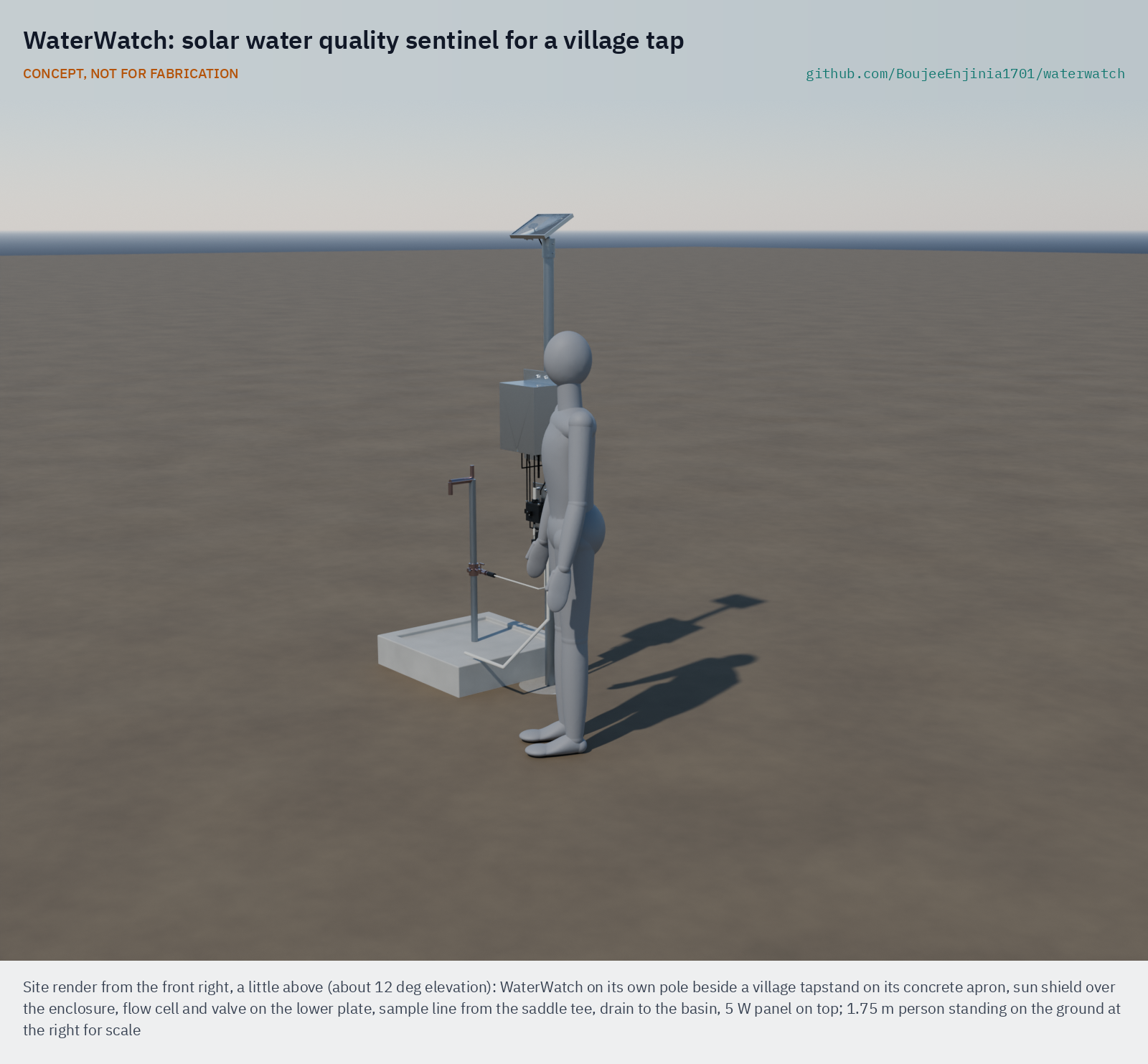
A pole-mounted sentinel beside a village tapstand flushes a small sample through a dark flow-through cell once an hour, measures turbidity, free chlorine and temperature, logs the readings and sends them over cellular (LTE-M, NB-IoT or 2G; LoRaWAN as a variant). An SMS goes to the caretaker and operator when chlorine drops below 0.2 mg/L or turbidity passes 5 NTU. The TRL 3 calculations give 0.54 Wh per day, 28.5 days on battery without sun, 18 L per day of flushed water and an estimated USD 325 in parts for the constructable design, USD 25 over the USD 300 value-engineering target. Following Amish's decisions of 2026-09-25 (WWT-DDR-002), the chlorine accuracy target is ±0.2 mg/L or ±25 %, and sites above pH 7.5 or with a moving pH take a pH probe in a spare port of the cell; the error budget then meets the target at the 0.2 to 0.5 mg/L where alerts are set, but, as corrected after the independent review of the STEM check, not at 1.5 mg/L (a restated target above 1.0 mg/L is proposed, awaiting Amish), and the low-cost sensor's long-term drift is unknown, so the monthly maintenance interval remains at risk.
Full design precis: docs/02-concept.md
STEM check
Every physical, chemical and biological claim of the design was checked against known science (WWT-STM-001, docs/04-calcs/stem_check.py). Of option A's 37 claims, 27 are within known science, 9 are plausible, to confirm by test at TRL 4 (among them the sun shield's effect, the chlorine sensor's drift and its reference electrode, fouling and freezing), and 1 fails with a fix that needs Amish's decision: the corrected chlorine error budget misses the accuracy target at 1.5 mg/L by up to 0.017 mg/L, while it is met at the 0.2 to 0.5 mg/L where alerts are set (WWT-DEC-001 O5). One detail failed at the first check and was fixed under Amish's standing instruction of 2026-10-23: the battery was listed as two 32700 cells holding 6 Ah, but one such cell holds 6 Ah, so it is now one cell (WWT-DEC-001 F1). An independent reviewer then tried to refute every verdict; four more fixes followed (a longer flush at low-pressure sites, a valve rated for 4 bar, kept TLS sessions and a second check valve at the cell inlet, F5 to F8), recorded in the check.
Concept options
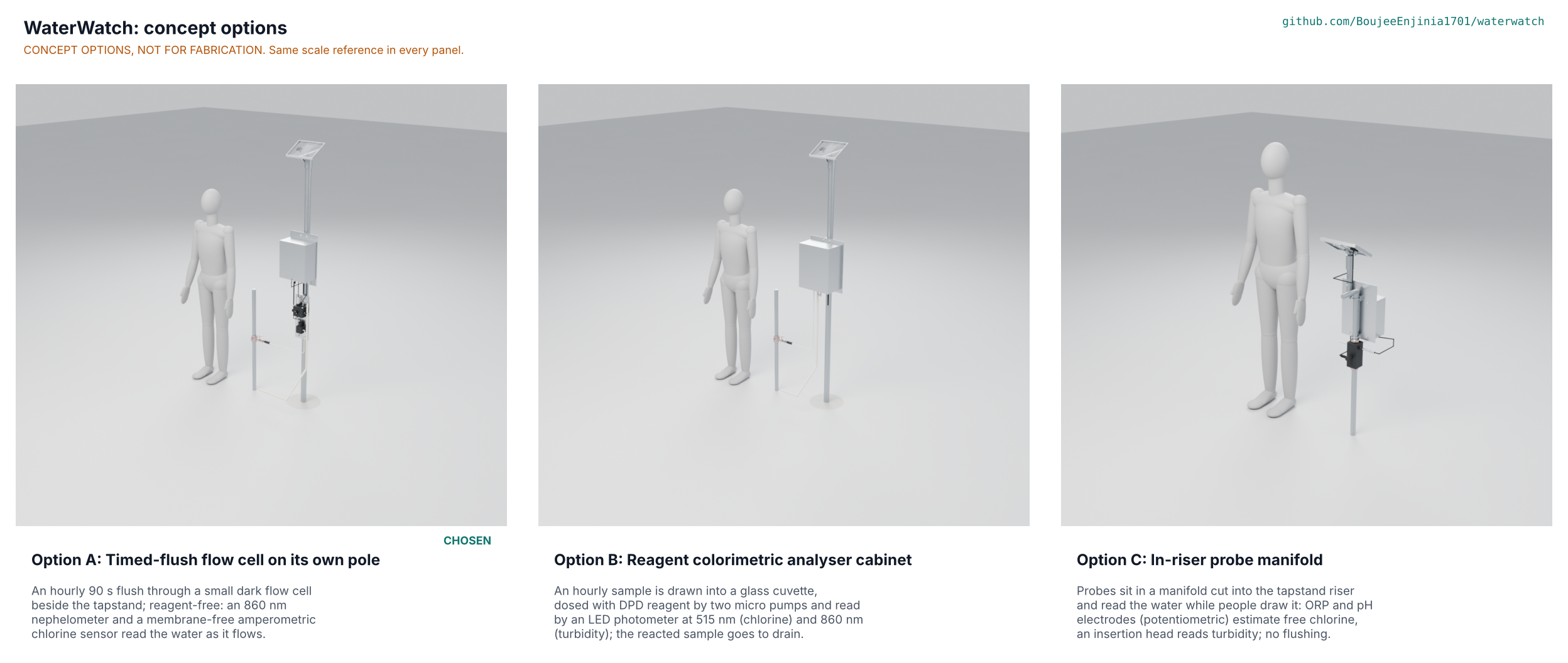
The current design is option A of three, each with a different way of reading chlorine and each modelled in full detail (WWT-OPT-001): A, a timed-flush flow cell with a reagent-free chlorine sensor on its own pole (196 of 245); B, a reagent colorimetric analyser that doses DPD into a cuvette (167); C, probes in a manifold cut into the riser that read while people draw water (155). Option A is recommended, with option B's best idea, a shared DPD photometer as the monthly reference, grafted on; Amish chose both on 2026-10-25 (WWT-DDR-004).
Key components
- Infrared (860 nm) nephelometric turbidity optics: LED, 90° scatter and 180° reference detectors on three walls of the cell
- Membrane-free three-electrode free chlorine sensor with a potentiostat front end
- Temperature probe
- Opaque 0.19 L flow-through cell fed through a pressure-compensating regulator and a latching solenoid valve from a tee on the tapstand riser, draining through an open air break
- Two aluminium back plates on U-bolts hold the enclosure and the flow cell to the pole
- ESP32 controller with microSD logging
- Cellular modem (LTE-M, NB-IoT, 2G fallback), LoRaWAN as a variant
- 5 W solar panel and one 3.2 V, 6 Ah LiFePO4 cell in an enclosure under a ventilated sun shield
The priced bill of materials is in bom/bom.csv. The parametric model is cad/src/model.py: every concept option is modelled to detail level D3 (real stock, every bolt, nut, washer and screw; option A has 215 parts, 120 of them fasteners) and checked by python .kit/cad_check.py --export (cad/fidelity.json), with a STEP file per part of option A in cad/step/A/ and an assembly STEP per option.
Building the prototype
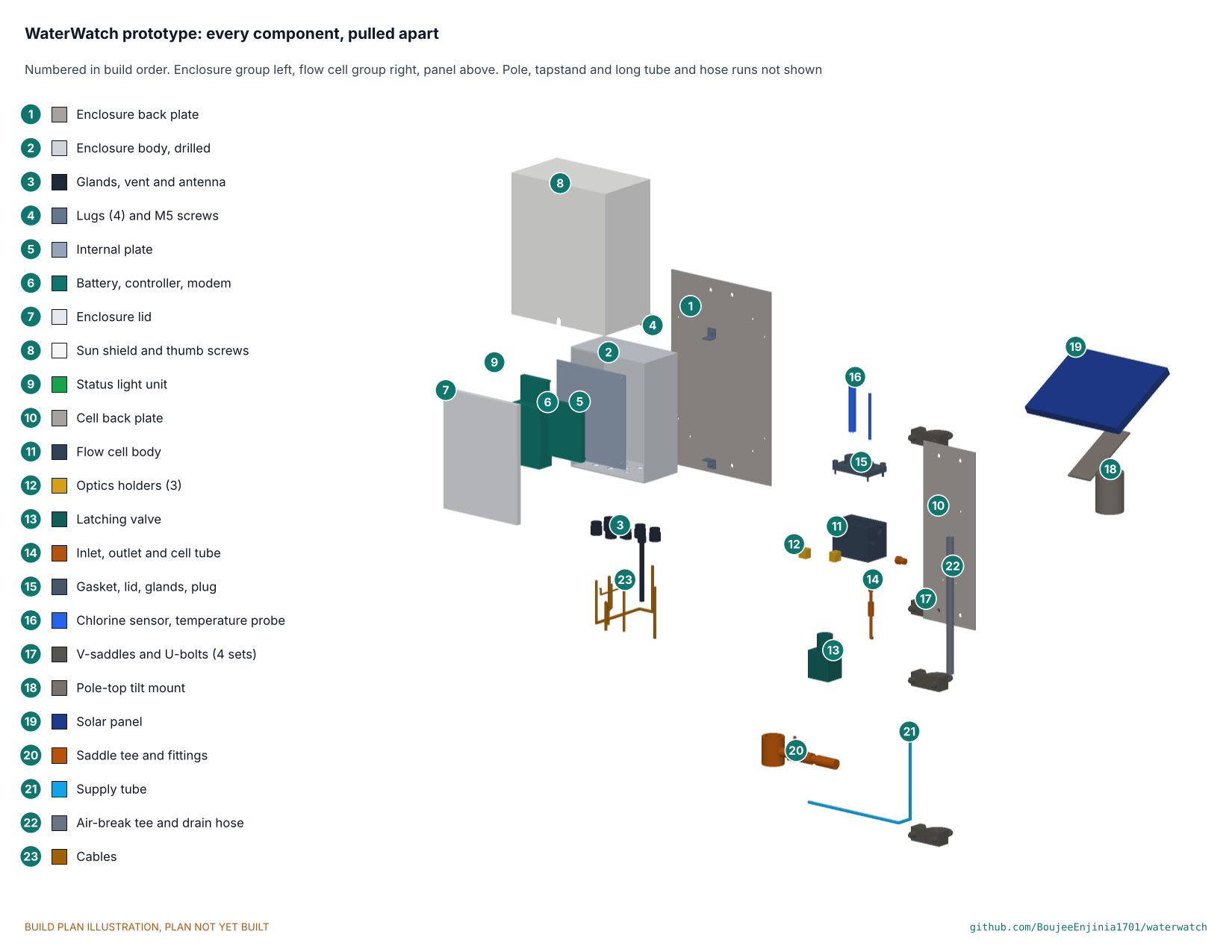
The prototype build plan (docs/05-build-plan.md) shows how to make and fit every component of the first proof-of-concept unit, with a making sketch for each made part, close-ups of the joints and a picture for every assembly step. Making it buildable changed the concept in places: the enclosure and the flow cell now hang on aluminium back plates held to the pole by U-bolts, every cable enters the box from below so the sun shield slides off, and the turbidity optics sit on three walls of the cell (decision record WWT-DDR-003, accepted by Amish on 2026-10-02). The plan is paper only; building and testing to it is TRL 4 work. Decisions made and the five still open (concept choice, calibration reference, render layout, how water use counts event flushes, the chlorine target above 1 mg/L) are in the design decisions register.
Safety
A sensor alert does not replace accredited lab testing, and a normal reading does not mean the water is safe to drink. Contains a LiFePO4 battery: use a protection board, a fuse and charging temperature cut-offs. The sample line connects to a pressurized drinking water supply: fit an isolation valve and a check valve so nothing flows back into the supply.
Repository layout
| Folder | Contents |
|---|---|
docs/ |
Problem, STEM check, concept options, user and product requirements, traceability, calculations, build plan, decisions, regulatory, feasibility, risk, market and plan |
cad/src/ |
build123d Python source, the source of truth for all geometry (model.py for every option, wwt_parts.py helpers, product_model.py for renders) |
cad/step/, cad/stl/ |
Exported models for FreeCAD, other CAD tools and printing |
cad/drawings/ |
2D sketches and dimensioned drawings |
bom/ |
Bill of materials |
electronics/ |
KiCad schematics and PCB layouts |
firmware/ |
Microcontroller code |
media/ |
Renders, perspectives and photos |
build-log/ |
Dated prototyping notes |
Documentation
Controlled documents follow the portfolio documentation standard. Each carries a document ID (WWT-PRC-001 for the precis), a version and a revision history. Branded PDFs are built with python .kit/render.py and attached to GitHub Releases when a document is tagged, for example WWT-PRC-001/v1.0.
Credits
Designed by Amish Chadha. See CONTRIBUTORS.md for roles. To cite this design, use CITATION.cff (GitHub shows it as "Cite this repository").
AI assistance (Claude) was used to accelerate concept renders, prototype documentation and first-pass sizing calculations. Design direction and all decisions are Amish Chadha's, recorded in this repository's decision records (docs/decisions/).
Licenses
- Hardware (CAD, drawings, BOM, electronics): CERN-OHL-S v2
- Software (firmware, scripts, notebooks): MIT
A project of the Design Molecule lab.