AI news 4 min read
Moonshot publishes Kimi K3.1 Pro weights: a 2.8T-parameter open model that scores near Claude Opus 5.5 on Terminal-Bench
The 1M-context agentic model from Moonshot AI is now downloadable from Hugging Face under an MIT-based license with two commercial clauses. It gives coding-agent builders a self-hostable option, but only if they have serious GPU capacity.
Moonshot AI has published the full weights of Kimi K3.1 Pro on Hugging Face, keeping the promise in its launch post to release them "by Nov 4". The model has been available through Kimi's apps and API since late October. Now anyone can download it, serve it themselves and fine-tune it.
What was released
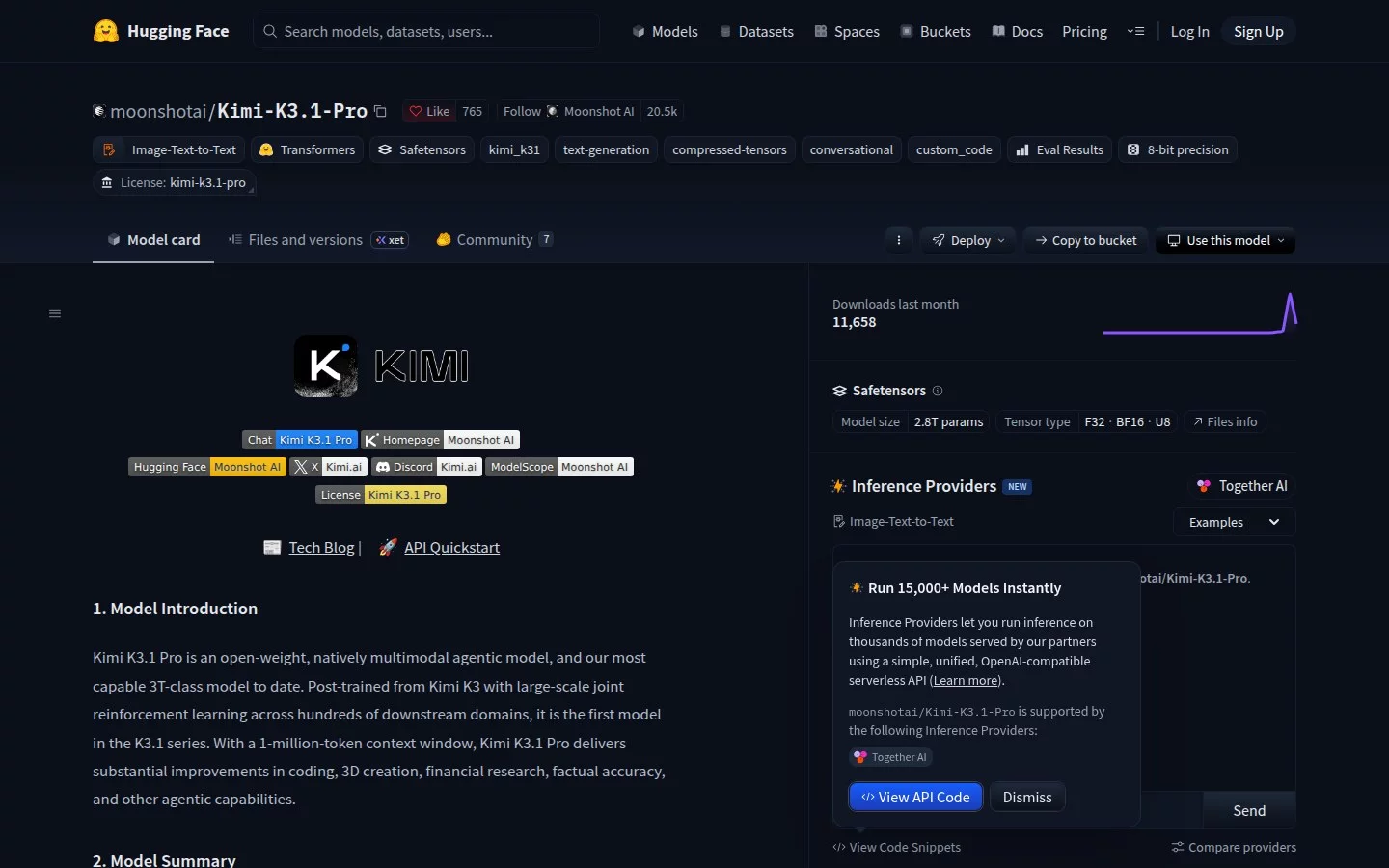
According to the model card, K3.1 Pro is a mixture-of-experts model with 2.8 trillion total parameters and 104 billion active per token. It has 896 experts (16 picked per token, plus 2 shared) and 93 layers that mix two attention types: 69 Kimi Delta Attention layers and 24 Gated DSA layers. The context window is 1,048,576 tokens. A 401M-parameter vision encoder (MoonViT-V2) handles image input. The weights ship in MXFP4, with MXFP8 activations, and were produced with quantization-aware training.
Moonshot describes it as the first model in the K3.1 series, post-trained from Kimi K3, and aims it at coding (including 3D and game creation), financial research and long-running agent work.
The model card lists vLLM, SGLang and TokenSpeed as recommended inference engines, plus a Docker Model Runner one-liner (docker model run hf.co/moonshotai/Kimi-K3.1-Pro). Together AI is listed as a hosted inference provider, and the card mentions community quantizations for llama.cpp, Ollama and LM Studio. Both vLLM and SGLang expose an OpenAI-compatible server, so existing agent harnesses can point at a self-hosted instance by swapping the base URL. The card does not state hardware requirements. Our own estimate, not Moonshot's: at 2.8T parameters, expect a multi-GPU server.
How it scores, per Moonshot
All benchmark numbers come from Moonshot, run at maximum reasoning effort. On Terminal-Bench 4.0, K3.1 Pro scores 65.7 against 66.4 for Claude Opus 5.5 and 58.2 for GPT-6 Astra. The model card has it in first place on SWE Marathon v1.1 (51.7 vs 46.3 for Opus 5.5), HLE-Full with tools (70.0) and BrowseComp (92.1). It also trails on several tests, including OSWorld V2.1 (79.6 vs 81.8 for Opus 5.5), BenchCAD with tools (92.7 vs 96.2), and two by large margins: ProgramBench 31.5 against 65.0 for Opus 5.5, and Terminal-Bench-Science 38.1 against 68.1 for GPT-6 Astra.
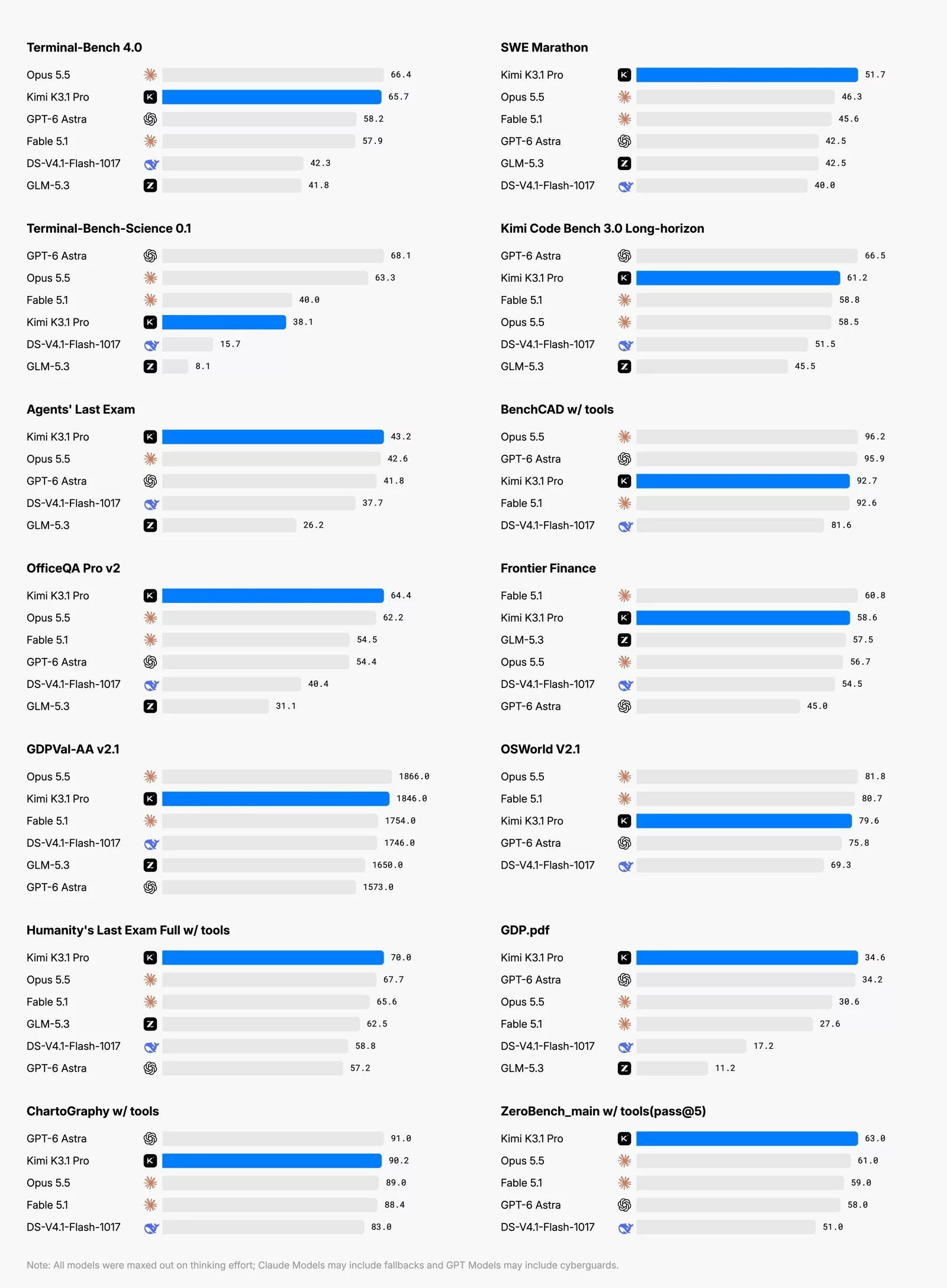
The comparisons are not like-for-like. Superpower Daily notes that Kimi ran through Claude Code for the terminal and SWE Marathon tests, while competitor scores came from release posts or leaderboards. Moonshot's own chart footnote says Claude results may include fallbacks and GPT results may include cyber safeguards. AILog notes that the benchmark figures come from Moonshot's own model card, not from independent evaluations.
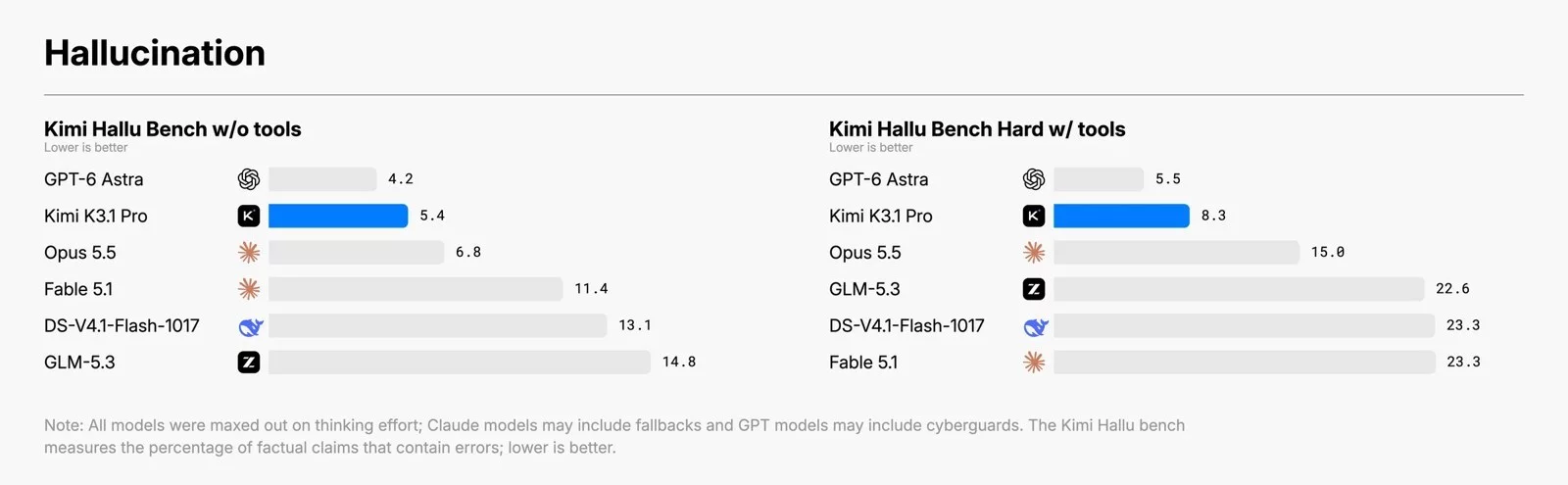
Moonshot also reports a drop in hallucinations. On its internal Kimi Hallu Bench Hard with tools, the claim-level error rate fell from 23.4% for K3 to 8.3%. GPT-6 Astra is lower on both variants of the bench (4.2% and 5.5%). The blog calls this a deliberate stress test and says the rates do not reflect everyday error rates.
The license and how to try it
The license is MIT with two extra clauses. A Model-as-a-Service business with more than US$20 million in revenue over any 12 months needs a separate agreement with Moonshot before commercial use. Any commercial product with more than 100 million monthly active users or more than US$20 million in monthly revenue must show "Kimi K3.1-Pro" prominently in its UI. Neither clause applies to internal use or to access through Moonshot's own products or its certified inference partners. The service clause also excludes end-user products that build model capabilities into specific features, and services that just relay requests to models hosted by others. A business can trigger both clauses. Below those thresholds, the MIT-style terms apply.
flowchart TD
    A[Using Kimi K3.1 Pro weights] --> B{Internal use only, or via Moonshot or a certified partner?}
    B -- Yes --> OK[MIT-style terms only]
    B -- No --> C{Selling model access, revenue over $20M in 12 months?}
    C -- Yes --> D[Separate agreement with Moonshot]
    C -- No --> E{Product over 100M MAU or $20M monthly revenue?}
    E -- Yes --> F[Show 'Kimi K3.1-Pro' in the UI]
    E -- No --> OK
If you can't host it yourself, the hosted API is the practical route. The quickstart uses the model ID kimi-k3.1-pro on Moonshot's OpenAI-compatible endpoint at api.moonshot.ai. Access unlocks after a top-up of at least $1. Output defaults to 131,072 tokens and can go up to the full 1M. Thinking is always on: reasoning_effort accepts low, high or max, with max as the default. Temperature and top-p are fixed, so don't send them. In multi-turn and tool-calling loops you have to pass back the whole assistant message, including reasoning_content and tool_calls. Harnesses that keep only content need changing. A kimi-k3.1-pro-highspeed variant runs 2 to 3 times faster, according to Moonshot. In Moonshot's Kimi Code, the /model command selects K3.1 Pro.
The pages we read did not list per-token prices for K3.1 Pro, so check Kimi's pricing page before you budget an agent run on it. Also keep in mind that Moonshot's blog says K3.1 Pro's cyber capability is behind frontier proprietary models and that cyber-related training data was removed. Security tooling builders should test it on their own tasks first.