AI news 3 min read
Cognition ships SWE-2 Flash, a 276B-A12B coding model for Devin at one-fifth SWE-2's price, but keeps the weights closed
Cognition post-trained Thinking Machines' Inkling-Small into a fast coding model for routine agent work. It runs only inside Devin for now, free through November 30, with no API, no per-token price and no public weights.
Cognition, the company behind Devin, released SWE-2 Flash on November 4: a smaller coding model that it says runs at about 3x the speed and one-fifth the price of its flagship SWE-2. It is available in Devin Desktop and the Devin CLI, and Cognition lists it as free through November 30. Unlike its base model, its weights are not public.

What Cognition built
SWE-2 Flash starts from Inkling-Small, an open-weight mixture-of-experts model from Thinking Machines with 276 billion total and 12 billion active parameters. SWE-2 is 2.8T-A104B, so Flash is roughly a tenth of its size. According to OrcaRouter's analysis, SWE-2 itself was built on Kimi K3; OrcaRouter also reports that Inkling-Small carries an Apache 2.0 license, which Cognition's post does not mention.
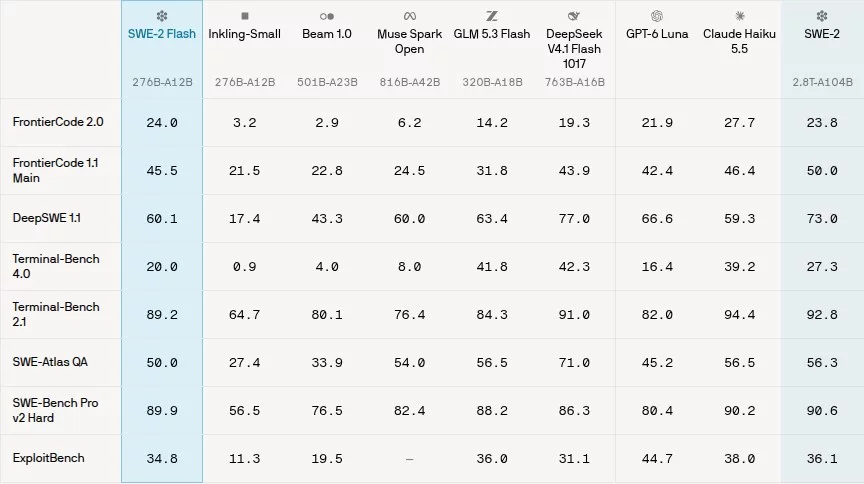
The new part of the recipe is a mid-training stage before reinforcement learning. Cognition trained on "a few trillion tokens" of scientific articles, blogs, code and other sources in three stages, saving the scarcest, highest-quality data for last, and chose the data by comparing the token efficiency of a baseline and seven candidate mixes against a held-out coding dataset. The RL stage reuses the SWE-2 recipe with tweaks; Cognition says most of the gains came from better and more varied RL tasks. It also targeted security work: ExploitBench went from 11.3 to 34.8.
The jump over the base model is large. Terminal-Bench 4.0 rose from 0.9% to 20.0%, and FrontierCode 2.0 (Cognition's own benchmark, per OrcaRouter) from 3.2% to 24.0%.
How it compares
Cognition's headline claim is that Flash "outperforms all American open-weight models, even models that are 3x larger." The full table in the announcement is more mixed once non-American and closed models are included:
- It nearly matches SWE-2 on SWE-Bench Pro v2 Hard (89.9 vs 90.6) and edges it on FrontierCode 2.0 (24.0 vs 23.8).
- It trails SWE-2 on DeepSWE 1.1 (60.1 vs 73.0) and Terminal-Bench 4.0 (20.0 vs 27.3).
- GLM 5.3 Flash and DeepSeek V4.1 Flash 1017 score higher on Terminal-Bench 4.0, DeepSWE 1.1 and SWE-Atlas QA; Claude Haiku 5.5 does on Terminal-Bench 4.0 and SWE-Atlas QA.
- Against Muse Spark Open, a model about 3x its size, the DeepSWE 1.1 margin is 60.1 to 60.0, which OrcaRouter calls within noise.
xychart-beta
    title "Terminal-Bench 4.0 score (%), reported by Cognition"
    x-axis ["Inkling-S", "GPT-6 Luna", "SWE-2 Flash", "SWE-2", "Haiku 5.5", "GLM 5.3F", "DS V4.1F"]
    y-axis "Score (%)" 0 --> 50
    bar [0.9, 16.4, 20.0, 27.3, 39.2, 41.8, 42.3]
The chart leaves out Beam 1.0 (4.0) and Muse Spark Open (8.0). All of these numbers are Cognition's. OrcaRouter notes that the post does not disclose the agent harness, does not say whether scores are pass@1 or best-of-N, and has no independent runs yet. The 200 vs 60 tokens per second speed figure is not a live measurement: Cognition replayed each model's run on a single Terminal-Bench 4.0 task at simulated rates, with transcripts cut to equal length.
What it means if you build with agents
Cognition pitches Flash for the routine share of agent work: automations, code review, feature development and documentation updates, with SWE-2 kept for harder tasks. That fits how many people already split work between a strong planner and a cheaper executor, and Devin Desktop (the renamed Windsurf) has a feature for exactly that. Its product page describes "Fusion", which pairs a frontier lead model with a cheaper sidekick model.
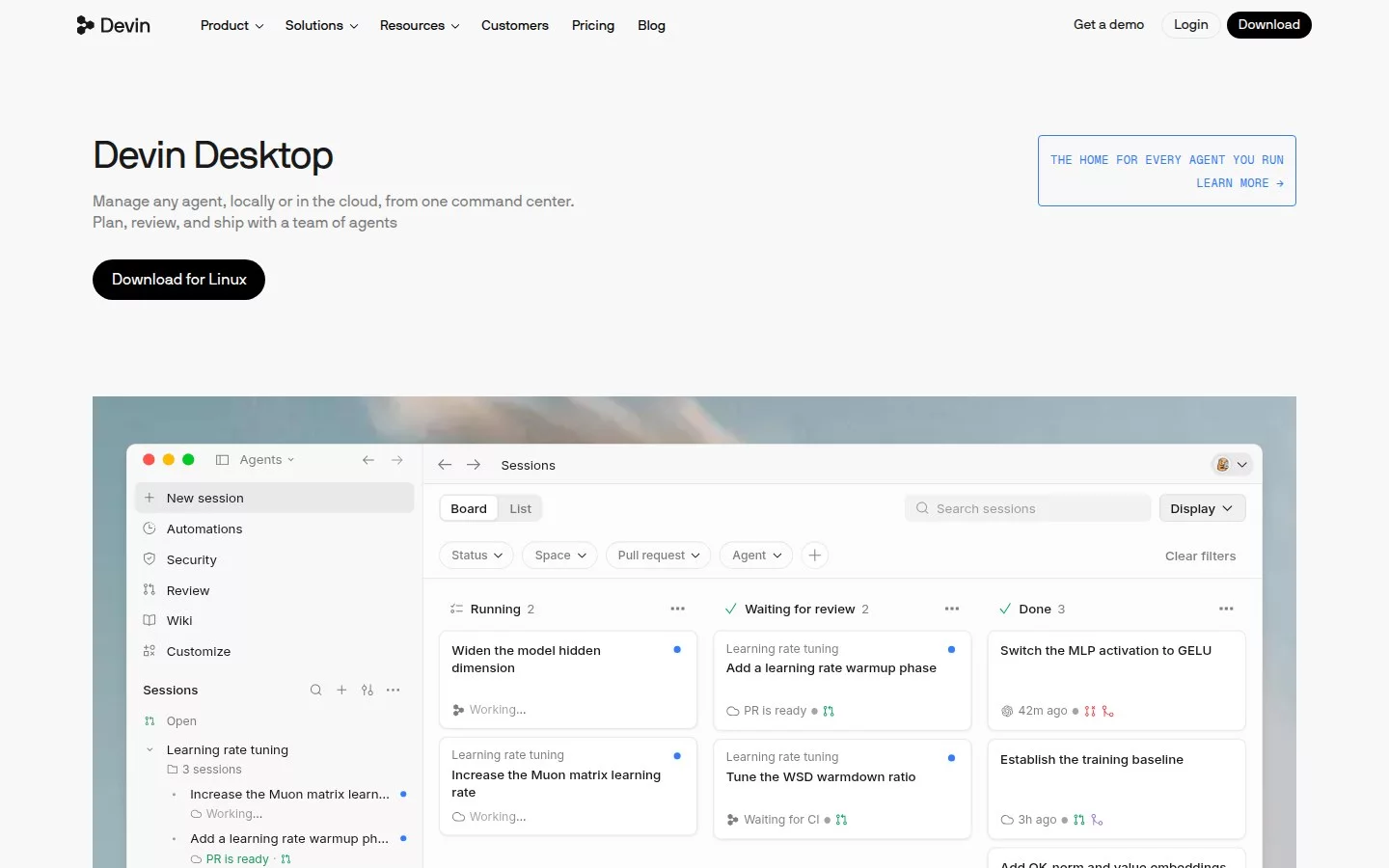
To try it, install Devin Desktop or the Devin CLI. Runtime Wire reports the free period through November 30 applies to paid Devin users; Cognition's post does not spell out eligibility. Paid plans start at $20 a month for Pro, according to the pricing on the Desktop page.
The caveats are practical ones. There is no public API or model ID, so you cannot route your own agent or app to it. No per-token price has been published, so "one-fifth the price" is a ratio against SWE-2, and pricing after November is unknown. No context window is stated. And Cognition is withholding the weights, citing the risk of cyber misuse from a model trained for exploit work; it says a program to share them with partners and research labs will be detailed "in a few weeks." Until then, self-hosters who want this class of model are left with the open base, Inkling-Small, and its much lower scores.