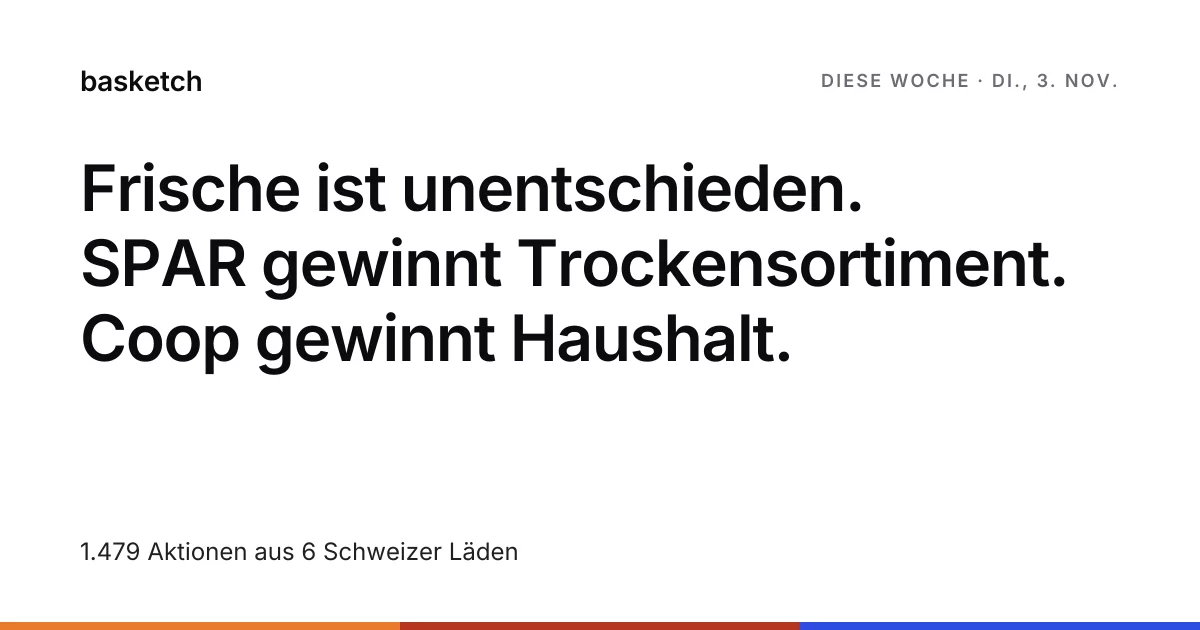

This week's grocery promotions from seven Swiss supermarkets, side by side.
basketch is a free web page that shows this week's promotions from Migros, Coop, LIDL, ALDI, Denner, SPAR and Volg. It compares the stores by category and lets you build a shopping list, grouped by store with an estimated total, that you can share. No app and no account are needed.
Live: https://basketch.vercel.app (German by default, English at /en).
What it does today
- Home. For each of Fresh, Long-life and Household, names the store with the highest average discount this week, or says it is tied.
- Deals. Every collected promotion, grouped by sub-category, with filters by type, category, storage and store, and a search.
- My list. Add deals to a list that is kept only in your browser. The list is grouped by store, with a total per store and an estimated overall total. Share it by WhatsApp, email or link.
- Honest prices. Each deal shows its validity dates and a link to where the price came from. Prices that apply only from a certain date or when buying several are labelled, and they never decide a winner.
basketch compares weekly promotions, not regular shelf prices. It does not choose the cheapest store for each item. You pick the deals; routing each item to its cheapest store is a long-term goal that has not been built. Details, known gaps and open questions are in the PRD.
Where the data comes from
| Retailer | Source |
|---|---|
| Denner | denner.ch |
| Volg | volg.ch weekly offers |
| LIDL, ALDI, SPAR | the retailer's public weekly flyer |
| Migros | the public weekly flyer (Issuu, Zurich edition), read with free OCR |
| Coop | aktionis.ch, a public Swiss deal site, because coop.ch blocks automated access |
A scheduled pipeline collects all seven retailers on Monday, Tuesday and Thursday. Products are sorted into basketch's own category list by an AI model (Google Gemini, free tier), and a second AI model (via OpenRouter) checks the answers. basketch never works around a technical block.
Tech stack
| Layer | Technology |
|---|---|
| Frontend | Next.js 16 (App Router), TypeScript, Tailwind, next-intl (German and English) |
| Pipeline | TypeScript, with Python for Migros OCR, on GitHub Actions |
| Database | Supabase (PostgreSQL) |
| Hosting | Vercel |
Cost: free tiers, plus one paid AI checker capped at USD 5 per month.
Case-study documents
| Document | What it covers |
|---|---|
| PRD v4.0 | Problem, goal vs. what ships, product rules, data, status, risks, open product questions |
| Use cases v3.0 | Live and parked use cases with acceptance criteria and known defects |
| Technical architecture v2.0 | System design, modules, data flow |
| Business model canvas v2.0 | The nine blocks, competition, assumptions to validate |
| Competitive analysis v2.0 | 13 tools (6 Swiss, 7 international), sourced |
Running it locally
Requires Node.js and Python 3.
./setup.sh                      # installs pipeline + frontend deps, Python OCR deps, creates .env from .env.example
cd web-next && npm run dev      # frontend at http://localhost:3000
Tests (three separate suites):
cd pipeline && npm test
cd shared   && npx vitest run
cd web-next && npm test && npm run lint
Type-check each package from its own folder: ./node_modules/.bin/tsc --noEmit -p tsconfig.json. See CLAUDE.md for conventions.
Built with
Built with Claude Code, from PRD through implementation, as part of the product process.
Author
Kiran Dommalapati, Senior Product Manager, Bern, Switzerland. LinkedIn | Email