
Jev Cards
Jev Cards v2 continues at Opper: play it at opper.ai/decision-benchmarks/jevcards. jevcards.com now goes there. This repository stays the original, open-source version that launched on Show HN on 20 October 2026, and it still runs as it is: see below.
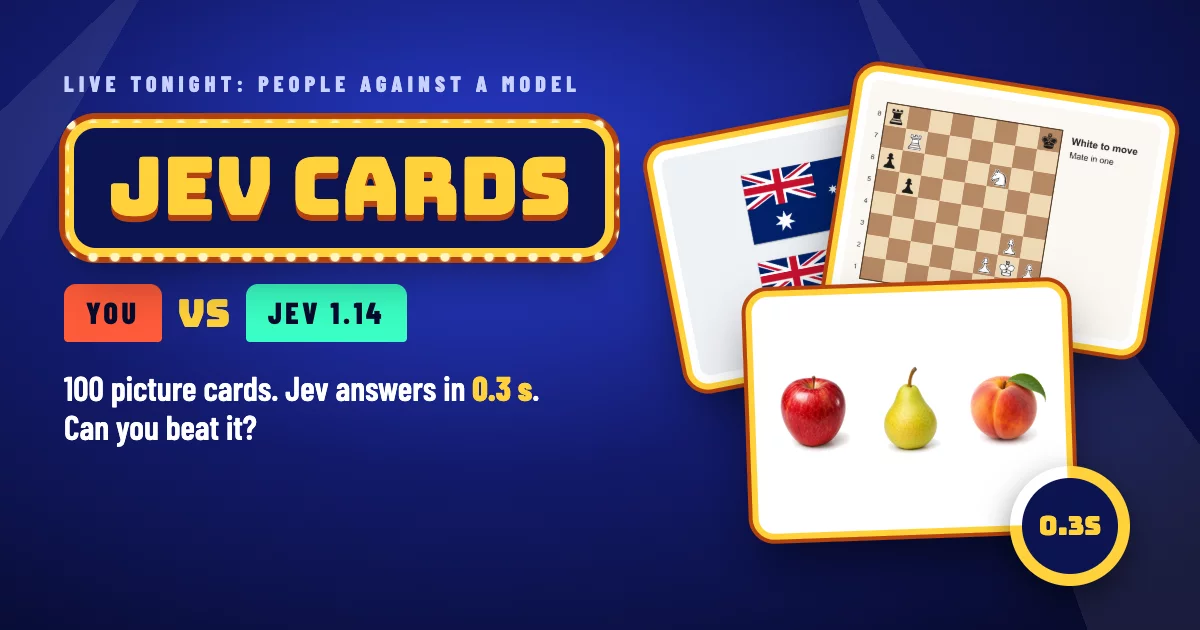
A visual quiz game: you against Jev, TypeSafe's vision decision model, on the same picture cards. Tap the peach among the fruit, point at Egypt on a map, find the chess move that mates, say what color the ink is. Jev looks at the same picture and answers in about a quarter of a second.
Jev never writes text: each card is one typed question (a choice with a probability per option, or a box
for "tap the place" cards), asked with the card's picture through the System One API.
Modes
| Mode | How it plays | Score |
|---|---|---|
| Sprint | N cards (5, 10, 20 or all) against the clock | Time spent answering plus 5 s per miss; lower is better. Jev's time on the same cards is its answer times plus the same penalty. |
| Versus Jev | 10 rounds, live: Jev is asked the moment the card is dealt, you get the seconds you picked (3, 5, 10 or 15) | 100 for a right answer in time, plus up to 50 for speed. |
| Streak | Cards until your first miss, 10 s each | Your run against Jev's run on the same cards in the same order. |
| Live match | Share a link; up to 12 people and Jev get the same cards at the same moment, 10 s each. The host picks 5, 10, 15 or 20 rounds and starts when the guests are ready | Like Versus, with a podium after every card and a leaderboard for the match. |
The page never has the answers: its deck (public/cards/deck.json) leaves them out, and the server marks each answer
as it is given (POST /api/mark), sending back right or wrong and the card's solution. Games on the standard settings
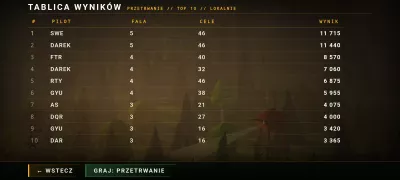
go on a top-10 leaderboard per mode. The server checks each one before it counts, from the answers it marked: the
cards were dealt by the server (signed), the times are possible, and Jev's answers are the ones it signed. Every
game has a share link with a preview image (/r/...), and so does every live match invite (/m/<code>).
Cards
Each card is a picture plus one question, written in cards/*.ts as an SVG of 960 x 720, so the picture and its
answer come from the same source. Three kinds:
- pick: tap one thing in the picture. Jev gets a
choicewhose options say where each thing is ("the object on the left"), never what it is. - buttons: pick a button under the picture. Jev gets the same options.
- point: tap a place. Jev answers a
box; it counts when the box's center is inside the target.
Games deal the themes in turn (deal() in shared/game.ts), so a 10-card game has 10 themes, whatever their
sizes. On the first 200 cards, Jev 1.14 answers 160 right at a median of 261 ms (2026-10-16), and 28 of the next 40:
nearly every photo card, fewer of the reasoning and "know the convention" ones.
Newer cards come in seasons (cards/season<N>/, which the deck builder picks up and tags season: N). The live
game deals them too; a season is published here once it is no longer new. New photos are made with
scripts/make-image.ts, which keeps a shared spending cap.
| File | Cards | Pictures |
|---|---|---|
cards/objects.ts, cards/objects2.ts |
24 look-alikes: peach, lime, cheetah, whisk, croissant, ukulele, corgi, Eiffel Tower, hedgehog, macaron, alpaca, sea lion, tortoise, hoverfly, moth, Samoyed, rigatoni, ciabatta, oboe, ball-peen hammer, Big Ben, Taj Mahal, alligator, gerbil | generated with GPT Image 2.5 Sunburst, each object on its own, reviewed by eye; in assets/objects/small/ |
cards/maps.ts, cards/maps2.ts |
19: point at a country, name a highlighted one | Natural Earth borders drawn with d3-geo; targets are the country polygons, checked against neighbours |
cards/chess.ts, cards/games.ts |
17: mate in one, pins, forks, hanging pieces, castling, tic-tac-toe, connect four, sudoku, poker, a cube net, battleship | drawn; every claim checked in code when the card is built (chess with chess.js) |
cards/flags.ts, cards/flags2.ts |
16: Nordic crosses and look-alike flags | drawn to the official colors and proportions |
cards/perception.ts, cards/puzzles.ts, cards/puzzles2.ts |
24: Stroop, illusions, counting, clocks, dice, Roman numerals, gears, scales, a maze, shadows, sequences, spot the difference | drawn; answers exact by construction |
cards/objects3.ts, cards/nature.ts |
30 more photos: cheeses, sushi, plugs, bikes, owls, leaves, shells, and taxonomy traps ("Tap the dolphin": the orca) | generated and reviewed like the first set |
cards/geo.ts |
14: country silhouettes, true sizes on a Mercator map, borders, landlocked countries | computed from the map data at build time |
cards/symbols.ts |
14: writing systems, road signs, hazard and laundry symbols, weather fronts, currency, music, Morse | drawn |
cards/charts.ts, cards/math.ts, cards/science.ts |
42: charts and gauges, quick maths, circuits, magnets, moon phases, levers, floating | drawn; answers computed from the same data |
cards/conventions.ts, cards/traps.ts, cards/calendar-geometry.ts |
40: alto clef and key signatures, Mercator and conic maps, log and broken axes, taxonomy traps, plugs, calendars, angles, symmetry | drawn or generated; answers computed or textbook facts |
cards/lib.ts has the format and the scoring helpers (inside, optionAt, boxHits), shared by the build, the
server and the page.
How Jev plays
The page at /how shows the exact request Jev gets for a card (GET /api/explain) and asks Jev live. Options go to
Jev under neutral names (option-1, ...) in a random order, so the request never says what anything is.
Sound
Soft quiz-show music, effects (a chime, a buzzer, applause) and a host who opens and closes each game, all made
with ElevenLabs (music, sound effects and v3 voice) by scripts/make-sound.ts. Music, effects and the
host can each be switched off on the home screen.
Run it
npm install
cp .env.example .env     # an API key for Jev
npm run deck             # render cards/*.ts to public/cards/*.png, cards/deck.json and public/cards/deck.json
npm run dev              # http://localhost:5173
npm test
In production, npm run build then npm start serves the built page and the API from one Node process. The
Dockerfile does the same (with railway.json for Railway); mount a volume at /data.
| Variable | What it is |
|---|---|
OPPER_API_KEY |
Calls Jev through the Opper gateway. Every question Jev answers is paid by this key (about $0.0001 a card). |
TYPESAFE_API_KEY |
Or calls Jev on TypeSafe directly (with both keys set, JEV_ROUTE=typesafe picks this one). |
SESSION_SECRET |
Signs deals, Jev's answers and share links. Set it in production; locally one is made in DATA_DIR/secret. |
DATA_DIR |
Where the leaderboards, Jev's tally of wins (tally.json) and the play log (stats.jsonl: one line per answer and per finished game, no addresses or names; see server/stats.ts) are kept (default data/). Mount a volume here. |
BOARDS |
off closes the leaderboards: no new entries, and the page hides them. What is on them is kept for when they open again. |
TRUST_PROXY |
1 behind a proxy, so the visitor's address comes from X-Forwarded-For. |
PUBLIC_ORIGIN |
The site's public address (https://jevcards.com), for link previews and the same-site check behind a proxy that rewrites the host. |
PROXY_SECRET |
Behind a proxy that sends it as X-Proxy-Secret: requests without it are refused (all but /api/health), so the server's own address cannot skip the proxy. |
PORT, STATIC_DIR |
Port (default 3000) and the built page (default dist/). |
npm run bench asks Jev every card and prints what it answered, right or wrong, and how fast
(--model typesafe/jev-1.13.0, --cards a,b, --runs 3).
Jev's calls
Point cards need Jev 1.14 (box answers). Every call is one System One request, built by wireBody() in
server/jev.ts.
The server only asks Jev about cards in a game in progress (POST /api/ask takes a card id and the game's deal;
the how-it-works page's six examples need no deal), since Jev's answer would give most answers away. It refuses cross-site requests,
and limits each visitor to a few questions a second. Live match names and leaderboard initials get one quick check
by Jev, and are refused only when Jev is at least 90% sure they are offensive.
License
Copyright (C) 2026 Jose Sabater.
-
The code is free software under the GNU Affero General Public License 3.0 or later. If you run a changed version as a website, the AGPL asks you to offer its source to the people who play it.
-
The cards (the pictures,
cards/deck.json, the questions and answers incards/*.ts), the sound and the preview image are under Creative Commons Attribution 4.0. Use them for anything, including training or evaluating models, as long as you credit them:Cards from Jev Cards by Jose Sabater (https://jose.sabater.io), CC BY 4.0
Fonts, map data and how the pictures and sound were made: see NOTICE.md.