See it run · Quickstart · How it works · Commands · Skill packs · Coming from Second Brain OS · Architecture
memcellar is a memory for Claude Code and Codex that lives in plain files. It
is an Obsidian vault and a Git repository at once. Your agent knows who you
are and what you are working on from the first message of a session. Before
it answers, it reads its own index and cites the page the answer came from.
What it learns lands as Markdown you can open, edit and commit. Git is the
only database: git log is the audit trail, git revert is undo.
See it run

You ask a question about your stack. The agent reads its own INDEX.md,
opens the page it points to, and answers with that page as its source, so
you can check it and correct it where it is wrong.
Why
- A session starts from what you already told it. Who you are, how you
like to work and the facts that matter are loaded at every start. The rest
is looked up, through
INDEX.md, when a question needs it. - Answers come with their source. The agent cites the page it read, so you can check it, and correct it where it is wrong.
- Memory that stays tidy. Every page is typed by how long it stays true.
A short write gate runs before anything is saved, so a new fact updates the
page it belongs to instead of piling up as
notes-v2. - Nothing to run or keep in sync. No database, no vector store, no server, no build step: just Markdown, JSON and Node, on Windows, macOS and Linux.
- Projects keep their own memory. Each project's status lives in its own repo, committed with the code. The vault stays out of it.
This is a cleaned-up copy of a vault I have used every day since 2026-08-18,
with the personal content taken out. Everything here runs somewhere, and what
was tried and removed is listed as removed — see
docs/DECISIONS.md. Every choice in that vault got a
numbered decision record (ADR), the reversed ones included, which is why the
numbers run high; v1.0, v1.1 and v2 are snapshots of the same vault. Full
records ship from ADR 0045 on; 0001–0044 are one line each in the index.
How it works
-
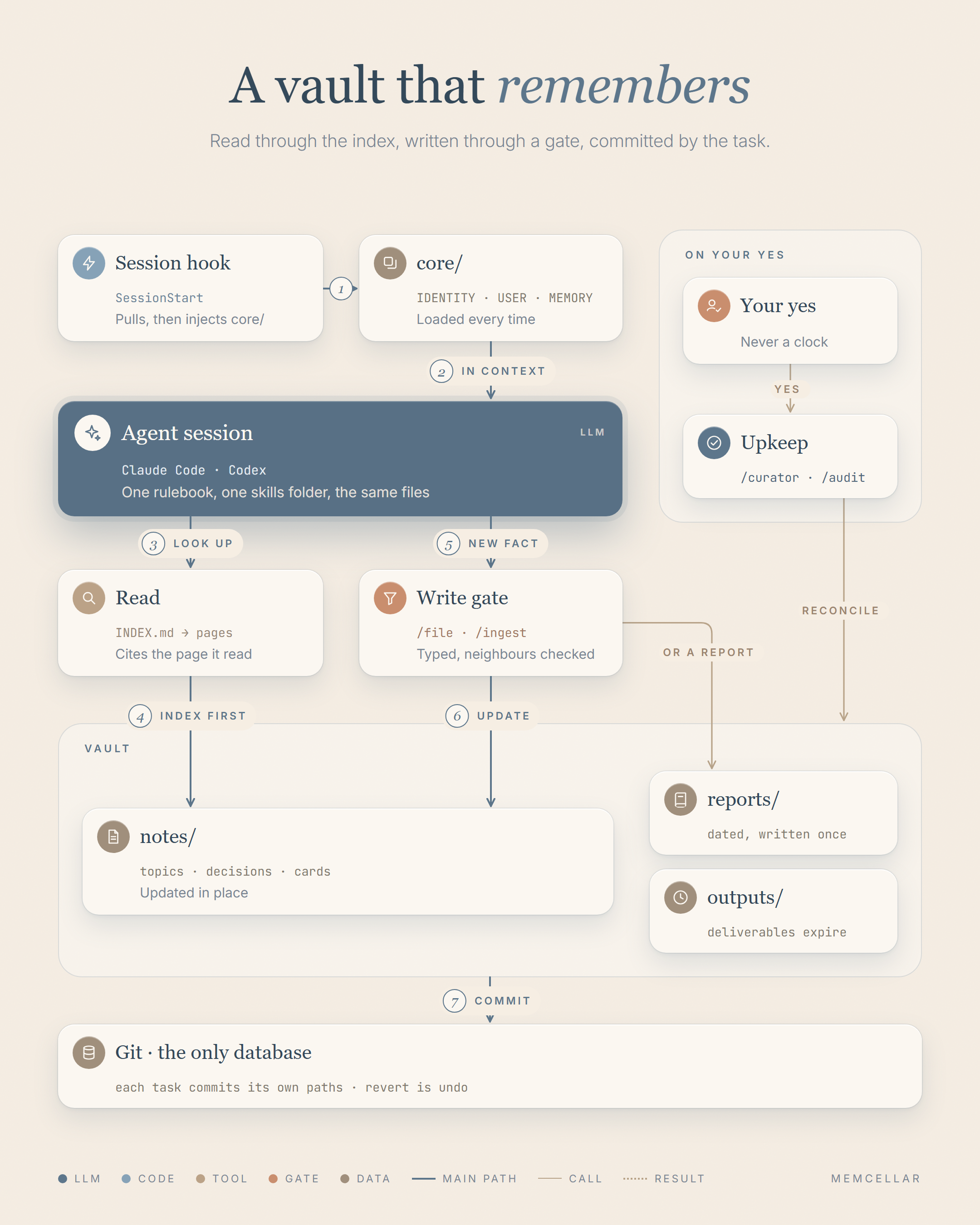
One hook, and it never commits. Both runtimes run the same
SessionStarthook. Inside the vault it pulls and injectscore/. Once a day it may also say which upkeep pass has work waiting; it asks, it never runs one. Outside the vault it does nothing. -
Reading is a rule. Before answering anything the vault may already know, the agent reads
INDEX.mdand the pages it points at. It then grepsnotes/,reports/andcore/in the language you asked in, and cites the page.logs/comes last. -
You talk, the agent distills. Something worth keeping is written on the spot. Before any page is written, the agent runs the write gate (
.agents/write-gate.md):- it writes nothing if the fact is already written down;
- it picks the page's type;
- it lists the pages on the same subject
(
scripts/note-neighbours.mjs); - in the same commit, it closes the pages the new one makes stale.
What you dictate word for word becomes an owner page (
author:), which no agent pass rewrites. -
Your language, your browser. The vault talks and writes in the language you chose at setup. In Obsidian,
notes/home.mdlinks the topic hubs and your to-do page, andarchive/,logs/andraw/stay out of search and the graph. -
Commits belong to the task. Each task commits the files it wrote, by name — never
git add -A— so two sessions, or both runtimes, can share one checkout. -
One copy of everything.
AGENTS.mdis the only rulebook (CLAUDE.mdjust imports it) and.agents/skills/the only skills folder, for Claude Code and Codex alike.
A page's type says how long it stays true (ADR 0055):
| Type | Example | Lives in | How it ages |
|---|---|---|---|
topic |
your coding preferences, what you know about a tool | notes/<subject>.md |
kept current in place; carries updated: |
report |
a research run, a comparison of two libraries | reports/YYYY-MM-DD_<slug>.md |
written once; its date says how old it is |
deliverable |
a shortlist, a draft, a one-week plan | outputs/YYYY-MM-DD_<slug>.<ext> |
expires (30 days unless you set it), then archived |
decision, playbook, project |
a choice and its reasons, steps proven by use, a project card | notes/ |
a decision is superseded, never edited; a playbook is revised on purpose; a card is updated in place |
One subject has one topic page. A report or a deliverable adds a line and a
link to its topic page, so INDEX.md lists only the living layer. Tiers,
budgets and the reasoning behind each part are in
docs/ARCHITECTURE.md.
Three homes, and projects stay walled off
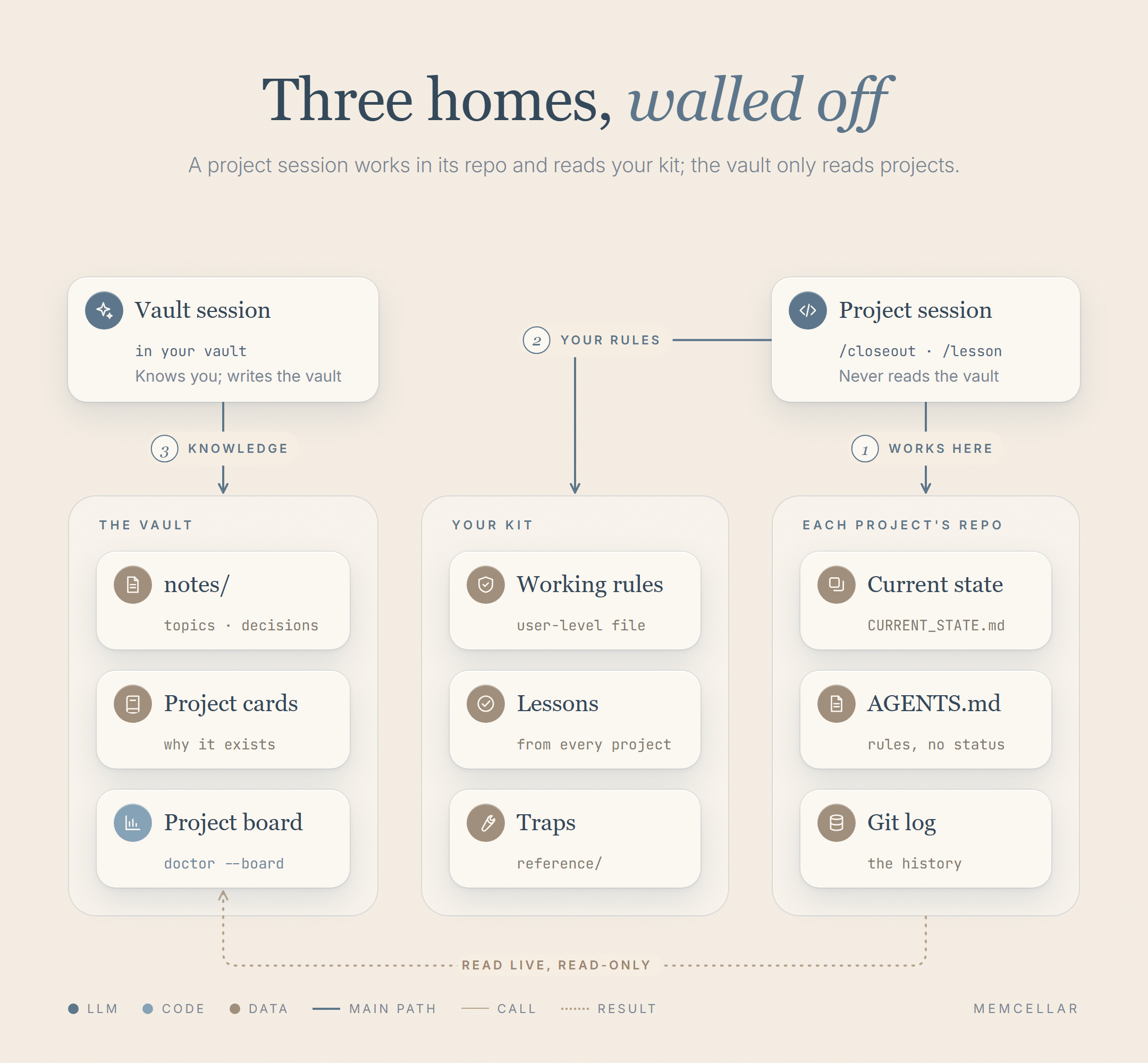
Your memory lives in three places, and each session loads only the ones it needs (ADR 0056):
- the vault — what you know, think and decide; read in vault sessions;
- each project's repo — that project's state, decisions and lessons; read only in that project;
- your kit — your user-level instruction file and two folders beside it: how you want work done, carried into every session, in the vault and in every project.
| The vault | Each project's repo | Your user-level kit |
|---|---|---|
| topic pages, decisions, reports, deliverables, the vault's own lessons | AGENTS.md — the contract: timeless, no status |
your working rules, in the user-level instruction file every session loads |
one thin card per project, notes/<project_id>.md: why it exists, where it lives, what it taught |
docs/CURRENT_STATE.md — the only file that states status |
lessons about how you want work done, from every project, in lessons/ |
docs/lessons/ for lessons tied to that repo; docs/runs/ for one report per autonomous run; git log for the history |
traps that would hit any repo (a tool quirk, a library surprise), in reference/ |
A session in a project neither reads nor writes the vault. The hook does nothing there, and the project keeps its own state, decisions and lessons.
To see every project at once, run node scripts/project-doctor.mjs --board
from the vault. It prints one row per repo, read live: the last commit, the
active milestone and the state file's Next line. It writes nothing.
What the kit is. Your user-level instruction file
(~/.claude/CLAUDE.md, ~/.codex/AGENTS.md) plus two folders next to it,
lessons/ and reference/. You don't create it: the first time /lesson or
/closeout saves something, the folder appears. To keep it in a git repo of
its own, point BRAIN_KIT_DIR at that folder. Keep it private: lessons quote
you word for word.
The kit is the only home that crosses projects: a correction you give in one
repo is there when you open the next. It fills only if /lesson and
/closeout run in your projects, so link them once with
node install.mjs --link-global-skills. Without that, they run in the vault
alone and the kit stays empty.
A choice made in one project, such as its framework, stays in that project's
docs/decisions/; another project is free to choose differently. From the
vault you can still ask about any project: the session reads its repo live,
read-only, and copies nothing back.
Formats and adoption steps:
.claude/templates/project-repo/.
The decisions: ADR 0045,
ADR 0052.
What's in the repo
core/         loaded at every session start ("Tier 0"): IDENTITY, USER,
              MEMORY inlined; OPEN_QUESTIONS by pointer
notes/        the living layer — topic pages, decisions, playbooks, project
              cards, and your own pages (author:); flat, wikilinked, told
              apart by frontmatter; home.md is the front page
reports/      dated research and comparisons, written once
outputs/      lists, drafts and other deliverables, each with an expiry date
raw/          immutable sources you put there; the agent reads, never writes
logs/         append-only session logs + logs/signals/, the event ledger
archive/      closed and superseded content — never deleted, always moved here
scripts/      link sweep, neighbour finder, vault and project doctors,
              maintenance, metrics
.agents/      skills, the optional skill packs and the write gate — the one
              copy both runtimes load
.claude/      the shared SessionStart hook, the compiled checks, page and
              project-repo templates
.codex/       the thin Codex adapter into that same hook
AGENTS.md     the constitution — the rules you and both agents work under
CLAUDE.md     one line that imports AGENTS.md, plus Claude-only notes
INDEX.md      the page catalog — read this first when answering a question
PROPOSALS.md  open work you keep by hand; no pass writes to it
SETUP.md      agent-run installation runbook, with a manual appendix
install.mjs   one-time interactive personalization, skill links and packs
docs/         architecture, decisions, FAQ, upgrade guide, the README's figures
Quickstart
You need:
- git 2.28+ and Node.js 18.13+;
- a GitHub account, with the GitHub CLI (
gh, logged in): the agent-run setup creates your repo with it; - Claude Code or Codex, or both.
Obsidian is optional; the vault is plain Markdown either way.
-
Hand the setup to your agent. Open Claude Code or Codex and paste:
Read SETUP.md from this repository and set up my memcellar vault: https://github.com/brkakyldz/memcellar/blob/main/SETUP.md -
Answer its questions. It creates your private repo from this template, interviews you, personalizes the core files, links the skills and checks that the hook fires. It asks before creating the repo and before writing user-level settings.
-
Check the wiring:
node scripts/vault-doctor.mjs. -
Work normally. Talk to your agent inside the vault: plan a project, think a problem through, ask what you decided last month. When a piece of work is done, it commits exactly the files that work touched.
Prefer to do it by hand? Manual setup
runs node install.mjs. It interviews you and prints the wiring without
touching your user-level settings or committing anything.
Wiring, in short.
- Claude Code needs nothing beyond this repo's own
.claude/settings.json. - Codex gets
core/once itsSessionStartentry is wired in~/.codex/hooks.json. Don't also add one in a project-level.codex/hooks.json: Codex adds the layers together. Details:SETUP.md, Step 5. - Link
/closeoutand/lessoninto your projects:node install.mjs --link-global-skills(--unlink-global-skillsundoes it). This is what fills your kit: without it, nothing learned in one project reaches the next. They write into the project or your kit, never into the vault.
Everyday commands
| Command | What it does |
|---|---|
/file |
keep an analysis from the conversation as the right kind of page — a topic update, a dated report or an expiring deliverable — instead of losing it to the transcript |
/ingest |
read a source in raw/ into a dated report, plus the lines it changes on its topic page |
/note |
write what you dictate into an owner page in notes/ (author:), which the agent never edits afterwards |
/truth |
go through what is true now, claim by claim, with selectable answers; then fix or archive every page that contradicts it and rebuild USER.md, MEMORY.md and INDEX.md, each step on your yes |
/truth-test |
check that a fresh session answers from what is true now: it asks your answer key's questions on a scratch clone, read-only, and names the pages behind every stale answer; it shows its cost first |
/import |
bring an existing notes folder (another vault, a notes-app export) in through the write gate: a dry-run table first, approved group by group; the source is never modified |
/lesson |
capture a correction verbatim into one file per recurring behaviour, in your kit by default; the second correction on the same behaviour proposes a rule or a check |
/closeout |
in a project: STATE up to date, the run report of an autonomous run, one commit of exactly the task's paths; never touches the vault |
/curator |
consolidate memory, close what time and new decisions made stale, keep the core files inside budget |
/audit |
report budgets, orphans, contradictions and tag sprawl; reports only, never fixes |
Scripts you run when you want them — nothing runs on a schedule:
node scripts/maintenance.mjs: what upkeep is due;rundoes the mechanical half after your yes.node scripts/vault-doctor.mjs: is the setup healthy.node scripts/project-doctor.mjs: is each project's memory committed and its state fresh;--boardgives one row per project.node scripts/note-neighbours.mjs "<subject>": the pages already on a subject.node scripts/link-sweep.mjs: broken links and orphans.node .claude/hooks/checks.mjs --staged: run before a commit.
All of them: scripts/README.md.
Skill packs
Four optional packs of skills for project work live in .agents/packs/. They
load nowhere until you link one at user level. After that, its skills work in
every project and in the vault
(ADR 0062).
| Pack | Skills | For |
|---|---|---|
research |
research, reports-architecture |
delegated web research that ends in a short dated report; a research store for any repo |
build |
repo-bootstrap, adr, scenario-author, unattended-run, slice-reviewer |
preparing a repo, recording decisions, independent held-out acceptance scenarios, autonomous runs with a review per milestone |
release |
ship, bug-sweep |
a templated GitHub release with preflight checks; a parallel bug hunt that files issues and fixes them in PRs |
ideas |
product-idea-research, idea-import, evolve |
scoping a product idea before research; adopting only the gaps from an outside design; ranked proposals for the system itself |
node install.mjs --list-packs shows them, --pack <name> links one and
--unpack <name> removes exactly those links.
Coming from Second Brain OS
memcellar v2 is the next release of Second Brain OS, which was last published as v1.1. Its headline: every page is typed by how long it stays true, projects and the vault are walled off, and the search machinery is gone.
- Reading. The agent reads
INDEX.mdand the pages it points at, then greps./recall, the ranker and its eval are retired. - Writing.
- The
topic,reportanddeliverablepage types replaceknowledgeandmemory, with the newreports/andoutputs/folders. - A write gate runs before every write, with a neighbour finder.
- New checks catch pages of the wrong type, expired deliverables and
-v2pages.
- The
- Projects.
- The hook does nothing outside the vault: no pull, no injection. Global mode is gone.
- The vault's three homes: the repo, your kit and the vault.
project-doctor --boardshows every project.docs/WORKLOG.mdis retired;git logis a project's history.
- Lessons. One file per recurring behaviour, in your kit by default. The second correction on the same behaviour proposes a rule.
- Upkeep. A once-a-day "Maintenance due" line, computed from outstanding work. Nothing runs until you say yes.
- Your own pages and language. Pages you write yourself sit in
notes/with anauthor:field, and a check keeps the agent from rewriting them. The vau